
O panorama
Juízes 7 abre com “Then Jerubbaal, who is Gideon, and all the people that were with him, rose up early, and…”, muda perto do versículo 13 com “And when Gideon was come, behold, there was a man that told a dream unto his fellow, and…” e termina com “And they took two princes of the Midianites, Oreb and Zeeb; and they slew Oreb upon the…”. Esses pontos traçam o movimento próprio do capítulo, da abertura à conclusão.
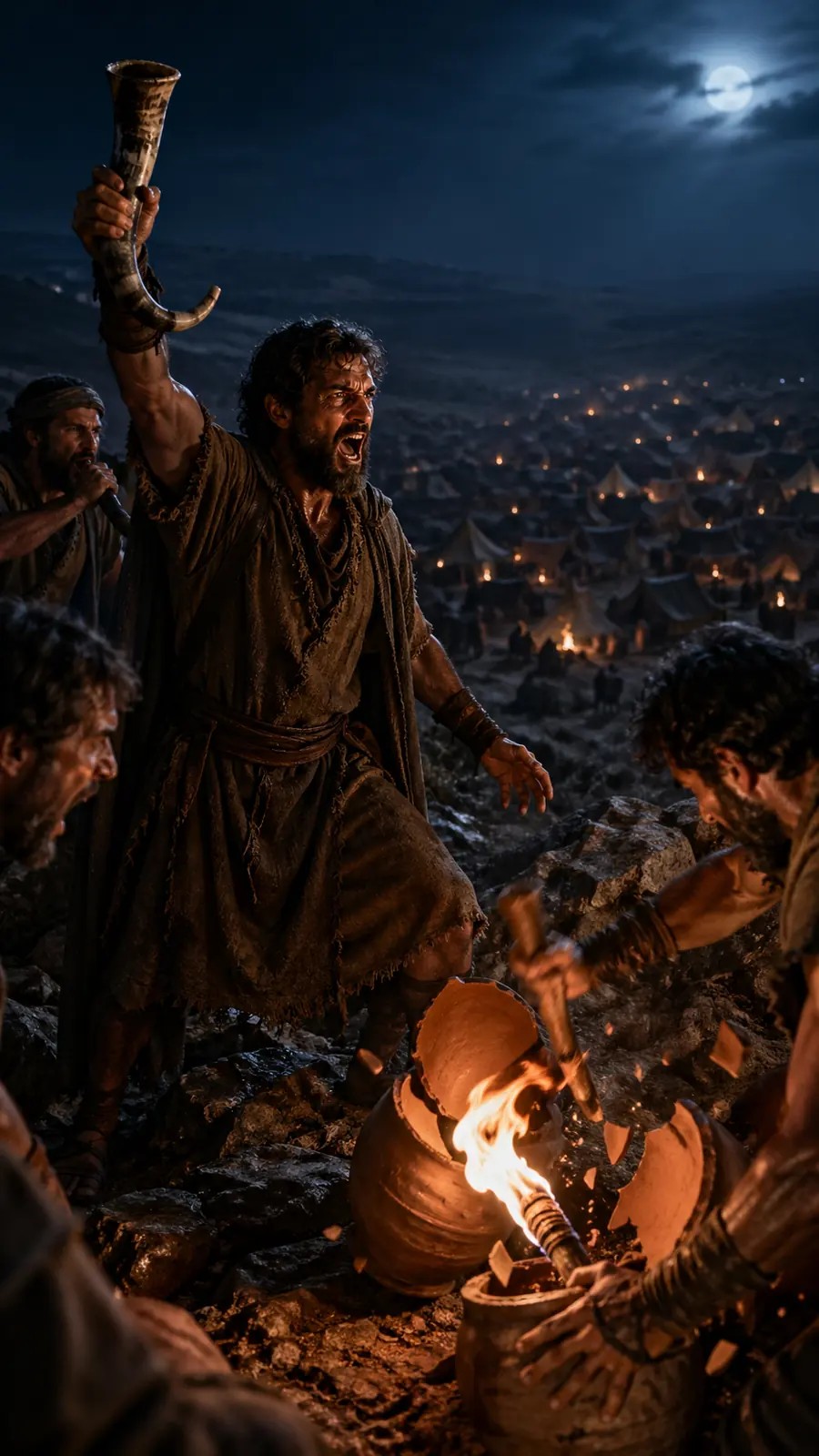
A Escritura ao lado do resumo
Juízes · Versão King James · 25Juízes 7:1-7
Versículos 1–7: Jerubbaal, who is Gideon, and all the people that were with him, rose up…
Juízes 7:1–7 abre com “Then Jerubbaal, who is Gideon, and all the people that were with him, rose up early, and pitched…” e chega a “And the LORD said unto Gideon, By the three hundred men that lapped will I save you, and deliver…” no último versículo. Esse percurso desenvolve Acompanhe as escolhas, a oposição, o livramento e os fracassos que aprofundam o conflito em Juízes.
Contexto que dá vida à passagem
“Then Jerubbaal, who is Gideon, and all the people that were with him, rose up early, and pitched beside the well of…” Nomear Gideon e Harod mantém o relato ligado a pessoas ou lugares concretos. Acompanhe onde o nome retorna e o que muda ao redor dele.
“And the LORD said unto Gideon, The people that are with thee are too many for me to give the Midianites into their…” Nomear Gideon e Israel mantém o relato ligado a pessoas ou lugares concretos. Acompanhe onde o nome retorna e o que muda ao redor dele.
“Now therefore go to, proclaim in the ears of the people, saying, Whosoever is fearful and afraid, let him return and…” O número twenty torna o relato concreto. Antes de decidir seu peso, observe se mede tempo, pessoas, distância, repetição ou totalidade.
“And the LORD said unto Gideon, The people are yet too many; bring them down unto the water, and I will try them for…” A ordem não pode ser entendida apenas pelo verbo. O destinatário, o propósito e seu lugar na aliança ou argumento definem a responsabilidade.
Juízes 7:1-7
Versão King James1Then Jerubbaal, who is Gideon, and all the people that were with him, rose up early, and pitched beside the well of Harod: so that the host of the Midianites were on the north side of them, by the hill of Moreh, in the valley.
2And the LORD said unto Gideon, The people that are with thee are too many for me to give the Midianites into their hands, lest Israel vaunt themselves against me, saying, Mine own hand hath saved me.
3Now therefore go to, proclaim in the ears of the people, saying, Whosoever is fearful and afraid, let him return and depart early from mount Gilead. And there returned of the people twenty and two thousand; and there remained ten thousand.
4And the LORD said unto Gideon, The people are yet too many; bring them down unto the water, and I will try them for thee there: and it shall be, that of whom I say unto thee, This shall go with thee, the same shall go with thee; and of whomsoever I say unto thee, This shall not go with thee, the same shall not go.
5So he brought down the people unto the water: and the LORD said unto Gideon, Every one that lappeth of the water with his tongue, as a dog lappeth, him shalt thou set by himself; likewise every one that boweth down upon his knees to drink.
6And the number of them that lapped, putting their hand to their mouth, were three hundred men: but all the rest of the people bowed down upon their knees to drink water.
7And the LORD said unto Gideon, By the three hundred men that lapped will I save you, and deliver the Midianites into thine hand: and let all the other people go every man unto his place.
Juízes 7:8-14
Versículos 8–14: So the people took victuals in their hand, and their trumpets: and he…
Juízes 7:8–14 abre com “So the people took victuals in their hand, and their trumpets: and he sent all the rest of…” e chega a “And his fellow answered and said, This is nothing else save the sword of Gideon the son of…” no último versículo. Esse percurso desenvolve Acompanhe as escolhas, a oposição, o livramento e os fracassos que aprofundam o conflito em Juízes.
Contexto que dá vida à passagem
“So the people took victuals in their hand, and their trumpets: and he sent all the rest of Israel every man unto his…” Esta linha fornece uma razão, resultado ou conclusão. Ela deve permanecer ligada à afirmação ou ação que lhe dá sentido.
“And it came to pass the same night, that the LORD said unto him, Arise, get thee down unto the host; for I have…” Esse conhecido sinal narrativo faz o tempo avançar. O que segue é uma nova cena, consequência ou resposta a uma tensão anterior.
“But if thou fear to go down, go thou with Phurah thy servant down to the host:” Nomear Phurah mantém o relato ligado a pessoas ou lugares concretos. Acompanhe onde o nome retorna e o que muda ao redor dele.
“And thou shalt hear what they say; and afterward shall thine hands be strengthened to go down unto the host. Then went…” A ordem não pode ser entendida apenas pelo verbo. O destinatário, o propósito e seu lugar na aliança ou argumento definem a responsabilidade.
Juízes 7:8-14
Versão King James8So the people took victuals in their hand, and their trumpets: and he sent all the rest of Israel every man unto his tent, and retained those three hundred men: and the host of Midian was beneath him in the valley.
9And it came to pass the same night, that the LORD said unto him, Arise, get thee down unto the host; for I have delivered it into thine hand.
10But if thou fear to go down, go thou with Phurah thy servant down to the host:
11And thou shalt hear what they say; and afterward shall thine hands be strengthened to go down unto the host. Then went he down with Phurah his servant unto the outside of the armed men that were in the host.
12And the Midianites and the Amalekites and all the children of the east lay along in the valley like grasshoppers for multitude; and their camels were without number, as the sand by the sea side for multitude.
13And when Gideon was come, behold, there was a man that told a dream unto his fellow, and said, Behold, I dreamed a dream, and, lo, a cake of barley bread tumbled into the host of Midian, and came unto a tent, and smote it that it fell, and overturned it, that the tent lay along.
14And his fellow answered and said, This is nothing else save the sword of Gideon the son of Joash, a man of Israel: for into his hand hath God delivered Midian, and all the host.
Juízes 7:15-21
Versículos 15–21: It was so, when Gideon heard the telling of the dream, and the…
Juízes 7:15–21 abre com “And it was so, when Gideon heard the telling of the dream, and the interpretation thereof, that…” e chega a “And they stood every man in his place round about the camp: and all the host ran, and cried, and…” no último versículo. Esse percurso desenvolve Acompanhe as escolhas, a oposição, o livramento e os fracassos que aprofundam o conflito em Juízes.
Contexto que dá vida à passagem
“And it was so, when Gideon heard the telling of the dream, and the interpretation thereof, that he worshipped, and…” Nomear Arise e Gideon mantém o relato ligado a pessoas ou lugares concretos. Acompanhe onde o nome retorna e o que muda ao redor dele.
“And he divided the three hundred men into three companies, and he put a trumpet in every man’s hand, with empty…” O número three torna o relato concreto. Antes de decidir seu peso, observe se mede tempo, pessoas, distância, repetição ou totalidade.
“And he said unto them, Look on me, and do likewise: and, behold, when I come to the outside of the camp, it shall be…” A ordem não pode ser entendida apenas pelo verbo. O destinatário, o propósito e seu lugar na aliança ou argumento definem a responsabilidade.
Juízes 7:15-21
Versão King James15And it was so, when Gideon heard the telling of the dream, and the interpretation thereof, that he worshipped, and returned into the host of Israel, and said, Arise; for the LORD hath delivered into your hand the host of Midian.
16And he divided the three hundred men into three companies, and he put a trumpet in every man’s hand, with empty pitchers, and lamps within the pitchers.
17And he said unto them, Look on me, and do likewise: and, behold, when I come to the outside of the camp, it shall be that, as I do, so shall ye do.
18When I blow with a trumpet, I and all that are with me, then blow ye the trumpets also on every side of all the camp, and say, The sword of the LORD , and of Gideon.
19So Gideon, and the hundred men that were with him, came unto the outside of the camp in the beginning of the middle watch; and they had but newly set the watch: and they blew the trumpets, and brake the pitchers that were in their hands.
20And the three companies blew the trumpets, and brake the pitchers, and held the lamps in their left hands, and the trumpets in their right hands to blow withal: and they cried, The sword of the LORD , and of Gideon.
21And they stood every man in his place round about the camp: and all the host ran, and cried, and fled.
Juízes 7:22-25
Versículos 22–25: The three hundred blew the trumpets, and the LORD set every man’s sword…
Juízes 7:22–25 abre com “And the three hundred blew the trumpets, and the LORD set every man’s sword against his fellow…” e chega a “And they took two princes of the Midianites, Oreb and Zeeb; and they slew Oreb upon the rock…” no último versículo. Esse percurso desenvolve Acompanhe as escolhas, a oposição, o livramento e os fracassos que aprofundam o conflito em Juízes.
Contexto que dá vida à passagem
“And the three hundred blew the trumpets, and the LORD set every man’s sword against his fellow, even throughout all…” O número three torna o relato concreto. Antes de decidir seu peso, observe se mede tempo, pessoas, distância, repetição ou totalidade.
“And the men of Israel gathered themselves together out of Naphtali, and out of Asher, and out of all Manasseh, and…” Nomear Asher e Israel mantém o relato ligado a pessoas ou lugares concretos. Acompanhe onde o nome retorna e o que muda ao redor dele.
Juízes 7:22-25
Versão King James22And the three hundred blew the trumpets, and the LORD set every man’s sword against his fellow, even throughout all the host: and the host fled to Beth-shittah in Zererath, and to the border of Abel-meholah, unto Tabbath.
23And the men of Israel gathered themselves together out of Naphtali, and out of Asher, and out of all Manasseh, and pursued after the Midianites.
24And Gideon sent messengers throughout all mount Ephraim, saying, Come down against the Midianites, and take before them the waters unto Beth-barah and Jordan. Then all the men of Ephraim gathered themselves together, and took the waters unto Beth-barah and Jordan.
25And they took two princes of the Midianites, Oreb and Zeeb; and they slew Oreb upon the rock Oreb, and Zeeb they slew at the winepress of Zeeb, and pursued Midian, and brought the heads of Oreb and Zeeb to Gideon on the other side Jordan.
Detalhes que merecem atenção
A imagem de abertura
Judges 7:1 começa com “Then Jerubbaal, who is Gideon, and all the people that were with him, rose up early, and pitched beside the well of Harod: so that the host of the…”
Onde o capítulo muda
Judges 7:10 forma uma mudança natural: “But if thou fear to go down, go thou with Phurah thy servant down to the host:”
A nota final
Judges 7:25 deixa o leitor com “And they took two princes of the Midianites, Oreb and Zeeb; and they slew Oreb upon the rock Oreb, and Zeeb they slew at the winepress of Zeeb, and pursued…”
Um caminho de palavras pelo capítulo
As palavras Gideon, host, LORD, people, hand, Midianites ajudam a revelar as preocupações repetidas do capítulo.
Primeiro o texto
Onde os leitores divergem
O resumo começa com o que a passagem diz e como suas partes se relacionam. Ele não presume que uma denominação já resolveu todas as questões. A dependência de uma tradição, teoria literária ou reconstrução histórica é claramente identificada.
O texto KJV aparece primeiro. As conclusões interpretativas são identificadas, e as diferenças surgem quando ajudam a explicar por que comunidades sérias nem sempre chegam à mesma resposta.
As notas interpretativas comparativas deste capítulo estão em preparação. Até que as notas revisadas estejam prontas, esta página separa o texto KJV do resumo e da aplicação sem afirmar que leitores responsáveis concordam em todas as questões.