
Esther
10 Chapters
Esther: The Whole Book, Chapter by Chapter
An Empire Troubles Itself Over One Refusal
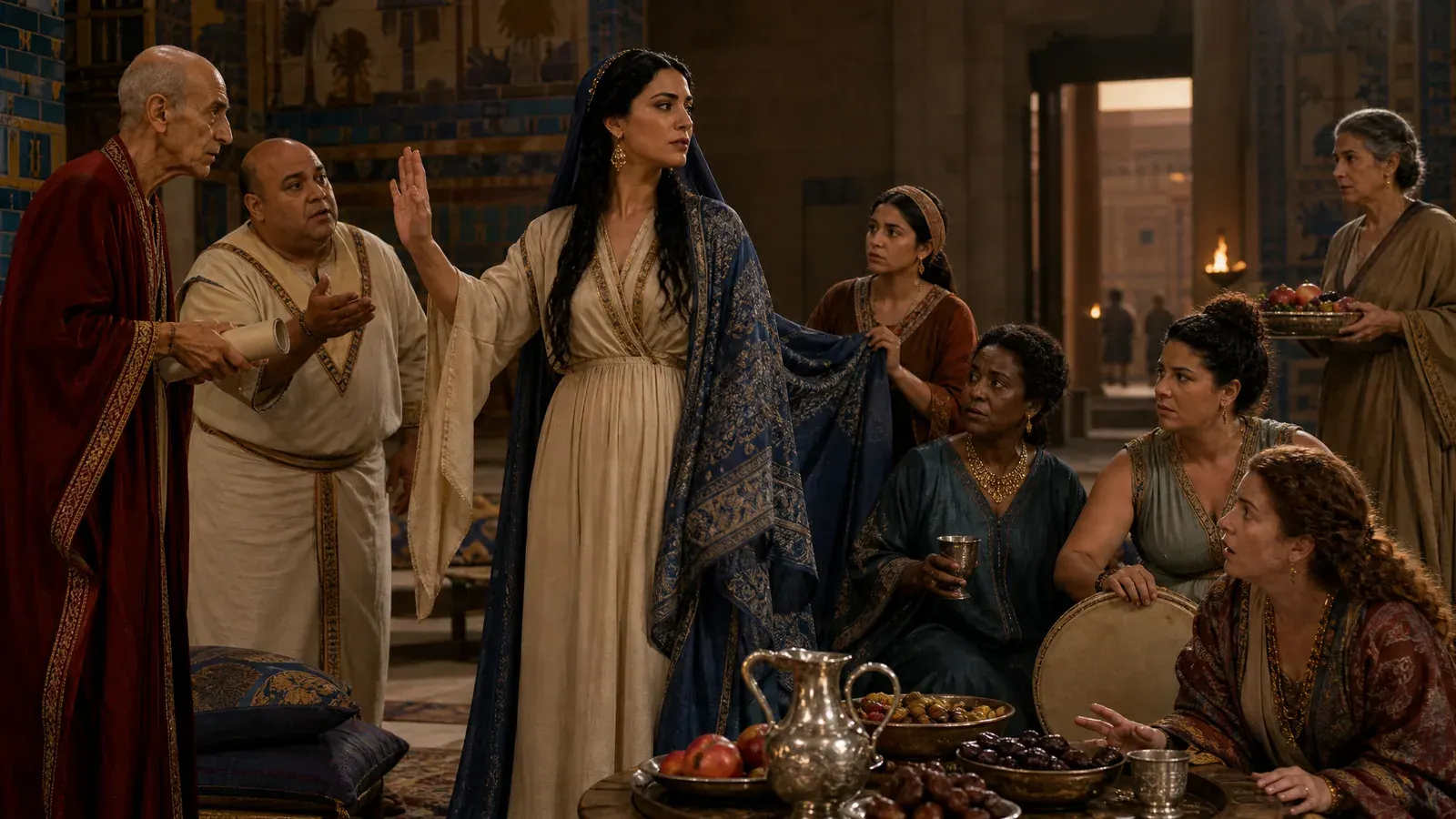
The Book of Esther opens by letting imperial splendour fill the frame before exposing how little control that splendour guarantees. Ahasuerus displays wealth for months, then extends the celebration to Shushan with elaborate furnishings, gold vessels, abundant wine, and a rule that even freedom from drinking pressure exists by royal command. Vashti’s refusal to appear interrupts that performance at one precise point. The king’s advisers then enlarge a palace dispute into a predicted crisis for husbands across one hundred and twenty-seven provinces. Their remedy is characteristically imperial: remove Vashti, declare the decision unalterable, and translate a household command into every language of the empire. The chapter ends with immense administrative reach being used to announce control that the decree itself cannot prove has been achieved.
One complete chapter pageOpen chapter →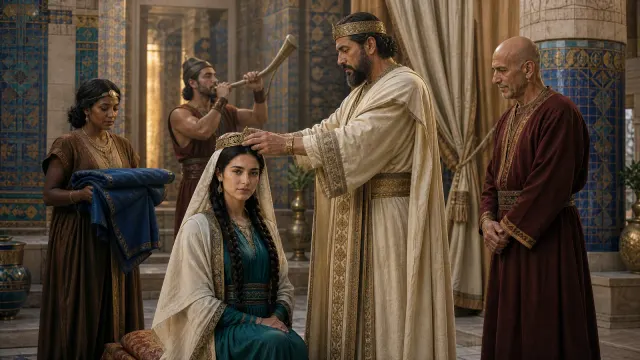
A Hidden Identity and an Unrewarded Rescue
Ahasuerus remembers Vashti and the decree against her, and his servants answer with a kingdom-wide search that gathers women into royal custody. The Book of Esther then introduces Mordecai and Hadassah, called Esther, against that machinery of selection. She is an orphan raised as Mordecai’s daughter, a Jew whose identity remains concealed at his instruction. Esther receives favourable treatment from Hegai, gains the king’s preference, and is crowned queen, but the chapter keeps the restrictions of the women’s house visible rather than treating royal preference as ordinary freedom. Mordecai continues watching over her welfare from outside. At the king’s gate he later learns of a conspiracy, and Esther reports it in his name. The plot is verified, the conspirators are executed, and Mordecai’s unrewarded service is quietly entered into the royal chronicles.
One complete chapter pageOpen chapter →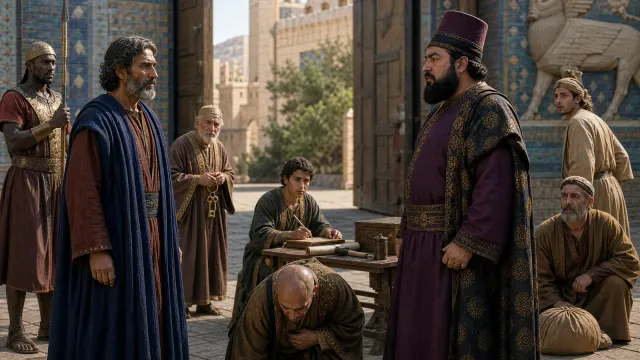
One Man’s Anger Acquires the King’s Seal
Haman’s promotion creates a new crisis at the gate. Mordecai refuses the commanded reverence, and Haman chooses to treat that refusal not as one man’s offense but as grounds for destroying an entire people. Pur is cast to determine the day before Haman presents his accusation, so the desired outcome precedes the case he makes to Ahasuerus. He describes a dispersed people with different laws, alleges disloyalty, and joins the accusation to a large financial offer without naming the personal grievance underneath it. Ahasuerus transfers his signet and authorizes Haman to act. The resulting decree uses the empire’s multilingual administrative network to command the destruction and plunder of Jews on one appointed day. The chapter closes with one of Esther’s hardest contrasts: the king and Haman drink while the city of Shushan is perplexed.
One complete chapter pageOpen chapter →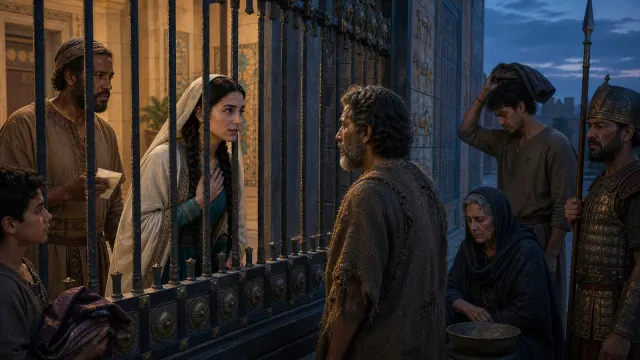
The Queen Learns What the Crown Cannot Protect
The destruction decree becomes visible first through mourning. Mordecai tears his clothes, wears sackcloth and ashes, and cries openly, while similar grief spreads wherever the royal order arrives. The palace boundary is sharp enough that sackcloth cannot enter, and Esther initially knows only that Mordecai is distressed. Hatach becomes the messenger who carries explanation and then a copy of the decree between them. Esther learns that intervention requires an unsummoned approach to Ahasuerus, an act governed by a law of death unless the king extends the golden sceptre. Mordecai answers that the palace does not make her exempt from the danger facing her people and raises the possibility that her position may matter precisely now. Esther then takes command of the preparation, orders a shared fast, and resolves to enter the king’s presence without claiming certainty that she will survive.
One complete chapter pageOpen chapter →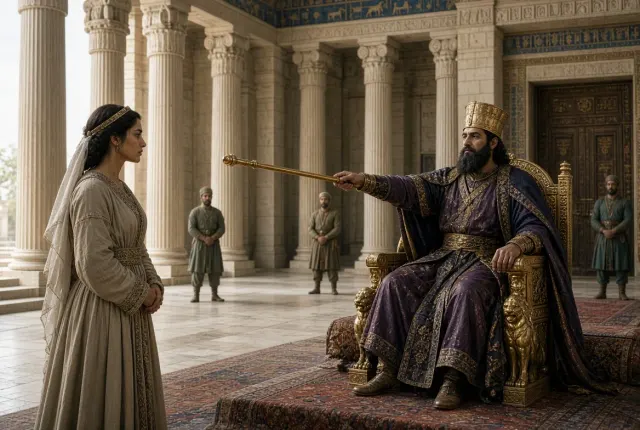
An Invitation That Haman Misunderstands
Esther acts on the decision made in the previous chapter. Dressed in royal apparel, she enters the inner court, is seen by Ahasuerus, and receives the extended sceptre that allows her to approach. The king offers extravagant generosity, but Esther’s immediate request is simply that he and Haman attend a banquet she has already prepared. At the meal, Ahasuerus asks again for her petition, and she answers with another invitation, promising to speak the next day. The Book of Esther does not explain her private reason for delaying, but the interval creates the night on which the central reversal will begin. Haman meanwhile leaves delighted, then sees Mordecai still refusing him honour. At home he lists his wealth, children, promotion, and exclusive invitations, only to declare that all of it means nothing while Mordecai remains. His household answers with a towering execution structure, and Haman approves.
One complete chapter pageOpen chapter →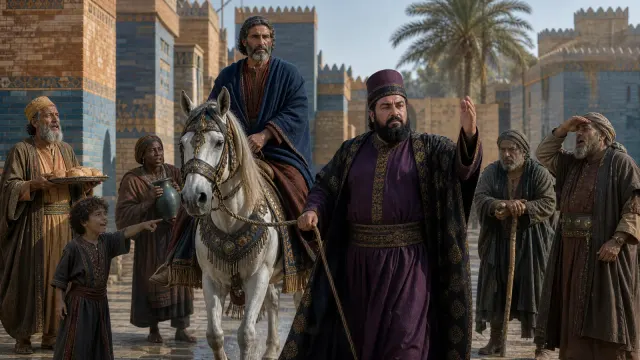
The Honour Ceremony Goes to the Wrong Man
A sleepless night turns an old administrative entry into the hinge of the Book of Esther. Ahasuerus has the royal chronicles read and discovers that Mordecai received no honour for exposing the assassination plot. At the same moment Haman enters the court intending to ask permission to execute Mordecai. The king asks what should be done for a man he delights to honour without naming the man, and Haman’s assumption that the honour must be for himself shapes an elaborate answer of royal clothing, the king’s horse, public procession, and proclamation. Ahasuerus then names Mordecai and orders Haman to omit nothing. Haman performs the entire ceremony for the very man he came to destroy. Mordecai returns to the gate, while Haman returns home mourning. His household reverses its earlier confidence and predicts his fall just as royal attendants hurry him to Esther’s second banquet.
One complete chapter pageOpen chapter →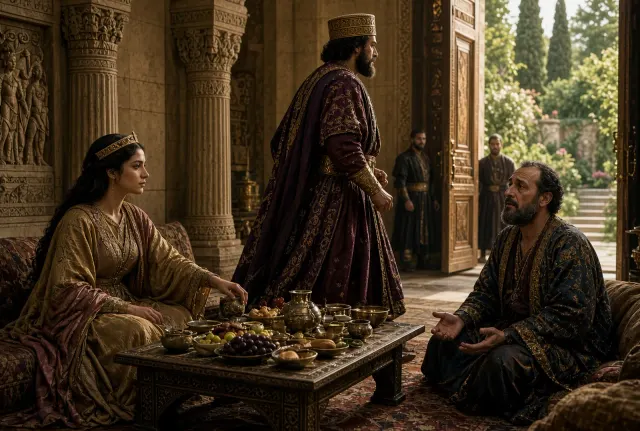
The Queen Names Her People and Their Enemy
At the second banquet, Esther finally states the petition that has been waiting behind two invitations. Against Ahasuerus’s offer of up to half the kingdom, she asks for her own life and the lives of her people. She repeats the destruction decree’s language and brings the anonymous target of Haman’s policy into the king’s immediate household. When Ahasuerus asks who has done this, Esther names Haman as the enemy. The king leaves in anger, while Haman pleads with Esther for his life. When the king returns, he interprets Haman’s position near Esther as an assault on the queen, although the Book of Esther has described Haman’s action as a plea. Harbonah then points out the enormous execution structure Haman built for Mordecai, the man who saved the king. Haman is put on his own prepared wood, but the royal decree against the Jews remains unresolved.
One complete chapter pageOpen chapter →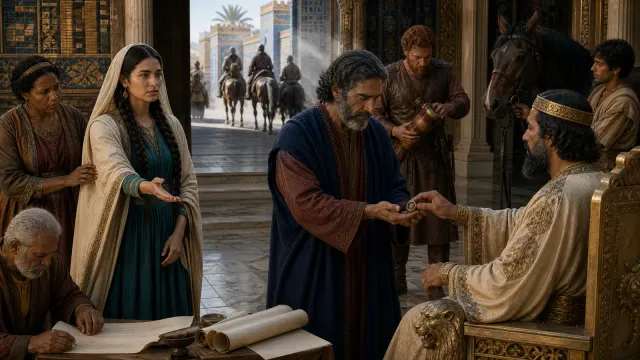
The First Decree Cannot Simply Be Erased
Haman is gone, but the policy he set in motion survives him. His estate passes to Esther, Mordecai receives the signet once held by Haman, and Esther discloses her family relationship to Mordecai. Those reversals at the centre do not cancel letters already sealed and distributed. Esther therefore falls before Ahasuerus again and asks him to reverse the order threatening her people. The king answers with the rule that a sealed royal writing cannot be revoked, then authorizes Esther and Mordecai to issue another decree in his name. The second writing mirrors the first in scale, languages, urgency, and severe vocabulary, but now permits the Jews to assemble and stand for their lives against those who attack them. As the couriers leave, Mordecai appears in royal clothing and Shushan rejoices. Public perplexity gives way to gladness before the appointed day has even arrived.
One complete chapter pageOpen chapter →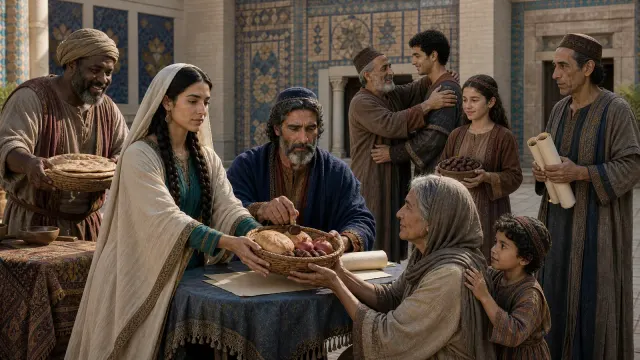
Deliverance Becomes a Date to Remember
The day chosen by Haman’s lot finally arrives, but the expected balance of power has changed. The Jews assemble in their cities, officials support them under the growing influence of Mordecai, and those seeking their harm are defeated. The Book of Esther does not soften the violence: it records five hundred killed in Shushan, the ten sons of Haman, three hundred more after Esther requests a second day in the city, and seventy-five thousand foes in the provinces. Yet three times the account emphasizes that the Jews do not take the spoil permitted by the counter-decree. Rest comes on different dates in Shushan and elsewhere, and those dates become days of feasting and gladness. Mordecai’s letters establish annual observance, shared portions, and gifts to the poor. Pur, once cast to schedule destruction, gives Purim its name. Esther’s own authority then confirms the remembrance in writing.
One complete chapter pageOpen chapter →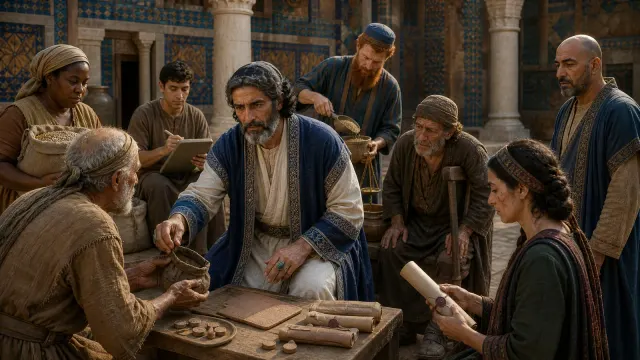
Power Ends with a Different Use
The Book of Esther closes in only three verses, but it deliberately returns to the empire that framed the opening. Ahasuerus still rules, lays tribute on the land and islands, and has acts of power recorded in the chronicles of Media and Persia. Mordecai’s advancement belongs in those records as well. He now stands next to the king, occupying a level of influence that recalls Haman’s earlier prominence without repeating Haman’s use of it. The final description turns from clothing, banquets, seals, and public ceremony to the direction of Mordecai’s work. He is great among the Jews, accepted among many of his brethren, seeking the welfare of his people and speaking peace. Esther therefore ends inside the same imperial order it began with, but with a markedly different use of proximity to power.
One complete chapter pageOpen chapter →Source: eBible.org · eng-kjv2006