The big picture
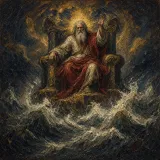
Psalm 93 announces a reign that does not need to be established by defeating a rival claimant. The Lord is already clothed with majesty and strength, the world stands under his rule, and his throne is “established of old” because he is from everlasting. Only then do the floods raise themselves, their voice, and their waves. The repetition lets their noise grow in the ear, but the answer is concise: the Lord on high is mightier than many waters and mighty waves. Volume is not sovereignty. The poem closes by moving from the turbulent sea to God’s testimonies and house. What he speaks is “very sure,” and holiness belongs to his dwelling “for ever.” Cosmic stability and trustworthy revelation therefore belong to the same reign. The God who rules the waters is also the God whose words and holiness give the sanctuary its character.
In this chapter
- Majesty Is Clothing, Not a Borrowed Title Psalms 93:1-2
The opening clothes the Lord twice, first in majesty and then in strength.
- The Loudest Voice Does Not Hold the Throne Psalms 93:3-5
The floods lift up three times: they lift themselves, lift their voice, and lift their waves.

Scripture beside the summary
Psalms · King James Version · 5Psalms 93:1-2
Majesty Is Clothing, Not a Borrowed Title
The opening clothes the Lord twice, first in majesty and then in strength. Psalm 93 does not separate royal appearance from actual power: the one who looks like the King is the one whose strength establishes the world. That statement concerns the stability of created order under divine rule, not a technical lesson about planetary motion. Then the poem moves behind even the world it has described. God’s throne is “established of old,” and God himself is “from everlasting.” Those words are placed before the floods appear so that the reader knows the scale of the contest in advance. The waters will sound immense, but they are late arrivals beneath an older throne. No coronation is about to be decided by which force shouts louder. The reign is already in place. The opening therefore gives the turbulence that follows a frame: whatever the floods do, they do it inside a world whose King does not begin with their challenge and does not receive authority from overcoming them.

Deep dive
The opening repeats that the Lord is clothed, first with majesty and then with strength. Royal appearance and actual power are not separated. The result is an established world. The language concerns the stability of the created order under divine rule, not a technical account of the earth’s motion.
The throne is "of old," and the address immediately reaches further: God is from everlasting. This matters because the next verses will introduce waters that sound as though they could overturn everything. Before their voice is heard, the poem has already located their challenge beneath a reign that does not begin with them. No rival coronation is being considered. The psalm’s opening is a declaration of an existing sovereignty, and the apparent turbulence of the world will be interpreted within it.
Words to trace: clothed, LORD, established, everlasting, girded, majesty
Verse-by-verse path
- Psalms 93:1
“The LORD reigneth” is two Hebrew words, YHWH malak, which can be read “the LORD is king” or “the LORD has become king”. The same cry opens Psalms 97 and 99. “Girded himself” is the action of a man tying his belt before work or battle. The ancient Greek heading assigns this psalm to the day before the sabbath, the sixth day, when the world was finished.
- Psalms 93:2
Verse 1 spoke about the LORD; here the psalm turns and speaks to him. “Of old” is me’az, from then, from the beginning. The throne is as old as the world just described, and the one who sits on it is older still.
Psalms 93:1-2
King James Version1The LORD reigneth, he is clothed with majesty; the LORD is clothed with strength, wherewith he hath girded himself: the world also is stablished, that it cannot be moved.
2Thy throne is established of old: thou art from everlasting.
Psalms 93:3-5
The Loudest Voice Does Not Hold the Throne
The floods lift up three times: they lift themselves, lift their voice, and lift their waves. Psalm 93 uses repetition to make the surge audible before it answers it. The sea does not need literal speech for its roar to feel like a challenge. Yet the response is not a longer noise contest. “The LORD on high is mightier.” Many waters and mighty waves can be loud without occupying the throne. Then the poem makes a surprising turn from sea to testimony: “Thy testimonies are very sure.” The move is less abrupt than it first appears. The same God whose rule holds amid unstable waters also speaks words that can be trusted. Finally, holiness “becometh thine house” for the same enduring horizon introduced at the beginning. Creation and sanctuary are not divided into separate realms with separate gods. The King whose strength secures the world is the one whose reliable testimonies and holiness shape the place where his people worship.

Deep dive
The floods lift up three times in the sentence: themselves, their voice, and their waves. Repetition makes the surge audible. The poem does not need a literal speech from the water to make its power felt. Yet the next line places the Lord "on high" above the noise and force of the sea. Volume is not sovereignty.
The final movement from waters to testimonies may initially seem abrupt, but it gathers the poem’s claim into the sphere of worship and trust. The one whose throne holds amid the floods also speaks words that are sure. Holiness belongs to his house for the same enduring horizon announced at the beginning. Psalm 93 thus moves from the world’s stability to the sanctuary’s character without dividing the God of creation from the God known by his people.
Words to trace: floods, LORD, lifted, waves, becometh, high
Verse-by-verse path
- Psalms 93:3
“Floods” is neharot, rivers or currents. In the Ugaritic texts Baal’s rival is called Prince Sea and Judge River in paired lines, and this verse uses the same pairing and the same step by step repetition common in Canaanite verse. “Waves” is dokhyam, a word found only here, their pounding or crashing.
- Psalms 93:4
The waves are called addir, mighty or majestic, and the LORD is called addir too: the same adjective for both. The sea is genuinely majestic, and the LORD is more so. “The noise of many waters” is literally their voices, answering the voice the floods lifted up in verse 3.
- Psalms 93:5
“Testimonies” is edot, the word for the covenant law, and in the singular it names the tablets kept in the ark (Exodus 25:16). “Very sure” shares its root with amen. “Becometh” means is fitting, is beautiful on. “For ever” is literally “for length of days”, the phrase that ends Psalm 23.
Psalms 93:3-5
King James Version3The floods have lifted up, O LORD, the floods have lifted up their voice; the floods lift up their waves.
4The LORD on high is mightier than the noise of many waters, yea, than the mighty waves of the sea.
5Thy testimonies are very sure: holiness becometh thine house, O LORD, for ever.
Questions to keep in mind while reading
- Follow the speaker, images, parallel lines, questions, and emotional movement.
- Notice where tension or suffering resists an easy answer.
- Read a saying as wisdom for faithful discernment, not as a mechanical promise detached from context.
Text first
Where readers differ
The chapter summary begins with what the passage says and how its parts fit together. It does not assume one denomination has already settled every question. Where a conclusion depends on a tradition, literary theory, or historical reconstruction, that dependence is named openly.
The KJV text is presented first. Interpretive conclusions are labeled, and differences are introduced only when they help a reader understand why serious communities do not always reach the same answer.
Comparative interpretive notes for this chapter are in preparation. Until reviewed notes are ready, this page separates the KJV text from summary and application without claiming that serious readers agree on every question.
Questions beneath the surface
- What account of God, human freedom, responsibility, and the good life emerges from Psalms 93?
- Which tension does the chapter refuse to resolve quickly?
- What changes when the chapter is read as part of the whole canon rather than as an isolated moral lesson?
- Where might a sincere reader confuse a familiar tradition with something the text states directly?
Questions for serious personal contemplation
These open-ended questions make room for tension, honest response, prayer, and conclusions that remain accountable to the chapter.
Observe without rushing
What part of Psalms 93 makes you stop, feel unsettled, or feel surprised, and why?
Which detail in the passage would be easiest to overlook? How does that detail change your understanding?
Where do you see tension between what happens and this focus: Psalms 93 develops its own movement around LORD, floods, clothed, lifted, waves?
What important question does the passage leave open instead of resolving quickly?
Examine your inner life honestly
Which person, response, fear, or desire in the passage feels most like your own life right now?
What assumption about God, other people, or yourself does this text challenge?
Which part would you rather soften, avoid, or explain away too quickly? What might that reaction reveal?
If this Scripture could ask you one direct question, what do you think it would ask?
Respond with wisdom and courage
What do you need to remember, confess, grieve, thank God for, or trust after reading this passage?
How might another faithful person read this situation differently without ignoring the text?
What obedient response would be costly, uncomfortable, or slow, yet still faithful to Scripture?
What question will you carry into prayer this week, and which verses will you keep in front of you?
Music and video connected to the passage
Related media appears when its Scripture reference overlaps this study. Music and video can illuminate a theme while the biblical text remains the foundation.