
O panorama
1 Samuel 17 abre com “Now the Philistines gathered together their armies to battle, and were gathered together…”, muda perto do versículo 29 com “And David said, What have I now done? Is there not a cause?” e termina com “And Saul said to him, Whose son art thou, thou young man? And David answered, I am the…”. Esses pontos traçam o movimento próprio do capítulo, da abertura à conclusão.
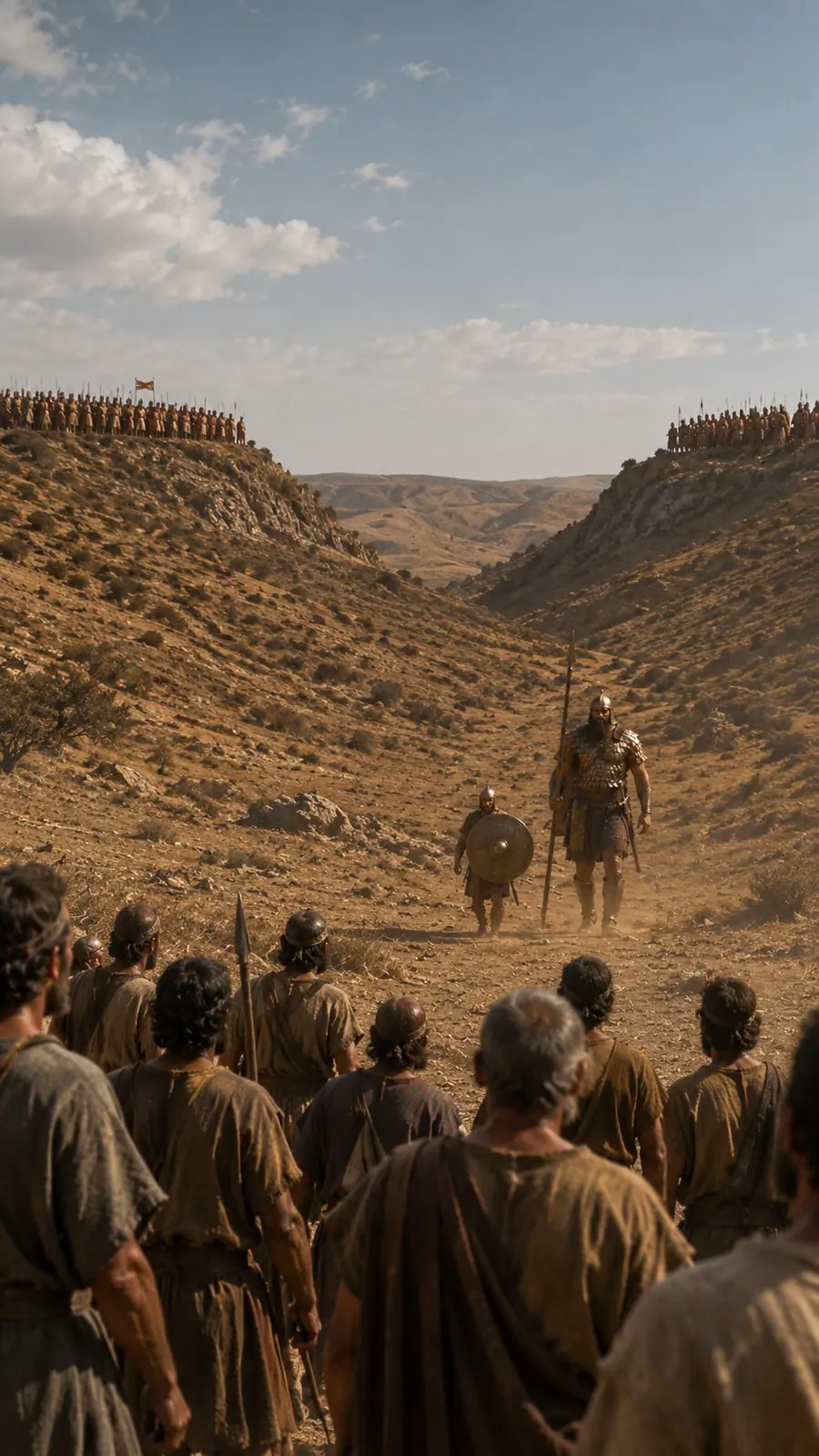
A Escritura ao lado do resumo
1 Samuel · Versão King James · 581 Samuel 17:1-8
Versículos 1–8: The Philistines gathered together their armies to battle, and were…
1 Samuel 17:1–8 abre com “Now the Philistines gathered together their armies to battle, and were gathered together at…” e chega a “And he stood and cried unto the armies of Israel, and said unto them, Why are ye come out to set…” no último versículo. Esse percurso desenvolve Estude o momento em que fé, rebelião, coragem ou providência mudam a direção de 1 Samuel.
Estudo aprofundado
1 Samuel 17:1–8 forma uma unidade literária. Abre com “Now the Philistines gathered together their armies to battle, and were gathered together at…”, muda perto do versículo 4 com “And there went out a champion out of the camp of the Philistines, named Goliath, of Gath…” e chega a “And he stood and cried unto the armies of Israel, and said unto them, Why are ye come out to…”. O narrador cria sentido por meio de quem inicia cada ação, quem responde, o que muda e quais consequências permanecem. Uma ação relatada não é automaticamente aprovada. Como verificação textual, a passagem fonte KJV contém 1 marcadores de fala, 1 perguntas, 0 contrastes e 0 versículos que nomeiam o LORD ou Deus. Esses traços também podem ser comparados com uma tradução bíblica confiável em português.
Cada observação se relaciona ao foco da aula, Estude o momento em que fé, rebelião, coragem ou providência mudam a direção de 1 Samuel. Algumas afirmações são diretas, outras reúnem vários versículos e outras devem continuar identificadas como interpretação.
Os nomes ou termos que sustentam a cena são Philistines, Israel, Saul, Shochoh, Azekah, Elah. A linguagem numérica inclui one, six, five, thousand, hundred. A mudança mais próxima do centro aparece no versículo 1: “Now the Philistines gathered together their armies to battle, and were gathered together at Shochoh, which belongeth to Judah, and…” Esse detalhe ajuda a distinguir o ponto de partida do que acontece depois.
Percurso versículo por versículo
- 1 Samuel 17:1
“Now the Philistines gathered together their armies to battle, and were gathered together at Shochoh, which belongeth…” Nomear Shochoh e Azekah mantém o relato ligado a pessoas ou lugares concretos. Acompanhe onde o nome retorna e o que muda ao redor dele.
- 1 Samuel 17:2
“And Saul and the men of Israel were gathered together, and pitched by the valley of Elah, and set the battle in array…” Nomear Elah e Israel mantém o relato ligado a pessoas ou lugares concretos. Acompanhe onde o nome retorna e o que muda ao redor dele.
- 1 Samuel 17:3
“And the Philistines stood on a mountain on the one side, and Israel stood on a mountain on the other side: and there…” O número one torna o relato concreto. Antes de decidir seu peso, observe se mede tempo, pessoas, distância, repetição ou totalidade.
- 1 Samuel 17:4
“And there went out a champion out of the camp of the Philistines, named Goliath, of Gath, whose height was six cubits…” O número six torna o relato concreto. Antes de decidir seu peso, observe se mede tempo, pessoas, distância, repetição ou totalidade.
- 1 Samuel 17:5
“And he had an helmet of brass upon his head, and he was armed with a coat of mail; and the weight of the coat was five…” O número five torna o relato concreto. Antes de decidir seu peso, observe se mede tempo, pessoas, distância, repetição ou totalidade.
- 1 Samuel 17:6
“And he had greaves of brass upon his legs, and a target of brass between his shoulders.” Os termos próprios desta linha incluem brass, greaves, legs. A relação com os versículos 5 e 7 permite verificar sua função na passagem.
- 1 Samuel 17:7
“And the staff of his spear was like a weaver’s beam; and his spear’s head weighed six hundred shekels of iron: and one…” O número six torna o relato concreto. Antes de decidir seu peso, observe se mede tempo, pessoas, distância, repetição ou totalidade.
- 1 Samuel 17:8
“And he stood and cried unto the armies of Israel, and said unto them, Why are ye come out to set your battle in array…” A pergunta desacelera a passagem. Observe quem precisa responder, o que ela pressupõe e se as linhas seguintes apresentam uma resposta.
1 Samuel 17:1-8
Versão King James1Now the Philistines gathered together their armies to battle, and were gathered together at Shochoh, which belongeth to Judah, and pitched between Shochoh and Azekah, in Ephes-dammim.
2And Saul and the men of Israel were gathered together, and pitched by the valley of Elah, and set the battle in array against the Philistines.
3And the Philistines stood on a mountain on the one side, and Israel stood on a mountain on the other side: and there was a valley between them.
4And there went out a champion out of the camp of the Philistines, named Goliath, of Gath, whose height was six cubits and a span.
5And he had an helmet of brass upon his head, and he was armed with a coat of mail; and the weight of the coat was five thousand shekels of brass.
6And he had greaves of brass upon his legs, and a target of brass between his shoulders.
7And the staff of his spear was like a weaver’s beam; and his spear’s head weighed six hundred shekels of iron: and one bearing a shield went before him.
8And he stood and cried unto the armies of Israel, and said unto them, Why are ye come out to set your battle in array? am not I a Philistine, and ye servants to Saul? choose you a man for you, and let him come down to me.
1 Samuel 17:9-16
Versículos 9–16: If he be able to fight with me, and to kill me, then will we be your…
1 Samuel 17:9–16 abre com “If he be able to fight with me, and to kill me, then will we be your servants: but if I prevail…” e chega a “And the Philistine drew near morning and evening, and presented himself forty days.” no último versículo. Esse percurso desenvolve Estude o momento em que fé, rebelião, coragem ou providência mudam a direção de 1 Samuel.
Estudo aprofundado
1 Samuel 17:9–16 forma uma unidade literária. Abre com “If he be able to fight with me, and to kill me, then will we be your servants: but if I…”, muda perto do versículo 12 com “Now David was the son of that Ephrathite of Beth-lehem-judah, whose name was Jesse; and he…” e chega a “And the Philistine drew near morning and evening, and presented himself forty days.”. O narrador cria sentido por meio de quem inicia cada ação, quem responde, o que muda e quais consequências permanecem. Uma ação relatada não é automaticamente aprovada. Como verificação textual, a passagem fonte KJV contém 1 marcadores de fala, 0 perguntas, 2 contrastes e 0 versículos que nomeiam o LORD ou Deus. Esses traços também podem ser comparados com uma tradução bíblica confiável em português.
Cada observação se relaciona ao foco da aula, Estude o momento em que fé, rebelião, coragem ou providência mudam a direção de 1 Samuel. Algumas afirmações são diretas, outras reúnem vários versículos e outras devem continuar identificadas como interpretação.
Os nomes ou termos que sustentam a cena são Saul, David, Philistine, Beth, Israel, Jesse. A linguagem numérica inclui eight, three, forty. A mudança mais próxima do centro aparece no versículo 12: “Now David was the son of that Ephrathite of Beth-lehem-judah, whose name was Jesse; and he had eight sons: and the man went among…” Esse detalhe ajuda a distinguir o ponto de partida do que acontece depois.
Percurso versículo por versículo
- 1 Samuel 17:9
“If he be able to fight with me, and to kill me, then will we be your servants: but if I prevail against him, and kill…” A ordem não pode ser entendida apenas pelo verbo. O destinatário, o propósito e seu lugar na aliança ou argumento definem a responsabilidade.
- 1 Samuel 17:10
“And the Philistine said, I defy the armies of Israel this day; give me a man, that we may fight together.” Nomear Israel e Philistine mantém o relato ligado a pessoas ou lugares concretos. Acompanhe onde o nome retorna e o que muda ao redor dele.
- 1 Samuel 17:11
“When Saul and all Israel heard those words of the Philistine, they were dismayed, and greatly afraid.” Nomear Israel e Philistine mantém o relato ligado a pessoas ou lugares concretos. Acompanhe onde o nome retorna e o que muda ao redor dele.
- 1 Samuel 17:12
“Now David was the son of that Ephrathite of Beth-lehem-judah, whose name was Jesse; and he had eight sons: and the man…” O número eight torna o relato concreto. Antes de decidir seu peso, observe se mede tempo, pessoas, distância, repetição ou totalidade.
- 1 Samuel 17:13
“And the three eldest sons of Jesse went and followed Saul to the battle: and the names of his three sons that went to…” O número three torna o relato concreto. Antes de decidir seu peso, observe se mede tempo, pessoas, distância, repetição ou totalidade.
- 1 Samuel 17:14
“And David was the youngest: and the three eldest followed Saul.” O número three torna o relato concreto. Antes de decidir seu peso, observe se mede tempo, pessoas, distância, repetição ou totalidade.
- 1 Samuel 17:15
“But David went and returned from Saul to feed his father’s sheep at Beth-lehem.” Nomear Beth e David mantém o relato ligado a pessoas ou lugares concretos. Acompanhe onde o nome retorna e o que muda ao redor dele.
- 1 Samuel 17:16
“And the Philistine drew near morning and evening, and presented himself forty days.” O número forty torna o relato concreto. Antes de decidir seu peso, observe se mede tempo, pessoas, distância, repetição ou totalidade.
1 Samuel 17:9-16
Versão King James9If he be able to fight with me, and to kill me, then will we be your servants: but if I prevail against him, and kill him, then shall ye be our servants, and serve us.
10And the Philistine said, I defy the armies of Israel this day; give me a man, that we may fight together.
11When Saul and all Israel heard those words of the Philistine, they were dismayed, and greatly afraid.
12Now David was the son of that Ephrathite of Beth-lehem-judah, whose name was Jesse; and he had eight sons: and the man went among men for an old man in the days of Saul.
13And the three eldest sons of Jesse went and followed Saul to the battle: and the names of his three sons that went to the battle were Eliab the firstborn, and next unto him Abinadab, and the third Shammah.
14And David was the youngest: and the three eldest followed Saul.
15But David went and returned from Saul to feed his father’s sheep at Beth-lehem.
16And the Philistine drew near morning and evening, and presented himself forty days.
1 Samuel 17:17-24
Versículos 17–24: Jesse said unto David his son, Take now for thy brethren an ephah of…
1 Samuel 17:17–24 abre com “And Jesse said unto David his son, Take now for thy brethren an ephah of this parched corn, and…” e chega a “And all the men of Israel, when they saw the man, fled from him, and were sore afraid.” no último versículo. Esse percurso desenvolve Estude o momento em que fé, rebelião, coragem ou providência mudam a direção de 1 Samuel.
Estudo aprofundado
1 Samuel 17:17–24 forma uma unidade literária. Abre com “And Jesse said unto David his son, Take now for thy brethren an ephah of this parched corn…”, muda perto do versículo 20 com “And David rose up early in the morning, and left the sheep with a keeper, and took, and…” e chega a “And all the men of Israel, when they saw the man, fled from him, and were sore afraid.”. O narrador cria sentido por meio de quem inicia cada ação, quem responde, o que muda e quais consequências permanecem. Uma ação relatada não é automaticamente aprovada. Como verificação textual, a passagem fonte KJV contém 2 marcadores de fala, 0 perguntas, 0 contrastes e 0 versículos que nomeiam o LORD ou Deus. Esses traços também podem ser comparados com uma tradução bíblica confiável em português.
Cada observação se relaciona ao foco da aula, Estude o momento em que fé, rebelião, coragem ou providência mudam a direção de 1 Samuel. Algumas afirmações são diretas, outras reúnem vários versículos e outras devem continuar identificadas como interpretação.
Os nomes ou termos que sustentam a cena são David, Israel, Philistines, Jesse, Elah, Gath. A linguagem numérica inclui ten, thousand. A mudança mais próxima do centro aparece no versículo 19: “Now Saul, and they, and all the men of Israel, were in the valley of Elah, fighting with the Philistines.” Esse detalhe ajuda a distinguir o ponto de partida do que acontece depois.
Percurso versículo por versículo
- 1 Samuel 17:17
“And Jesse said unto David his son, Take now for thy brethren an ephah of this parched corn, and these ten loaves, and…” O número ten torna o relato concreto. Antes de decidir seu peso, observe se mede tempo, pessoas, distância, repetição ou totalidade.
- 1 Samuel 17:18
“And carry these ten cheeses unto the captain of their thousand, and look how thy brethren fare, and take their pledge.” O número ten torna o relato concreto. Antes de decidir seu peso, observe se mede tempo, pessoas, distância, repetição ou totalidade.
- 1 Samuel 17:19
“Now Saul, and they, and all the men of Israel, were in the valley of Elah, fighting with the Philistines.” Nomear Elah e Israel mantém o relato ligado a pessoas ou lugares concretos. Acompanhe onde o nome retorna e o que muda ao redor dele.
- 1 Samuel 17:20
“And David rose up early in the morning, and left the sheep with a keeper, and took, and went, as Jesse had commanded…” A ordem não pode ser entendida apenas pelo verbo. O destinatário, o propósito e seu lugar na aliança ou argumento definem a responsabilidade.
- 1 Samuel 17:21
“For Israel and the Philistines had put the battle in array, army against army.” Esta linha fornece uma razão, resultado ou conclusão. Ela deve permanecer ligada à afirmação ou ação que lhe dá sentido.
- 1 Samuel 17:22
“And David left his carriage in the hand of the keeper of the carriage, and ran into the army, and came and saluted his…” Nomear David mantém o relato ligado a pessoas ou lugares concretos. Acompanhe onde o nome retorna e o que muda ao redor dele.
- 1 Samuel 17:23
“And as he talked with them, behold, there came up the champion, the Philistine of Gath, Goliath by name, out of the…” Nomear David e Gath mantém o relato ligado a pessoas ou lugares concretos. Acompanhe onde o nome retorna e o que muda ao redor dele.
- 1 Samuel 17:24
“And all the men of Israel, when they saw the man, fled from him, and were sore afraid.” Nomear Israel mantém o relato ligado a pessoas ou lugares concretos. Acompanhe onde o nome retorna e o que muda ao redor dele.
1 Samuel 17:17-24
Versão King James17And Jesse said unto David his son, Take now for thy brethren an ephah of this parched corn, and these ten loaves, and run to the camp to thy brethren;
18And carry these ten cheeses unto the captain of their thousand, and look how thy brethren fare, and take their pledge.
19Now Saul, and they, and all the men of Israel, were in the valley of Elah, fighting with the Philistines.
20And David rose up early in the morning, and left the sheep with a keeper, and took, and went, as Jesse had commanded him; and he came to the trench, as the host was going forth to the fight, and shouted for the battle.
21For Israel and the Philistines had put the battle in array, army against army.
22And David left his carriage in the hand of the keeper of the carriage, and ran into the army, and came and saluted his brethren.
23And as he talked with them, behold, there came up the champion, the Philistine of Gath, Goliath by name, out of the armies of the Philistines, and spake according to the same words: and David heard them.
24And all the men of Israel, when they saw the man, fled from him, and were sore afraid.
1 Samuel 17:25-32
Versículos 25–32: The men of Israel said, Have ye seen this man that is come up? surely to…
1 Samuel 17:25–32 abre com “And the men of Israel said, Have ye seen this man that is come up? surely to defy Israel is he…” e chega a “And David said to Saul, Let no man’s heart fail because of him; thy servant will go and fight…” no último versículo. Esse percurso desenvolve Estude o momento em que fé, rebelião, coragem ou providência mudam a direção de 1 Samuel.
Estudo aprofundado
1 Samuel 17:25–32 forma uma unidade literária. Abre com “And the men of Israel said, Have ye seen this man that is come up? surely to defy Israel is…”, muda perto do versículo 28 com “And Eliab his eldest brother heard when he spake unto the men; and Eliab’s anger was kindled…” e chega a “And David said to Saul, Let no man’s heart fail because of him; thy servant will go and…”. O narrador cria sentido por meio de quem inicia cada ação, quem responde, o que muda e quais consequências permanecem. Uma ação relatada não é automaticamente aprovada. Como verificação textual, a passagem fonte KJV contém 8 marcadores de fala, 4 perguntas, 0 contrastes e 1 versículos que nomeiam o LORD ou Deus. Esses traços também podem ser comparados com uma tradução bíblica confiável em português.
Cada observação se relaciona ao foco da aula, Estude o momento em que fé, rebelião, coragem ou providência mudam a direção de 1 Samuel. Algumas afirmações são diretas, outras reúnem vários versículos e outras devem continuar identificadas como interpretação.
Os nomes ou termos que sustentam a cena são David, Israel, Philistine, Eliab, Saul, God. A mudança mais próxima do centro aparece no versículo 28: “And Eliab his eldest brother heard when he spake unto the men; and Eliab’s anger was kindled against David, and he said, Why…” Esse detalhe ajuda a distinguir o ponto de partida do que acontece depois.
Percurso versículo por versículo
- 1 Samuel 17:25
“And the men of Israel said, Have ye seen this man that is come up? surely to defy Israel is he come up: and it shall…” A pergunta desacelera a passagem. Observe quem precisa responder, o que ela pressupõe e se as linhas seguintes apresentam uma resposta.
- 1 Samuel 17:26
“And David spake to the men that stood by him, saying, What shall be done to the man that killeth this Philistine, and…” A pergunta desacelera a passagem. Observe quem precisa responder, o que ela pressupõe e se as linhas seguintes apresentam uma resposta.
- 1 Samuel 17:27
“And the people answered him after this manner, saying, So shall it be done to the man that killeth him.” A ordem não pode ser entendida apenas pelo verbo. O destinatário, o propósito e seu lugar na aliança ou argumento definem a responsabilidade.
- 1 Samuel 17:28
“And Eliab his eldest brother heard when he spake unto the men; and Eliab’s anger was kindled against David, and he…” A pergunta desacelera a passagem. Observe quem precisa responder, o que ela pressupõe e se as linhas seguintes apresentam uma resposta.
- 1 Samuel 17:29
“And David said, What have I now done? Is there not a cause?” A pergunta desacelera a passagem. Observe quem precisa responder, o que ela pressupõe e se as linhas seguintes apresentam uma resposta.
- 1 Samuel 17:30
“And he turned from him toward another, and spake after the same manner: and the people answered him again after the…” Os termos próprios desta linha incluem manner, former, people. A relação com os versículos 29 e 31 permite verificar sua função na passagem.
- 1 Samuel 17:31
“And when the words were heard which David spake, they rehearsed them before Saul: and he sent for him.” Nomear David e Saul mantém o relato ligado a pessoas ou lugares concretos. Acompanhe onde o nome retorna e o que muda ao redor dele.
- 1 Samuel 17:32
“And David said to Saul, Let no man’s heart fail because of him; thy servant will go and fight with this Philistine.” Nomear David e Philistine mantém o relato ligado a pessoas ou lugares concretos. Acompanhe onde o nome retorna e o que muda ao redor dele.
1 Samuel 17:25-32
Versão King James25And the men of Israel said, Have ye seen this man that is come up? surely to defy Israel is he come up: and it shall be, that the man who killeth him, the king will enrich him with great riches, and will give him his daughter, and make his father’s house free in Israel.
26And David spake to the men that stood by him, saying, What shall be done to the man that killeth this Philistine, and taketh away the reproach from Israel? for who is this uncircumcised Philistine, that he should defy the armies of the living God?
27And the people answered him after this manner, saying, So shall it be done to the man that killeth him.
28And Eliab his eldest brother heard when he spake unto the men; and Eliab’s anger was kindled against David, and he said, Why camest thou down hither? and with whom hast thou left those few sheep in the wilderness? I know thy pride, and the naughtiness of thine heart; for thou art come down that thou mightest see the battle.
29And David said, What have I now done? Is there not a cause?
30And he turned from him toward another, and spake after the same manner: and the people answered him again after the former manner.
31And when the words were heard which David spake, they rehearsed them before Saul: and he sent for him.
32And David said to Saul, Let no man’s heart fail because of him; thy servant will go and fight with this Philistine.
1 Samuel 17:33-40
Versículos 33–40: Saul said to David, Thou art not able to go against this Philistine to…
1 Samuel 17:33–40 abre com “And Saul said to David, Thou art not able to go against this Philistine to fight with him: for…” e chega a “And he took his staff in his hand, and chose him five smooth stones out of the brook, and put…” no último versículo. Esse percurso desenvolve Estude o momento em que fé, rebelião, coragem ou providência mudam a direção de 1 Samuel.
Estudo aprofundado
1 Samuel 17:33–40 forma uma unidade literária. Abre com “And Saul said to David, Thou art not able to go against this Philistine to fight with him…”, muda perto do versículo 36 com “Thy servant slew both the lion and the bear: and this uncircumcised Philistine shall be as…” e chega a “And he took his staff in his hand, and chose him five smooth stones out of the brook, and…”. O narrador cria sentido por meio de quem inicia cada ação, quem responde, o que muda e quais consequências permanecem. Uma ação relatada não é automaticamente aprovada. Como verificação textual, a passagem fonte KJV contém 4 marcadores de fala, 0 perguntas, 1 contrastes e 2 versículos que nomeiam o LORD ou Deus. Esses traços também podem ser comparados com uma tradução bíblica confiável em português.
Cada observação se relaciona ao foco da aula, Estude o momento em que fé, rebelião, coragem ou providência mudam a direção de 1 Samuel. Algumas afirmações são diretas, outras reúnem vários versículos e outras devem continuar identificadas como interpretação.
Os nomes ou termos que sustentam a cena são David, Saul, Philistine, Thy, God, Thou. A linguagem numérica inclui one, five. A mudança mais próxima do centro aparece no versículo 36: “Thy servant slew both the lion and the bear: and this uncircumcised Philistine shall be as one of them, seeing he hath defied the…” Esse detalhe ajuda a distinguir o ponto de partida do que acontece depois.
Percurso versículo por versículo
- 1 Samuel 17:33
“And Saul said to David, Thou art not able to go against this Philistine to fight with him: for thou art but a youth…” Nomear David e Philistine mantém o relato ligado a pessoas ou lugares concretos. Acompanhe onde o nome retorna e o que muda ao redor dele.
- 1 Samuel 17:34
“And David said unto Saul, Thy servant kept his father’s sheep, and there came a lion, and a bear, and took a lamb out…” Nomear David e Saul mantém o relato ligado a pessoas ou lugares concretos. Acompanhe onde o nome retorna e o que muda ao redor dele.
- 1 Samuel 17:35
“And I went out after him, and smote him, and delivered it out of his mouth: and when he arose against me, I caught him…” Os termos próprios desta linha incluem smote, arose, beard. A relação com os versículos 34 e 36 permite verificar sua função na passagem.
- 1 Samuel 17:36
“Thy servant slew both the lion and the bear: and this uncircumcised Philistine shall be as one of them, seeing he hath…” A ordem não pode ser entendida apenas pelo verbo. O destinatário, o propósito e seu lugar na aliança ou argumento definem a responsabilidade.
- 1 Samuel 17:37
“David said moreover, The LORD that delivered me out of the paw of the lion, and out of the paw of the bear, he will…” Nomear David e Philistine mantém o relato ligado a pessoas ou lugares concretos. Acompanhe onde o nome retorna e o que muda ao redor dele.
- 1 Samuel 17:38
“And Saul armed David with his armour, and he put an helmet of brass upon his head; also he armed him with a coat of…” Nomear David e Saul mantém o relato ligado a pessoas ou lugares concretos. Acompanhe onde o nome retorna e o que muda ao redor dele.
- 1 Samuel 17:39
“And David girded his sword upon his armour, and he assayed to go; for he had not proved it. And David said unto Saul…” Nomear David e Saul mantém o relato ligado a pessoas ou lugares concretos. Acompanhe onde o nome retorna e o que muda ao redor dele.
- 1 Samuel 17:40
“And he took his staff in his hand, and chose him five smooth stones out of the brook, and put them in a shepherd’s bag…” O número five torna o relato concreto. Antes de decidir seu peso, observe se mede tempo, pessoas, distância, repetição ou totalidade.
1 Samuel 17:33-40
Versão King James33And Saul said to David, Thou art not able to go against this Philistine to fight with him: for thou art but a youth, and he a man of war from his youth.
34And David said unto Saul, Thy servant kept his father’s sheep, and there came a lion, and a bear, and took a lamb out of the flock:
35And I went out after him, and smote him, and delivered it out of his mouth: and when he arose against me, I caught him by his beard, and smote him, and slew him.
36Thy servant slew both the lion and the bear: and this uncircumcised Philistine shall be as one of them, seeing he hath defied the armies of the living God.
37David said moreover, The LORD that delivered me out of the paw of the lion, and out of the paw of the bear, he will deliver me out of the hand of this Philistine. And Saul said unto David, Go, and the LORD be with thee.
38And Saul armed David with his armour, and he put an helmet of brass upon his head; also he armed him with a coat of mail.
39And David girded his sword upon his armour, and he assayed to go; for he had not proved it. And David said unto Saul, I cannot go with these; for I have not proved them. And David put them off him.
40And he took his staff in his hand, and chose him five smooth stones out of the brook, and put them in a shepherd’s bag which he had, even in a scrip; and his sling was in his hand: and he drew near to the Philistine.
1 Samuel 17:41-48
Versículos 41–48: The Philistine came on and drew near unto David; and the man that bare…
1 Samuel 17:41–48 abre com “And the Philistine came on and drew near unto David; and the man that bare the shield went…” e chega a “And it came to pass, when the Philistine arose, and came and drew nigh to meet David, that David…” no último versículo. Esse percurso desenvolve Estude o momento em que fé, rebelião, coragem ou providência mudam a direção de 1 Samuel.
Estudo aprofundado
1 Samuel 17:41–48 forma uma unidade literária. Abre com “And the Philistine came on and drew near unto David; and the man that bare the shield went…”, muda perto do versículo 44 com “And the Philistine said to David, Come to me, and I will give thy flesh unto the fowls of…” e chega a “And it came to pass, when the Philistine arose, and came and drew nigh to meet David, that…”. O narrador cria sentido por meio de quem inicia cada ação, quem responde, o que muda e quais consequências permanecem. Uma ação relatada não é automaticamente aprovada. Como verificação textual, a passagem fonte KJV contém 3 marcadores de fala, 1 perguntas, 2 contrastes e 3 versículos que nomeiam o LORD ou Deus. Esses traços também podem ser comparados com uma tradução bíblica confiável em português.
Cada observação se relaciona ao foco da aula, Estude o momento em que fé, rebelião, coragem ou providência mudam a direção de 1 Samuel. Algumas afirmações são diretas, outras reúnem vários versículos e outras devem continuar identificadas como interpretação.
Os nomes ou termos que sustentam a cena são David, Philistine, God, Israel, Come, Philistines. A mudança mais próxima do centro aparece no versículo 43: “And the Philistine said unto David, Am I a dog, that thou comest to me with staves? And the Philistine cursed David by his gods.” Esse detalhe ajuda a distinguir o ponto de partida do que acontece depois.
Percurso versículo por versículo
- 1 Samuel 17:41
“And the Philistine came on and drew near unto David; and the man that bare the shield went before him.” Nomear David e Philistine mantém o relato ligado a pessoas ou lugares concretos. Acompanhe onde o nome retorna e o que muda ao redor dele.
- 1 Samuel 17:42
“And when the Philistine looked about, and saw David, he disdained him: for he was but a youth, and ruddy, and of a…” Nomear David e Philistine mantém o relato ligado a pessoas ou lugares concretos. Acompanhe onde o nome retorna e o que muda ao redor dele.
- 1 Samuel 17:43
“And the Philistine said unto David, Am I a dog, that thou comest to me with staves? And the Philistine cursed David by…” A pergunta desacelera a passagem. Observe quem precisa responder, o que ela pressupõe e se as linhas seguintes apresentam uma resposta.
- 1 Samuel 17:44
“And the Philistine said to David, Come to me, and I will give thy flesh unto the fowls of the air, and to the beasts…” Nomear Come e David mantém o relato ligado a pessoas ou lugares concretos. Acompanhe onde o nome retorna e o que muda ao redor dele.
- 1 Samuel 17:45
“Then said David to the Philistine, Thou comest to me with a sword, and with a spear, and with a shield: but I come to…” Nomear David mantém o relato ligado a pessoas ou lugares concretos. Acompanhe onde o nome retorna e o que muda ao redor dele.
- 1 Samuel 17:46
“This day will the LORD deliver thee into mine hand; and I will smite thee, and take thine head from thee; and I will…” Nomear Israel mantém o relato ligado a pessoas ou lugares concretos. Acompanhe onde o nome retorna e o que muda ao redor dele.
- 1 Samuel 17:47
“And all this assembly shall know that the LORD saveth not with sword and spear: for the battle is the LORD’s , and he…” A ordem não pode ser entendida apenas pelo verbo. O destinatário, o propósito e seu lugar na aliança ou argumento definem a responsabilidade.
- 1 Samuel 17:48
“And it came to pass, when the Philistine arose, and came and drew nigh to meet David, that David hasted, and ran…” Esse conhecido sinal narrativo faz o tempo avançar. O que segue é uma nova cena, consequência ou resposta a uma tensão anterior.
1 Samuel 17:41-48
Versão King James41And the Philistine came on and drew near unto David; and the man that bare the shield went before him.
42And when the Philistine looked about, and saw David, he disdained him: for he was but a youth, and ruddy, and of a fair countenance.
43And the Philistine said unto David, Am I a dog, that thou comest to me with staves? And the Philistine cursed David by his gods.
44And the Philistine said to David, Come to me, and I will give thy flesh unto the fowls of the air, and to the beasts of the field.
45Then said David to the Philistine, Thou comest to me with a sword, and with a spear, and with a shield: but I come to thee in the name of the LORD of hosts, the God of the armies of Israel, whom thou hast defied.
46This day will the LORD deliver thee into mine hand; and I will smite thee, and take thine head from thee; and I will give the carcases of the host of the Philistines this day unto the fowls of the air, and to the wild beasts of the earth; that all the earth may know that there is a God in Israel.
47And all this assembly shall know that the LORD saveth not with sword and spear: for the battle is the LORD’s , and he will give you into our hands.
48And it came to pass, when the Philistine arose, and came and drew nigh to meet David, that David hasted, and ran toward the army to meet the Philistine.
1 Samuel 17:49-56
Versículos 49–56: David put his hand in his bag, and took thence a stone, and slang it…
1 Samuel 17:49–56 abre com “And David put his hand in his bag, and took thence a stone, and slang it, and smote the…” e chega a “And the king said, Enquire thou whose son the stripling is.” no último versículo. Esse percurso desenvolve Estude o momento em que fé, rebelião, coragem ou providência mudam a direção de 1 Samuel.
Estudo aprofundado
1 Samuel 17:49–56 forma uma unidade literária. Abre com “And David put his hand in his bag, and took thence a stone, and slang it, and smote the…”, muda perto do versículo 52 com “And the men of Israel and of Judah arose, and shouted, and pursued the Philistines, until…” e chega a “And the king said, Enquire thou whose son the stripling is.”. O narrador cria sentido por meio de quem inicia cada ação, quem responde, o que muda e quais consequências permanecem. Uma ação relatada não é automaticamente aprovada. Como verificação textual, a passagem fonte KJV contém 2 marcadores de fala, 1 perguntas, 2 contrastes e 0 versículos que nomeiam o LORD ou Deus. Esses traços também podem ser comparados com uma tradução bíblica confiável em português.
Cada observação se relaciona ao foco da aula, Estude o momento em que fé, rebelião, coragem ou providência mudam a direção de 1 Samuel. Algumas afirmações são diretas, outras reúnem vários versículos e outras devem continuar identificadas como interpretação.
Os nomes ou termos que sustentam a cena são David, Philistine, Philistines, Abner, Ekron, Israel. A mudança mais próxima do centro aparece no versículo 52: “And the men of Israel and of Judah arose, and shouted, and pursued the Philistines, until thou come to the valley, and to the…” Esse detalhe ajuda a distinguir o ponto de partida do que acontece depois.
Percurso versículo por versículo
- 1 Samuel 17:49
“And David put his hand in his bag, and took thence a stone, and slang it, and smote the Philistine in his forehead…” Nomear David e Philistine mantém o relato ligado a pessoas ou lugares concretos. Acompanhe onde o nome retorna e o que muda ao redor dele.
- 1 Samuel 17:50
“So David prevailed over the Philistine with a sling and with a stone, and smote the Philistine, and slew him; but…” Esta linha fornece uma razão, resultado ou conclusão. Ela deve permanecer ligada à afirmação ou ação que lhe dá sentido.
- 1 Samuel 17:51
“Therefore David ran, and stood upon the Philistine, and took his sword, and drew it out of the sheath thereof, and…” Esta linha fornece uma razão, resultado ou conclusão. Ela deve permanecer ligada à afirmação ou ação que lhe dá sentido.
- 1 Samuel 17:52
“And the men of Israel and of Judah arose, and shouted, and pursued the Philistines, until thou come to the valley, and…” Nomear Ekron e Philistines mantém o relato ligado a pessoas ou lugares concretos. Acompanhe onde o nome retorna e o que muda ao redor dele.
- 1 Samuel 17:53
“And the children of Israel returned from chasing after the Philistines, and they spoiled their tents.” Nomear Israel e Philistines mantém o relato ligado a pessoas ou lugares concretos. Acompanhe onde o nome retorna e o que muda ao redor dele.
- 1 Samuel 17:54
“And David took the head of the Philistine, and brought it to Jerusalem; but he put his armour in his tent.” Nomear David e Jerusalem mantém o relato ligado a pessoas ou lugares concretos. Acompanhe onde o nome retorna e o que muda ao redor dele.
- 1 Samuel 17:55
“And when Saul saw David go forth against the Philistine, he said unto Abner, the captain of the host, Abner, whose son…” A pergunta desacelera a passagem. Observe quem precisa responder, o que ela pressupõe e se as linhas seguintes apresentam uma resposta.
- 1 Samuel 17:56
“And the king said, Enquire thou whose son the stripling is.” Nomear Enquire mantém o relato ligado a pessoas ou lugares concretos. Acompanhe onde o nome retorna e o que muda ao redor dele.
1 Samuel 17:49-56
Versão King James49And David put his hand in his bag, and took thence a stone, and slang it, and smote the Philistine in his forehead, that the stone sunk into his forehead; and he fell upon his face to the earth.
50So David prevailed over the Philistine with a sling and with a stone, and smote the Philistine, and slew him; but there was no sword in the hand of David.
51Therefore David ran, and stood upon the Philistine, and took his sword, and drew it out of the sheath thereof, and slew him, and cut off his head therewith. And when the Philistines saw their champion was dead, they fled.
52And the men of Israel and of Judah arose, and shouted, and pursued the Philistines, until thou come to the valley, and to the gates of Ekron. And the wounded of the Philistines fell down by the way to Shaaraim, even unto Gath, and unto Ekron.
53And the children of Israel returned from chasing after the Philistines, and they spoiled their tents.
54And David took the head of the Philistine, and brought it to Jerusalem; but he put his armour in his tent.
55And when Saul saw David go forth against the Philistine, he said unto Abner, the captain of the host, Abner, whose son is this youth? And Abner said, As thy soul liveth, O king, I cannot tell.
56And the king said, Enquire thou whose son the stripling is.
1 Samuel 17:57-58
Versículos 57–58: As David returned from the slaughter of the Philistine, Abner took him…
1 Samuel 17:57–58 abre com “And as David returned from the slaughter of the Philistine, Abner took him, and brought him…” e chega a “And Saul said to him, Whose son art thou, thou young man? And David answered, I am the son of…” no último versículo. Esse percurso desenvolve Estude o momento em que fé, rebelião, coragem ou providência mudam a direção de 1 Samuel.
Estudo aprofundado
1 Samuel 17:57–58 forma uma unidade literária. Abre com “And as David returned from the slaughter of the Philistine, Abner took him, and brought him…”, muda perto do versículo 57 com “And as David returned from the slaughter of the Philistine, Abner took him, and brought him…” e chega a “And Saul said to him, Whose son art thou, thou young man? And David answered, I am the son…”. O narrador cria sentido por meio de quem inicia cada ação, quem responde, o que muda e quais consequências permanecem. Uma ação relatada não é automaticamente aprovada. Como verificação textual, a passagem fonte KJV contém 1 marcadores de fala, 1 perguntas, 0 contrastes e 0 versículos que nomeiam o LORD ou Deus. Esses traços também podem ser comparados com uma tradução bíblica confiável em português.
Cada observação se relaciona ao foco da aula, Estude o momento em que fé, rebelião, coragem ou providência mudam a direção de 1 Samuel. Algumas afirmações são diretas, outras reúnem vários versículos e outras devem continuar identificadas como interpretação.
Os nomes ou termos que sustentam a cena são David, Philistine, Saul, Abner, Beth, Jesse. A mudança mais próxima do centro aparece no versículo 58: “And Saul said to him, Whose son art thou, thou young man? And David answered, I am the son of thy servant Jesse the Beth-lehemite.” Esse detalhe ajuda a distinguir o ponto de partida do que acontece depois.
Percurso versículo por versículo
- 1 Samuel 17:57
“And as David returned from the slaughter of the Philistine, Abner took him, and brought him before Saul with the head…” Nomear Philistine e Abner mantém o relato ligado a pessoas ou lugares concretos. Acompanhe onde o nome retorna e o que muda ao redor dele.
- 1 Samuel 17:58
“And Saul said to him, Whose son art thou, thou young man? And David answered, I am the son of thy servant Jesse the…” A pergunta desacelera a passagem. Observe quem precisa responder, o que ela pressupõe e se as linhas seguintes apresentam uma resposta.
1 Samuel 17:57-58
Versão King James57And as David returned from the slaughter of the Philistine, Abner took him, and brought him before Saul with the head of the Philistine in his hand.
58And Saul said to him, Whose son art thou, thou young man? And David answered, I am the son of thy servant Jesse the Beth-lehemite.
Questões para manter em mente durante a leitura
- Acompanhe quem age, quem fala, quem é afetado e o que muda.
- Observe promessas, fracassos, livramentos e consequências repetidas.
- Não suponha que o narrador aprove toda ação que relata.
Primeiro o texto
Onde os leitores divergem
O resumo começa com o que a passagem diz e como suas partes se relacionam. Ele não presume que uma denominação já resolveu todas as questões. A dependência de uma tradição, teoria literária ou reconstrução histórica é claramente identificada.
O texto KJV aparece primeiro. As conclusões interpretativas são identificadas, e as diferenças surgem quando ajudam a explicar por que comunidades sérias nem sempre chegam à mesma resposta.
As notas interpretativas comparativas deste capítulo estão em preparação. Até que as notas revisadas estejam prontas, esta página separa o texto KJV do resumo e da aplicação sem afirmar que leitores responsáveis concordam em todas as questões.
Questões sob a superfície
- Que parte de 1 Samuel 17 faz você parar, se sentir desconfortável ou se surpreender, e por quê?
- Que detalhe da passagem seria fácil ignorar? Como esse detalhe muda sua compreensão?
- Onde você percebe tensão entre o que acontece e este foco: 1 Samuel 17?
- Que pergunta importante a passagem deixa aberta em vez de resolver rapidamente?
Perguntas para uma reflexão pessoal séria
Estas perguntas são intencionalmente abertas. Permaneça com a tensão da passagem, responda com honestidade e volte à Escritura antes de chegar a uma conclusão.
Observe sem pressa
Que parte de 1 Samuel 17 faz você parar, se sentir desconfortável ou se surpreender, e por quê?
Que detalhe da passagem seria fácil ignorar? Como esse detalhe muda sua compreensão?
Onde você percebe tensão entre o que acontece e este foco: Estude o momento em que fé, rebelião, coragem ou providência mudam a direção de 1 Samuel.?
Que pergunta importante a passagem deixa aberta em vez de resolver rapidamente?
Examine seu interior com honestidade
Com qual pessoa, resposta, medo ou desejo da passagem você mais se identifica neste momento?
Que suposição sua sobre Deus, outras pessoas ou você mesmo este texto desafia?
Que parte você preferiria suavizar, evitar ou explicar depressa demais? O que essa reação pode revelar?
Se esta Escritura pudesse fazer uma pergunta direta a você, qual seria?
Responda com sabedoria e coragem
O que você precisa lembrar, confessar, lamentar, agradecer ou confiar depois de ler esta passagem?
Como outra pessoa fiel poderia ler esta situação de modo diferente sem ignorar o texto?
Que resposta obediente seria difícil, desconfortável ou lenta, mas ainda fiel à Escritura?
Que pergunta você levará à oração nesta semana e quais versículos manterá diante de si?