The big picture
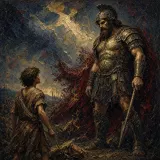
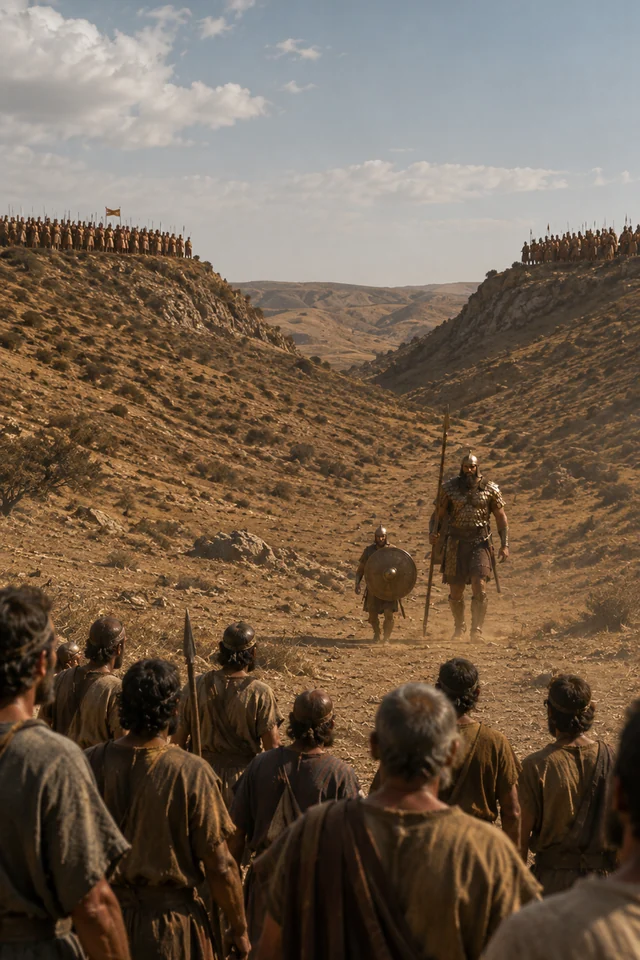
For forty days Goliath has taught both armies to read the valley his way: one enormous champion, one mountain of bronze, one bargain that turns a national battle into a single contest. David arrives carrying bread and cheese, hears exactly the words everyone else has heard, and assigns them a different meaning. Where the soldiers see a terrifying man and a royal reward, David hears defiance of "the armies of the living God." His confidence is not detached from experience. He argues from the lion and bear, rejects armour he has never tested, and walks out with tools he actually knows. The Book of 1 Samuel spends far more time on the speeches than on the strike itself, because the speeches explain what the brief combat is supposed to mean. One stone ends the champion's advance, Goliath's own sword completes his defeat, and the frightened army becomes a pursuing one. The chapter closes not with David announcing his anointing, but with Saul asking whose son the young victor is.
In this chapter
- A Valley Arranged Around One Man's Challenge 1 Samuel 17:1-11
The armies are already arranged for battle, but Goliath steps into the valley and tries to rearrange the meaning of the whole war around himself.
- Bread, Cheese, and Careful Arrangements 1 Samuel 17:12-22
David enters the valley carrying lunch, not a military commission.
- The Same Words, a Different Account of the Insult 1 Samuel 17:23-30
Goliath says the same words he has been saying, and the Book of 1 Samuel explicitly notes that David hears them.
- The Equipment David Has Actually Tested 1 Samuel 17:31-40
Saul's objection is sensible on its face: Goliath has been a warrior from youth, while David is still young.
- The Speeches Name What the Combat Is About 1 Samuel 17:41-47
Goliath reads David by appearance and takes offence at what he sees.
- One Stone, Then the Champion's Own Sword 1 Samuel 17:48-54
Forty days of challenge, pages of description, and long speeches collapse into a few movements.
- The King Asks Whose Son Has Returned 1 Samuel 17:55-58
The chapter ends on a question that sounds odd after chapter 16: Saul asks Abner, "whose son is this youth?" and then asks David the same thing.

Scripture beside the summary
1 Samuel · King James Version · 581 Samuel 17:1-11
A Valley Arranged Around One Man's Challenge
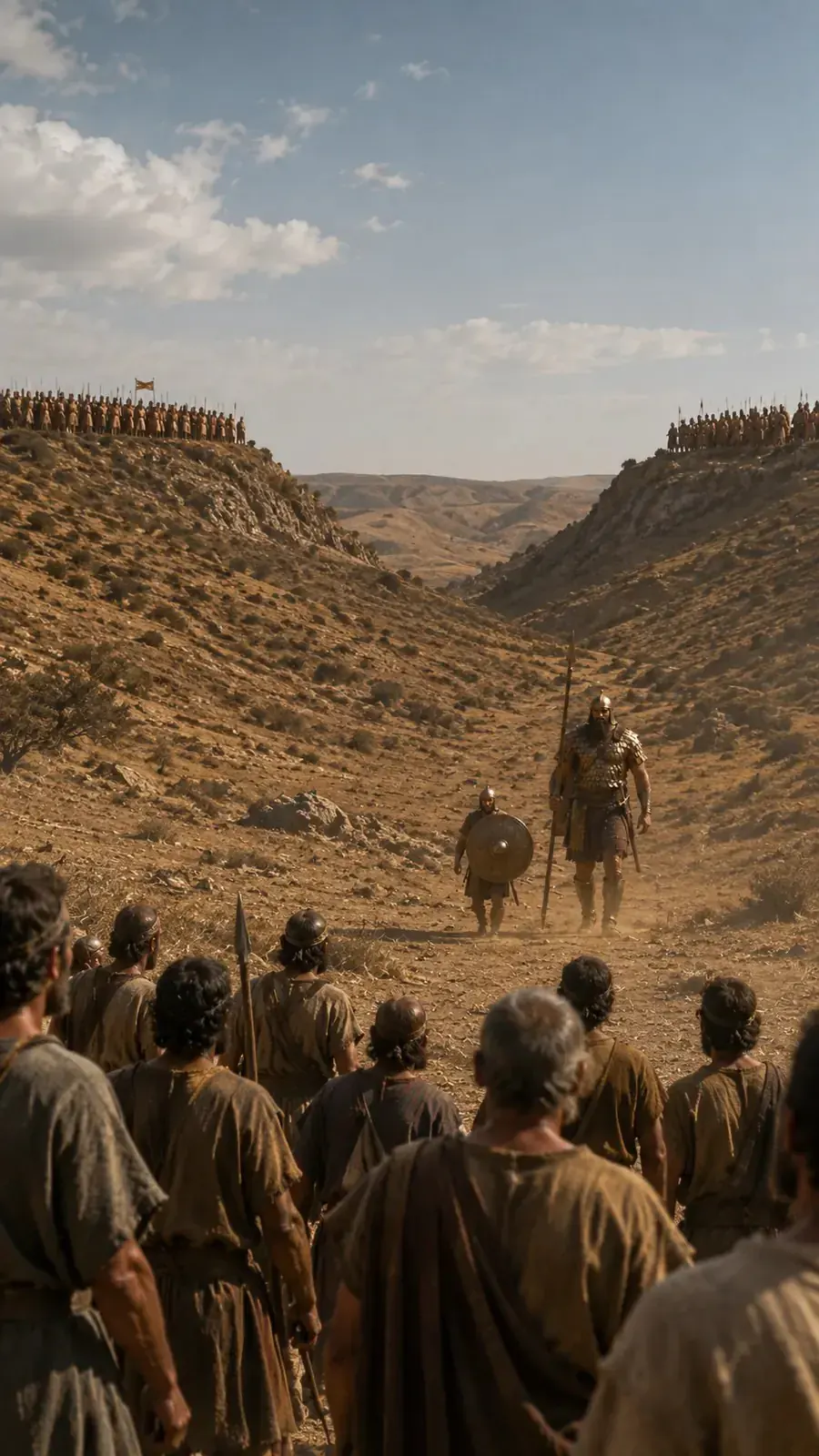
The armies are already arranged for battle, but Goliath steps into the valley and tries to rearrange the meaning of the whole war around himself. He calls Israel "servants to Saul" and offers a compact in which one champion will decide who serves whom. The Book of 1 Samuel then lingers over bronze, mail, greaves, shield, spear, and measurements until the man seems almost built out of inventory. Even the spearhead is weighed. That slow catalogue matters because Israel's response comes only after the reader has been made to feel the visual argument Goliath is making. Everything about him says advantage before anyone moves. A textual difference in ancient witnesses affects the reported height, but it does not change the function of the description: the champion appears formidable enough to freeze Saul and his army. His challenge is therefore military and interpretive at once. He defines Israel by Saul, measures power by visible equipment, and waits for someone to accept those terms.
Deep dive
The opening places the conflict in Judah and arranges the armies across a valley. Goliath then steps into the space between them and attempts to set the terms under which the entire conflict will be decided. His challenge describes the Israelites as Saul's servants. David will later call them the armies of the living God. The dispute will involve not only which man is stronger, but whose authority and identity define the force on the opposite hill.
The inventory slows the account down: helmet, mail, leg protection, bronze equipment between the shoulders, a massive spear, and a separate shieldbearer. The KJV gives Goliath's height as six cubits and a span. The NET translators' note on 17:4 records a shorter reading, four cubits and a span, in some ancient Greek witnesses and a manuscript from Qumran. The textual difference deserves acknowledgment without silently replacing the KJV or building a medical explanation from either figure. In the account's movement, the accumulated measurements establish the formidable appearance that has already paralysed Saul and Israel.
Words to trace: Israel, brass, Philistines, armies, battle, gathered
Verse-by-verse path
- 1 Samuel 17:1
Shochoh and Azekah lay in the Shephelah, the low hills west of Bethlehem, well inside land “which belongeth to Judah”. The Philistines are pushing up the valley routes toward the hill country. Ephes-dammim probably means “boundary of blood”, a name that suggests the ground had been fought over before.
- 1 Samuel 17:2
Elah means terebinth, a large spreading tree, so this is the Valley of the Terebinth. “Set the battle in array” is arak, to lay out in rows, a word that runs through the chapter as the army’s ranks. Israel has taken up position; it has not yet done anything.
- 1 Samuel 17:3
The verse is a diagram: a hill, a valley, a hill. Whichever side went down first would have to fight uphill against the other, which may explain why neither moves for forty days, though the text does not say so. The only thing that crosses the valley is one man’s voice.
- 1 Samuel 17:4
“Champion” is literally “the man of the in-between”, the fighter who steps into the space between two lines. Gath was one of the five Philistine cities, and Joshua 11:22 notes that Anakim, the giants of Canaan, survived there. Six cubits and a span comes to about nine and a half feet.
- 1 Samuel 17:5
“Brass” in 1611 covered what we call bronze. “Coat of mail” is literally a coat of scales, using the word for the scales of a fish (Leviticus 11:9): overlapping bronze plates. Five thousand shekels is roughly 125 pounds, more than many men weigh.
- 1 Samuel 17:6
Greaves were bronze shin guards. The King James “target” means a small shield, but the Hebrew kidon more likely names a javelin or curved sword slung across the back; Joshua held out a kidon at Ai (Joshua 8:18). Goliath is armed at every range.
- 1 Samuel 17:7
A weaver’s beam was the heddle rod of a loom. Yigael Yadin suggested the comparison describes a spear fitted with a loop and cord for throwing, like the leash on a loom rod. The head alone weighs about fifteen pounds, and it is iron, the metal Israel was forbidden to forge (13:19).
- 1 Samuel 17:8
The Hebrew has “Am not I the Philistine?”, with the definite article, as though he embodies his nation. “Let him come down” names the move neither army will make. He addresses a whole army and asks it for one man.
- 1 Samuel 17:9
Deciding a war by single combat is known from Homer, where Paris and Menelaus fight to settle the Trojan war (Iliad 3), and the Philistines came from the Aegean world, though a direct link is an inference. The stakes are servitude either way; the loser’s nation serves the winner’s.
- 1 Samuel 17:10
“Defy” is charaf, to taunt or reproach, the verb behind the “reproach” Nahash wanted to lay on Israel (11:2). It recurs through the chapter, in the soldiers’ mouths, in David’s, and in David’s reply to Goliath. The challenge is an insult first and a proposal second.
- 1 Samuel 17:11
“Dismayed” is chatat, to be shattered. The pair “dismayed” and “afraid” turns inside out the charge given to Joshua: “fear not, neither be dismayed” (Joshua 1:9). Saul, taller than any of his people (9:2), was the obvious match for Goliath, and he is among the frightened.
1 Samuel 17:1-11
King James Version1Now the Philistines gathered together their armies to battle, and were gathered together at Shochoh, which belongeth to Judah, and pitched between Shochoh and Azekah, in Ephes-dammim.
2And Saul and the men of Israel were gathered together, and pitched by the valley of Elah, and set the battle in array against the Philistines.
3And the Philistines stood on a mountain on the one side, and Israel stood on a mountain on the other side: and there was a valley between them.
4And there went out a champion out of the camp of the Philistines, named Goliath, of Gath, whose height was six cubits and a span.
5And he had an helmet of brass upon his head, and he was armed with a coat of mail; and the weight of the coat was five thousand shekels of brass.
6And he had greaves of brass upon his legs, and a target of brass between his shoulders.
7And the staff of his spear was like a weaver’s beam; and his spear’s head weighed six hundred shekels of iron: and one bearing a shield went before him.
8And he stood and cried unto the armies of Israel, and said unto them, Why are ye come out to set your battle in array? am not I a Philistine, and ye servants to Saul? choose you a man for you, and let him come down to me.
9If he be able to fight with me, and to kill me, then will we be your servants: but if I prevail against him, and kill him, then shall ye be our servants, and serve us.
10And the Philistine said, I defy the armies of Israel this day; give me a man, that we may fight together.
11When Saul and all Israel heard those words of the Philistine, they were dismayed, and greatly afraid.
1 Samuel 17:12-22
Bread, Cheese, and Careful Arrangements
David enters the valley carrying lunch, not a military commission. Jesse sends grain, bread, and cheeses, asks for news of his sons, and gives David an errand whose ordinariness makes the next development almost comic in scale. The future champion arrives because his father wants provisions delivered. The Book of 1 Samuel is careful, however, not to make ordinary responsibility disappear once the larger moment arrives. David leaves the sheep with a keeper, then leaves the supplies with the keeper of the baggage before running to greet his brothers. Those small handoffs matter when Eliab later accuses him of abandoning "those few sheep" merely to watch the battle. The account has already answered that charge before it is spoken. Meanwhile Goliath has repeated the same appearance morning and evening for forty days. The army has had plenty of time to become accustomed to the threat without becoming able to answer it. David reaches a crisis everyone else now knows by routine.

Deep dive
The introduction returns to Jesse's family and identifies the three older sons with Saul's army. David moves between Saul's service and the sheep, so his presence at home is not itself evidence that the previous chapter has been forgotten. Jesse's instructions concern food, the brothers' welfare, and a token or report of their condition. The man who will answer the champion does not arrive because a recruitment officer has recognized his military promise. He comes carrying provisions.
Two small arrangements resist the accusation David will soon receive. He leaves the sheep with a keeper and the supplies with the keeper of the baggage. Eliab will suggest that curiosity has drawn him away from a few neglected sheep, but the Book of 1 Samuel has already recorded responsible handovers. The repeated running also gives his movement energy: he rises early, reaches the camp, and runs to greet his brothers. His eagerness is visible before any claim is made about what he will do in battle.
Words to trace: David, Saul, battle, brethren, Jesse, army
Verse-by-verse path
- 1 Samuel 17:12
Ephrath was the old name of Bethlehem (Genesis 35:19), and Elimelech’s family in Ruth are “Ephrathites of Beth-lehem-judah” (Ruth 1:2). David is reintroduced as though for the first time, and the main Greek manuscript, Codex Vaticanus, lacks verses 12–31 altogether. Jesse is too old for the campaign.
- 1 Samuel 17:13
The three eldest are named in the same order in which they passed before Samuel (16:6–9). The sons the LORD did not choose now serve in the army of the king he has rejected, while the chosen one is at home with the flock.
- 1 Samuel 17:14
The Hebrew sets “the youngest”, haqqatan, the little one, against “the three eldest”, literally “the three big ones”. Little and big is the contrast the whole chapter plays out in the valley.
- 1 Samuel 17:15
“Went and returned” describes a young man going back and forth between court and flock. “Feed” is ra’ah, to shepherd, and it becomes David’s royal commission: “Thou shalt feed my people Israel” (2 Samuel 5:2).
- 1 Samuel 17:16
Morning and evening were the hours of Israel’s daily sacrifices (Exodus 29:38–39), and Goliath keeps them like a liturgy of insult. Forty days is Israel’s number for testing, the length of Moses’ stay on the mountain and of the spies’ search of the land.
- 1 Samuel 17:17
An ephah was about half a bushel. “Parched corn” was roasted grain, a soldier’s staple, and the same food Boaz handed Ruth at harvest (Ruth 2:14), David’s great-grandmother in the same fields. Soldiers in this army ate what their families sent.
- 1 Samuel 17:18
“Ten cheeses” is literally “ten cuts of milk”, portions of curd. They go to the captain of a thousand, a gift to keep the commander well disposed toward Jesse’s sons. “Their pledge” is some token proving they were alive and well.
- 1 Samuel 17:19
The line may be Jesse still speaking, telling David where to find them, or the account’s own aside; the Hebrew allows either. “Fighting” is a participle, “were fighting”, which is a generous description of forty days of standing still.
- 1 Samuel 17:20
“The trench” is ma’gal, the circle of the encampment, perhaps a ring of wagons. David arrives just as the army marches out raising the war cry, the same daily cry that led nowhere. He has left the sheep “with a keeper”, a small fact that matters in verse 28.
- 1 Samuel 17:21
“Army against army” is literally “rank against rank”, ma’arakah, the chapter’s word for battle lines. Both sides are drawn up, and the verse states the stand-off in five Hebrew words without a verb of motion.
- 1 Samuel 17:22
“Carriage” in 1611 meant baggage, things carried, not a vehicle. “Saluted his brethren” is literally “asked his brothers of their shalom”, exactly the errand Jesse gave in verse 18, where “look how thy brethren fare” is literally “see to their shalom”.
1 Samuel 17:12-22
King James Version12Now David was the son of that Ephrathite of Beth-lehem-judah, whose name was Jesse; and he had eight sons: and the man went among men for an old man in the days of Saul.
13And the three eldest sons of Jesse went and followed Saul to the battle: and the names of his three sons that went to the battle were Eliab the firstborn, and next unto him Abinadab, and the third Shammah.
14And David was the youngest: and the three eldest followed Saul.
15But David went and returned from Saul to feed his father’s sheep at Beth-lehem.
16And the Philistine drew near morning and evening, and presented himself forty days.
17And Jesse said unto David his son, Take now for thy brethren an ephah of this parched corn, and these ten loaves, and run to the camp to thy brethren;
18And carry these ten cheeses unto the captain of their thousand, and look how thy brethren fare, and take their pledge.
19Now Saul, and they, and all the men of Israel, were in the valley of Elah, fighting with the Philistines.
20And David rose up early in the morning, and left the sheep with a keeper, and took, and went, as Jesse had commanded him; and he came to the trench, as the host was going forth to the fight, and shouted for the battle.
21For Israel and the Philistines had put the battle in array, army against army.
22And David left his carriage in the hand of the keeper of the carriage, and ran into the army, and came and saluted his brethren.
1 Samuel 17:23-30
The Same Words, a Different Account of the Insult
Goliath says the same words he has been saying, and the Book of 1 Samuel explicitly notes that David hears them. The new element is not a new challenge but a new hearing. Israel's soldiers talk about the king's promised riches, marriage, and freedom for the victor's household. David asks about the reward too, so the account does not turn him into a man too spiritual to notice practical consequences. Yet he adds something the others do not: the insult is a reproach against Israel because this "uncircumcised Philistine" has defied "the armies of the living God." Eliab then claims to know David's pride and wicked heart, a confident diagnosis placed one chapter after the LORD has told Samuel that human beings do not see the heart as God does. The accusation also ignores facts already supplied about Jesse's command and the keeper of the sheep. David does not win the family argument. He simply turns away and keeps asking the same question until his words reach Saul.
Deep dive
The Philistine speaks "the same words", and David hears them. Nothing about the challenge has become easier on this particular morning. What changes is the interpretation within the Israelite camp. The soldiers discuss the king's promised reward; David also asks about that reward, but his language adds the reproach against Israel and the defiance of the living God. The account need not erase his interest in the practical reward to show that his understanding of the challenge is different.
Eliab claims to know the pride and wickedness of David's heart. That claim stands close to the previous chapter's insistence that the LORD, unlike human observers, sees the heart. Eliab has not been given that divine access. His anger and accusation are reported as his own response, while the earlier details about Jesse's commission and the keeper of the sheep supply information he does not acknowledge. David turns from the quarrel to continue the inquiry. The exchange gives his oldest brother a confident verdict, but not the account's final word.
Words to trace: Israel, David, spake, killeth, manner, Philistine
Verse-by-verse path
- 1 Samuel 17:23
Goliath is named only here and in verse 4; everywhere else he is simply “the Philistine”, a title more than a man. 2 Samuel 21:19 credits Elhanan of Bethlehem with killing “Goliath the Gittite”, and 1 Chronicles 20:5 makes Elhanan’s victim Goliath’s brother, a difficulty long discussed.
- 1 Samuel 17:24
The whole line breaks at the sight of one man walking forward, before he speaks. So the forty days were not a standoff so much as a daily rout, with Israel retreating morning and evening and coming back to its position.
- 1 Samuel 17:25
The reward has three parts: riches, the king’s daughter, and a “free” household. The word chofshi is the one used of a Hebrew slave going free (Exodus 21:2); here it probably meant exemption from royal taxes and forced service, the burdens Samuel warned of in 8:11–17.
- 1 Samuel 17:26
These are David’s first recorded words in the book, and they begin with a question. “Reproach” is cherpah, the disgrace Nahash wanted to lay on Israel (11:2). “The living God” is the phrase Joshua used at the Jordan (Joshua 3:10), set against a people whose god Dagon fell on his face before the ark.
- 1 Samuel 17:27
“After this manner” is literally “according to this word”, and the chapter keeps counting words passed from mouth to mouth. David now has the terms confirmed by men who heard them, not by rumour alone.
- 1 Samuel 17:28
“Naughtiness” in 1611 meant wickedness, not mere mischief. “Why camest thou down hither?” is sharp in context: Goliath has asked forty days for someone to come down to him (verse 8), and the first to come down is scolded by his brother for it.
- 1 Samuel 17:29
“Is there not a cause?” renders a Hebrew phrase that more likely means “Was it not just a word?”: I only asked. “What have I now done?” sounds like a youngest brother who has heard accusations before.
- 1 Samuel 17:30
David does not answer Eliab; he simply turns to someone else. The Hebrew repeats “word” again, the former word, the same word. Questions travel along the line of men, and by the next verse they reach the king.
1 Samuel 17:23-30
King James Version23And as he talked with them, behold, there came up the champion, the Philistine of Gath, Goliath by name, out of the armies of the Philistines, and spake according to the same words: and David heard them.
24And all the men of Israel, when they saw the man, fled from him, and were sore afraid.
25And the men of Israel said, Have ye seen this man that is come up? surely to defy Israel is he come up: and it shall be, that the man who killeth him, the king will enrich him with great riches, and will give him his daughter, and make his father’s house free in Israel.
26And David spake to the men that stood by him, saying, What shall be done to the man that killeth this Philistine, and taketh away the reproach from Israel? for who is this uncircumcised Philistine, that he should defy the armies of the living God?
27And the people answered him after this manner, saying, So shall it be done to the man that killeth him.
28And Eliab his eldest brother heard when he spake unto the men; and Eliab’s anger was kindled against David, and he said, Why camest thou down hither? and with whom hast thou left those few sheep in the wilderness? I know thy pride, and the naughtiness of thine heart; for thou art come down that thou mightest see the battle.
29And David said, What have I now done? Is there not a cause?
30And he turned from him toward another, and spake after the same manner: and the people answered him again after the former manner.
1 Samuel 17:31-40
The Equipment David Has Actually Tested
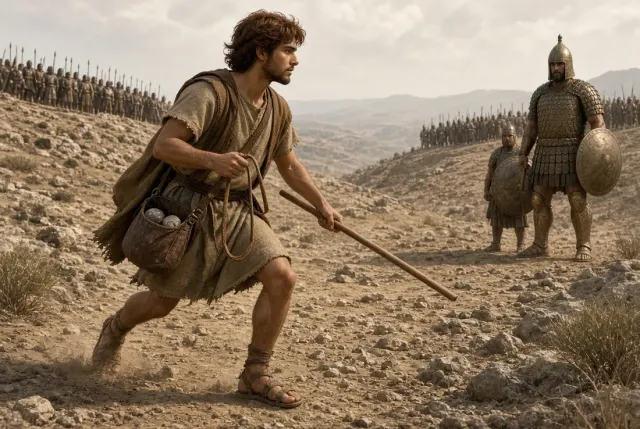
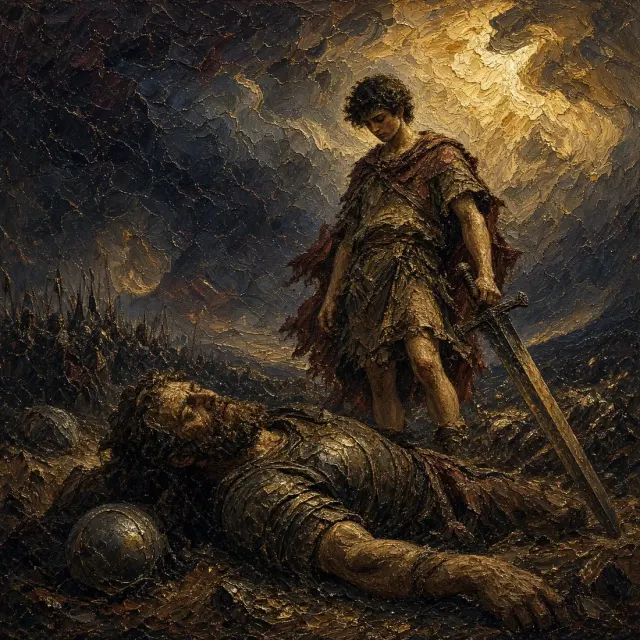
Saul's objection is sensible on its face: Goliath has been a warrior from youth, while David is still young. David does not answer by pretending experience is irrelevant. He supplies his own kind of experience, the dangerous work of recovering sheep from a lion and a bear, and he attributes those deliverances to the LORD rather than to nerve alone. The shepherd's field becomes his evidence that he has faced lethal danger before. Saul then tries to make David battle-ready by dressing him in royal armour. David removes it for a plain reason: he has not "proved" it. The Book of 1 Samuel does not say the armour is ridiculous, sinful, or too large. It says it is untested. David is not rejecting equipment altogether either. He takes staff, bag, sling, and five carefully chosen stones, the tools with which he actually knows how to move. The contrast is not faith versus material means so much as borrowed equipment versus practiced skill under remembered deliverance.
Deep dive
Saul's objection is understandable in its stated terms: David is young, and Goliath has been a fighter since youth. David answers with specific acts of rescue rather than a denial that experience matters. The lion and bear have required him to pursue danger on behalf of a lamb, and he attributes his survival to the LORD. His argument joins past action to divine deliverance. It does not present courage as a feeling strong enough to create an outcome by itself.
Saul equips him with armour, but David cannot proceed in equipment he has not proved. The reason given is unfamiliarity, not a statement that the armour is comically oversized or that material protection is inherently unfaithful. David does take material equipment: staff, bag, sling, and carefully chosen stones. The account contrasts tested and untested means as well as the obvious difference in weight. The five stones receive no interpretation as five virtues, five future enemies, or a hidden code. Their stated function is to be available in the shepherd's bag.
Words to trace: David, Saul, Philistine, bear, hand, lion
Verse-by-verse path
- 1 Samuel 17:31
“Rehearsed” means repeated or reported. The Hebrew says Saul “took him”, the verb of royal conscription Samuel warned of in 8:11. Music brought David to Saul in chapter 16; now words do.
- 1 Samuel 17:32
“Let no man’s heart fail” is literally “let no man’s heart fall upon him”. David calls himself “thy servant”, a title he uses repeatedly in this conversation. Goliath had sneered at Israel as “servants to Saul” (verse 8), and David takes the title up gladly.
- 1 Samuel 17:33
Saul uses the same root twice: David is a na’ar, a boy, and Goliath has been a warrior from his ne’urim, his boyhood. Goliath had been a soldier for longer than David had been alive, or near enough.
- 1 Samuel 17:34
Lions lived in the Jordan thickets and the Judean wilderness (Jeremiah 49:19). Amos pictures a shepherd who can save from a lion’s mouth only two legs or a piece of an ear (Amos 3:12), the remains a shepherd produced as proof that a beast, not he, had taken the animal (Exodus 22:13).
- 1 Samuel 17:35
“Beard” is the word for a man’s chin or beard, here the lion’s jaw or mane. “Delivered” is natsal, to snatch away, the verb David applies to God in verse 37. Samson also killed a lion, but with the Spirit on him and his bare hands (Judges 14:6).
- 1 Samuel 17:36
David classes Goliath with the lion and the bear, animals who took what was not theirs. Goliath will ask a few verses later whether he is a dog (verse 43), and the insult has already been answered.
- 1 Samuel 17:37
The “paw” of the lion and bear is literally their “hand”, yad, and so is the “hand” of the Philistine. Three hands, one deliverer. Saul’s blessing, “the LORD be with thee”, prays for what the courtier already said was true (16:18).
- 1 Samuel 17:38
“His armour” is Saul’s maddav, his own tunic or battle dress, the word used when Jonathan gives David “his garments” in 18:4. Saul was one of only two men in Israel with proper weapons (13:22), and he hands his kit to a shepherd.
- 1 Samuel 17:39
“Assayed” means tried. “Proved” is nissah, to test, the verb of God proving Abraham (Genesis 22:1). The Hebrew says David could not “walk” in them. The sword he girds and then removes sets up the line in verse 50: there was no sword in his hand.
- 1 Samuel 17:40
The brook is the wadi bed in the valley floor, where water had rounded the stones. “Scrip” was old English for a small bag; the Hebrew word appears nowhere else. Benjamin had slingers who could hit a hair and not miss (Judges 20:16), and sling stones found at excavated sites are roughly the size of a tennis ball.
1 Samuel 17:31-40
King James Version31And when the words were heard which David spake, they rehearsed them before Saul: and he sent for him.
32And David said to Saul, Let no man’s heart fail because of him; thy servant will go and fight with this Philistine.
33And Saul said to David, Thou art not able to go against this Philistine to fight with him: for thou art but a youth, and he a man of war from his youth.
34And David said unto Saul, Thy servant kept his father’s sheep, and there came a lion, and a bear, and took a lamb out of the flock:
35And I went out after him, and smote him, and delivered it out of his mouth: and when he arose against me, I caught him by his beard, and smote him, and slew him.
36Thy servant slew both the lion and the bear: and this uncircumcised Philistine shall be as one of them, seeing he hath defied the armies of the living God.
37David said moreover, The LORD that delivered me out of the paw of the lion, and out of the paw of the bear, he will deliver me out of the hand of this Philistine. And Saul said unto David, Go, and the LORD be with thee.
38And Saul armed David with his armour, and he put an helmet of brass upon his head; also he armed him with a coat of mail.
39And David girded his sword upon his armour, and he assayed to go; for he had not proved it. And David said unto Saul, I cannot go with these; for I have not proved them. And David put them off him.
40And he took his staff in his hand, and chose him five smooth stones out of the brook, and put them in a shepherd’s bag which he had, even in a scrip; and his sling was in his hand: and he drew near to the Philistine.
1 Samuel 17:41-47
The Speeches Name What the Combat Is About
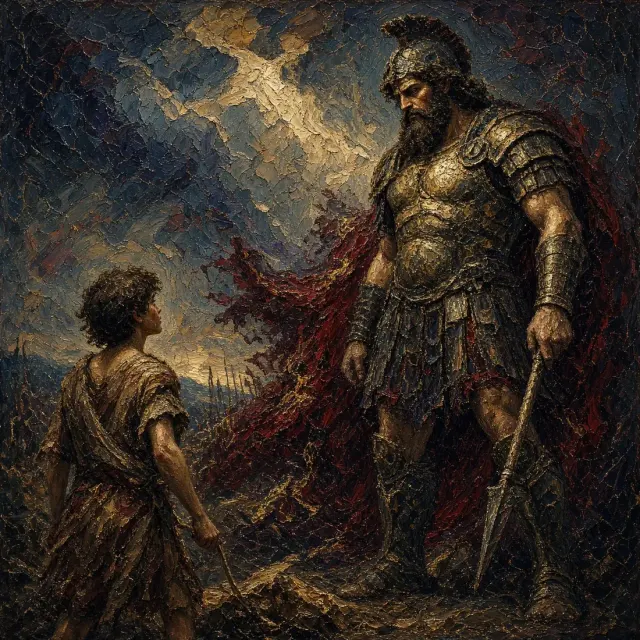
Goliath reads David by appearance and takes offence at what he sees. A young man with a staff looks to him like contempt, as though Israel has sent someone to handle a dog. His curse by his gods turns the exchange openly religious. David's reply does the same, but he refuses to make the sling the center of his answer. Goliath comes with sword, spear, and shield; David comes "in the name of the LORD of hosts," the God whose armies Goliath has defied. He then names two audiences for the outcome. The earth is to know that there is a God in Israel, and the gathered armies are to know that "the LORD saveth not with sword and spear." That claim echoes Jonathan's earlier conviction that conventional advantage does not limit the LORD's ability to save. The Book of 1 Samuel puts this interpretation before the throw so the coming result cannot be reduced to a lucky shot or an inspirational upset by an unusually talented underdog.
Deep dive
Goliath notices the staff and complains that he is being approached like a dog. He sees youth, colouring, and appearance, and dismisses the opponent on that basis. The reader has just heard Samuel corrected for making a selection through outward appearance. Goliath's assessment brings that issue onto the battlefield. His confidence rests partly on what he sees, while the account has already established that seeing David is not the same as understanding his appointment.
David does not answer by advertising the sling as superior technology. He names the LORD whom Goliath has defied, then explains the intended witnesses to the result: the earth will know that there is a God in Israel, and the assembled armies will know that the LORD does not depend on sword and spear to save. The announced violence remains real, but its stated meaning is public recognition of divine agency. The contest is not presented merely as an encouraging example of an underdog exceeding expectations.
The last part of David's reply also echoes Jonathan's conviction in 14:6 that the LORD can save without conventional advantage. Different men, different circumstances, and different weapons produce a shared claim about the source of deliverance. The lengthy argument comes before the throw, ensuring that the act is interpreted by the words surrounding it rather than left as an isolated feat of marksmanship.
Words to trace: David, Philistine, LORD, beasts, comest, earth
Verse-by-verse path
- 1 Samuel 17:41
The Hebrew lingers on Goliath’s approach: walking, going, drawing near, the slow advance of a man in a hundred pounds of bronze behind a shield-bearer. Every verb for David in the coming verses will be quick.
- 1 Samuel 17:42
“Disdained” is bazah, to despise, the verb Michal will use of David when she watches him dance before the ark (2 Samuel 6:16). “Ruddy” and “fair countenance” repeat the description of 16:12 word for word; Goliath sees what Samuel saw and draws the opposite conclusion.
- 1 Samuel 17:43
“Staves” is plural though David carries one staff, perhaps a sneer, or perhaps Goliath counts the sling. His curse “by his gods” makes the contest openly religious. The Greek adds David’s retort: “No, but worse than a dog.”
- 1 Samuel 17:44
Leaving a body to birds and beasts was the curse of the unburied, the worst fate the ancient world could name (Deuteronomy 28:26). “Come to me” repeats the demand that someone come down, now as a personal invitation.
- 1 Samuel 17:45
“The LORD of hosts” is YHWH tseva’ot, “LORD of armies”, the title first heard at Shiloh (1:3). David pairs it with a second word for armies, the ranks of Israel that Goliath has defied. The kidon rendered “shield” here is the weapon slung on Goliath’s back in verse 6.
- 1 Samuel 17:46
David takes Goliath’s curse of verse 44 word for word and enlarges it from one body to the whole Philistine host. “That all the earth may know” is the purpose clause of the plagues (Exodus 9:14, 16), which the Philistines themselves remembered with dread (4:8; 6:6).
- 1 Samuel 17:47
“This assembly” is qahal, the word for Israel gathered before God, so an army becomes a congregation. “The battle is the LORD’s” is heard again when a prophet tells King Jehoshaphat, “the battle is not yours, but God’s” (2 Chronicles 20:15).
1 Samuel 17:41-47
King James Version41And the Philistine came on and drew near unto David; and the man that bare the shield went before him.
42And when the Philistine looked about, and saw David, he disdained him: for he was but a youth, and ruddy, and of a fair countenance.
43And the Philistine said unto David, Am I a dog, that thou comest to me with staves? And the Philistine cursed David by his gods.
44And the Philistine said to David, Come to me, and I will give thy flesh unto the fowls of the air, and to the beasts of the field.
45Then said David to the Philistine, Thou comest to me with a sword, and with a spear, and with a shield: but I come to thee in the name of the LORD of hosts, the God of the armies of Israel, whom thou hast defied.
46This day will the LORD deliver thee into mine hand; and I will smite thee, and take thine head from thee; and I will give the carcases of the host of the Philistines this day unto the fowls of the air, and to the wild beasts of the earth; that all the earth may know that there is a God in Israel.
47And all this assembly shall know that the LORD saveth not with sword and spear: for the battle is the LORD’s, and he will give you into our hands.
1 Samuel 17:48-54
One Stone, Then the Champion's Own Sword
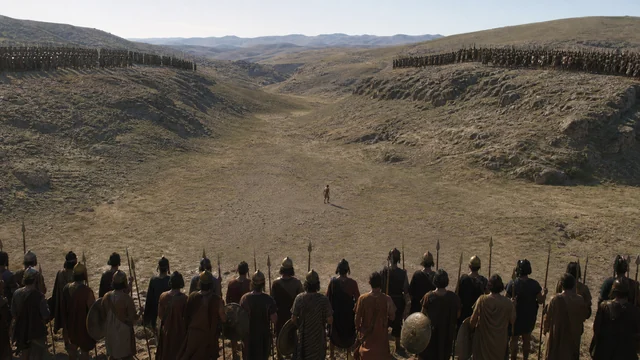
Forty days of challenge, pages of description, and long speeches collapse into a few movements. David runs toward the Philistine, reaches into the shepherd's bag, slings one stone, and Goliath falls facedown. The Book of 1 Samuel then pauses to say something almost unnecessary unless it matters: "there was no sword in the hand of David." The sling and stone are the means by which he first prevails. Only after the champion is down does David take Goliath's own sword and use it against him, turning the weapon that helped define the giant's superiority into evidence of his defeat. The fallen posture also recalls Dagon before the ark, and the removal of the head deepens the resemblance without requiring David to be staging a literary echo. The Philistines immediately abandon the bargain Goliath proposed. They do not submit as servants; they run. Israel, which had fled from one man, now pursues an army. The spectacle reverses who is moving from whom.
Deep dive
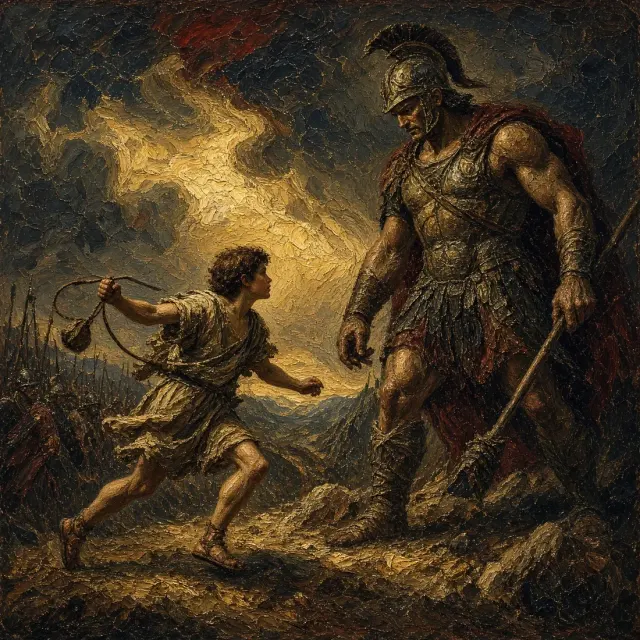
After forty days of repeated challenge and many verses of speech, the decisive action is remarkably brief. David runs forward, reaches into the bag, and strikes Goliath with a stone. The account then underlines the absence of a sword in David's hand before describing his use of Goliath's own weapon. Verse 50 summarizes the victory with the sling; verse 51 supplies the following action with the sword. Their sequence does not make the sword the means by which David first overcame the champion.
Goliath falls facedown. That posture recalls Dagon before the ark in 5:3, and the removal of the head strengthens the literary resemblance without requiring that David consciously stage it. The Philistines do not honour their champion's proposed agreement by submitting as servants; they flee. Israel's fearful watchers become pursuers. The mention of Jerusalem with the trophy anticipates a city whose capture by David is recorded in 2 Samuel 5:6–9, but this verse does not explain the trophy's route or timing. The brief notice is not a complete itinerary.
Words to trace: David, Philistine, Philistines, stone, took, arose
Verse-by-verse path
- 1 Samuel 17:48
Goliath “arose”, perhaps from where he had been waiting, and moves forward. David “hasted, and ran” toward the ranks; the only running in the combat is his, and he runs toward the Philistine line rather than away from it.
- 1 Samuel 17:49
“Slang” is the old past tense of sling. “Sunk” is taba’, the verb for Pharaoh’s captains sinking in the Red Sea (Exodus 15:4). “Forehead” is metsach, from the same root as the “greaves” of verse 6, which has led a few scholars to suggest the stone struck below the knee, a minority reading.
- 1 Samuel 17:50
“Prevailed” is chazaq, the verb Goliath used in verse 9: “if I prevail against him”. His own word is turned on him. The verse is the chapter’s summary sentence, placed before the details of verse 51 like a headline.
- 1 Samuel 17:51
“Stood upon” is the victor’s stance over a fallen enemy. “Champion” here is gibbor, “mighty man”, not the “man of the in-between” of verse 4. The sword David draws will turn up again wrapped in a cloth behind the ephod at Nob (21:9).
- 1 Samuel 17:52
Israel and Judah are named apart again. The Greek reads “Gath” for “the valley”, which pairs neatly with Ekron: the two nearest Philistine cities. Shaaraim, “two gates”, was a town of the Shephelah near the battlefield (Joshua 15:36).
- 1 Samuel 17:53
“Chasing” is dalaq, literally “burning after”, the verb Jacob used when he protested that Laban had “hotly pursued” him (Genesis 31:36). The army that fled the sight of one man now plunders the tents of a whole camp.
- 1 Samuel 17:54
Jerusalem was still a Jebusite city until 2 Samuel 5. “His tent” has no clear referent, since David was a visitor with no tent in camp; it may mean his home. The sword later lies at the sanctuary at Nob (21:9), perhaps given there as a thank offering, though the text never says how it arrived.
1 Samuel 17:48-54
King James Version48And it came to pass, when the Philistine arose, and came and drew nigh to meet David, that David hasted, and ran toward the army to meet the Philistine.
49And David put his hand in his bag, and took thence a stone, and slang it, and smote the Philistine in his forehead, that the stone sunk into his forehead; and he fell upon his face to the earth.
50So David prevailed over the Philistine with a sling and with a stone, and smote the Philistine, and slew him; but there was no sword in the hand of David.
51Therefore David ran, and stood upon the Philistine, and took his sword, and drew it out of the sheath thereof, and slew him, and cut off his head therewith. And when the Philistines saw their champion was dead, they fled.
52And the men of Israel and of Judah arose, and shouted, and pursued the Philistines, until thou come to the valley, and to the gates of Ekron. And the wounded of the Philistines fell down by the way to Shaaraim, even unto Gath, and unto Ekron.
53And the children of Israel returned from chasing after the Philistines, and they spoiled their tents.
54And David took the head of the Philistine, and brought it to Jerusalem; but he put his armour in his tent.
1 Samuel 17:55-58
The King Asks Whose Son Has Returned
The chapter ends on a question that sounds odd after chapter 16: Saul asks Abner, "whose son is this youth?" and then asks David the same thing. The wording is about family identity, not merely David's name, which fits the earlier promise that the victor's father's house would receive royal benefits. Still, the difficulty does not vanish, because Saul has already sent to Jesse about David and employed him at court. The Book of 1 Samuel does not stop to harmonize every feature of those scenes. One reading takes this as a renewed formal inquiry now that David's status has changed; another sees evidence that closely related accounts have been preserved together. Ancient Greek textual evidence also shows complexity around these verses. What the present scene does make unmistakable is David's answer. He identifies himself as the son of Jesse of Bethlehem and continues to speak as the king's servant. The reader knows about Samuel's private anointing. David does not use the victory as an occasion to announce it.
Deep dive
The repeated wording asks whose son David is, not simply what his name is. That makes family identity a plausible concern, especially after the reported promise in verse 25 of benefits for the victor's father's house. Yet chapter 16 has already described Saul sending messages to Jesse. The earlier acquaintance therefore remains a genuine interpretive difficulty; changing the question from identity to parentage does not explain every feature of the sequence.
One reading treats this as a fresh formal inquiry into the family of a servant now entering a different position. Another understands the passages as preserving accounts whose introductions have not been fully harmonized. The Book of 1 Samuel does not explicitly choose between those explanations. The NET textual note on 17:55 also records that most Greek manuscripts omit 17:55–18:5, showing that this passage has a complicated textual history. What the present exchange does make clear is David's answer: he belongs to Jesse of Bethlehem and addresses the king as a servant. The successful challenger returns without announcing the private anointing that the reader already knows.
Words to trace: Abner, David, Philistine, Saul, king, Beth
Verse-by-verse path
- 1 Samuel 17:55
“As thy soul liveth” is a courtier’s oath. Abner, the king’s cousin and general (14:50), will one day negotiate with David for the kingdom (2 Samuel 3:12). From here on Saul tends to call David “the son of Jesse”, often as a sneer (20:27, 31; 22:7), and the question of parentage starts here.
- 1 Samuel 17:56
“Stripling” in 1611 meant a youth not yet full grown. The Hebrew elem is rare, used again only in 20:22 of Jonathan’s boy. The king uses a softer word than the na’ar of verse 33.
- 1 Samuel 17:57
“Abner took him”, the same verb Saul used in verse 31 and will use again in 18:2. David comes before the king holding the severed head, which shows that verse 54 is summarising what happened later.
- 1 Samuel 17:58
“Jesse the Beth-lehemite” is the exact title the LORD used in 16:1 and the courtier in 16:18, and now David says it himself. Calling his father “thy servant” places the whole household at Saul’s disposal in the answer that ends the chapter.
1 Samuel 17:55-58
King James Version55And when Saul saw David go forth against the Philistine, he said unto Abner, the captain of the host, Abner, whose son is this youth? And Abner said, As thy soul liveth, O king, I cannot tell.
56And the king said, Enquire thou whose son the stripling is.
57And as David returned from the slaughter of the Philistine, Abner took him, and brought him before Saul with the head of the Philistine in his hand.
58And Saul said to him, Whose son art thou, thou young man? And David answered, I am the son of thy servant Jesse the Beth-lehemite.
Questions to keep in mind while reading
- Track who acts, who speaks, who is affected, and what changes.
- Notice repeated promises, failures, rescues, and consequences.
- Do not assume the account approves every action that is reported.
Text first
Where readers differ
The chapter summary begins with what the passage says and how its parts fit together. It does not assume one denomination has already settled every question. Where a conclusion depends on a tradition, literary theory, or historical reconstruction, that dependence is named openly.
The KJV text is presented first. Interpretive conclusions are labeled, and differences are introduced only when they help a reader understand why serious communities do not always reach the same answer.
Comparative interpretive notes for this chapter are in preparation. Until reviewed notes are ready, this page separates the KJV text from summary and application without claiming that serious readers agree on every question.
Questions beneath the surface
- What account of God, human freedom, responsibility, and the good life emerges from 1 Samuel 17?
- Which tension does the chapter refuse to resolve quickly?
- What changes when the chapter is read as part of the whole canon rather than as an isolated moral lesson?
- Where might a sincere reader confuse a familiar tradition with something the text states directly?
Questions for serious personal contemplation
These open-ended questions make room for tension, honest response, prayer, and conclusions that remain accountable to the chapter.
Observe without rushing
What part of 1 Samuel 17 makes you stop, feel unsettled, or feel surprised, and why?
Which detail in the passage would be easiest to overlook? How does that detail change your understanding?
Where do you see tension between what happens and this focus: David approaching Goliath with sling and stones, followed by the army’s response?
What important question does the passage leave open instead of resolving quickly?
Examine your inner life honestly
Which person, response, fear, or desire in the passage feels most like your own life right now?
What assumption about God, other people, or yourself does this text challenge?
Which part would you rather soften, avoid, or explain away too quickly? What might that reaction reveal?
If this Scripture could ask you one direct question, what do you think it would ask?
Respond with wisdom and courage
What do you need to remember, confess, grieve, thank God for, or trust after reading this passage?
How might another faithful person read this situation differently without ignoring the text?
What obedient response would be costly, uncomfortable, or slow, yet still faithful to Scripture?
What question will you carry into prayer this week, and which verses will you keep in front of you?
Music and video connected to the passage
Related media appears when its Scripture reference overlaps this study. Music and video can illuminate a theme while the biblical text remains the foundation.