Places of the Bible

Bethlehem

A town small enough that the prophet who named it had to say so.

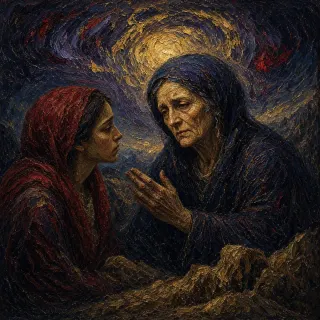
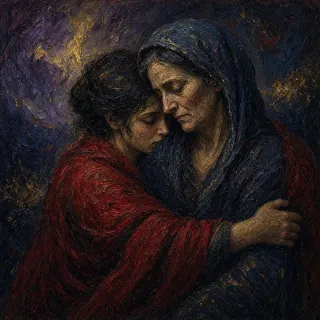
The name means house of bread and the book of Ruth opens by reporting that there was none: a famine in the land, and a family from Bethlehem-judah leaving for Moab because of it. Everything the town is known for comes back through that account. Ruth returns with Naomi at the beginning of barley harvest, gleans in a field belonging to Boaz, and the women of the town name a child who becomes the grandfather of David.

Where it appearsRuth 1 · 1 Samuel 16 · Micah 5 · Matthew 2 · Luke 2

Scroll down to the account

The movements, in the order the text gives them.

The Account of Bethlehem

  1. 01

    Ruth 1:1-6

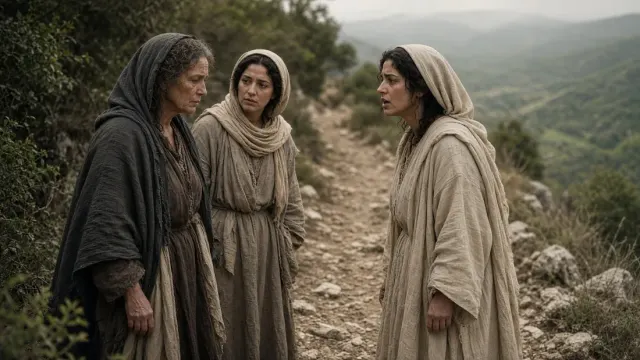
    A famine in the house of bread

    The book opens by emptying the town. The family leaves for Moab, and the return ten years later is what the rest of the account runs on.

    House of Bread is a hard address to leave hungry. Bethlehem's Hebrew name gives the opening of the Book of Ruth a quiet sting: the family must leave the place whose name promises exactly what it cannot supply. Then to sojourn, a word for staying as a resident outsider, stretches into about ten years. What began as a move for food has acquired marriages and graves.

    The sentences keep subtracting. First Naomi is left with her two sons; then the woman is left of her two sons and her husband. The repetition makes the losses accumulate without supplying speeches at the graveside. Nor does the passage identify those deaths as punishment for moving to Moab. That explanation would be an addition, not an observation.

    The first explicit report of the LORD's intervention concerns bread, not an explanation of the funerals. Naomi hears that food has returned to Judah. Bethlehem becomes a destination again, but the road home cannot restore the household that left. Food is available. Her husband and sons are not.

    Verse by verse

    1. 1:1

      Sojourn describes living away from the family's own land; it does not mean that the stay actually remained brief.

    2. 1:3-5

      The deaths are stated without a cause. Neither migration nor the marriages is explicitly identified here as their punishment.

    3. 1:6

      Visited means an effective act of divine attention, here specified as the provision of food.

    Ruth 1:1-6

    King James Version · 6 verses

    1:1Now it came to pass in the days when the judges ruled, that there was a famine in the land. And a certain man of Beth-lehem-judah went to sojourn in the country of Moab, he, and his wife, and his two sons.

    1:2And the name of the man was Elimelech, and the name of his wife Naomi, and the name of his two sons Mahlon and Chilion, Ephrathites of Beth-lehem-judah. And they came into the country of Moab, and continued there.

    1:3And Elimelech Naomi’s husband died; and she was left, and her two sons.

    1:4And they took them wives of the women of Moab; the name of the one was Orpah, and the name of the other Ruth: and they dwelled there about ten years.

    1:5And Mahlon and Chilion died also both of them; and the woman was left of her two sons and her husband.

    1:6Then she arose with her daughters in law, that she might return from the country of Moab: for she had heard in the country of Moab how that the LORD had visited his people in giving them bread.

    Ruth 1:1-6: A famine in the house of bread
  2. 02

    Ruth 4:13-17

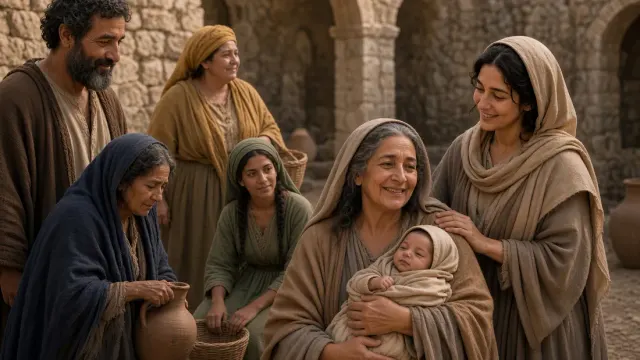
    The women of the town named him

    A child is born to a Moabite widow and the neighbours name him Obed, and the account traces the line forward three generations.

    The women of Bethlehem have the final word on Ruth, and it is larger than the customary congratulations. Better to thee than seven sons. The foreign daughter-in-law is not merely being tolerated at the edge of this household; her love is being named as its extraordinary strength. A book that opened with the loss of two sons now lets the town's women say that family cannot be measured by counting sons alone.

    Their announcement that a son has been born to Naomi does not confuse the birth certificate. Verse 13 has already identified the parents. It names what this birth means for the bereaved household, while Naomi's arms give the sentence a physical form. The earlier emptiness has not been explained away. There is now someone to hold.

    Then the passage quietly supplies three generations: Obed, Jesse, David. The women are talking about old age, nourishment, and a child's name. The Book of Ruth lets those domestic concerns occupy the very ground from which Israel's royal line emerges.

    Verse by verse

    1. 4:15

      Seven sons expresses an ideal fullness of family blessing; the women make Ruth's love the point of comparison.

    2. 4:16

      Nurse here describes the child's caregiver. The verse does not say that Naomi gave birth or began to lactate.

    3. 4:17

      The neighbors name the child, but no formal adoption ceremony is described.

    Ruth 4:13-17

    King James Version · 5 verses

    4:13So Boaz took Ruth, and she was his wife: and when he went in unto her, the LORD gave her conception, and she bare a son.

    4:14And the women said unto Naomi, Blessed be the LORD, which hath not left thee this day without a kinsman, that his name may be famous in Israel.

    4:15And he shall be unto thee a restorer of thy life, and a nourisher of thine old age: for thy daughter in law, which loveth thee, which is better to thee than seven sons, hath born him.

    4:16And Naomi took the child, and laid it in her bosom, and became nurse unto it.

    4:17And the women her neighbours gave it a name, saying, There is a son born to Naomi; and they called his name Obed: he is the father of Jesse, the father of David.

    Ruth 4:13-17: The women of the town named him
  3. 03

    1 Samuel 16:1-13

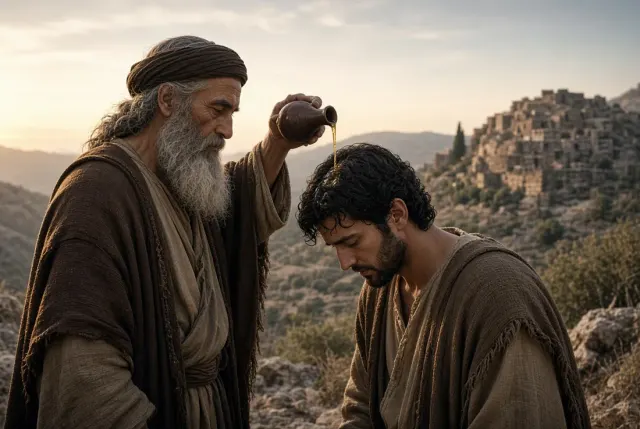
    There remaineth yet the youngest

    Seven sons pass by and none is chosen, and the search stalls until somebody remembers who is not in the room.

    Even Samuel gets the first candidate wrong. Eliab looks suitable, and the prophet's confidence arrives before God's instruction. That is what gives the correction its bite: the warning about outward appearance is addressed to the man carrying the anointing oil, not merely to an uninformed crowd. Knowing the purpose of the visit does not mean knowing which son to choose.

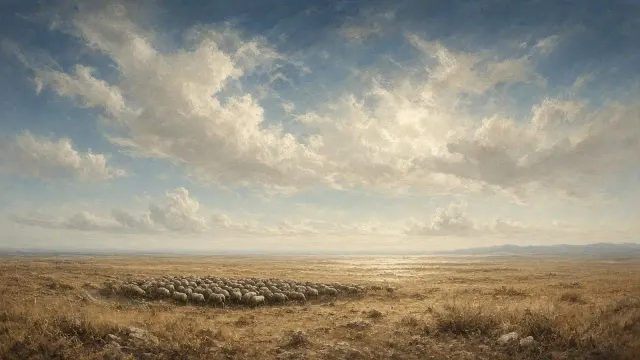
    Seven sons pass before him. The remaining son is still with the sheep, and the gathering cannot proceed until someone fetches him. The passage does not say Jesse hated David or deliberately humiliated him. His absence is enough: the person required for this gathering was not in it.

    Then, immediately after the warning about appearances, David is described as handsome. The point was never that beauty disqualifies a king. It was that beauty cannot identify God's choice. Only after the divine identification and the anointing does the passage supply David's name. Bethlehem has no public coronation here, no surrendered throne, no defeated Saul. It has a horn of oil and the coming of the Spirit.

    Verse by verse

    1. 16:7

      The contrast concerns the basis of divine choice, not a claim that physical beauty is itself a fault.

    2. 16:11

      The text supplies neither David's exact age nor a stated motive for leaving him with the flock.

    3. 16:13

      This anointing occurs among his brothers. Judah and all Israel anoint him on later occasions in 2 Samuel 2:4 and 5:3.

    1 Samuel 16:1-13: There remaineth yet the youngest

    1 Samuel 16:1-13

    King James Version · 13 verses

    16:1And the LORD said unto Samuel, How long wilt thou mourn for Saul, seeing I have rejected him from reigning over Israel? fill thine horn with oil, and go, I will send thee to Jesse the Beth-lehemite: for I have provided me a king among his sons.

    16:2And Samuel said, How can I go? if Saul hear it, he will kill me. And the LORD said, Take an heifer with thee, and say, I am come to sacrifice to the LORD.

    16:3And call Jesse to the sacrifice, and I will shew thee what thou shalt do: and thou shalt anoint unto me him whom I name unto thee.

    16:4And Samuel did that which the LORD spake, and came to Beth-lehem. And the elders of the town trembled at his coming, and said, Comest thou peaceably?

    16:5And he said, Peaceably: I am come to sacrifice unto the LORD: sanctify yourselves, and come with me to the sacrifice. And he sanctified Jesse and his sons, and called them to the sacrifice.

    16:6And it came to pass, when they were come, that he looked on Eliab, and said, Surely the LORD’s anointed is before him.

    16:7But the LORD said unto Samuel, Look not on his countenance, or on the height of his stature; because I have refused him: for the LORD seeth not as man seeth; for man looketh on the outward appearance, but the LORD looketh on the heart.

    16:8Then Jesse called Abinadab, and made him pass before Samuel. And he said, Neither hath the LORD chosen this.

    16:9Then Jesse made Shammah to pass by. And he said, Neither hath the LORD chosen this.

    16:10Again, Jesse made seven of his sons to pass before Samuel. And Samuel said unto Jesse, The LORD hath not chosen these.

    16:11And Samuel said unto Jesse, Are here all thy children? And he said, There remaineth yet the youngest, and, behold, he keepeth the sheep. And Samuel said unto Jesse, Send and fetch him: for we will not sit down till he come hither.

    16:12And he sent, and brought him in. Now he was ruddy, and withal of a beautiful countenance, and goodly to look to. And the LORD said, Arise, anoint him: for this is he.

    16:13Then Samuel took the horn of oil, and anointed him in the midst of his brethren: and the Spirit of the LORD came upon David from that day forward. So Samuel rose up, and went to Ramah.

  4. 04

    Micah 5:2

    Though thou be little among the thousands

    The prophecy names the town by its insignificance, which is the detail the scribes quote back to Herod seven centuries later.

    The little town is not the little part of this sentence. Bethlehem's lack of standing is stated plainly, but the ruler's coming forth is directed unto me. The town supplies the place; God supplies the commission. Micah is not predicting that an overlooked village will finally become fashionable. The promise concerns rule over Israel.

    The surrounding verses sharpen that distinction. In 5:1 Israel's judge is struck on the cheek; in 5:4 the promised ruler stands and feeds in the strength of the LORD. Humiliation and shepherding frame the name Bethlehem, the town already associated with David. Royal hope returns to the place where the shepherd was found, rather than beginning with the prestige of a capital.

    The closing words reach backward as well as forward. The KJV's from everlasting gives this coming ruler a horizon beyond his appearance in Bethlehem. Matthew 2:5-6 explicitly reads the prophecy as identifying the Messiah's birthplace. The promise is geographically precise without being geographically small.

    Verse by verse

    1. 5:2

      Ephratah identifies Bethlehem in Judah; Joshua 19:15 also names a Bethlehem within Zebulun.

    2. 5:2

      The Hebrew olam can concern remote antiquity or enduring time (Strong's H5769). The KJV renders this clause from everlasting; interpretations of its precise scope differ.

    Micah 5:2

    King James Version · 1 verse

    5:2But thou, Beth-lehem Ephratah, though thou be little among the thousands of Judah, yet out of thee shall he come forth unto me that is to be ruler in Israel; whose goings forth have been from of old, from everlasting.

    Micah 5:2: Though thou be little among the thousands
  5. 05

    Luke 2:1-7

    There was no room for them in the inn

    A tax decree moves a family the length of the country, and the town that was named for bread has nowhere to put them.

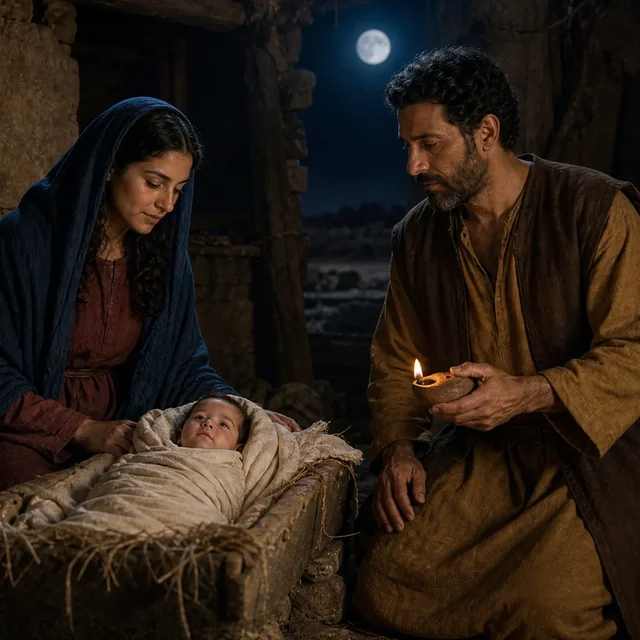
    The paragraph begins with an emperor's decree and ends with a feeding trough. Between those two scales of importance, Luke places the house and lineage of David. Joseph's ancestry explains the journey, but it does not provide royal accommodation. Bethlehem is called the city of David precisely where the circumstances are least like a court.

    Mary's actions carry the birth itself: she brings forth, wraps, and lays down her son. Luke gives those ordinary acts room to stand without decorating them with a crowd of attendants or a speech about their meaning. The manger is not scenery chosen for charm. It is the available place to put the child.

    A small phrase also deserves protection from familiar retellings: while they were there. The text does not say labor began as the couple arrived, and it introduces neither a hostile innkeeper nor a succession of slammed doors. The lack of room is real; its cause is not dramatized. Luke's restraint leaves the contrast intact. David's descendant is in David's town, lying where animals are fed.

    Verse by verse

    1. 2:1

      Taxed here concerns enrollment for a census, not a scene in which Joseph is shown paying money.

    2. 2:4

      Luke applies city of David to David's ancestral Bethlehem here; 2 Samuel 5:7 uses the designation for his Jerusalem stronghold.

    3. 2:6-7

      Neither a stable building nor an innkeeper is explicitly named. The manger and the absence of available lodging space are explicit.

    Luke 2:1-7

    King James Version · 7 verses

    2:1And it came to pass in those days, that there went out a decree from Cæsar Augustus, that all the world should be taxed.

    2:2(And this taxing was first made when Cyrenius was governor of Syria.)

    2:3And all went to be taxed, every one into his own city.

    2:4And Joseph also went up from Galilee, out of the city of Nazareth, into Judæa, unto the city of David, which is called Bethlehem; (because he was of the house and lineage of David:)

    2:5To be taxed with Mary his espoused wife, being great with child.

    2:6And so it was, that, while they were there, the days were accomplished that she should be delivered.

    2:7And she brought forth her firstborn son, and wrapped him in swaddling clothes, and laid him in a manger; because there was no room for them in the inn.

    Luke 2:1-7: There was no room for them in the inn

Why it matters

Samuel is sent here to anoint a king and the prophet is not told which son, only which house, and the search goes down the family until somebody remembers the youngest is out with the sheep. Micah names the town by its size: though thou be little among the thousands of Judah, yet out of thee shall he come forth. And a thousand years after Ruth a decree about taxation sends a carpenter back to his family town, and the census that moves him is recorded in the same paragraph as the manger.

9 songs

The music

Every song in the catalogue whose passage falls inside these chapters.

  1. Ruth 1:1-7

    Call Me Mara

  2. Ruth 1:8-22

    Where You Go, I Will Go

  3. 1 Samuel 16:1-23

    The LORD Looketh on the Heart

  4. 1 Samuel 16

    The Shepherd Anointed

  5. Micah 5:1-15

    Out of Bethlehem

    Play hereOpen song pageRead lyrics
  6. Matthew 1-2; Luke 2:1-38

    Glory in the Highest

  7. Matthew 2:1-23

    The Star and the Sword

    Play here
    Open song pageRead lyrics
  8. Luke 2:1-7

    Born in Bethlehem

    Play here
    Open song pageRead lyrics
  9. Luke 2:8-20

    Glory in the Highest

    Play here
    Open song pageRead lyrics

Nearby

All the places

Report an error on this page