New · FreePlay The Witnesses The in-depth puzzle battle quest through Bible history

People of the Bible

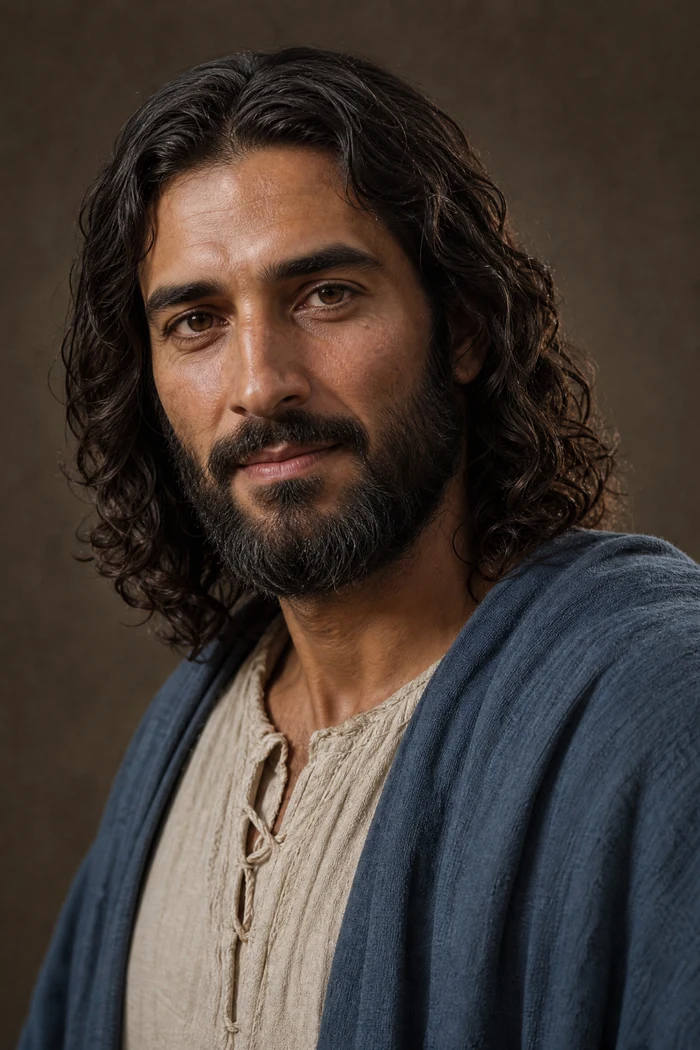
Jesus

Four accounts, one life, and the only figure in this catalogue every other sheet is arranged around.

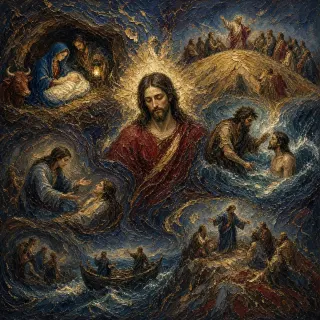
Jesus is born in Bethlehem in the reign of Herod and grows up in a town nobody expected anything from. He begins publicly at about thirty, baptised by his cousin in the Jordan, and spends roughly three years teaching in Galilee and Judea, healing, eating with the wrong people, and arguing with the ones who kept the law best. He is arrested at night, tried twice, executed on a Roman cross outside the city, and buried in a borrowed tomb. On the third day the tomb is empty and the accounts do not agree on the order of the morning, which is part of why they read as testimony.

Where he appearsMatthew 1 to 28 · Mark 1 to 16 · Luke 1 to 24 · John 1 to 21

Scroll down to the account
Jesus

The movements, in the order the text gives them.

The Account of Jesus

  1. 01

    Luke 2:1-20

    Wrapped and laid in a manger

    A census, a town full of travellers, and a first announcement made to shift workers on a hillside. The sign given to them is not glory but swaddling clothes and a feeding trough.

    The sign is a feeding trough. Not the light that surrounds the shepherds, not the multitude in heaven, but a wrapped child lying where animals eat. The Gospel of Luke repeats the manger three times, in the birth, the announcement, and the discovery. That repetition holds the whole passage together. The angel supplies the titles, Saviour, Christ, Lord; the manger supplies the address. Neither cancels the other. The extraordinary claim is attached to this particular, ordinary-looking child, not to an impressive spectacle somewhere else. Even the swaddling matters: Mary is caring for her son, not displaying a symbol. The one proclaimed as Lord is being wrapped by his mother.

    The opening decree reaches all the world; the announcement promises joy to all people. Between those broad horizons stand a family traveling because of an enrollment and shepherds keeping a night watch. The Gospel of Luke does not begin by removing Jesus from public history, but it refuses to let the emperor's decree remain the largest thing happening in it. Bethlehem is identified as David's city before the angel repeats that identification. The child belongs within the promised royal line, yet no court receives the announcement here. Nor does the passage supply the familiar innkeeper, a slammed door, or a frantic arrival during labor. It says that the birth occurred while they were there. The written details are striking enough without a supporting cast added around them.

    The shepherds move from hearing to seeing, and then from seeing to speaking. Their report concerns what was told them about the child, not merely the impressive light they witnessed. Mary responds differently: she keeps these things and ponders them. Public testimony and sustained attention sit beside each other without either being treated as the lesser response. The shepherds finally return to the place from which they came, still shepherds, praising God because what they found agreed with what they heard. The Gospel of John will express the incarnation as the Word made flesh (John 1:14). Here its weight is carried by cloth, a mother's hands, and a feeding trough. The titles are immense. The child is real.

    Verse by verse

    1. 2:1

      Taxed here concerns registration or enrollment; the passage does not describe Joseph handing over a tax payment.

    2. 2:4

      Bethlehem is identified through David and Joseph's lineage. The wording locates the birth within the royal promise announced in Luke 1:32-33.

    3. 2:11

      Christ is a title, meaning the anointed one, not a surname. The angel joins it to Saviour and Lord.

    4. 2:12

      The sign repeats the physical details of verse 7, and the shepherds find those details in verse 16.

    5. 2:19

      The Greek verb translated pondered conveys bringing things together or considering them. Luke 2:51 again describes Mary keeping the sayings in her heart.

    Luke 2:1-20

    King James Version · 20 verses

    2:1And it came to pass in those days, that there went out a decree from Cæsar Augustus, that all the world should be taxed.

    2:2(And this taxing was first made when Cyrenius was governor of Syria.)

    2:3And all went to be taxed, every one into his own city.

    2:4And Joseph also went up from Galilee, out of the city of Nazareth, into Judæa, unto the city of David, which is called Bethlehem; (because he was of the house and lineage of David:)

    2:5To be taxed with Mary his espoused wife, being great with child.

    2:6And so it was, that, while they were there, the days were accomplished that she should be delivered.

    2:7And she brought forth her firstborn son, and wrapped him in swaddling clothes, and laid him in a manger; because there was no room for them in the inn.

    2:8And there were in the same country shepherds abiding in the field, keeping watch over their flock by night.

    2:9And, lo, the angel of the Lord came upon them, and the glory of the Lord shone round about them: and they were sore afraid.

    2:10And the angel said unto them, Fear not: for, behold, I bring you good tidings of great joy, which shall be to all people.

    2:11For unto you is born this day in the city of David a Saviour, which is Christ the Lord.

    2:12And this shall be a sign unto you; Ye shall find the babe wrapped in swaddling clothes, lying in a manger.

    2:13And suddenly there was with the angel a multitude of the heavenly host praising God, and saying,

    2:14Glory to God in the highest, and on earth peace, good will toward men.

    2:15And it came to pass, as the angels were gone away from them into heaven, the shepherds said one to another, Let us now go even unto Bethlehem, and see this thing which is come to pass, which the Lord hath made known unto us.

    2:16And they came with haste, and found Mary, and Joseph, and the babe lying in a manger.

    2:17And when they had seen it, they made known abroad the saying which was told them concerning this child.

    2:18And all they that heard it wondered at those things which were told them by the shepherds.

    2:19But Mary kept all these things, and pondered them in her heart.

    2:20And the shepherds returned, glorifying and praising God for all the things that they had heard and seen, as it was told unto them.

  2. 02

    Matthew 3:13-4:11

    The Jordan and the wilderness

    He is baptised by a man who says he should be baptised by him, and a voice names him beloved before he has done anything public. Then forty days, three offers, and three answers out of Deuteronomy.

    Heaven has already declared the identity that the wilderness is made to test. At the Jordan, Jesus is the beloved Son; in the desert, the tempter repeatedly presses him to act as though sonship needs a demonstration on demand. The order matters. The Father's approval does not arrive as a prize for surviving the temptations. It comes before them. Nor does the Spirit's descent lead directly to a public triumph. The same Spirit leads Jesus into the wilderness. The Gospel of Matthew places divine approval and real testing next to each other, with no suggestion that one has made the other impossible.

    John's objection keeps the baptism from being read as an ordinary confession of personal wrongdoing. Others have entered the water confessing their sins; Jesus gives a different explanation: to fulfil all righteousness. He submits to the Father's appointed course and stands among the people John has been preparing. The voice from heaven brings together royal sonship and the language of God's delight in his servant, resonating with Psalm 2:7 and Isaiah 42:1. Then the scene moves into terrain already marked by Israel's history. Israel was called God's son in Exodus 4:22, and the Gospel of Matthew has already applied the call out of Egypt to Jesus (2:15). Now come wilderness, hunger, testing, and words from Deuteronomy. These are not decorative similarities. Jesus answers at precisely the points where Israel's wilderness experience had exposed dependence, presumption, and divided worship. The hunger is real; the obedience is not theater.

    The tempter can quote Scripture too. Psalm 91 becomes an invitation to manufacture danger and demand rescue. Jesus does not answer by dismissing the psalm, but by refusing to set one promise against God's command. Trust is not a device for making God perform. The final offer strips away the pretense: kingdoms in exchange for worship. The price is not small simply because the gesture would be brief. At the end of this Gospel, authority over heaven and earth will be given to Jesus (28:18), but not by the one making this offer. The closing detail is beautifully exact. Angels do come and minister to him, after he has refused to force an angelic rescue. Provision is received, not extracted. Hebrews 4:15 later insists on both sides of the event: he was genuinely tempted, and he remained without sin. The desert does not correct heaven's declaration. It shows what the Son's obedience looks like.

    Verse by verse

    1. 3:15

      Suffer means permit here. Jesus supplies fulfillment of righteousness, not confession of sin, as the reason for this baptism.

    2. 3:17

      The declaration echoes the son in Psalm 2:7 and the servant in whom God delights in Isaiah 42:1; the latter passage also mentions God's Spirit.

    3. 4:1

      The Spirit leads; the devil tempts. The passage distinguishes those agents rather than treating divine leading as enticement to sin.

    4. 4:2

      Forty days and forty nights also marks Moses' fast in Exodus 34:28. Deuteronomy 8:2 explicitly recalls Israel's forty years of testing.

    5. 4:6

      The quoted promise comes from Psalm 91:11-12. Jesus answers it with Deuteronomy 6:16, which recalls Israel testing God at Massah.

    6. 4:11

      The angels minister after the temptation. The text does not describe Jesus compelling their arrival by the proposed leap.

    Matthew 3:13-4:11

    King James Version · 16 verses

    3:13Then cometh Jesus from Galilee to Jordan unto John, to be baptized of him.

    3:14But John forbad him, saying, I have need to be baptized of thee, and comest thou to me?

    3:15And Jesus answering said unto him, Suffer it to be so now: for thus it becometh us to fulfil all righteousness. Then he suffered him.

    3:16And Jesus, when he was baptized, went up straightway out of the water: and, lo, the heavens were opened unto him, and he saw the Spirit of God descending like a dove, and lighting upon him:

    3:17And lo a voice from heaven, saying, This is my beloved Son, in whom I am well pleased.

    4:1Then was Jesus led up of the Spirit into the wilderness to be tempted of the devil.

    4:2And when he had fasted forty days and forty nights, he was afterward an hungred.

    4:3And when the tempter came to him, he said, If thou be the Son of God, command that these stones be made bread.

    4:4But he answered and said, It is written, Man shall not live by bread alone, but by every word that proceedeth out of the mouth of God.

    4:5Then the devil taketh him up into the holy city, and setteth him on a pinnacle of the temple,

    4:6And saith unto him, If thou be the Son of God, cast thyself down: for it is written, He shall give his angels charge concerning thee: and in their hands they shall bear thee up, lest at any time thou dash thy foot against a stone.

    4:7Jesus said unto him, It is written again, Thou shalt not tempt the Lord thy God.

    4:8Again, the devil taketh him up into an exceeding high mountain, and sheweth him all the kingdoms of the world, and the glory of them;

    4:9And saith unto him, All these things will I give thee, if thou wilt fall down and worship me.

    4:10Then saith Jesus unto him, Get thee hence, Satan: for it is written, Thou shalt worship the Lord thy God, and him only shalt thou serve.

    4:11Then the devil leaveth him, and, behold, angels came and ministered unto him.

    Matthew 3:13-4:11: The Jordan and the wilderness
  3. 03

    Matthew 5:1-7:29

    The sermon on the mount

    Blessings on the people nobody congratulates, then a raising of the standard past behaviour into motive, and an ending about two builders. The crowds are astonished because he teaches as one having authority.

    The first word is Blessed, but the people receiving it do not look like an obvious list of winners. They mourn, hunger for righteousness, make peace, and suffer persecution. Jesus begins by declaring their standing in the kingdom before describing the life that belongs to it. This is not a collection of pleasant sayings detached from a speaker. Again and again the center of gravity is Jesus himself: persecution for his sake, his interpretation of the law, his verdict at judgment, these sayings of mine. The mountain recalls the setting of Moses' instruction, but Jesus does not merely repeat a law received elsewhere. He speaks with an authority that becomes the crowd's final astonishment. Meanwhile, the law and the prophets frame the teaching, appearing in 5:17 and again in 7:12. Fulfillment is the announced purpose, not disposal. Anger and lust expose the roots of murder and adultery; reconciliation can interrupt an offering already brought to the altar. A formal permission or a carefully worded oath cannot make a divided life whole. By the time the teaching reaches love of enemies, the measure is the Father's own generosity: his sun and rain are not reserved for those who behave well. The righteousness described here reaches farther than avoiding an indictable offense.

    There is an apparent collision between the lamp that must shine before others and the alms that must not be done to be seen. The distinction is not public versus private as an absolute rule. It is who receives the glory. In 5:16 the visible good directs attention to the Father; in 6:1 the act has become a performance for the giver's benefit. Giving, prayer, and fasting each receive the same unsentimental verdict when applause is their aim: they have their reward. The desired payment has arrived. The prayer Jesus teaches moves in the opposite direction. God's name, kingdom, and will come first; bread, forgiveness, and deliverance follow. Its requests are communal rather than a solitary inventory of wants. Forgiveness is not an ornamental addition either: Jesus immediately returns to it and states its seriousness in both directions. The same concern with an undivided life governs treasure, the eye, and the two masters. Wealth is not merely something to possess; mammon appears as a rival claimant to service. The birds and lilies answer anxiety without pretending that food and clothing are imaginary needs. The Father knows those needs. The argument is about whom the life serves and trusts, not about whether bodies require bread.

    The beam and the speck give the teaching its sharpest visual humor. A man with timber in his eye volunteers for delicate work on someone else's vision. Jesus does not abolish discernment: this same chapter requires recognition of false prophets by their fruit. He exposes judgment that exempts the judge from scrutiny. The remaining contrasts become steadily less comfortable: two gates, two kinds of fruit, impressive religious speech without obedience, and two houses facing the same storm. The repeated title Lord, Lord is no substitute for doing the Father's will. Even extraordinary claims of ministry do not settle the matter. Finally, both builders have heard Jesus; the difference is whether hearing became doing. The sturdy house does not receive better weather. Its foundation holds. The closing astonishment therefore concerns more than eloquence. Jesus has made his own words the decisive ground on which a human life stands or falls.

    Verse by verse

    1. 5:5

      The promise to the meek closely echoes Psalm 37:11. In that psalm, inheritance contrasts with the apparently successful violence of the wicked.

    2. 5:32

      The exception uses the Greek porneia, sexual immorality. Christian interpreters differ over its precise scope and its implications for divorce and remarriage.

    3. 5:48

      Perfect translates teleios, conveying completeness or maturity. Its immediate setting is love that extends even to enemies, patterned on the Father's generosity.

    4. 6:7

      Vain repetitions is explained by the belief that much speaking wins a hearing. Matthew 26:44 later records Jesus repeating the same words in prayer, so repetition itself is not the whole issue.

    5. 6:25

      Take no thought here addresses anxiety, as the Greek merimnao indicates. It is not a command to stop all thinking or prudent preparation.

    6. 7:1-5

      The instruction ends with the possibility of seeing clearly enough to help another. The target is hypocritical judgment, not the elimination of moral discernment.

    Matthew 5:1-7:29: The sermon on the mount

    Matthew 5:1-7:29

    King James Version · 111 verses

    5:1And seeing the multitudes, he went up into a mountain: and when he was set, his disciples came unto him:

    5:2And he opened his mouth, and taught them, saying,

    5:3Blessed are the poor in spirit: for theirs is the kingdom of heaven.

    5:4Blessed are they that mourn: for they shall be comforted.

    5:5Blessed are the meek: for they shall inherit the earth.

    5:6Blessed are they which do hunger and thirst after righteousness: for they shall be filled.

    5:7Blessed are the merciful: for they shall obtain mercy.

    5:8Blessed are the pure in heart: for they shall see God.

    5:9Blessed are the peacemakers: for they shall be called the children of God.

    5:10Blessed are they which are persecuted for righteousness’ sake: for theirs is the kingdom of heaven.

    5:11Blessed are ye, when men shall revile you, and persecute you, and shall say all manner of evil against you falsely, for my sake.

    5:12Rejoice, and be exceeding glad: for great is your reward in heaven: for so persecuted they the prophets which were before you.

    5:13Ye are the salt of the earth: but if the salt have lost his savour, wherewith shall it be salted? it is thenceforth good for nothing, but to be cast out, and to be trodden under foot of men.

    5:14Ye are the light of the world. A city that is set on an hill cannot be hid.

    5:15Neither do men light a candle, and put it under a bushel, but on a candlestick; and it giveth light unto all that are in the house.

    5:16Let your light so shine before men, that they may see your good works, and glorify your Father which is in heaven.

    5:17Think not that I am come to destroy the law, or the prophets: I am not come to destroy, but to fulfil.

    5:18For verily I say unto you, Till heaven and earth pass, one jot or one tittle shall in no wise pass from the law, till all be fulfilled.

    5:19Whosoever therefore shall break one of these least commandments, and shall teach men so, he shall be called the least in the kingdom of heaven: but whosoever shall do and teach them, the same shall be called great in the kingdom of heaven.

    5:20For I say unto you, That except your righteousness shall exceed the righteousness of the scribes and Pharisees, ye shall in no case enter into the kingdom of heaven.

    5:21Ye have heard that it was said by them of old time, Thou shalt not kill; and whosoever shall kill shall be in danger of the judgment:

    5:22But I say unto you, That whosoever is angry with his brother without a cause shall be in danger of the judgment: and whosoever shall say to his brother, Raca, shall be in danger of the council: but whosoever shall say, Thou fool, shall be in danger of hell fire.

    5:23Therefore if thou bring thy gift to the altar, and there rememberest that thy brother hath ought against thee;

    5:24Leave there thy gift before the altar, and go thy way; first be reconciled to thy brother, and then come and offer thy gift.

    5:25Agree with thine adversary quickly, whiles thou art in the way with him; lest at any time the adversary deliver thee to the judge, and the judge deliver thee to the officer, and thou be cast into prison.

    5:26Verily I say unto thee, Thou shalt by no means come out thence, till thou hast paid the uttermost farthing.

    5:27Ye have heard that it was said by them of old time, Thou shalt not commit adultery:

    5:28But I say unto you, That whosoever looketh on a woman to lust after her hath committed adultery with her already in his heart.

    5:29And if thy right eye offend thee, pluck it out, and cast it from thee: for it is profitable for thee that one of thy members should perish, and not that thy whole body should be cast into hell.

    5:30And if thy right hand offend thee, cut it off, and cast it from thee: for it is profitable for thee that one of thy members should perish, and not that thy whole body should be cast into hell.

    5:31It hath been said, Whosoever shall put away his wife, let him give her a writing of divorcement:

    5:32But I say unto you, That whosoever shall put away his wife, saving for the cause of fornication, causeth her to commit adultery: and whosoever shall marry her that is divorced committeth adultery.

    5:33Again, ye have heard that it hath been said by them of old time, Thou shalt not forswear thyself, but shalt perform unto the Lord thine oaths:

    5:34But I say unto you, Swear not at all; neither by heaven; for it is God’s throne:

    5:35Nor by the earth; for it is his footstool: neither by Jerusalem; for it is the city of the great King.

    5:36Neither shalt thou swear by thy head, because thou canst not make one hair white or black.

    5:37But let your communication be, Yea, yea; Nay, nay: for whatsoever is more than these cometh of evil.

    5:38Ye have heard that it hath been said, An eye for an eye, and a tooth for a tooth:

    5:39But I say unto you, That ye resist not evil: but whosoever shall smite thee on thy right cheek, turn to him the other also.

    5:40And if any man will sue thee at the law, and take away thy coat, let him have thy cloke also.

    5:41And whosoever shall compel thee to go a mile, go with him twain.

    5:42Give to him that asketh thee, and from him that would borrow of thee turn not thou away.

    5:43Ye have heard that it hath been said, Thou shalt love thy neighbour, and hate thine enemy.

    5:44But I say unto you, Love your enemies, bless them that curse you, do good to them that hate you, and pray for them which despitefully use you, and persecute you;

    5:45That ye may be the children of your Father which is in heaven: for he maketh his sun to rise on the evil and on the good, and sendeth rain on the just and on the unjust.

    5:46For if ye love them which love you, what reward have ye? do not even the publicans the same?

    5:47And if ye salute your brethren only, what do ye more than others? do not even the publicans so?

    5:48Be ye therefore perfect, even as your Father which is in heaven is perfect.

    6:1Take heed that ye do not your alms before men, to be seen of them: otherwise ye have no reward of your Father which is in heaven.

    6:2Therefore when thou doest thine alms, do not sound a trumpet before thee, as the hypocrites do in the synagogues and in the streets, that they may have glory of men. Verily I say unto you, They have their reward.

    6:3But when thou doest alms, let not thy left hand know what thy right hand doeth:

    6:4That thine alms may be in secret: and thy Father which seeth in secret himself shall reward thee openly.

    6:5And when thou prayest, thou shalt not be as the hypocrites are: for they love to pray standing in the synagogues and in the corners of the streets, that they may be seen of men. Verily I say unto you, They have their reward.

    6:6But thou, when thou prayest, enter into thy closet, and when thou hast shut thy door, pray to thy Father which is in secret; and thy Father which seeth in secret shall reward thee openly.

    6:7But when ye pray, use not vain repetitions, as the heathen do: for they think that they shall be heard for their much speaking.

    6:8Be not ye therefore like unto them: for your Father knoweth what things ye have need of, before ye ask him.

    6:9After this manner therefore pray ye: Our Father which art in heaven, Hallowed be thy name.

    6:10Thy kingdom come. Thy will be done in earth, as it is in heaven.

    6:11Give us this day our daily bread.

    6:12And forgive us our debts, as we forgive our debtors.

    6:13And lead us not into temptation, but deliver us from evil: For thine is the kingdom, and the power, and the glory, for ever. Amen.

    6:14For if ye forgive men their trespasses, your heavenly Father will also forgive you:

    6:15But if ye forgive not men their trespasses, neither will your Father forgive your trespasses.

    6:16Moreover when ye fast, be not, as the hypocrites, of a sad countenance: for they disfigure their faces, that they may appear unto men to fast. Verily I say unto you, They have their reward.

    6:17But thou, when thou fastest, anoint thine head, and wash thy face;

    6:18That thou appear not unto men to fast, but unto thy Father which is in secret: and thy Father, which seeth in secret, shall reward thee openly.

    6:19Lay not up for yourselves treasures upon earth, where moth and rust doth corrupt, and where thieves break through and steal:

    6:20But lay up for yourselves treasures in heaven, where neither moth nor rust doth corrupt, and where thieves do not break through nor steal:

    6:21For where your treasure is, there will your heart be also.

    6:22The light of the body is the eye: if therefore thine eye be single, thy whole body shall be full of light.

    6:23But if thine eye be evil, thy whole body shall be full of darkness. If therefore the light that is in thee be darkness, how great is that darkness!

    6:24No man can serve two masters: for either he will hate the one, and love the other; or else he will hold to the one, and despise the other. Ye cannot serve God and mammon.

    6:25Therefore I say unto you, Take no thought for your life, what ye shall eat, or what ye shall drink; nor yet for your body, what ye shall put on. Is not the life more than meat, and the body than raiment?

    6:26Behold the fowls of the air: for they sow not, neither do they reap, nor gather into barns; yet your heavenly Father feedeth them. Are ye not much better than they?

    6:27Which of you by taking thought can add one cubit unto his stature?

    6:28And why take ye thought for raiment? Consider the lilies of the field, how they grow; they toil not, neither do they spin:

    6:29And yet I say unto you, That even Solomon in all his glory was not arrayed like one of these.

    6:30Wherefore, if God so clothe the grass of the field, which to day is, and to morrow is cast into the oven, shall he not much more clothe you, O ye of little faith?

    6:31Therefore take no thought, saying, What shall we eat? or, What shall we drink? or, Wherewithal shall we be clothed?

    6:32(For after all these things do the Gentiles seek:) for your heavenly Father knoweth that ye have need of all these things.

    6:33But seek ye first the kingdom of God, and his righteousness; and all these things shall be added unto you.

    6:34Take therefore no thought for the morrow: for the morrow shall take thought for the things of itself. Sufficient unto the day is the evil thereof.

    7:1Judge not, that ye be not judged.

    7:2For with what judgment ye judge, ye shall be judged: and with what measure ye mete, it shall be measured to you again.

    7:3And why beholdest thou the mote that is in thy brother’s eye, but considerest not the beam that is in thine own eye?

    7:4Or how wilt thou say to thy brother, Let me pull out the mote out of thine eye; and, behold, a beam is in thine own eye?

    7:5Thou hypocrite, first cast out the beam out of thine own eye; and then shalt thou see clearly to cast out the mote out of thy brother’s eye.

    7:6Give not that which is holy unto the dogs, neither cast ye your pearls before swine, lest they trample them under their feet, and turn again and rend you.

    7:7Ask, and it shall be given you; seek, and ye shall find; knock, and it shall be opened unto you:

    7:8For every one that asketh receiveth; and he that seeketh findeth; and to him that knocketh it shall be opened.

    7:9Or what man is there of you, whom if his son ask bread, will he give him a stone?

    7:10Or if he ask a fish, will he give him a serpent?

    7:11If ye then, being evil, know how to give good gifts unto your children, how much more shall your Father which is in heaven give good things to them that ask him?

    7:12Therefore all things whatsoever ye would that men should do to you, do ye even so to them: for this is the law and the prophets.

    7:13Enter ye in at the strait gate: for wide is the gate, and broad is the way, that leadeth to destruction, and many there be which go in thereat:

    7:14Because strait is the gate, and narrow is the way, which leadeth unto life, and few there be that find it.

    7:15Beware of false prophets, which come to you in sheep’s clothing, but inwardly they are ravening wolves.

    7:16Ye shall know them by their fruits. Do men gather grapes of thorns, or figs of thistles?

    7:17Even so every good tree bringeth forth good fruit; but a corrupt tree bringeth forth evil fruit.

    7:18A good tree cannot bring forth evil fruit, neither can a corrupt tree bring forth good fruit.

    7:19Every tree that bringeth not forth good fruit is hewn down, and cast into the fire.

    7:20Wherefore by their fruits ye shall know them.

    7:21Not every one that saith unto me, Lord, Lord, shall enter into the kingdom of heaven; but he that doeth the will of my Father which is in heaven.

    7:22Many will say to me in that day, Lord, Lord, have we not prophesied in thy name? and in thy name have cast out devils? and in thy name done many wonderful works?

    7:23And then will I profess unto them, I never knew you: depart from me, ye that work iniquity.

    7:24Therefore whosoever heareth these sayings of mine, and doeth them, I will liken him unto a wise man, which built his house upon a rock:

    7:25And the rain descended, and the floods came, and the winds blew, and beat upon that house; and it fell not: for it was founded upon a rock.

    7:26And every one that heareth these sayings of mine, and doeth them not, shall be likened unto a foolish man, which built his house upon the sand:

    7:27And the rain descended, and the floods came, and the winds blew, and beat upon that house; and it fell: and great was the fall of it.

    7:28And it came to pass, when Jesus had ended these sayings, the people were astonished at his doctrine:

    7:29For he taught them as one having authority, and not as the scribes.

  4. 04

    Matthew 16:13-28

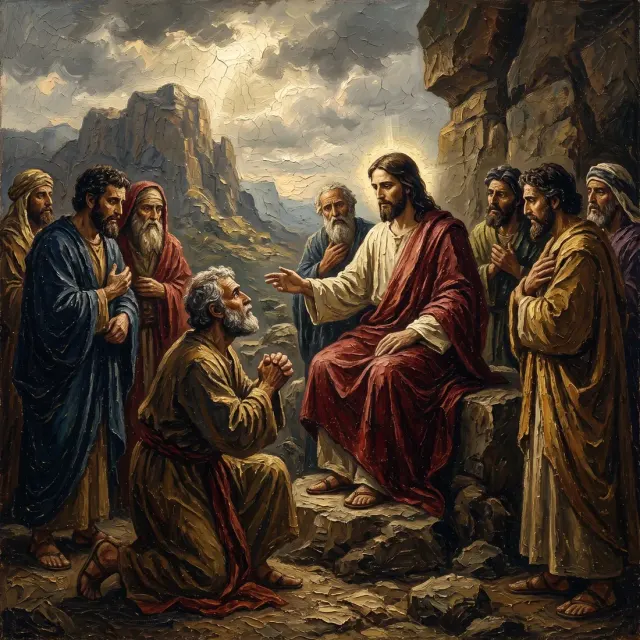
    Who do you say that I am

    At Caesarea Philippi he asks what people say, and then asks them. Peter answers, and from that time he begins to tell them he must go to Jerusalem and suffer and be killed and be raised.

    Peter gets the name right and the road wrong. His confession identifies Jesus as the Christ, the Son of the living God; a few sentences later, he rebukes the very person he has correctly identified. The Gospel of Matthew does not soften the collision by putting years between these statements. The blessing and the rebuke belong to one unfolding conversation. Recognition is genuine, but it is not the same thing as understanding what this Messiah must do. Jesus begins to explain the necessity of suffering, death, and resurrection, and Peter objects to the course itself. The word must in verse 21 meets this shall not be in verse 22. That is the disagreement.

    Between confession and correction stands the promise of a church that belongs to Jesus and will be built by him. The personal claim is easy to lose inside later arguments: my church, I will build. The Petros and petra wordplay links Peter's name with the rock, but readers have differed over how Peter, his confession, and Christ himself relate within the image. It cannot be responsibly settled by treating the two Greek forms as a simple contrast between a useless pebble and a strong rock. Nor does acknowledging Peter's place automatically settle every later question of office and succession. The text gives him a significant, delegated responsibility without making him the owner of what is built. The keys recall the steward's authority in Isaiah 22:22; the language of binding and loosing reappears in the plural in Matthew 18:18. Ephesians 2:20 later places apostles in the foundation while naming Jesus Christ as the chief corner stone. A real human responsibility and Christ's decisive place are not competing claims.

    The same Peter now becomes an offence, an obstacle in the path he has tried to redirect. Jesus' severe address identifies the force of his proposal: a Messiah protected from suffering would turn away from the work just announced. It does not say Peter has become possessed. Get thee behind me also restores the order implied by following: the disciple does not walk ahead and prescribe the route. The teaching about the cross then extends the issue beyond Peter. A cross is not a label for any inconvenience; within the passage it belongs to a road toward death. The paradox about losing and finding life is therefore tied to allegiance to Jesus, not to a general admiration for suffering. Finally, the Son of man's coming and judgment prevent the cross from becoming the last word about his identity. The one whose suffering Peter rejects is also the one who will judge. The confession was not too large. Peter's account of what it meant was too small.

    Verse by verse

    1. 16:13

      Coasts means districts or surrounding regions here, not necessarily a shoreline. The location is the area of Caesarea Philippi.

    2. 16:18

      Hell translates Hades in this phrase, the realm of the dead. The promise concerns the church's survival against the power of death, not a description of a local cave.

    3. 16:19

      Isaiah 22:22 uses a key for authority entrusted to a steward. Matthew 18:18 repeats binding and loosing with plural addressees.

    4. 16:23

      Offence translates skandalon, a stumbling block or snare. Peter's proposal obstructs the announced path of suffering rather than merely hurting Jesus' feelings.

    5. 16:28

      Readings differ over the coming in this verse, including the transfiguration as a foretaste and the resurrection or subsequent manifestation of the kingdom. Matthew 17:1 immediately marks a six-day interval before the transfiguration.

    Matthew 16:13-28

    King James Version · 16 verses

    16:13When Jesus came into the coasts of Caesarea Philippi, he asked his disciples, saying, Whom do men say that I the Son of man am?

    16:14And they said, Some say that thou art John the Baptist: some, Elias; and others, Jeremias, or one of the prophets.

    16:15He saith unto them, But whom say ye that I am?

    16:16And Simon Peter answered and said, Thou art the Christ, the Son of the living God.

    16:17And Jesus answered and said unto him, Blessed art thou, Simon Bar-jona: for flesh and blood hath not revealed it unto thee, but my Father which is in heaven.

    16:18And I say also unto thee, That thou art Peter, and upon this rock I will build my church; and the gates of hell shall not prevail against it.

    16:19And I will give unto thee the keys of the kingdom of heaven: and whatsoever thou shalt bind on earth shall be bound in heaven: and whatsoever thou shalt loose on earth shall be loosed in heaven.

    16:20Then charged he his disciples that they should tell no man that he was Jesus the Christ.

    16:21From that time forth began Jesus to shew unto his disciples, how that he must go unto Jerusalem, and suffer many things of the elders and chief priests and scribes, and be killed, and be raised again the third day.

    16:22Then Peter took him, and began to rebuke him, saying, Be it far from thee, Lord: this shall not be unto thee.

    16:23But he turned, and said unto Peter, Get thee behind me, Satan: thou art an offence unto me: for thou savourest not the things that be of God, but those that be of men.

    16:24Then said Jesus unto his disciples, If any man will come after me, let him deny himself, and take up his cross, and follow me.

    16:25For whosoever will save his life shall lose it: and whosoever will lose his life for my sake shall find it.

    16:26For what is a man profited, if he shall gain the whole world, and lose his own soul? or what shall a man give in exchange for his soul?

    16:27For the Son of man shall come in the glory of his Father with his angels; and then he shall reward every man according to his works.

    16:28Verily I say unto you, There be some standing here, which shall not taste of death, till they see the Son of man coming in his kingdom.

    Matthew 16:13-28: Who do you say that I am
  5. 05

    Matthew 26:36-27:56

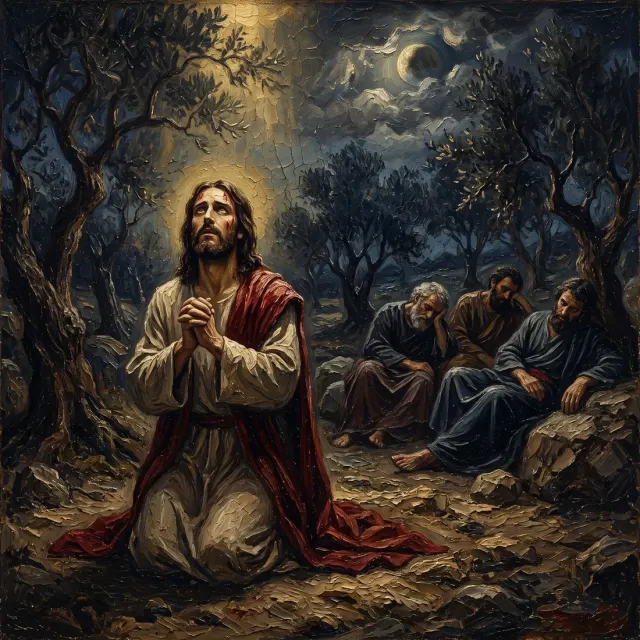
    Gethsemane to the cross

    A prayer with his face to the ground, an arrest with a kiss, two trials, a scourging, a crown of thorns, and six hours. The veil of the temple is torn from the top to the bottom.

    The prayer is repeated because the anguish is real. Matthew does not describe a man untouched by what is coming: sorrowful, very heavy, exceeding sorrowful, even unto death. Jesus falls on his face. The obedience of Gethsemane is not indifference to suffering but the submission of a will that has named its terrible cost. The words thy will be done, heard earlier in the prayer of Matthew 6:10, are now spoken over the cup he himself must drink. Around that prayer, the disciples keep failing to stay awake. Their willing spirit does not make their flesh less weak. Yet the arrest does not catch Jesus without alternatives. He rejects the sword, speaks of more than twelve legions of angels, and places the fulfilment of Scripture above an escape purchased by violence. Matthew holds those things together: the betrayal and abandonment are real, and so is his deliberate refusal to prevent the arrest. Fulfilment is not an acquittal for the people carrying it out.

    The hearing turns on identity. Asked whether he is the Christ, the Son of God, Jesus answers with the Son of man seated at the right hand of power and coming in heaven's clouds. Psalm 110:1 and Daniel 7:13 stand behind the reply: the accused speaks of his vindication in terms that overturn the court's apparent authority. Outside, Peter denies knowing the man who has just confessed who he is. Matthew then piles up testimony to innocent blood without allowing that testimony to stop the killing. Judas names his betrayal as sin. Pilate's wife calls Jesus just. Pilate publicly washes his hands, then has Jesus scourged and hands him over. The water has not changed the action. Even the returned silver produces a dreadful precision: money acceptable for arranging the arrest is judged unacceptable for the treasury because it is the price of blood. Matthew records identifiable decisions by identifiable people, not a warrant to assign inherited guilt to an entire people. The soldiers add their own cruelty. The robe, thorns and reed turn royal signs into instruments of humiliation; the reed is not merely displayed but used to strike his head.

    At the cross, the old temptation returns in a new voice. If thou be the Son of God, come down from the cross echoes the wilderness demand that sonship prove itself through a spectacular act of self-preservation. The mockers treat remaining there as disproof. Matthew has already given a different explanation: this is the blood Jesus described as shed for many for the remission of sins in 26:28. His cry from Psalm 22 is not a decorative quotation placed over an otherwise painless death. It is a loud cry of abandonment addressed, still, to my God. The psalm's taunts and divided garments have already entered the scene; its later movement toward vindication does not cancel the first verse's anguish. Matthew leaves the death itself brutally brief, then records consequences that cannot be contained within the execution ground: the temple veil torn from top to bottom, the earth shaking, graves opened. The appearance of the raised saints is specifically placed after his resurrection, not casually folded into the afternoon of the crucifixion. At the cross, the centurion and those with him confess the sonship that the mockers have challenged. And the account closes this passage by naming women who followed from Galilee and ministered to Jesus. The disciples' flight does not mean that every follower has vanished. The women are still there.

    Verse by verse

    1. 26:39

      The cup can signify an allotted experience, including divine judgment in Psalm 75:8 and Isaiah 51:17. Here it concerns the suffering Jesus accepts, not an ordinary drink.

    2. 26:64

      The right hand of power recalls Psalm 110:1; the Son of man with heaven's clouds recalls Daniel 7:13. The answer joins enthronement and vindication.

    3. 27:9

      The thirty silver pieces closely match Zechariah 11:12-13, although Matthew names Jeremiah. A combined prophetic reference involving Jeremiah's potter and field passages is one explanation; the attribution remains debated.

    4. 27:25

      This is the crowd's reported statement, not a divine command assigning guilt to Jewish people of later generations. The passage identifies several parties and their distinct actions.

    5. 27:46

      The cry quotes Psalm 22:1. Its presence should neither erase the expressed abandonment nor be made to settle, by itself, every theological question about the relation of Father and Son.

    6. 27:53

      Matthew explicitly dates the emergence and appearance of these saints after Jesus' resurrection. Their names and subsequent lives are not supplied.

    Matthew 26:36-27:56: Gethsemane to the cross

    Matthew 26:36-27:56

    King James Version · 96 verses

    26:36Then cometh Jesus with them unto a place called Gethsemane, and saith unto the disciples, Sit ye here, while I go and pray yonder.

    26:37And he took with him Peter and the two sons of Zebedee, and began to be sorrowful and very heavy.

    26:38Then saith he unto them, My soul is exceeding sorrowful, even unto death: tarry ye here, and watch with me.

    26:39And he went a little further, and fell on his face, and prayed, saying, O my Father, if it be possible, let this cup pass from me: nevertheless not as I will, but as thou wilt.

    26:40And he cometh unto the disciples, and findeth them asleep, and saith unto Peter, What, could ye not watch with me one hour?

    26:41Watch and pray, that ye enter not into temptation: the spirit indeed is willing, but the flesh is weak.

    26:42He went away again the second time, and prayed, saying, O my Father, if this cup may not pass away from me, except I drink it, thy will be done.

    26:43And he came and found them asleep again: for their eyes were heavy.

    26:44And he left them, and went away again, and prayed the third time, saying the same words.

    26:45Then cometh he to his disciples, and saith unto them, Sleep on now, and take your rest: behold, the hour is at hand, and the Son of man is betrayed into the hands of sinners.

    26:46Rise, let us be going: behold, he is at hand that doth betray me.

    26:47And while he yet spake, lo, Judas, one of the twelve, came, and with him a great multitude with swords and staves, from the chief priests and elders of the people.

    26:48Now he that betrayed him gave them a sign, saying, Whomsoever I shall kiss, that same is he: hold him fast.

    26:49And forthwith he came to Jesus, and said, Hail, master; and kissed him.

    26:50And Jesus said unto him, Friend, wherefore art thou come? Then came they, and laid hands on Jesus, and took him.

    26:51And, behold, one of them which were with Jesus stretched out his hand, and drew his sword, and struck a servant of the high priest’s, and smote off his ear.

    26:52Then said Jesus unto him, Put up again thy sword into his place: for all they that take the sword shall perish with the sword.

    26:53Thinkest thou that I cannot now pray to my Father, and he shall presently give me more than twelve legions of angels?

    26:54But how then shall the scriptures be fulfilled, that thus it must be?

    26:55In that same hour said Jesus to the multitudes, Are ye come out as against a thief with swords and staves for to take me? I sat daily with you teaching in the temple, and ye laid no hold on me.

    26:56But all this was done, that the scriptures of the prophets might be fulfilled. Then all the disciples forsook him, and fled.

    26:57And they that had laid hold on Jesus led him away to Caiaphas the high priest, where the scribes and the elders were assembled.

    26:58But Peter followed him afar off unto the high priest’s palace, and went in, and sat with the servants, to see the end.

    26:59Now the chief priests, and elders, and all the council, sought false witness against Jesus, to put him to death;

    26:60But found none: yea, though many false witnesses came, yet found they none. At the last came two false witnesses,

    26:61And said, This fellow said, I am able to destroy the temple of God, and to build it in three days.

    26:62And the high priest arose, and said unto him, Answerest thou nothing? what is it which these witness against thee?

    26:63But Jesus held his peace. And the high priest answered and said unto him, I adjure thee by the living God, that thou tell us whether thou be the Christ, the Son of God.

    26:64Jesus saith unto him, Thou hast said: nevertheless I say unto you, Hereafter shall ye see the Son of man sitting on the right hand of power, and coming in the clouds of heaven.

    26:65Then the high priest rent his clothes, saying, He hath spoken blasphemy; what further need have we of witnesses? behold, now ye have heard his blasphemy.

    26:66What think ye? They answered and said, He is guilty of death.

    26:67Then did they spit in his face, and buffeted him; and others smote him with the palms of their hands,

    26:68Saying, Prophesy unto us, thou Christ, Who is he that smote thee?

    26:69Now Peter sat without in the palace: and a damsel came unto him, saying, Thou also wast with Jesus of Galilee.

    26:70But he denied before them all, saying, I know not what thou sayest.

    26:71And when he was gone out into the porch, another maid saw him, and said unto them that were there, This fellow was also with Jesus of Nazareth.

    26:72And again he denied with an oath, I do not know the man.

    26:73And after a while came unto him they that stood by, and said to Peter, Surely thou also art one of them; for thy speech bewrayeth thee.

    26:74Then began he to curse and to swear, saying, I know not the man. And immediately the cock crew.

    26:75And Peter remembered the word of Jesus, which said unto him, Before the cock crow, thou shalt deny me thrice. And he went out, and wept bitterly.

    27:1When the morning was come, all the chief priests and elders of the people took counsel against Jesus to put him to death:

    27:2And when they had bound him, they led him away, and delivered him to Pontius Pilate the governor.

    27:3Then Judas, which had betrayed him, when he saw that he was condemned, repented himself, and brought again the thirty pieces of silver to the chief priests and elders,

    27:4Saying, I have sinned in that I have betrayed the innocent blood. And they said, What is that to us? see thou to that.

    27:5And he cast down the pieces of silver in the temple, and departed, and went and hanged himself.

    27:6And the chief priests took the silver pieces, and said, It is not lawful for to put them into the treasury, because it is the price of blood.

    27:7And they took counsel, and bought with them the potter’s field, to bury strangers in.

    27:8Wherefore that field was called, The field of blood, unto this day.

    27:9Then was fulfilled that which was spoken by Jeremy the prophet, saying, And they took the thirty pieces of silver, the price of him that was valued, whom they of the children of Israel did value;

    27:10And gave them for the potter’s field, as the Lord appointed me.

    27:11And Jesus stood before the governor: and the governor asked him, saying, Art thou the King of the Jews? And Jesus said unto him, Thou sayest.

    27:12And when he was accused of the chief priests and elders, he answered nothing.

    27:13Then said Pilate unto him, Hearest thou not how many things they witness against thee?

    27:14And he answered him to never a word; insomuch that the governor marvelled greatly.

    27:15Now at that feast the governor was wont to release unto the people a prisoner, whom they would.

    27:16And they had then a notable prisoner, called Barabbas.

    27:17Therefore when they were gathered together, Pilate said unto them, Whom will ye that I release unto you? Barabbas, or Jesus which is called Christ?

    27:18For he knew that for envy they had delivered him.

    27:19When he was set down on the judgment seat, his wife sent unto him, saying, Have thou nothing to do with that just man: for I have suffered many things this day in a dream because of him.

    27:20But the chief priests and elders persuaded the multitude that they should ask Barabbas, and destroy Jesus.

    27:21The governor answered and said unto them, Whether of the twain will ye that I release unto you? They said, Barabbas.

    27:22Pilate saith unto them, What shall I do then with Jesus which is called Christ? They all say unto him, Let him be crucified.

    27:23And the governor said, Why, what evil hath he done? But they cried out the more, saying, Let him be crucified.

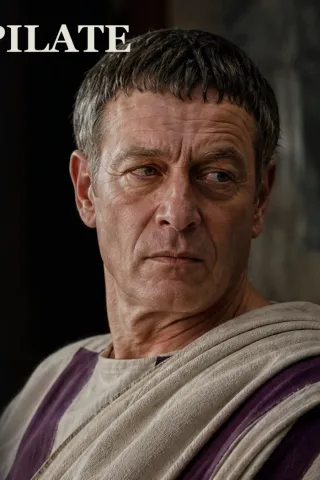
    27:24When Pilate saw that he could prevail nothing, but that rather a tumult was made, he took water, and washed his hands before the multitude, saying, I am innocent of the blood of this just person: see ye to it.

    27:25Then answered all the people, and said, His blood be on us, and on our children.

    27:26Then released he Barabbas unto them: and when he had scourged Jesus, he delivered him to be crucified.

    27:27Then the soldiers of the governor took Jesus into the common hall, and gathered unto him the whole band of soldiers.

    27:28And they stripped him, and put on him a scarlet robe.

    27:29And when they had platted a crown of thorns, they put it upon his head, and a reed in his right hand: and they bowed the knee before him, and mocked him, saying, Hail, King of the Jews!

    27:30And they spit upon him, and took the reed, and smote him on the head.

    27:31And after that they had mocked him, they took the robe off from him, and put his own raiment on him, and led him away to crucify him.

    27:32And as they came out, they found a man of Cyrene, Simon by name: him they compelled to bear his cross.

    27:33And when they were come unto a place called Golgotha, that is to say, a place of a skull,

    27:34They gave him vinegar to drink mingled with gall: and when he had tasted thereof, he would not drink.

    27:35And they crucified him, and parted his garments, casting lots: that it might be fulfilled which was spoken by the prophet, They parted my garments among them, and upon my vesture did they cast lots.

    27:36And sitting down they watched him there;

    27:37And set up over his head his accusation written, THIS IS JESUS THE KING OF THE JEWS.

    27:38Then were there two thieves crucified with him, one on the right hand, and another on the left.

    27:39And they that passed by reviled him, wagging their heads,

    27:40And saying, Thou that destroyest the temple, and buildest it in three days, save thyself. If thou be the Son of God, come down from the cross.

    27:41Likewise also the chief priests mocking him, with the scribes and elders, said,

    27:42He saved others; himself he cannot save. If he be the King of Israel, let him now come down from the cross, and we will believe him.

    27:43He trusted in God; let him deliver him now, if he will have him: for he said, I am the Son of God.

    27:44The thieves also, which were crucified with him, cast the same in his teeth.

    27:45Now from the sixth hour there was darkness over all the land unto the ninth hour.

    27:46And about the ninth hour Jesus cried with a loud voice, saying, Eli, Eli, lama sabachthani? that is to say, My God, my God, why hast thou forsaken me?

    27:47Some of them that stood there, when they heard that, said, This man calleth for Elias.

    27:48And straightway one of them ran, and took a spunge, and filled it with vinegar, and put it on a reed, and gave him to drink.

    27:49The rest said, Let be, let us see whether Elias will come to save him.

    27:50Jesus, when he had cried again with a loud voice, yielded up the ghost.

    27:51And, behold, the veil of the temple was rent in twain from the top to the bottom; and the earth did quake, and the rocks rent;

    27:52And the graves were opened; and many bodies of the saints which slept arose,

    27:53And came out of the graves after his resurrection, and went into the holy city, and appeared unto many.

    27:54Now when the centurion, and they that were with him, watching Jesus, saw the earthquake, and those things that were done, they feared greatly, saying, Truly this was the Son of God.

    27:55And many women were there beholding afar off, which followed Jesus from Galilee, ministering unto him:

    27:56Among which was Mary Magdalene, and Mary the mother of James and Joses, and the mother of Zebedee’s children.

  6. 06

    Matthew 28:1-20

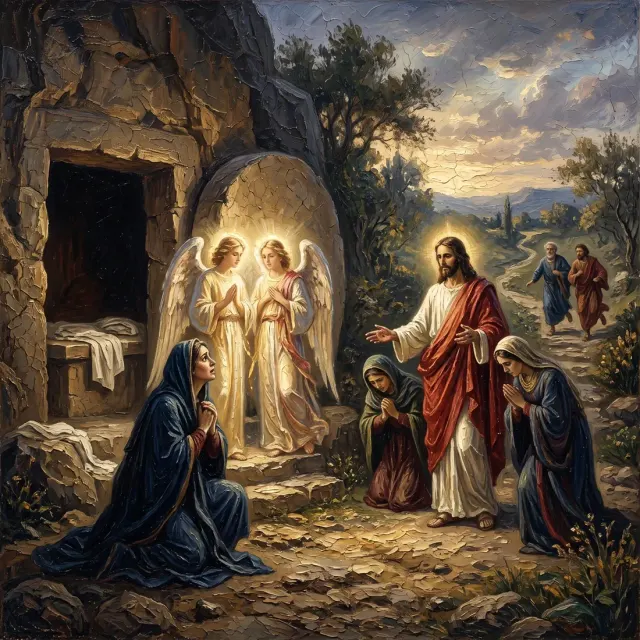
    He is not here

    The stone is rolled away for the witnesses rather than for him. He meets women first, then the eleven on a mountain in Galilee, and sends them to every nation with a promise about being with them always.

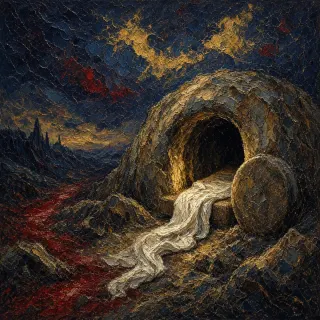
    The guards become as dead men; the man they were guarding is alive. Matthew places the reversal in plain sight. The earthquake and the angel's appearance terrify the keepers, but the women receive an explanation and an invitation to inspect the place where the Lord lay. These are not visitors who have wandered into an unfamiliar burial ground: Matthew 27:61 has already placed the two Marys opposite this tomb. Nor does the text say that moving the stone was necessary to let Jesus escape. Its stated purpose in the encounter is disclosure: the burial place is empty, as he said. The women leave with fear and great joy together, not one emotion tidily replacing the other. When Jesus meets them, they hold his feet. This is an encounter with the crucified one alive, not merely with an enduring influence. He sends them to his brethren. After abandonment and denial, that family word remains.

    There are now two reports moving away from the same tomb. The women are sent to the disciples; some of the guards go to the chief priests. The second report produces money and a rehearsed explanation. Its weakness sits in its wording: sleeping men are required to identify the people who supposedly removed the body. Matthew records the counterclaim rather than pretending that the resurrection announcement met no opposition. The paid instruction of the soldiers also forms a sharp contrast with the instruction at the end of the chapter. One group is taught what to say in order to conceal; the other is sent to teach what Jesus commanded. The distinction is not between impressive and unimpressive messengers. The group on the mountain numbers eleven, and Matthew has no interest in concealing why the number has changed.

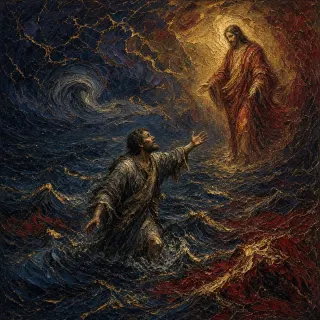
    They worship, and some doubt. The commission is not postponed until the account can present a spotless group of witnesses. Its foundation is the authority of Jesus, not a claim that his disciples have suddenly become incapable of hesitation. All power here means authority, and it has been given to him in heaven and earth. The kingdoms offered by the tempter in chapter 4 have not been obtained on the tempter's terms. Making disciples of all nations includes baptism and instruction, and the instruction concerns observing his commands, not merely collecting his sayings. The Sermon on the Mount ended with the difference between hearing and doing; the Gospel closes with that difference still intact. Matthew began with Emmanuel and its promise of divine presence in 1:23. It ends with the risen Jesus promising his own continuing presence. The work extends to all nations. The workers are not sent alone.

    Verse by verse

    1. 28:1

      The other Mary is already present at the burial in Matthew 27:61. The women's knowledge of the tomb belongs to the preceding passage, not an added reconstruction.

    2. 28:9

      Holding Jesus by the feet gives the encounter a concrete bodily detail. Matthew joins this action to worship.

    3. 28:17

      The Greek verb distazo occurs elsewhere in the New Testament only at Matthew 14:31, addressed to Peter on the water. The verse does not identify or count those who hesitated here.

    4. 28:18

      Exousia denotes authority or right to rule, not simply physical strength. The authority is described as given, in contrast with the tempter's offered bargain in Matthew 4:8-10.

    5. 28:19

      The principal command, matheteusate, means make disciples. Name is singular, followed by the Father, the Son and the Holy Ghost.

    6. 28:20

      The Greek phrase translated the end of the world refers to the completion of the age. The promise of presence also closes the Emmanuel theme introduced in Matthew 1:23.

    Matthew 28:1-20

    King James Version · 20 verses

    28:1In the end of the sabbath, as it began to dawn toward the first day of the week, came Mary Magdalene and the other Mary to see the sepulchre.

    28:2And, behold, there was a great earthquake: for the angel of the Lord descended from heaven, and came and rolled back the stone from the door, and sat upon it.

    28:3His countenance was like lightning, and his raiment white as snow:

    28:4And for fear of him the keepers did shake, and became as dead men.

    28:5And the angel answered and said unto the women, Fear not ye: for I know that ye seek Jesus, which was crucified.

    28:6He is not here: for he is risen, as he said. Come, see the place where the Lord lay.

    28:7And go quickly, and tell his disciples that he is risen from the dead; and, behold, he goeth before you into Galilee; there shall ye see him: lo, I have told you.

    28:8And they departed quickly from the sepulchre with fear and great joy; and did run to bring his disciples word.

    28:9And as they went to tell his disciples, behold, Jesus met them, saying, All hail. And they came and held him by the feet, and worshipped him.

    28:10Then said Jesus unto them, Be not afraid: go tell my brethren that they go into Galilee, and there shall they see me.

    28:11Now when they were going, behold, some of the watch came into the city, and shewed unto the chief priests all the things that were done.

    28:12And when they were assembled with the elders, and had taken counsel, they gave large money unto the soldiers,

    28:13Saying, Say ye, His disciples came by night, and stole him away while we slept.

    28:14And if this come to the governor’s ears, we will persuade him, and secure you.

    28:15So they took the money, and did as they were taught: and this saying is commonly reported among the Jews until this day.

    28:16Then the eleven disciples went away into Galilee, into a mountain where Jesus had appointed them.

    28:17And when they saw him, they worshipped him: but some doubted.

    28:18And Jesus came and spake unto them, saying, All power is given unto me in heaven and in earth.

    28:19Go ye therefore, and teach all nations, baptizing them in the name of the Father, and of the Son, and of the Holy Ghost:

    28:20Teaching them to observe all things whatsoever I have commanded you: and, lo, I am with you alway, even unto the end of the world. Amen.

    Matthew 28:1-20: He is not here

Why it matters

Everything on this site converges here. The promise to Abraham, the throne of David, the servant of Isaiah, the son of man of Daniel and the shepherd of Ezekiel all arrive at one person, and the New Testament spends its whole length saying so. The four gospels are not a single biography: Matthew writes for readers who know the law, Mark writes fast and physical, Luke writes as an investigator, and John writes seven signs and long conversations. Held together they are the most closely examined life in history.

181 songs

The music

Every song in the catalogue whose passage falls inside these chapters.

  1. Matthew 1:18-25

    Emmanuel in Joseph's Dream

  2. Matthew 1-2; Luke 2:1-38

    Glory in the Highest

  3. Matthew 1:1-13:58

    Matthew, Part One

    Play here
    Open song pageRead lyrics
  4. Matthew 2:1-23

    The Star and the Sword

    Play here
    Open song pageRead lyrics
  5. Matthew 3:1-12; Mark 1:1-8; Luke 3:1-20; John 1:19-34

    Prepare the Way

  6. Matthew 3:1-12

    The Axe and the Winnowing Fan

  7. Matthew 3:13-17; Mark 1:9-11; Luke 3:21-22

    The Beloved Son

  8. Matthew 4:1-11

    It is Written

  9. Matthew 4:18-22; Mark 1:16-20; Luke 5:1-11; John 1:35-51

    Leave the Nets

  10. Matthew 4:12-25

    Light upon Galilee

  11. Matthew 4:1-11; Mark 1:12-13; Luke 4:1-13

    Not by Bread Alone

  12. Matthew 5-7

    Blessed Are

  13. Matthew 5:1-7:29

    The Narrow Way

  14. Matthew 8:23-27; Mark 4:35-41; Luke 8:22-25

    Peace, Be Still

  15. Matthew 8:5-13

    Speak the Word Only

  16. Matthew 8:28-34; Mark 5:1-20; Luke 8:26-39

    What Is Thy Name?

  17. Matthew 9:1-8; Mark 2:1-12; Luke 5:17-26

    Arise and Walk

  18. Matthew 9:18-26; Mark 5:21-43; Luke 8:40-56

    Daughter, Arise

  19. Matthew 9:9-13

    I Will Have Mercy

  20. Matthew 9:35-10:20

    The Harvest Is Plenteous

  21. Matthew 11:25-30

    Learn of Me

  22. Matthew 13:1-52

    The Sower Went Forth to Sow

  23. Matthew 14:1-12; Mark 6:14-29

    A Voice Silenced

  24. Matthew 14:13-21; Mark 6:30-44; Luke 9:10-17; John 6:1-15

    Give Ye Them to Eat

  25. Matthew 14:1-28:20

    Matthew, Part Two

    Play here
    Open song pageRead lyrics
  26. Matthew 14:22-33; Mark 6:45-52; John 6:16-21

    Upon the Water

  27. Matthew 14:22-33

    Why Didst Thou Doubt?

  28. Matthew 15:21-28

    Crumbs from the Master's Table

  29. Matthew 16:13-28; Mark 8:27-38; Luke 9:18-27

    Thou Art the Christ

  30. Matthew 16:13-20

    Upon This Rock

  31. Matthew 17:1-13

    His Face Did Shine

  32. Matthew 17:1-13; Mark 9:2-13; Luke 9:28-36

    On the Holy Mount

  33. Matthew 17:24-27

    The Coin in the Fish's Mouth

  34. Matthew 18:21-35

    The Debt He Would Not Forgive

  35. Matthew 20:1-16

    The Eleventh Hour

  36. Matthew 21:12-23:39; Mark 11:12-12:44; Luke 19:45-21:4

    A House of Prayer

  37. Matthew 21:1-11; Mark 11:1-11; Luke 19:28-44; John 12:12-19

    Hosanna

  38. Matthew 21:1-17

    Hosanna to the Son of David

  39. Matthew 24-25; Mark 13; Luke 21:5-38

    Watch and Be Ready

  40. Matthew 24:1-25:46

    Watch Therefore

  41. Matthew 25:1-13

    Lamps at Midnight

  42. Matthew 26:47-75; Mark 14:43-72; Luke 22:47-62; John 18:1-27

    Before the Cock Crow

  43. Matthew 26:36-56

    The Cup in the Garden

    Play here
    Open song pageRead lyrics
  44. Matthew 26:1-16; Mark 14:1-11; John 12:1-8

    The Fragrance and the Silver

  45. Matthew 26:17-35; Mark 14:12-31; Luke 22:7-38; John 13-17

    This Do in Remembrance

  46. Matthew 26:36-46; Mark 14:32-42; Luke 22:39-46

    Thy Will Be Done

  47. Matthew 27:57-66; Mark 15:42-47; Luke 23:50-56; John 19:38-42

    A Stone at the Door

  48. Matthew 27:1-31; Mark 15:1-20; Luke 22:63-23:25; John 18:28-19:16

    Behold the Man

  49. Matthew 27:32-56; Mark 15:21-41; Luke 23:26-49; John 19:16-37

    It Is Finished

  50. Matthew 27:57-66

    Sealed until the Third Day

  51. Matthew 27:27-56

    The Veil Was Torn

  52. Matthew 28:16-20; Mark 16:14-18

    Go Into All the World

  53. Matthew 28:1-10; Mark 16:1-11; Luke 24:1-12; John 20:1-18

    He Is Risen

  54. Mark 1:14-20

    Follow Me

    Play here
    Open song pageRead lyrics
  55. Mark 1:40-45

    Moved with Compassion

    Play here
    Open song pageRead lyrics
  56. Mark 1:1-8

    Prepare the Way

    Play here
    Open song pageRead lyrics
  57. Mark 1:1-16:20

    The Book of Mark

    Play here
    Open song pageRead lyrics
  58. Mark 1:21-28

    With Authority

    Play here
    Open song pageRead lyrics
  59. Mark 2:13-17

    I Came Not to Call the Righteous

    Play here
    Open song pageRead lyrics
  60. Mark 2:23-3:6

    Lord of the Sabbath

    Play here
    Open song pageRead lyrics
  61. Mark 2:1-12

    Through the Roof

    Play here
    Open song pageRead lyrics
  62. Mark 3:20-35

    A House Divided

  63. Mark 4:1-20

    He That Hath Ears to Hear

    Play here
    Open song pageRead lyrics
  64. Mark 4:35-41

    Peace, Be Still

    Play here
    Open song pageRead lyrics
  65. Mark 4:26-34

    The Kingdom Grows

    Play here
    Open song pageRead lyrics
  66. Mark 5:1-20

    Legion

    Play here
    Open song pageRead lyrics
  67. Mark 5:21-43

    Talitha Cumi

    Play here
    Open song pageRead lyrics
  68. Mark 6:1-13

    A Prophet without Honour

  69. Mark 6:30-44

    Give Ye Them to Eat

    Play here
    Open song pageRead lyrics
  70. Mark 6:45-52

    It Is I, Be Not Afraid

    Play here
    Open song pageRead lyrics
  71. Mark 6:14-29

    The Head of John

    Play here
    Open song pageRead lyrics
  72. Mark 7:31-37

    Ephphatha

    Play here
    Open song pageRead lyrics
  73. Mark 7:1-23

    From Within

  74. Mark 8:22-26

    I See Men as Trees Walking

    Play here
    Open song pageRead lyrics
  75. Mark 8:1-21

    One Loaf in the Boat

  76. Mark 8:27-30

    Whom Say Ye That I Am?

    Play here
    Open song pageRead lyrics
  77. Mark 9:14-29

    Help Thou Mine Unbelief

    Play here
    Open song pageRead lyrics
  78. Mark 9:33-37

    The Servant of All

    Play here
    Open song pageRead lyrics
  79. Mark 9:2-13

    This Is My Beloved Son

    Play here
    Open song pageRead lyrics
  80. Mark 10:13-31

    Let the Little Children Come

  81. Mark 10:35-45

    The Ransom for Many

    Play here
    Open song pageRead lyrics
  82. Mark 11:12-26

    The Fig Tree and the Temple

    Play here
    Open song pageRead lyrics
  83. Mark 12:13-27

    Render unto Caesar

  84. Mark 12:1-12

    The Rejected Stone

    Play here
    Open song pageRead lyrics
  85. Mark 12:28-44

    The Widow's Two Mites

  86. Mark 14:53-72

    Before the Council

  87. Mark 14:1-26

    Broken and Poured Out

  88. Mark 15:1-20

    Before Pilate

  89. Mark 15:21-47

    Truly This Man Was the Son of God

  90. Mark 16:1-20

    He Is Risen

  91. Luke 1:5-25

    A Son Named John

    Play here
    Open song pageRead lyrics
  92. Luke 1

    Be It Unto Me

  93. Luke 1:39-56

    Blessed Among Women

    Play here
    Open song pageRead lyrics
  94. Luke 1:57-80

    His Name Is John

    Play here
    Open song pageRead lyrics
  95. Luke 1:26-38

    The Annunciation

    Play here
    Open song pageRead lyrics
  96. Luke 1:1-24:53

    The Book of Luke

    Play here
    Open song pageRead lyrics
  97. Luke 2:21-40

    A Light to Lighten the Gentiles

    Play here
    Open song pageRead lyrics
  98. Luke 2:1-7

    Born in Bethlehem

    Play here
    Open song pageRead lyrics
  99. Luke 2:8-20

    Glory in the Highest

    Play here
    Open song pageRead lyrics
  100. Luke 2:41-52

    My Father's Business

    Play here
    Open song pageRead lyrics
  101. Luke 3:21-4:13

    The Beloved Son in the Wilderness

    Play here
    Open song pageRead lyrics
  102. Luke 3:1-20

    The Voice in the Wilderness

    Play here
    Open song pageRead lyrics
  103. Luke 4:14-30

    Today, This Scripture Is Fulfilled

    Play here
    Open song pageRead lyrics
  104. Luke 4:31-44

    What a Word Is This!

  105. Luke 5:1-11

    Launch Out into the Deep

    Play here
    Open song pageRead lyrics
  106. Luke 5:12-26

    Thy Sins Are Forgiven Thee

  107. Luke 6:27-49

    Love Your Enemies

  108. Luke 7:36-50

    She Loved Much

    Play here
    Open song pageRead lyrics
  109. Luke 7:11-17

    The Widow of Nain

    Play here
    Open song pageRead lyrics
  110. Luke 8:22-39

    Where Is Your Faith?

  111. Luke 9:28-45

    This Is My Beloved Son: Hear Him

  112. Luke 10:38-42

    The Better Part

    Play here
    Open song pageRead lyrics
  113. Luke 10:25-37

    Who Is My Neighbor?

    Play here
    Open song pageRead lyrics
  114. Luke 10:25-37

    Who Was Neighbor?

  115. Luke 11:1-13

    Lord, Teach Us to Pray

  116. Luke 12:13-21

    Thou Fool, This Night

    Play here
    Open song pageRead lyrics
  117. Luke 13:10-17

    Woman, Thou Art Loosed

    Play here
    Open song pageRead lyrics
  118. Luke 14:15-35

    Come; for All Things Are Now Ready

  119. Luke 15

    The Lost Came Home

  120. Luke 15:11-32

    When He Came to Himself

    Play here
    Open song pageRead lyrics
  121. Luke 16:19-31

    A Great Gulf Fixed

    Play here
    Open song pageRead lyrics
  122. Luke 17:11-19

    Where Are the Nine?

    Play here
    Open song pageRead lyrics
  123. Luke 18:9-14

    God Be Merciful to Me

    Play here
    Open song pageRead lyrics
  124. Luke 18:1-8

    The Persistent Widow

    Play here
    Open song pageRead lyrics
  125. Luke 19:1-10

    Come Down, Zacchaeus

    Play here
    Open song pageRead lyrics
  126. Luke 19:41-44

    He Wept Over Jerusalem

    Play here
    Open song pageRead lyrics
  127. Luke 22:39-53

    The Hour of Darkness

    Play here
    Open song pageRead lyrics
  128. Luke 22:7-23

    The New Covenant Cup

    Play here
    Open song pageRead lyrics
  129. Luke 23:6-12

    Before Herod

    Play here
    Open song pageRead lyrics
  130. Luke 23:32-43

    Remember Me

    Play here
    Open song pageRead lyrics
  131. Luke 24:50-53

    Carried Up into Heaven

    Play here
    Open song pageRead lyrics
  132. Luke 24:13-35

    Hearts Burning Within Us

    Play here
    Open song pageRead lyrics
  133. Luke 24:36-49

    Opened Their Understanding

    Play here
    Open song pageRead lyrics
  134. Luke 24:13-49; John 20:19-31

    Peace Be Unto You

  135. Luke 24:50-53; Acts 1:1-11

    Why Stand Ye Gazing?

  136. John 1:19-36

    Behold the Lamb of God

    Play here
    Open song pageRead lyrics
  137. John 1:35-51

    Come and See

    Play here
    Open song pageRead lyrics
  138. John 1:1-21:25

    The Book of John

    Play here
    Open song pageRead lyrics
  139. John 1:1-18

    The Word Was Made Flesh

    Play here
    Open song pageRead lyrics
  140. John 1:1-21:25

    The World Could Not Contain

  141. John 2:1-11

    The First Sign

  142. John 2:13-25

    The Zeal of Thine House

    Play here
    Open song pageRead lyrics
  143. John 2:1-12

    Whatsover He Saith Unto You

    Play here
    Open song pageRead lyrics
  144. John 3:1-21

    Born Again

  145. John 3:1-21

    Born of the Spirit

    Play here
    Open song pageRead lyrics
  146. John 3:14-21

    God So Loved the World

  147. John 3:22-36

    He Must Increase

    Play here
    Open song pageRead lyrics
  148. John 4:27-42

    Come, See a Man

  149. John 4:1-42

    Living Water

  150. John 4:1-42

    The Water That I Shall Give

    Play here
    Open song pageRead lyrics
  151. John 4:43-54

    Thy Son Liveth

    Play here
    Open song pageRead lyrics
  152. John 5:1-18

    Rise, Take Up Thy Bed

    Play here
    Open song pageRead lyrics
  153. John 5:19-29

    The Son Quickeneth Whom He Will

  154. John 6:1-14

    Five Barley Loaves

    Play here
    Open song pageRead lyrics
  155. John 6:15-21

    IT is I, Be not Afraid

    Play here
    Open song pageRead lyrics
  156. John 6:22-71

    The Bread of Life

    Play here
    Open song pageRead lyrics
  157. John 7:1-53

    If Any Man Thirst

    Play here
    Open song pageRead lyrics
  158. John 8:12-59

    Before Abraham I Was, I Am

    Play here
    Open song pageRead lyrics
  159. John 8:1-11

    Go, and Sin No More

  160. John 8:1-11

    Neither Do I Condemn Thee

    Play here
    Open song pageRead lyrics
  161. John 9

    I Was Blind, Now I See

  162. John 10:11-21

    I Know My Sheep

  163. John 10:1-42

    The Good Shepherd

    Play here
    Open song pageRead lyrics
  164. John 11:1-46

    Lazarus, Come Forth

  165. John 11:45-57

    One Man Should Die

    Play here
    Open song pageRead lyrics
  166. John 12:20-36

    Except a Corn of Wheat Fall

    Play here
    Open song pageRead lyrics
  167. John 12:1-11

    Six Days Before Passover

    Play here
    Open song pageRead lyrics
  168. John 13:1-38

    He Loved Them unto the End

    Play here
    Open song pageRead lyrics
  169. John 13:1-17

    Ye Ought Also to Wash One Another's Feet

  170. John 14:1-31

    Let Not Your Heart Be Troubled

    Play here
    Open song pageRead lyrics
  171. John 15:1-17

    Abide in Me

    Play here
    Open song pageRead lyrics
  172. John 15:18-16:4

    The World Hath Hated Me

    Play here
    Open song pageRead lyrics
  173. John 16:5-33

    Your Sorrow shall be Turned into Joy

    Play here
    Open song pageRead lyrics
  174. John 17:1-26

    That They All May Be One

    Play here
    Open song pageRead lyrics
  175. John 18:12-40

    My Kingdom is Not of This World

    Play here
    Open song pageRead lyrics
  176. John 18:1-11

    Whom Seek Ye

    Play here
    Open song pageRead lyrics
  177. John 19:1-37

    It is Finished

    Play here
    Open song pageRead lyrics
  178. John 20:24-31

    Blessed Are They That Have Not Seen, and Yet Have Believed

  179. John 20:1-31

    These Are Written That Ye Might Believe

    Play here
    Open song pageRead lyrics
  180. John 21

    Feed His Sheep

  181. John 21:1-25

    Lovest Thou Me

    Play here
    Open song pageRead lyrics

The videos

The videos

Every release whose passage falls inside these chapters, playing here.

Nearby

All the people

Report an error on this page