New · FreePlay The Witnesses The in-depth puzzle battle quest through Bible history

People of the Bible

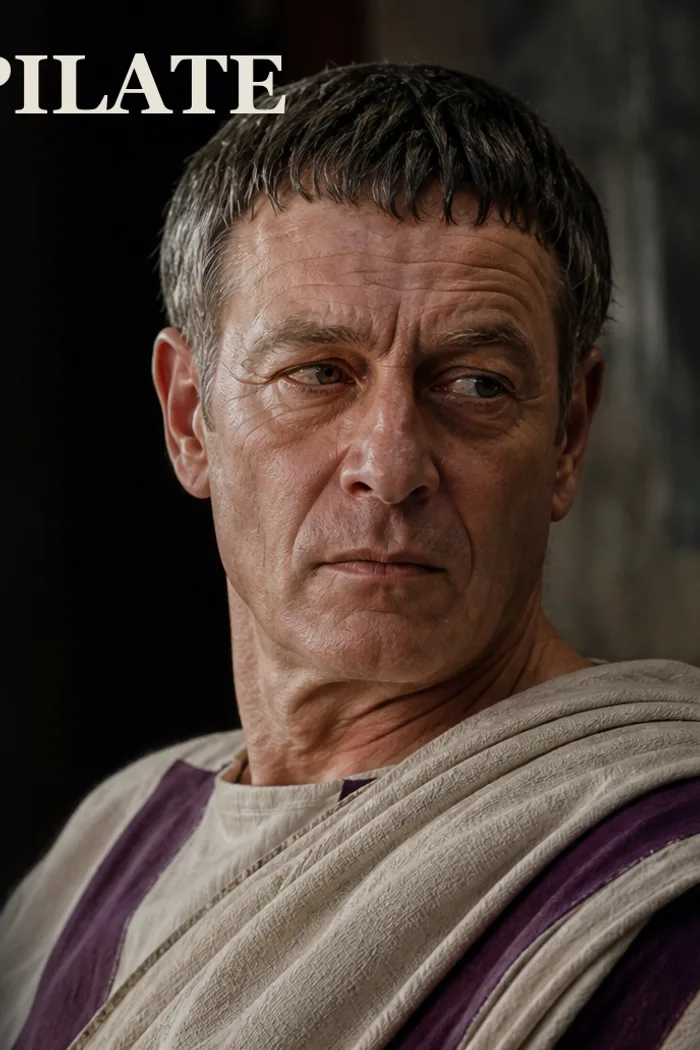
Pontius Pilate

Said three times that he found no fault in him, and signed the order anyway.

Pilate is the Roman governor of Judea, which makes him the only man in the city who can order an execution. He does not want the case. He tries to hand it back to the council, tries to send it to Herod on a jurisdictional technicality, offers a prisoner release, and offers a scourging as a substitute for a cross. Every move is an attempt to be rid of the decision without making it. John gives him the longest private conversation with a prisoner in the gospels.

Where he appearsMatthew 27 · Mark 15 · Luke 23 · John 18 to 19

Scroll down to the account
Pontius Pilate

The movements, in the order the text gives them.

The Account of Pontius Pilate

  1. 01

    John 18:33-38

    What is truth

    The interview turns on whether the kingdom is of this world. Pilate asks the largest question in the book and leaves the room before it can be answered.

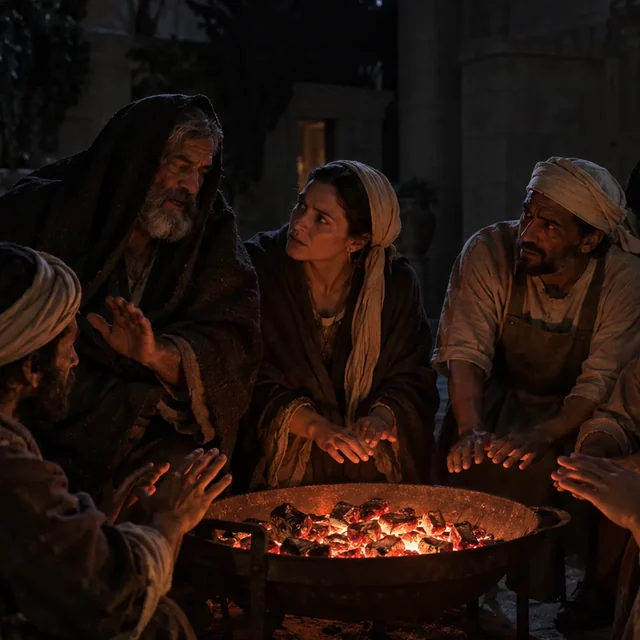
    The prisoner does not accept the governor's definition of a king. Pilate asks about a title that could describe a rival authority. Jesus asks where the accusation came from, then explains his kingdom by its source and its manner of action. His servants are not fighting to prevent this delivery. That is not an incidental detail in a chapter where Peter has drawn a sword and Jesus has ordered it put away.

    Not of this world does not mean that Jesus has no claim upon anything happening in the world. The sentence ends with not from hence, emphasizing origin. His purpose is to bear witness to the truth, and those who belong to the truth hear his voice. The conversation has moved from the governor's classification of a prisoner to the prisoner's account of who truly listens.

    Pilate's question about truth is famous enough to float away from its setting. John keeps it attached to a movement: he went out again. No reply to the question is recorded before Pilate announces that he finds no fault in Jesus. Whatever tone the question carried, the public finding is unambiguous. The examination has not established the charge.

    Verse by verse

    1. 18:34

      Jesus asks whether Pilate's title comes from his own assessment or from others. The exchange tests the source and meaning of the accusation.

    2. 18:36

      The absence of fighting corresponds to Jesus's command that Peter put away his sword in John 18:11. "Not from hence" restates the kingdom's different source.

    3. 18:37

      First Timothy 6:13 later recalls that Jesus witnessed a good confession before Pontius Pilate. The hearing becomes part of the letter's account of Jesus's faithful testimony.

    4. 18:38

      This is the first of three declarations in John that Pilate finds no fault in Jesus. The others occur in John 19:4 and 19:6.
    John 18:33-38

    King James Version · 6 verses

    18:33Then Pilate entered into the judgment hall again, and called Jesus, and said unto him, Art thou the King of the Jews?

    18:34Jesus answered him, Sayest thou this thing of thyself, or did others tell it thee of me?

    18:35Pilate answered, Am I a Jew? Thine own nation and the chief priests have delivered thee unto me: what hast thou done?

    18:36Jesus answered, My kingdom is not of this world: if my kingdom were of this world, then would my servants fight, that I should not be delivered to the Jews: but now is my kingdom not from hence.

    18:37Pilate therefore said unto him, Art thou a king then? Jesus answered, Thou sayest that I am a king. To this end was I born, and for this cause came I into the world, that I should bear witness unto the truth. Every one that is of the truth heareth my voice.

    18:38Pilate saith unto him, What is truth? And when he had said this, he went out again unto the Jews, and saith unto them, I find in him no fault at all.

    John 18:33-38: What is truth
  2. 02

    Luke 23:6-12

    He sent him to Herod

    Learning the man is a Galilean, he moves the case to another jurisdiction. It comes back, and the day makes Herod and Pilate friends.

    The journey to Herod ends where it began. Jesus is sent away from Pilate and then sent back to Pilate. The change of hearing produces no recorded answer from the prisoner, no miracle for Herod, and no finding of a capital offense. It does produce a splendid robe and a new friendship. Luke leaves those results standing beside one another without dressing them up as justice.

    Galilee is the hinge in Pilate's decision. Once jurisdiction is established, he sends Jesus to Herod, who is also in Jerusalem. This is not a journey north to Galilee. Herod's pleasure has an explicit explanation: he has long wanted to see Jesus and hopes for a miracle. Many questions follow. Nothing is the answer. The contrast between the ruler's abundant words and the prisoner's silence needs no invented exchange to sharpen it.

    The accusers remain active, and Herod's soldiers join the mockery. The robe changes the prisoner's appearance, not the unresolved case. Luke's closing sentence then turns to the two rulers: enemies have become friends on this very day. He states the reconciliation but does not give a private negotiation or a full explanation of its causes. Jesus returns to Pilate. The relationship between his examiners has changed.

    Verse by verse

    1. 23:6

      Luke previously mentions Galilaeans killed by Pilate in Luke 13:1. That report does not establish the cause of the earlier hostility between Pilate and Herod.

    2. 23:7

      Herod is in Jerusalem at the time. Jesus is not being sent from Jerusalem to Galilee in this verse.

    3. 23:8-9

      Herod's hope of seeing a miracle is explicit. Luke records many questions but no answer from Jesus.

    4. 23:12

      Luke states that the rulers became friends that day. He does not describe a treaty, bargain, or private conversation establishing the reconciliation.

    Luke 23:6-12

    King James Version · 7 verses

    23:6When Pilate heard of Galilee, he asked whether the man were a Galilæan.

    23:7And as soon as he knew that he belonged unto Herod’s jurisdiction, he sent him to Herod, who himself also was at Jerusalem at that time.

    23:8And when Herod saw Jesus, he was exceeding glad: for he was desirous to see him of a long season, because he had heard many things of him; and he hoped to have seen some miracle done by him.

    23:9Then he questioned with him in many words; but he answered him nothing.

    23:10And the chief priests and scribes stood and vehemently accused him.

    23:11And Herod with his men of war set him at nought, and mocked him, and arrayed him in a gorgeous robe, and sent him again to Pilate.

    23:12And the same day Pilate and Herod were made friends together: for before they were at enmity between themselves.

    Luke 23:6-12: He sent him to Herod
  3. 03

    Matthew 27:15-23

    Which of the two

    He offers the crowd a choice he expects to win and loses it. Asked why, what evil has he done, they only cry out the more.

    By the last verse, volume has taken the place of an answer. Pilate asks what evil Jesus has done; the crowd repeats the demand for crucifixion more loudly. Matthew does not record a new piece of evidence arriving between the question and that response. The demand intensifies without the charge becoming clearer. This is the passage's movement, and the repeated shouting does the work.

    Pilate is not presented as lacking every warning. Matthew says that he knows envy lies behind the delivery of Jesus. While he sits on the judgment seat, a message from his wife calls the prisoner just and urges him to have nothing to do with the case. The dream itself is not described. The warning that reaches the court is. At the same time, the chief priests and elders persuade the assembled crowd to request Barabbas and destroy Jesus.

    The release custom has turned the question from the merits of an accusation into a choice between prisoners. Jesus's name keeps returning with which is called Christ, while Barabbas is the requested release. Pilate continues asking what to do with the man whose wrongdoing has not been established. The judgment seat is occupied. The answer is coming from the shouting.

    Verse by verse

    1. 27:18

      Matthew explicitly names envy as the motive Pilate recognized in those who delivered Jesus. No additional motive needs to be invented for this verse.

    2. 27:19

      Pilate's wife is unnamed here. Her distress and warning are recorded, but the contents of the dream are not.

    3. 27:20

      The chief priests and elders persuade the multitude present at the hearing. The verse does not describe a decision made by every Jewish person.

    4. 27:21

      "Twain" means two. The question concerns which of the two prisoners will be released under the stated custom.

    5. 27:23

      The crowd responds with a louder demand, not a specified criminal act. Acts 13:28 later recalls the request to Pilate despite the absence of a cause for death.

    Matthew 27:15-23

    King James Version · 9 verses

    27:15Now at that feast the governor was wont to release unto the people a prisoner, whom they would.

    27:16And they had then a notable prisoner, called Barabbas.

    27:17Therefore when they were gathered together, Pilate said unto them, Whom will ye that I release unto you? Barabbas, or Jesus which is called Christ?

    27:18For he knew that for envy they had delivered him.

    27:19When he was set down on the judgment seat, his wife sent unto him, saying, Have thou nothing to do with that just man: for I have suffered many things this day in a dream because of him.

    27:20But the chief priests and elders persuaded the multitude that they should ask Barabbas, and destroy Jesus.

    27:21The governor answered and said unto them, Whether of the twain will ye that I release unto you? They said, Barabbas.

    27:22Pilate saith unto them, What shall I do then with Jesus which is called Christ? They all say unto him, Let him be crucified.

    27:23And the governor said, Why, what evil hath he done? But they cried out the more, saying, Let him be crucified.

    Matthew 27:15-23: Which of the two
  4. 04

    Matthew 27:24

    He washed his hands

    He declares himself innocent of the blood of this just person with water and a sentence, and then delivers him to be crucified in the next verse.

    The water is real; the innocence is Pilate's claim. Matthew records a public washing and the words attached to it, not a declaration from heaven that the governor has been cleared. That distinction is essential because the same account continues with Pilate releasing Barabbas, scourging Jesus, and delivering him for crucifixion. The hands are washed. The decision remains his action.

    The phrase this just person makes the gesture sharper. Pilate does not announce that new evidence has established guilt. He still calls Jesus just while attempting to place responsibility elsewhere. Before the multitude describes the audience for this act. The washing is meant to be seen, and the declaration is meant to be heard. Neither changes the identity of the official who subsequently authorizes the punishment.

    Matthew has already used a similar dismissal when the chief priests answered Judas's confession about innocent blood: see thou to that. Pilate now says see ye to it. Responsibility is being pushed from one set of speakers toward another, but the repeated words do not make it vanish. The passage exposes the distance between a public denial of responsibility and the actions that follow it.

    Verse by verse

    1. 27:24

      Pilate's statement of innocence is quoted speech, not Matthew's endorsement. Matthew 27:26 continues to assign the release and delivery of the prisoners to Pilate.

    2. 27:24

      The wording about leaving the matter to others echoes the chief priests' reply to Judas in Matthew 27:4. Both exchanges concern innocent blood and attempted refusal of responsibility.

    3. 27:24

      The washing occurs before the multitude and so is explicitly public. Matthew does not describe it as a legal acquittal of Jesus or an act that removes Pilate's authority.

    Matthew 27:24

    King James Version · 1 verse

    27:24When Pilate saw that he could prevail nothing, but that rather a tumult was made, he took water, and washed his hands before the multitude, saying, I am innocent of the blood of this just person: see ye to it.

    Matthew 27:24: He washed his hands
  5. 05

    John 19:19-22

    What I have written I have written

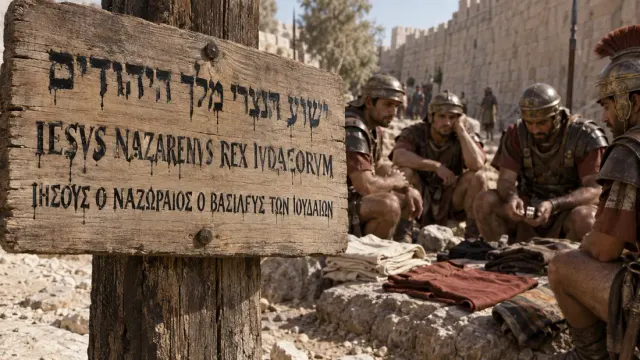
    The title over the cross names a king of the Jews in three languages. The priests ask him to change it and this, finally, is the thing he will not do.

    The dispute is over two small words: he said. The chief priests do not merely ask Pilate to remove a title they dislike. They ask him to turn a declaration into a report of a claim. The King of the Jews would become the man who said he was king. John makes the requested change precise because the difference carries the whole argument.

    The inscription is public in several ways. It is attached to the cross, the place is near the city, many people read it, and the words appear in three languages. This is not a private annotation on the governor's papers. The charge has become a visible identification over the person being executed. The title that Pilate questioned inside the judgment hall now stands outside where others can read it.

    Pilate refuses the revision. John does not say that this refusal makes him a disciple or explains all his motives. The irony is in the outcome, not in an invented conversion: the governor who delivered Jesus for crucifixion leaves the royal title unqualified above him. Here, at least, the wording will not be negotiated. The requested addition never reaches the sign.

    Verse by verse

    1. 19:19

      The title identifies both Jesus's place association, Nazareth, and his kingship. John gives no dimensions or material for the inscription.

    2. 19:20

      The KJV lists Hebrew, Greek, and Latin. John explicitly connects the number of readers with the execution site's nearness to the city.

    3. 19:21

      The requested change is from an asserted title to a statement of what Jesus allegedly claimed. The chief priests object to the unqualified wording.

    4. 19:22

      Pilate refuses to alter the inscription. John does not present this refusal as proof that Pilate became a disciple of Jesus.

    John 19:19-22

    King James Version · 4 verses

    19:19And Pilate wrote a title, and put it on the cross. And the writing was, JESUS OF NAZARETH THE KING OF THE JEWS.

    19:20This title then read many of the Jews: for the place where Jesus was crucified was nigh to the city: and it was written in Hebrew, and Greek, and Latin.

    19:21Then said the chief priests of the Jews to Pilate, Write not, The King of the Jews; but that he said, I am King of the Jews.

    19:22Pilate answered, What I have written I have written.

    John 19:19-22: What I have written I have written

Why it matters

He is the study of a man who knows the right answer and is not willing to pay for it. His wife sends word to have nothing to do with that just man. He asks what is truth and does not wait for an answer. He washes his hands in front of the crowd, which is a religious gesture from a man who does not share their religion, and it changes nothing about who gave the order. The sentence is decided by one line from the chief priests: if you let this man go, you are not Caesar’s friend.

12 songs

The music

Every song in the catalogue whose passage falls inside these chapters.

  1. Matthew 27:57-66; Mark 15:42-47; Luke 23:50-56; John 19:38-42

    A Stone at the Door

  2. Matthew 27:1-31; Mark 15:1-20; Luke 22:63-23:25; John 18:28-19:16

    Behold the Man

  3. Matthew 27:32-56; Mark 15:21-41; Luke 23:26-49; John 19:16-37

    It Is Finished

  4. Matthew 27:57-66

    Sealed until the Third Day

  5. Matthew 27:27-56

    The Veil Was Torn

  6. Mark 15:1-20

    Before Pilate

  7. Mark 15:21-47

    Truly This Man Was the Son of God

  8. Luke 23:6-12

    Before Herod

    Play here
    Open song pageRead lyrics
  9. Luke 23:32-43

    Remember Me

    Play here
    Open song pageRead lyrics
  10. John 18:12-40

    My Kingdom is Not of This World

    Play here
    Open song pageRead lyrics
  11. John 18:1-11

    Whom Seek Ye

    Play here
    Open song pageRead lyrics
  12. John 19:1-37

    It is Finished

    Play here
    Open song pageRead lyrics

Nearby

All the people

Report an error on this page