
New · FreePlay The Witnesses The in-depth puzzle battle quest through Bible history

People of the Bible

Peter

Said the best thing anyone said about him and the worst thing anyone said to him, in the same conversation.

Also called Simon, Cephas

Peter is a fisherman from Bethsaida working the lake with his brother when he is told to leave the nets. He is first in every list of the twelve and first into every situation: out of the boat onto the water, into the argument, into the high priest’s courtyard, into the empty tomb. He is also the one who has to be corrected most, and the gospels keep it all in. He confesses that Jesus is the Christ and is called blessed, and six verses later is told to get behind me, Satan.

Where he appearsMatthew 4 · Matthew 14 to 18 · Matthew 26 · Mark 8 to 9 · Mark 14 · Luke 5 · Luke 22 · John 13 · John 18 · John 21

Scroll down to the account
Peter

The movements, in the order the text gives them.

The Account of Peter

  1. 01

    Luke 5:1-11

    Depart from me, for I am a sinful man

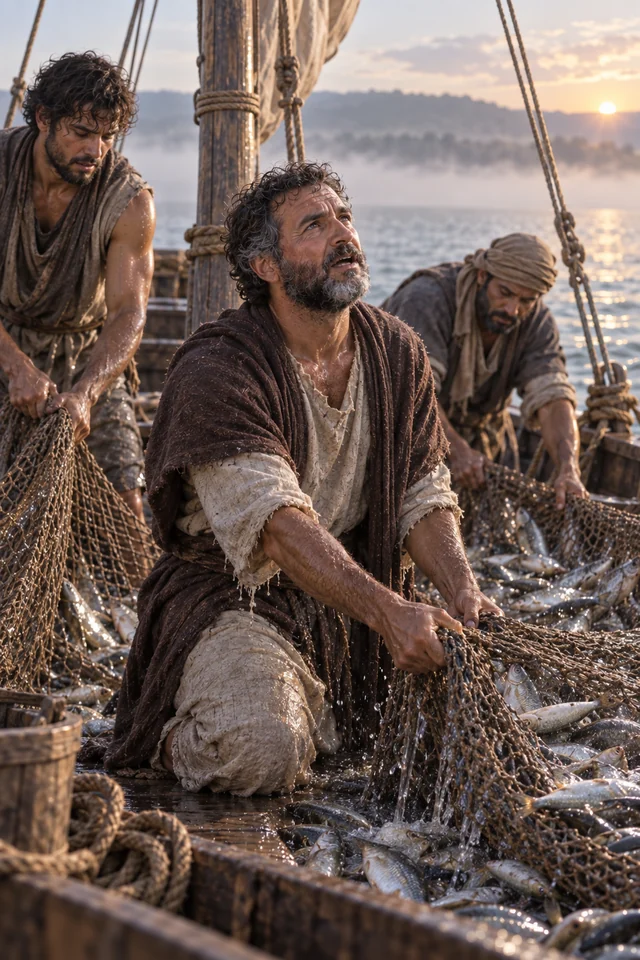
    After a night with nothing, he lets down the nets on a carpenter’s word and the nets break. His reaction to the catch is not gratitude but fear, and he asks to be left alone.

    Peter's first response to the catch is not a business proposal. A net is breaking, two boats are beginning to sink, and the man who knows this trade is on his knees talking about sin. That unexpected turn is the centre of the passage. The miracle does not merely improve his estimate of Jesus' usefulness. It changes his sense of who is standing in his boat. Luke begins with a crowd pressing to hear the word of God; then that word reaches one fisherman as an instruction that cuts across an entire night's experience. The nets are already being washed. The unsuccessful working night is over. Nevertheless at thy word means returning to the work, not pretending the night had gone differently.

    There is no need to make Peter an incompetent fisherman to magnify Jesus. The passage gives him partners, equipment, experience, and the entirely sensible report that nothing has been caught. What fails is not his diligence. What exceeds him is the authority now speaking. Even the physical abundance is awkward: help has to be signalled for, and the second boat becomes as heavily burdened as the first. Luke has not supplied a tidy illustration about increasing profits. Peter's answer takes the account somewhere far more searching. Depart from me; for I am a sinful man, O Lord. The confession recalls the shape of Isaiah 6, where the sight of the Lord exposes the prophet's uncleanness before he is commissioned. The settings differ, but the order matters in both: encounter, confession, then a task that comes from God rather than from a confident applicant.

    Jesus answers the request for distance with a call into his company. Fear not is followed by from henceforth, a future assigned to the very man who has just declared his unfitness. The commission concerns people, not larger catches. Acts 2:41 gives that change of work a concrete public expression when about three thousand receive the apostolic word and are baptized; the household of Cornelius in Acts 10 extends its reach beyond Israel. None of that makes the fish at the shore an allegory to decode one by one. The final contrast is already sharp enough. They forsook all after the boats were filled, not because the business had nothing left to offer. Peter leaves the catch. He follows the one who provided it.

    Verse by verse

    1. 5:3

      Prayed him means requested or asked him. Jesus is asking Peter to move the boat, not praying to Peter.

    2. 5:5

      At thy word connects Peter's action with the word of God that the crowd came to hear in 5:1.

    3. 5:8

      Isaiah 6:5-8 provides a comparable sequence of exposure before divine holiness, confession, and commission; Luke does not reproduce every feature of Isaiah's experience.

    4. 5:10

      The Greek anthropous means people or human beings. The commission is not restricted to males.

    5. 5:11

      The abandonment follows the successful catch. Luke does not present an empty boat as the reason for following Jesus.
    Luke 5:1-11

    King James Version · 11 verses

    5:1And it came to pass, that, as the people pressed upon him to hear the word of God, he stood by the lake of Gennesaret,

    5:2And saw two ships standing by the lake: but the fishermen were gone out of them, and were washing their nets.

    5:3And he entered into one of the ships, which was Simon’s, and prayed him that he would thrust out a little from the land. And he sat down, and taught the people out of the ship.

    5:4Now when he had left speaking, he said unto Simon, Launch out into the deep, and let down your nets for a draught.

    5:5And Simon answering said unto him, Master, we have toiled all the night, and have taken nothing: nevertheless at thy word I will let down the net.

    5:6And when they had this done, they inclosed a great multitude of fishes: and their net brake.

    5:7And they beckoned unto their partners, which were in the other ship, that they should come and help them. And they came, and filled both the ships, so that they began to sink.

    5:8When Simon Peter saw it, he fell down at Jesus’ knees, saying, Depart from me; for I am a sinful man, O Lord.

    5:9For he was astonished, and all that were with him, at the draught of the fishes which they had taken:

    5:10And so was also James, and John, the sons of Zebedee, which were partners with Simon. And Jesus said unto Simon, Fear not; from henceforth thou shalt catch men.

    5:11And when they had brought their ships to land, they forsook all, and followed him.

    Luke 5:1-11: Depart from me, for I am a sinful man
  2. 02

    Matthew 14:22-33

    Why did you doubt

    He asks to be called out onto the water, walks, sees the wind, and begins to sink. The hand catches him immediately, and the question comes afterwards.

    The hand comes before the question. Matthew says immediately Jesus stretched forth his hand, and caught him; only then comes the rebuke about little faith. Peter is not required to finish an examination on trust while going under. That order keeps the passage from becoming a celebration of the man who dared to leave the boat or a contemptuous account of the man who sank. The decisive action belongs to Jesus. Even the boat's difficult position begins with his instruction: he constrained the disciples to cross while he dismissed the crowd and went apart to pray. The contrary wind is not evidence that they boarded the wrong boat in disobedience.

    Peter's request also has a condition that is easy to miss. He does not announce that he has discovered a capacity to walk on water. He asks Jesus to command him to come. His movement depends on an address from the person he is trying to reach, and Matthew explicitly says that he walked on the water, to go to Jesus. The passage grants the extraordinary fact before it describes the failure. Then Peter sees the boisterous wind and becomes afraid. Matthew gives that fear; no invented account of his private ambitions is needed. The prayer contracts to three words: Lord, save me. There is nothing elegant about it and nothing missing from its request. Jesus' immediate grip answers the danger before his words address the doubt. Little faith is a rebuke, but it is not the assertion that Peter has never trusted him at all.

    The wind ceases after they enter the boat. Matthew does not say that Jesus first makes the conditions harmless and only then brings Peter through them. Nor does the account finish with Peter explaining his experience. Those in the boat worship Jesus and confess him as the Son of God. The movement is from a frightened identification of an apparition to recognition of the one who comes across the sea. Psalm 77:19 already speaks of God's way in the sea and his path in great waters, so this is more than a display of unusual balance. The sea is the setting for a disclosure of identity. Peter's courage, fear, prayer, rescue, and correction all belong inside that larger disclosure. He is an important participant. He is not the destination of the passage.

    Verse by verse

    1. 14:22

      Constrained means compelled or strongly directed. The disciples are crossing at Jesus' instruction.

    2. 14:26

      The Greek phantasma means an apparition or spectre. This is the disciples' frightened identification, not Matthew's description of what Jesus is.

    3. 14:28-29

      Peter requests a command, and Matthew explicitly records that he does walk on the water before beginning to sink.

    4. 14:31

      The Greek sequence places the immediate grasp before the spoken correction. Little faith and no faith are not identical expressions.

    5. 14:33

      Psalm 77:19 places God's path in the great waters; Matthew's scene ends in a confession of Jesus' identity, not a commendation of Peter's performance.

    Matthew 14:22-33

    King James Version · 12 verses

    14:22And straightway Jesus constrained his disciples to get into a ship, and to go before him unto the other side, while he sent the multitudes away.

    14:23And when he had sent the multitudes away, he went up into a mountain apart to pray: and when the evening was come, he was there alone.

    14:24But the ship was now in the midst of the sea, tossed with waves: for the wind was contrary.

    14:25And in the fourth watch of the night Jesus went unto them, walking on the sea.

    14:26And when the disciples saw him walking on the sea, they were troubled, saying, It is a spirit; and they cried out for fear.

    14:27But straightway Jesus spake unto them, saying, Be of good cheer; it is I; be not afraid.

    14:28And Peter answered him and said, Lord, if it be thou, bid me come unto thee on the water.

    14:29And he said, Come. And when Peter was come down out of the ship, he walked on the water, to go to Jesus.

    14:30But when he saw the wind boisterous, he was afraid; and beginning to sink, he cried, saying, Lord, save me.

    14:31And immediately Jesus stretched forth his hand, and caught him, and said unto him, O thou of little faith, wherefore didst thou doubt?

    14:32And when they were come into the ship, the wind ceased.

    14:33Then they that were in the ship came and worshipped him, saying, Of a truth thou art the Son of God.

    Matthew 14:22-33: Why did you doubt
  3. 03

    Matthew 16:13-23

    Blessed are you, and get behind me

    He answers the question nobody else answers and is told flesh and blood did not reveal it. Then he takes the Lord aside to rebuke him about dying, and receives the sharpest words in the gospels.

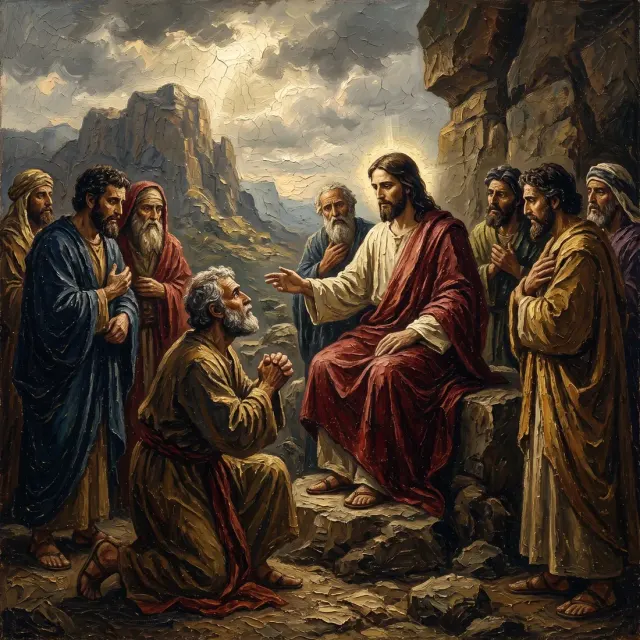
    Peter confesses the Christ, then begins correcting him. Matthew leaves the two speeches close enough for the collision to be felt. The first answer comes from revelation by the Father; the second is judged to be thinking according to men rather than God. Being right about Jesus' title has not made Peter right about Jesus' path. The blessing is genuine, and so is the rebuke. Neither cancels the other by making the first merely flattery or the second merely a misunderstanding that need not be taken seriously. Jesus has just entrusted Peter with words about the church and the kingdom. Peter then takes him aside and objects to the suffering through which Jesus says his mission must pass.

    The language about the rock has attracted centuries of argument, but its first feature is a play on Peter's name: Petros and petra. The difference between a masculine personal name and a feminine noun does not by itself settle the passage's meaning. Peter, his confession, and the Christ he confesses cannot simply be pulled apart as though only one appeared in the conversation. Augustine, in Tractate 124 on John, identifies Christ as the rock while describing Peter as representing the church; other readings place the accent on Peter as the confessing apostle. The implications for later church authority remain disputed. What is not disputed by the grammar is who builds and whose church it is: I will build my church. The keys likewise describe entrusted responsibility, not independent ownership. Isaiah 22:22 supplies the image of a key carried by the steward of David's house. In Matthew 18:18, binding and loosing are also addressed to the disciples in the plural. Peter's prominence is real without making every other disciple disappear.

    Then comes the necessity Peter resists: Jerusalem, suffering, death, and resurrection on the third day. His protest is a rebuke of Jesus' declared course, not simply an expression of sadness. Jesus' answer names the obstruction with terrifying directness: Satan. Matthew does not say that Peter has become demon-possessed. He is opposing what Jesus identifies as God's purpose, taking the adversarial position. The man associated with the rock is now called an offence, a stumbling block. Get thee behind me also restores the physical language of following: in the next verse, a disciple comes after Jesus, not ahead of him to revise the route. Galatians 2:11-14 preserves a later occasion when Peter's conduct again required correction despite his recognized place among the apostles. The New Testament neither erases his commission nor hides his need to be corrected. Authority has been given. The right to redirect the Christ has not.

    Verse by verse

    1. 16:17

      Bar-jona identifies Simon by his father. Flesh and blood contrasts human disclosure with revelation from the Father.

    2. 16:18

      The Greek behind hell is Hades, the realm of the dead. Interpretations of the rock differ, but the wordplay on Peter's name is explicit.

    3. 16:19

      Isaiah 22:22 connects a key with authority over David's house. Matthew 18:18 repeats binding and loosing with plural forms addressed to the disciples.

    4. 16:21

      Must governs Jesus' announced course; resurrection belongs to that announcement as well as suffering and death.

    5. 16:22

      Matthew explicitly calls Peter's action a rebuke. The text does not provide a private speech explaining all his motives.

    6. 16:23

      Offence translates skandalon, a stumbling block. The rebuke identifies opposition to God's purpose; it does not state that Peter is demon-possessed.

    Matthew 16:13-23

    King James Version · 11 verses

    16:13When Jesus came into the coasts of Caesarea Philippi, he asked his disciples, saying, Whom do men say that I the Son of man am?

    16:14And they said, Some say that thou art John the Baptist: some, Elias; and others, Jeremias, or one of the prophets.

    16:15He saith unto them, But whom say ye that I am?

    16:16And Simon Peter answered and said, Thou art the Christ, the Son of the living God.

    16:17And Jesus answered and said unto him, Blessed art thou, Simon Bar-jona: for flesh and blood hath not revealed it unto thee, but my Father which is in heaven.

    16:18And I say also unto thee, That thou art Peter, and upon this rock I will build my church; and the gates of hell shall not prevail against it.

    16:19And I will give unto thee the keys of the kingdom of heaven: and whatsoever thou shalt bind on earth shall be bound in heaven: and whatsoever thou shalt loose on earth shall be loosed in heaven.

    16:20Then charged he his disciples that they should tell no man that he was Jesus the Christ.

    16:21From that time forth began Jesus to shew unto his disciples, how that he must go unto Jerusalem, and suffer many things of the elders and chief priests and scribes, and be killed, and be raised again the third day.

    16:22Then Peter took him, and began to rebuke him, saying, Be it far from thee, Lord: this shall not be unto thee.

    16:23But he turned, and said unto Peter, Get thee behind me, Satan: thou art an offence unto me: for thou savourest not the things that be of God, but those that be of men.

    Matthew 16:13-23: Blessed are you, and get behind me
  4. 04

    John 13:6-10

    You shall never wash my feet

    He refuses, is told he has no part otherwise, and swings straight to the opposite extreme: not my feet only, but also my hands and my head.

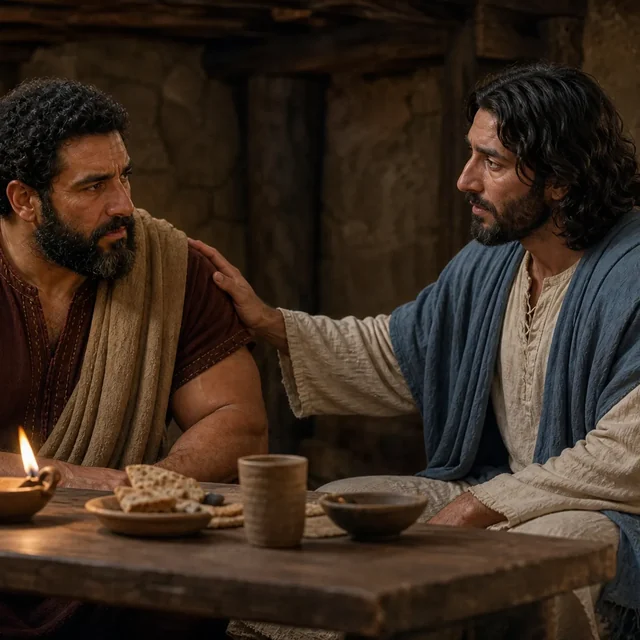
    The hands to which the Father has entrusted all things are washing Peter's feet. John puts that knowledge in 13:3 before the towel and basin appear. Jesus is not serving because he has forgotten who he is, nor does he cease to be Lord while doing it. Afterward he explicitly confirms the disciples' address: Master and Lord. That is what makes Peter's objection more than embarrassment over a social courtesy. Lord, dost thou wash my feet places the title and the action in a collision Peter cannot yet resolve. He can recognize the Lord and still resist the form the Lord's service takes.

    His refusal is wonderfully definite, and very short-lived. Never becomes hands and head as soon as Jesus says that refusing the washing means having no part with him. Peter has moved from forbidding the action to enlarging the assignment. Both responses try to specify how Jesus should serve him, while Jesus insists on the action he himself has chosen. The explanation promised hereafter also matters. Peter is not asked to invent an understanding he does not have. He is told that understanding will come later. Receiving this service precedes comprehending it. The exchange cannot therefore be reduced to an agreeable lesson about helping others: before the action becomes an example to imitate in 13:14-15, it is something Peter must receive from Jesus. No part with me makes relationship, not merely etiquette, the issue.

    Jesus then distinguishes the person who has bathed from the washing of the feet. The Greek uses different verbs, and the difference explains why Peter's proposal to add his hands and head is not accepted. More water is not the missing requirement. Clean every whit is immediately qualified by but not all, and the following verse expressly connects that exception with the betrayer. Bodily dirt cannot account for the whole conversation. John 15:3 also speaks of the disciples as clean through Jesus' word. Christian readers have related this washing to baptism, forgiveness, the cross, and the commanded practice of footwashing in different ways; the passage does not explain every later sacramental distinction. Its immediate pressure is clearer. Peter cannot preserve Jesus' honour by refusing the service Jesus says is necessary. The Lord who takes the towel remains Lord of what the washing means. Peter's place is to receive it, not to redesign it.

    Verse by verse

    1. 13:6

      John 13:3 places Jesus' knowledge of his authority immediately before he takes the towel. His service is not presented as ignorance of his identity.

    2. 13:7

      Hereafter promises understanding later. The verse does not require Peter to claim that he already understands.

    3. 13:8

      No part with me makes the washing a question of participation with Jesus, not merely permission to perform a courtesy.

    4. 13:9

      The request for hands and head reverses the absolute refusal of 13:8. Jesus accepts neither Peter's prohibition nor his proposed expansion.

    5. 13:10

      Every whit means entirely. John 13:11 identifies the exception, not all, with Jesus' knowledge of the betrayer.

    John 13:6-10

    King James Version · 5 verses

    13:6Then cometh he to Simon Peter: and Peter saith unto him, Lord, dost thou wash my feet?

    13:7Jesus answered and said unto him, What I do thou knowest not now; but thou shalt know hereafter.

    13:8Peter saith unto him, Thou shalt never wash my feet. Jesus answered him, If I wash thee not, thou hast no part with me.

    13:9Simon Peter saith unto him, Lord, not my feet only, but also my hands and my head.

    13:10Jesus saith to him, He that is washed needeth not save to wash his feet, but is clean every whit: and ye are clean, but not all.

    John 13:6-10: You shall never wash my feet
  5. 05

    Luke 22:54-62

    Before the cock crow

    A servant girl, a bystander, and an hour later a man who is sure. At the third denial the cock crows, the Lord turns and looks at him, and he goes out and weeps bitterly.

    Peter follows Jesus, but afar off. Before anyone speaks, Luke has put distance into the description of discipleship. The fire then gathers Peter among people who begin naming the very connections he is trying to deny. The maid says he was with Jesus. Another identifies him as one of the group. A third insists on the connection and points to his Galilean origin. These are not elaborate false accusations that the passage expects Peter to refute. He has been with Jesus, he does belong to the disciples, and he is a Galilean. His replies dismantle his public association with facts the Gospel has already established.

    Luke also leaves time between the denials. About an hour passes before the last challenge, so the three answers are not compressed into one confused exchange. Then the cock crows while Peter is still speaking. His denial of knowing what the man means is interrupted by the fulfilment of words whose meaning is now unmistakable. The Lord turned, and looked upon Peter. Luke does not describe the expression on Jesus' face. A commentary that supplies a reproachful glare, a reassuring smile, or an unspoken sentence adds what the passage has not given. What Luke does give is the effect: Peter remembers the Lord's word. The look does not introduce a new accusation. It returns him to the warning he had answered with a declaration of readiness for prison and death in 22:33. The comparison is devastating without any additional dialogue.

    The warning itself had already been enclosed within Jesus' prayer for him and the instruction that, after turning back, he should strengthen his brethren. That does not soften the denial into a minor lapse. It prevents the denial from being read as though Jesus had been deceived by Peter's earlier confidence or had said nothing about a future beyond it. Immediately after Peter leaves weeping, Luke records Jesus being mocked and told to prophesy, although the prediction about Peter has just been fulfilled. The prisoner being taunted is the one whose word has proved exact. Luke 24:34 later records that the risen Lord appeared to Simon without supplying the conversation between them. Both silences deserve to remain intact: no invented words at the look, no invented transcript of the later meeting. At the close of this passage there are only the remembered words and the bitter tears. Neither is made smaller.

    Verse by verse

    1. 22:54

      Afar off is not a separate action from following; distance qualifies the following itself. Luke records both Peter's presence and his separation.

    2. 22:56-58

      The challenges identify association with Jesus and membership among his followers. Those associations are true within Luke's account.

    3. 22:59

      Luke specifies approximately an hour before the final challenge. The three denials do not all occur in one brief exchange.

    4. 22:61

      Luke reports the turn, the look, and Peter's remembrance, but gives no description of Jesus' facial expression or unspoken words.

    5. 22:62

      Jesus' earlier instruction in 22:32 anticipates Peter turning back and strengthening his brethren. Luke 24:34 names an appearance to Simon without reporting its conversation.

    Luke 22:54-62

    King James Version · 9 verses

    22:54Then took they him, and led him, and brought him into the high priest’s house. And Peter followed afar off.

    22:55And when they had kindled a fire in the midst of the hall, and were set down together, Peter sat down among them.

    22:56But a certain maid beheld him as he sat by the fire, and earnestly looked upon him, and said, This man was also with him.

    22:57And he denied him, saying, Woman, I know him not.

    22:58And after a little while another saw him, and said, Thou art also of them. And Peter said, Man, I am not.

    22:59And about the space of one hour after another confidently affirmed, saying, Of a truth this fellow also was with him: for he is a Galilæan.

    22:60And Peter said, Man, I know not what thou sayest. And immediately, while he yet spake, the cock crew.

    22:61And the Lord turned, and looked upon Peter. And Peter remembered the word of the Lord, how he had said unto him, Before the cock crow, thou shalt deny me thrice.

    22:62And Peter went out, and wept bitterly.

    Luke 22:54-62: Before the cock crow
  6. 06

    John 21:15-19

    Do you love me

    A charcoal fire on the shore, breakfast, and three questions to answer three denials. Each answer is met with a command about feeding, and the last with a word about how he will die.

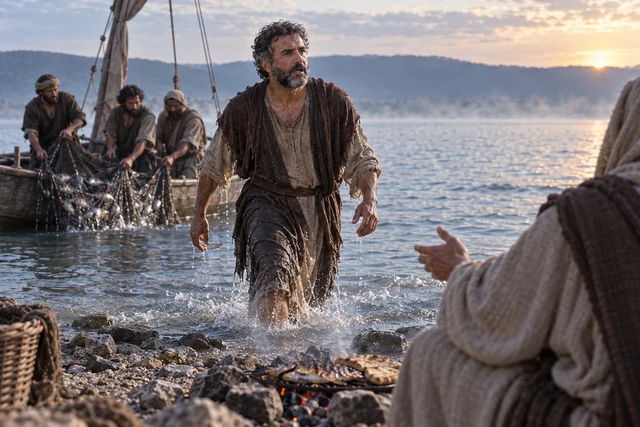
    The conversation begins after the meal. Jesus has already given Peter bread and fish before asking about his love. John has also placed a fire of coals on this shore, using the same rare noun, anthrakia, that appeared beside Peter's denials in 18:18. Those are its only New Testament occurrences. A second fire, another gathering, and this time three declarations of love answer the three denials. The correspondence is strong without supplying remembered smells or private recollections that John never mentions. Jesus addresses Simon by name, and each answer receives an assignment. This is not a public announcement that the failure never happened. It is a renewed commission given to the man whose failure the Gospel has recorded.

    Peter does not repeat the comparison in more than these. However that phrase is understood, whether comparing his love with the other disciples' love or with his attachment to those present or the things around him, his answer rests on Jesus' knowledge: thou knowest that I love thee. By the third reply it becomes thou knowest all things. The emphasis is no longer a claim that his loyalty can be measured above someone else's. Nor should the alternation of Greek verbs for love be turned automatically into a ladder from divine love down to mere friendship; John uses both verbs for the Father's love of the Son. The explicitly stated cause of Peter's grief is the third asking. Three times the reply is met with responsibility for sheep that Jesus calls mine. The possessive matters. Peter receives care of the flock, not possession of it. In 1 Peter 5:1-4, the apostle calls himself a fellow elder, charges elders to feed God's flock without lording it over them, and names Christ the chief Shepherd. That later language keeps the commission's ownership clear.

    The charge is followed, not by a promise of safety, but by a description of Peter's death. John himself supplies that interpretation in verse 19, so the contrast between dressing himself and being bound and led by another is more than a general observation about growing old. Stretching out the hands has commonly been read as indicating crucifixion; the passage itself gives neither its location nor the later tradition about an inverted cross. Second Peter 1:14 likewise speaks of approaching death as something the Lord Jesus has made known. Then comes Follow me. In John 13:36 Peter had been told that he could not follow then but would follow afterward. Here that afterward has a cost. The man who denied association with Jesus is entrusted with his sheep and told of a death that will glorify God. The commission does not erase the denial. The denial does not have the final word.

    Verse by verse

    1. 21:15

      More than these admits different comparisons; the pronoun does not name its referent. Peter answers without repeating the comparison.

    2. 21:16

      The command in this verse uses poimaino, to shepherd or tend, while 21:15 and 21:17 use bosko, to feed. Both concern care of Jesus' flock.

    3. 21:17

      John expressly connects Peter's grief with the third question. The passage does not explicitly identify a change of Greek love-verb as its cause.

    4. 21:18

      John 21:19 explains these words as indicating Peter's death. Details about the location or an upside-down crucifixion are not supplied here.

    5. 21:19

      John 13:36 anticipates Peter following afterward, and 2 Peter 1:14 refers to death made known by Jesus. Neither passage supplies a date for Peter's death.

    John 21:15-19

    King James Version · 5 verses

    21:15So when they had dined, Jesus saith to Simon Peter, Simon, son of Jonas, lovest thou me more than these? He saith unto him, Yea, Lord; thou knowest that I love thee. He saith unto him, Feed my lambs.

    21:16He saith to him again the second time, Simon, son of Jonas, lovest thou me? He saith unto him, Yea, Lord; thou knowest that I love thee. He saith unto him, Feed my sheep.

    21:17He saith unto him the third time, Simon, son of Jonas, lovest thou me? Peter was grieved because he said unto him the third time, Lovest thou me? And he said unto him, Lord, thou knowest all things; thou knowest that I love thee. Jesus saith unto him, Feed my sheep.

    21:18Verily, verily, I say unto thee, When thou wast young, thou girdedst thyself, and walkedst whither thou wouldest: but when thou shalt be old, thou shalt stretch forth thy hands, and another shall gird thee, and carry thee whither thou wouldest not.

    21:19This spake he, signifying by what death he should glorify God. And when he had spoken this, he saith unto him, Follow me.

    John 21:15-19: Do you love me

Why it matters

What makes Peter the pattern rather than a warning is the restoration. He denies three times beside a charcoal fire, and the next charcoal fire in the gospel of John is on a beach where he is asked three times whether he loves him and given a flock each time. Nothing is pretended about what happened; the count matches. From there he preaches at Pentecost, and the man who could not hold his nerve in front of a servant girl stands up in front of the city.

38 songs

The music

Every song in the catalogue whose passage falls inside these chapters.

  1. Matthew 4:1-11

    It is Written

  2. Matthew 4:18-22; Mark 1:16-20; Luke 5:1-11; John 1:35-51

    Leave the Nets

  3. Matthew 4:12-25

    Light upon Galilee

  4. Matthew 4:1-11; Mark 1:12-13; Luke 4:1-13

    Not by Bread Alone

  5. Matthew 14:1-12; Mark 6:14-29

    A Voice Silenced

  6. Matthew 14:13-21; Mark 6:30-44; Luke 9:10-17; John 6:1-15

    Give Ye Them to Eat

  7. Matthew 14:22-33; Mark 6:45-52; John 6:16-21

    Upon the Water

  8. Matthew 14:22-33

    Why Didst Thou Doubt?

  9. Matthew 15:21-28

    Crumbs from the Master's Table

  10. Matthew 16:13-28; Mark 8:27-38; Luke 9:18-27

    Thou Art the Christ

  11. Matthew 16:13-20

    Upon This Rock

  12. Matthew 17:1-13

    His Face Did Shine

  13. Matthew 17:1-13; Mark 9:2-13; Luke 9:28-36

    On the Holy Mount

  14. Matthew 17:24-27

    The Coin in the Fish's Mouth

  15. Matthew 18:21-35

    The Debt He Would Not Forgive

  16. Matthew 26:47-75; Mark 14:43-72; Luke 22:47-62; John 18:1-27

    Before the Cock Crow

  17. Matthew 26:36-56

    The Cup in the Garden

    Play here
    Open song pageRead lyrics
  18. Matthew 26:1-16; Mark 14:1-11; John 12:1-8

    The Fragrance and the Silver

  19. Matthew 26:17-35; Mark 14:12-31; Luke 22:7-38; John 13-17

    This Do in Remembrance

  20. Matthew 26:36-46; Mark 14:32-42; Luke 22:39-46

    Thy Will Be Done

  21. Mark 8:22-26

    I See Men as Trees Walking

    Play here
    Open song pageRead lyrics
  22. Mark 8:1-21

    One Loaf in the Boat

  23. Mark 8:27-30

    Whom Say Ye That I Am?

    Play here
    Open song pageRead lyrics
  24. Mark 9:14-29

    Help Thou Mine Unbelief

    Play here
    Open song pageRead lyrics
  25. Mark 9:33-37

    The Servant of All

    Play here
    Open song pageRead lyrics
  26. Mark 9:2-13

    This Is My Beloved Son

    Play here
    Open song pageRead lyrics
  27. Mark 14:53-72

    Before the Council

  28. Mark 14:1-26

    Broken and Poured Out

  29. Luke 5:1-11

    Launch Out into the Deep

    Play here
    Open song pageRead lyrics
  30. Luke 5:12-26

    Thy Sins Are Forgiven Thee

  31. Luke 22:39-53

    The Hour of Darkness

    Play here
    Open song pageRead lyrics
  32. Luke 22:7-23

    The New Covenant Cup

    Play here
    Open song pageRead lyrics
  33. John 13:1-38

    He Loved Them unto the End

    Play here
    Open song pageRead lyrics
  34. John 13:1-17

    Ye Ought Also to Wash One Another's Feet

  35. John 18:12-40

    My Kingdom is Not of This World

    Play here
    Open song pageRead lyrics
  36. John 18:1-11

    Whom Seek Ye

    Play here
    Open song pageRead lyrics
  37. John 21

    Feed His Sheep

  38. John 21:1-25

    Lovest Thou Me

    Play here
    Open song pageRead lyrics

The videos

The videos

Every release whose passage falls inside these chapters, playing here.

Nearby

All the people

Report an error on this page