
New · FreePlay The Witnesses The in-depth puzzle battle quest through Bible history

People of the Bible

Mary Magdalene

Out of her went seven devils, and out of her came the first sentence anyone spoke about the resurrection.

Luke introduces her in a list of women who travelled with the twelve and supported the work out of their own means, and notes that seven devils had gone out of her. That is everything the gospels say about her past; the long tradition that makes her a prostitute is a later confusion with an unnamed woman two chapters earlier. What the text does with her instead is put her at the cross, at the burial, and at the tomb, in that order, in all four gospels.

Where she appearsLuke 8 · Matthew 27 to 28 · Mark 15 to 16 · John 19 to 20

Scroll down to the account
Mary Magdalene

The movements, in the order the text gives them.

The Account of Mary Magdalene

  1. 01

    Luke 8:1-3

    Out of whom went seven devils

    She is named first among the women who followed and who ministered unto him of their substance. The support of the mission was, in part, theirs.

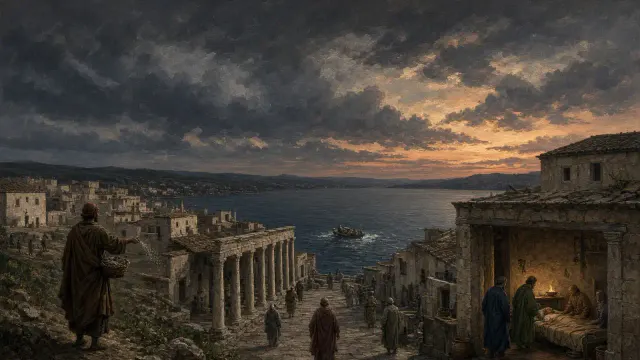
    The travelling company has more members than the twelve, and Luke is quite specific about who helps pay its way. Mary, Joanna, Susanna, and many others minister of their substance. That last word keeps the sentence firmly on the ground. Proclaiming the kingdom through cities and villages involves actual resources, and these women contribute theirs. They are not scenery behind the men. They are named participants in the work.

    Mary's introduction also gives a terrible fact about her past: seven devils had gone out of her. It does not supply a sexual history. Luke neither calls her a prostitute nor identifies her with the unnamed woman in the preceding chapter. Seven spirits are not seven sins, and an affliction is not a profession. Her account already has enough weight without borrowed scandal.

    The movement of the paragraph matters. It begins with people who have received healing and ends with people providing support. Mary is not left permanently inside the description of what once oppressed her. Alongside the twelve, she belongs to the company accompanying Jesus. Luke records both what she was delivered from and what she now takes part in.

    Verse by verse

    1. 8:2

      Magdalene is a geographical designation associated with Magdala, not a description of moral character.

    2. 8:2

      Luke does not identify Mary with the unnamed sinful woman of Luke 7 or with Mary of Bethany.

    3. 8:3

      Substance means possessions or material resources. The sentence explicitly describes support drawn from the women's own means.

    4. 8:3

      Joanna is the wife of Chuza, who is identified as Herod's steward; the office belongs to her husband.
    Luke 8:1-3

    King James Version · 3 verses

    8:1And it came to pass afterward, that he went throughout every city and village, preaching and shewing the glad tidings of the kingdom of God: and the twelve were with him,

    8:2And certain women, which had been healed of evil spirits and infirmities, Mary called Magdalene, out of whom went seven devils,

    8:3And Joanna the wife of Chuza Herod’s steward, and Susanna, and many others, which ministered unto him of their substance.

    Luke 8:1-3: Out of whom went seven devils
  2. 02

    John 19:25

    Standing by the cross

    She is one of the women who do not leave. Most of the twelve are elsewhere and the text does not soften the contrast.

    The preceding verse concerns what can be taken from Jesus. This one names the people standing beside him. Soldiers divide the clothing and cast lots for the coat; then the Gospel of John turns to his mother and the women at the cross. Garments can be distributed. These relationships cannot be reduced to the executioners' shares.

    Mary Magdalene is named without a speech, an explanation, or a description of her face. The plainness is part of the weight. There stood. John does not need to invent a declaration of loyalty for someone whose location already says something definite. She is present at the cross of the person she has followed.

    It also matters that several women called Mary remain several distinct people. Magdalene does not become Jesus' mother, Mary of Cleophas, or the unnamed sister simply because the verse places them close together. The next exchange concerns Jesus' mother and the beloved disciple; it should not swallow the identities of everyone else present. Mary Magdalene has her own place in the sentence, and John preserves it. Her testimony begins here without a recorded word.

    Verse by verse

    1. 19:25

      Mary Magdalene is distinguished from Jesus' mother and from Mary associated with Cleophas.

    2. 19:25

      The verse records the women's presence, not their words or their precise movements during the crucifixion.

    3. 19:25

      In verses 26-27 the woman entrusted to the beloved disciple is Jesus' mother, not Mary Magdalene.

    John 19:25

    King James Version · 1 verse

    19:25Now there stood by the cross of Jesus his mother, and his mother’s sister, Mary the wife of Cleophas, and Mary Magdalene.

    John 19:25: Standing by the cross
  3. 03

    Mark 16:1-4

    Who shall roll us away the stone

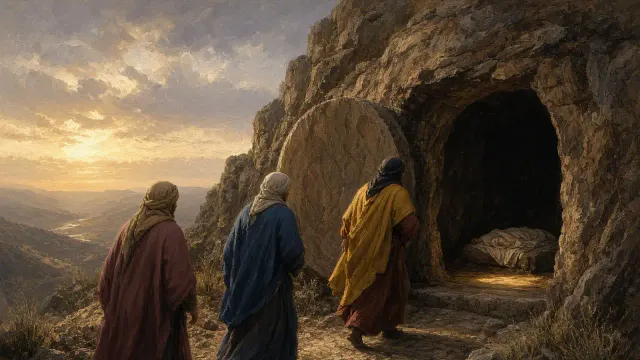
    She comes with spices to finish a burial, carrying a practical worry about a rock, and finds the worry already answered.

    The spices are ready. The question of the stone is not. Mark leaves that practical imbalance exactly where it belongs, on the way to the tomb. These women have made provision to anoint a dead body, not arranged a celebration for a risen one. Their question is about access. The obstacle they expect is heavy, physical, and entirely real.

    That is why the last clause of verse 4 is so well placed. Mark says the stone has been rolled away and only then adds that it was very great. The explanation of its size comes after the discovery that it no longer blocks the entrance. Their concern was not foolish; it has been overtaken by something they did not do.

    Mary Magdalene's presence also connects this morning with the burial. Mark 15:47 has already named her among those who observed where Jesus was laid. She has not wandered into an unfamiliar cemetery looking for a likely tomb. The account holds together through the people who were actually there. Yet familiarity with the place does not supply understanding of the event. She knows the tomb. She has come carrying the expectations of a funeral.

    Verse by verse

    1. 16:1

      The spices are intended for anointing a body. Mark does not present the women as expecting resurrection when they set out.

    2. 16:2

      Mark specifies the rising of the sun; John 20:1 describes Mary coming while it was still dark. Neither wording should be silently substituted for the other.

    3. 16:4

      These verses report the stone already moved but do not name the person or agent who moved it.

    Mark 16:1-4

    King James Version · 4 verses

    16:1And when the sabbath was past, Mary Magdalene, and Mary the mother of James, and Salome, had bought sweet spices, that they might come and anoint him.

    16:2And very early in the morning the first day of the week, they came unto the sepulchre at the rising of the sun.

    16:3And they said among themselves, Who shall roll us away the stone from the door of the sepulchre?

    16:4And when they looked, they saw that the stone was rolled away: for it was very great.

    Mark 16:1-4: Who shall roll us away the stone
  4. 04

    John 20:11-16

    She, supposing him to be the gardener

    She asks a stranger where the body has been taken and offers to carry it herself. One word, her own name, ends the mistake.

    Two angels do not change Mary's explanation. One spoken name does. Even after looking into the tomb, she still explains the absence of Jesus in terms of someone carrying him away. The person she mistakes for a gardener is drawn into the same explanation: perhaps he knows where the body has gone. Her offer to take it away belongs to that determined search, not to any expectation that the dead man might answer.

    Then Jesus says Mary. The Gospel of John gives no description of a special tone of voice, no account of tears clearing from her eyes, no explanation involving a gardener's disguise. It gives the name and her response. Rabboni. The person she has been referring to as an absent body is suddenly the Master she addresses.

    The exchange has a quiet connection with John 10:3-4, where the shepherd calls his sheep by name and they know his voice. That earlier language makes the recognition here especially resonant without explaining every detail of how it happened. The turning point is not a better theory about the tomb. Jesus speaks to her, and the search for where someone laid him gives way to recognition of who is standing there.

    Verse by verse

    1. 20:11

      Without means outside, not lacking something. Mary is standing outside the tomb before she stoops to look in.

    2. 20:14

      John states that Mary did not recognize Jesus but does not specify the reason.

    3. 20:16

      John himself translates Rabboni as Master. The response identifies the person Mary now recognizes.

    4. 20:16

      John 10:3-4 similarly joins being called by name with recognition of the shepherd's voice; the connection is a textual echo, not a stated explanation of this encounter.

    John 20:11-16

    King James Version · 6 verses

    20:11But Mary stood without at the sepulchre weeping: and as she wept, she stooped down, and looked into the sepulchre,

    20:12And seeth two angels in white sitting, the one at the head, and the other at the feet, where the body of Jesus had lain.

    20:13And they say unto her, Woman, why weepest thou? She saith unto them, Because they have taken away my Lord, and I know not where they have laid him.

    20:14And when she had thus said, she turned herself back, and saw Jesus standing, and knew not that it was Jesus.

    20:15Jesus saith unto her, Woman, why weepest thou? whom seekest thou? She, supposing him to be the gardener, saith unto him, Sir, if thou have borne him hence, tell me where thou hast laid him, and I will take him away.

    20:16Jesus saith unto her, Mary. She turned herself, and saith unto him, Rabboni; which is to say, Master.

    John 20:11-16: She, supposing him to be the gardener
  5. 05

    John 20:17-18

    I have seen the Lord

    She is sent to the disciples with a message about ascending to my Father and your Father. She is the first to say it, and she says it to the men who will repeat it.

    The words Touch me not are followed by a task, not a dismissal. But go to my brethren. Recognition does not end with Mary remaining at the tomb; Jesus gives her something to carry from it. The message concerns his ascent and the disciples' relationship to the Father. She is entrusted with more than the news that an entrance is empty.

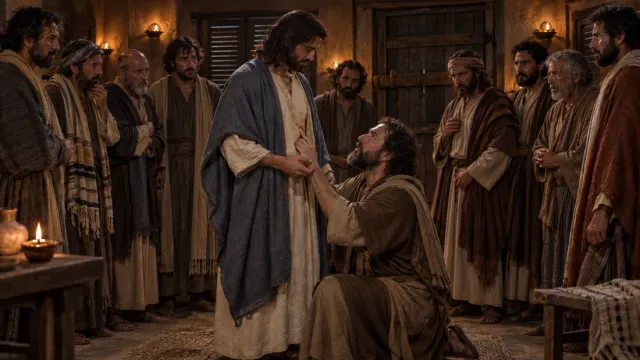
    The wording holds together closeness and distinction: my Father, and your Father; my God, and your God. Jesus brings the disciples into the message as brethren without simply flattening the sentence into "our Father." The two expressions belong beside each other. So do the command about touch and the command to go. Later in the same chapter Jesus invites Thomas to reach toward his wounds, which prevents this moment from becoming a general rule that the risen body cannot be approached.

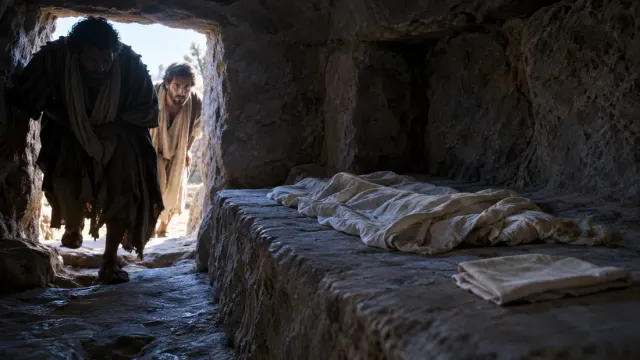
    Mary has now carried two reports in one morning. In verse 2 she reports that the Lord has been taken away. In verse 18 she reports that she has seen him. The same witness, a radically different claim. She does not merely revise the location of a body. She announces an encounter with the living person who has spoken to her.

    Verse by verse

    1. 20:17

      The Greek haptou can involve touching or holding on. A reading about clinging is possible, but the wording alone does not describe exactly how Mary was positioned.

    2. 20:17

      John 20:27 invites Thomas to approach Jesus' wounds, so this instruction to Mary should not become a blanket prohibition on touching the risen Jesus.

    3. 20:17

      Jesus says my Father and your Father, preserving both a shared relation to the Father and a distinction in the way he expresses it.

    4. 20:18

      The report concerns seeing the Lord and hearing his words, not merely finding the tomb empty.

    John 20:17-18

    King James Version · 2 verses

    20:17Jesus saith unto her, Touch me not; for I am not yet ascended to my Father: but go to my brethren, and say unto them, I ascend unto my Father, and your Father; and to my God, and your God.

    20:18Mary Magdalene came and told the disciples that she had seen the Lord, and that he had spoken these things unto her.

    John 20:17-18: I have seen the Lord

Why it matters

She is the only person present at all three of the events the creed is built on. When the stone is found moved she runs for Peter and John, and when they go home she stays outside weeping. The scene that follows is the quietest in the gospel: she mistakes him for the gardener, he says her name, and she turns. Then she is sent, go to my brethren and say unto them, and the first resurrection sermon in history is one line long and she preaches it.

14 songs

The music

Every song in the catalogue whose passage falls inside these chapters.

  1. Luke 8:22-39

    Where Is Your Faith?

  2. Matthew 27:57-66; Mark 15:42-47; Luke 23:50-56; John 19:38-42

    A Stone at the Door

  3. Matthew 27:1-31; Mark 15:1-20; Luke 22:63-23:25; John 18:28-19:16

    Behold the Man

  4. Matthew 27:32-56; Mark 15:21-41; Luke 23:26-49; John 19:16-37

    It Is Finished

  5. Matthew 27:57-66

    Sealed until the Third Day

  6. Matthew 27:27-56

    The Veil Was Torn

  7. Matthew 28:16-20; Mark 16:14-18

    Go Into All the World

  8. Matthew 28:1-10; Mark 16:1-11; Luke 24:1-12; John 20:1-18

    He Is Risen

  9. Mark 15:1-20

    Before Pilate

  10. Mark 15:21-47

    Truly This Man Was the Son of God

  11. Mark 16:1-20

    He Is Risen

  12. John 19:1-37

    It is Finished

    Play here
    Open song pageRead lyrics
  13. John 20:24-31

    Blessed Are They That Have Not Seen, and Yet Have Believed

  14. John 20:1-31

    These Are Written That Ye Might Believe

    Play here
    Open song pageRead lyrics

Nearby

All the people

Report an error on this page