
New · FreePlay The Witnesses The in-depth puzzle battle quest through Bible history

People of the Bible

Mary

Asked one practical question, got an answer that explained nothing, and agreed anyway.

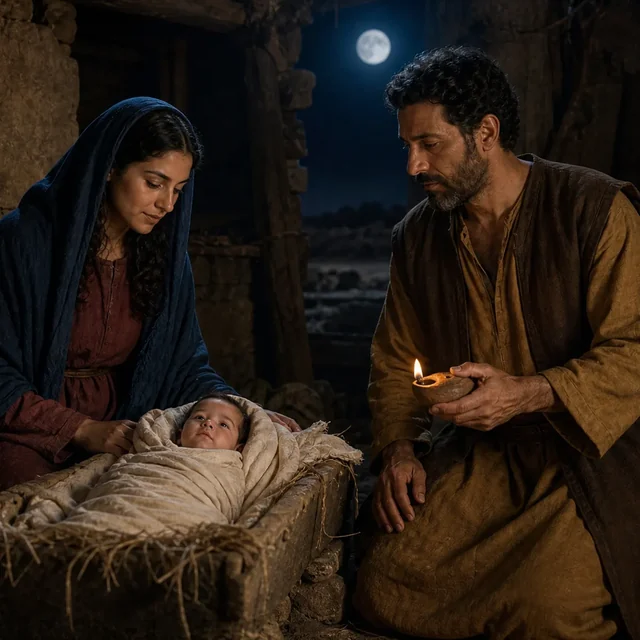
Mary is a young woman in Nazareth engaged to a carpenter when a messenger arrives with a greeting that troubles her before he has said anything else. She is told she will conceive, and her question is not doubt but logistics: how shall this be. The answer she is given is not a mechanism, it is a person and a promise, and she replies be it unto me according to your word. She travels to the hill country, sings a song about thrones cast down and the hungry filled, and then spends thirty years in a village.

Where she appearsMatthew 1 to 2 · Luke 1 to 2 · John 2 · John 19

Scroll down to the account
Mary

The movements, in the order the text gives them.

The Account of Mary

  1. 01

    Luke 1:26-38

    How shall this be

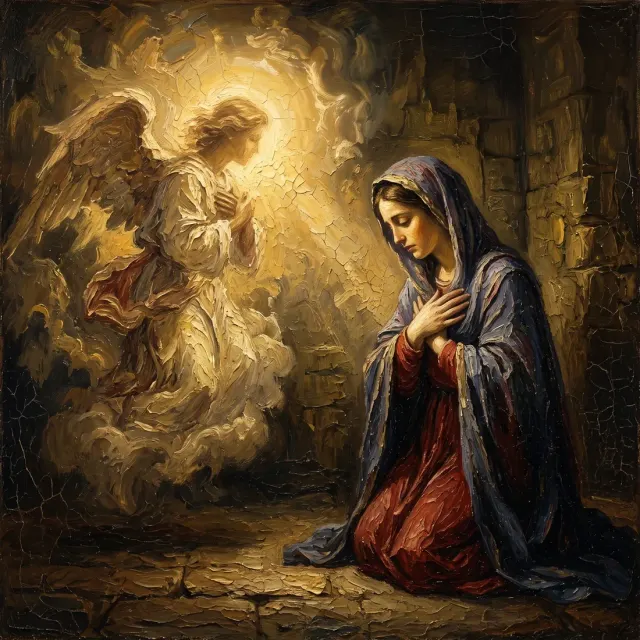
    The greeting troubles her before the message arrives. She asks the practical question, is told the Holy Ghost shall come upon her, and answers behold the handmaid of the Lord.

    Gabriel brings a kingdom into a conversation about a pregnancy. The throne of David, the house of Jacob, a reign without an ending: these are not ornamental titles added to good family news. They place Mary's child inside the promise of 2 Samuel 7, where David was told that his house and kingdom would be established for ever. The scale of the announcement is immense. Mary's question stays wonderfully precise. She asks how conception will occur, since she has not known a man. Luke does not rebuke that question. Unlike Zechariah, whose demand for assurance is explicitly named unbelief in 1:20, Mary receives an explanation of divine agency and a sign in Elizabeth's pregnancy. Asking a question is not, by itself, the opposite of believing.

    The answer identifies the Holy Ghost and the power of the Highest. It does not describe a human father or supply a biological mechanism. Mary's response neither pretends to understand every detail nor bargains for a less disruptive assignment. Behold the handmaid of the Lord identifies whose service she accepts; be it unto me according to thy word gives that acceptance a voice. Her words matter precisely because she is not a silent prop in the announcement. Luke records her attention, her question and her consent. Then the angel departs. The conversation ends, but its consequences belong to Mary.

    Verse by verse

    1. 1:28

      Kecharitomene is a perfect passive participle: the greeting describes Mary as the recipient of favour. The grammar alone does not settle every later doctrine concerning her.

    2. 1:32-33

      The throne and enduring kingdom recall the promise to David in 2 Samuel 7:12-16. Gabriel identifies the promised child as the Son of the Highest.

    3. 1:34

      Know is a biblical expression for sexual relations. Luke records Mary's question without the rebuke given to Zechariah in 1:20.

    4. 1:36

      The sixth month is the sixth month of Elizabeth's pregnancy. The Greek kinship word translated cousin means a female relative and does not specify first cousins.

    5. 1:38

      Handmaid renders doule, a female servant or slave. Mary speaks her acceptance; Luke does not invent a further account of her private thoughts.
    Luke 1:26-38

    King James Version · 13 verses

    1:26And in the sixth month the angel Gabriel was sent from God unto a city of Galilee, named Nazareth,

    1:27To a virgin espoused to a man whose name was Joseph, of the house of David; and the virgin’s name was Mary.

    1:28And the angel came in unto her, and said, Hail, thou that art highly favoured, the Lord is with thee: blessed art thou among women.

    1:29And when she saw him, she was troubled at his saying, and cast in her mind what manner of salutation this should be.

    1:30And the angel said unto her, Fear not, Mary: for thou hast found favour with God.

    1:31And, behold, thou shalt conceive in thy womb, and bring forth a son, and shalt call his name JESUS.

    1:32He shall be great, and shall be called the Son of the Highest: and the Lord God shall give unto him the throne of his father David:

    1:33And he shall reign over the house of Jacob for ever; and of his kingdom there shall be no end.

    1:34Then said Mary unto the angel, How shall this be, seeing I know not a man?

    1:35And the angel answered and said unto her, The Holy Ghost shall come upon thee, and the power of the Highest shall overshadow thee: therefore also that holy thing which shall be born of thee shall be called the Son of God.

    1:36And, behold, thy cousin Elisabeth, she hath also conceived a son in her old age: and this is the sixth month with her, who was called barren.

    1:37For with God nothing shall be impossible.

    1:38And Mary said, Behold the handmaid of the Lord; be it unto me according to thy word. And the angel departed from her.

    Luke 1:26-38: How shall this be
  2. 02

    Luke 1:39-56

    My soul magnifies the Lord

    She goes with haste to Elizabeth and the song that follows is about proud hearts scattered, the mighty put down from their seats, and the rich sent empty away.

    Mary begins with her own soul and ends with Abraham. That widening is the shape of the song. Elizabeth has blessed the mother and the child, but Mary's praise does not settle comfortably on being admired. The reason future generations will call her blessed is that the mighty one has done great things for her. The repeated actor is God: he regards, does, scatters, brings down, lifts up, fills and helps. Her low estate is not a decorative pose of modesty. It belongs beside the hungry and the lowly whom the song names, people whose standing is altered by God's action.

    The reversal has teeth. Thrones lose their occupants; the hungry receive good things; the rich leave empty. This is not merely a private feeling expressed in grand language. Mary places her pregnancy within Israel's history of mercy and within the promise made to Abraham. Hannah's prayer in 1 Samuel 2 is an especially close companion, with its broken strength, filled hunger and poor raised from the dust. These women do not reduce the birth of a child to a pleasant domestic occasion. They see it in relation to what God does with power. Luke later gives that same reversal a public voice in Jesus' blessings and woes in 6:20-26. Mary is not singing off to one side of the Gospel's concerns. She is already naming them.

    Verse by verse

    1. 1:41

      Elizabeth is explicitly filled with the Holy Ghost before she speaks. Luke supplies that basis for her recognition, rather than an invented private conversation.

    2. 1:45

      Elizabeth singles out Mary's belief in the fulfilment of the Lord's words. This contrasts with Zechariah's unbelief in 1:20.

    3. 1:48

      The word translated low estate, tapeinosis, concerns a lowly or humbled condition. Mary gives God's regard as the reason she will be called blessed.

    4. 1:52-53

      Seats means thrones in this context. The reversal concerns actual power, hunger and wealth, not only inner attitudes.

    5. 1:54-55

      Holpen is an older English form of helped. The close of the song identifies Israel and the promise to Abraham, preventing its reduction to Mary's private experience.

    Luke 1:39-56

    King James Version · 18 verses

    1:39And Mary arose in those days, and went into the hill country with haste, into a city of Juda;

    1:40And entered into the house of Zacharias, and saluted Elisabeth.

    1:41And it came to pass, that, when Elisabeth heard the salutation of Mary, the babe leaped in her womb; and Elisabeth was filled with the Holy Ghost:

    1:42And she spake out with a loud voice, and said, Blessed art thou among women, and blessed is the fruit of thy womb.

    1:43And whence is this to me, that the mother of my Lord should come to me?

    1:44For, lo, as soon as the voice of thy salutation sounded in mine ears, the babe leaped in my womb for joy.

    1:45And blessed is she that believed: for there shall be a performance of those things which were told her from the Lord.

    1:46And Mary said, My soul doth magnify the Lord,

    1:47And my spirit hath rejoiced in God my Saviour.

    1:48For he hath regarded the low estate of his handmaiden: for, behold, from henceforth all generations shall call me blessed.

    1:49For he that is mighty hath done to me great things; and holy is his name.

    1:50And his mercy is on them that fear him from generation to generation.

    1:51He hath shewed strength with his arm; he hath scattered the proud in the imagination of their hearts.

    1:52He hath put down the mighty from their seats, and exalted them of low degree.

    1:53He hath filled the hungry with good things; and the rich he hath sent empty away.

    1:54He hath holpen his servant Israel, in remembrance of his mercy;

    1:55As he spake to our fathers, to Abraham, and to his seed for ever.

    1:56And Mary abode with her about three months, and returned to her own house.

    Luke 1:39-56: My soul magnifies the Lord
  3. 03

    Luke 2:33-35

    A sword shall pierce your own soul

    Simeon blesses them and then turns to her alone with a sentence nobody asked for, about a child set for the falling and rising again of many, and a sword.

    Simeon blesses the parents and then refuses to make the blessing comfortable. The child who has just been called light and glory will also be a sign spoken against. Those descriptions belong together. Luke does not arrange the opposition as an embarrassing exception to a successful mission; it is named while the child is still being presented in the temple. The coming of salvation will disclose resistance as well as welcome.

    Then the words narrow from many in Israel to Mary herself. A sword shall pierce through thy own soul also is not a prediction that she will be physically stabbed, nor an invitation to invent every feeling she will have. It says that the division surrounding her son will reach her personally. John 19:25 places his mother at the cross, giving that warning a terrible concrete setting. Yet Simeon's final clause looks beyond the mother's sorrow: the thoughts of many hearts will be revealed. Jesus will not simply occupy a place within settled expectations. Reactions to him will expose what those expectations contain. Mary receives no promise that nearness to him will keep suffering at a distance. She has been called blessed. She has not been called untouched.

    Verse by verse

    1. 2:33

      Marvelling does not mean the parents have heard nothing about the child before. Luke has already recorded announcements to Mary and the shepherds.

    2. 2:34

      Readers differ over whether fall and rising describe different groups or a humbling and raising within the same people. The text clearly associates the child with division and disclosure.

    3. 2:35

      The sword is rhomphaia in Greek, a forceful image of piercing suffering. John 19:25 supplies the explicit later picture of Mary beside the cross.

    Luke 2:33-35

    King James Version · 3 verses

    2:33And Joseph and his mother marvelled at those things which were spoken of him.

    2:34And Simeon blessed them, and said unto Mary his mother, Behold, this child is set for the fall and rising again of many in Israel; and for a sign which shall be spoken against;

    2:35(Yea, a sword shall pierce through thy own soul also,) that the thoughts of many hearts may be revealed.

    Luke 2:33-35: A sword shall pierce your own soul
  4. 04

    John 2:1-11

    Whatever he says to you, do it

    At a wedding she states the problem in three words, they have no wine, is answered with what looks like a refusal, and instructs the servants anyway.

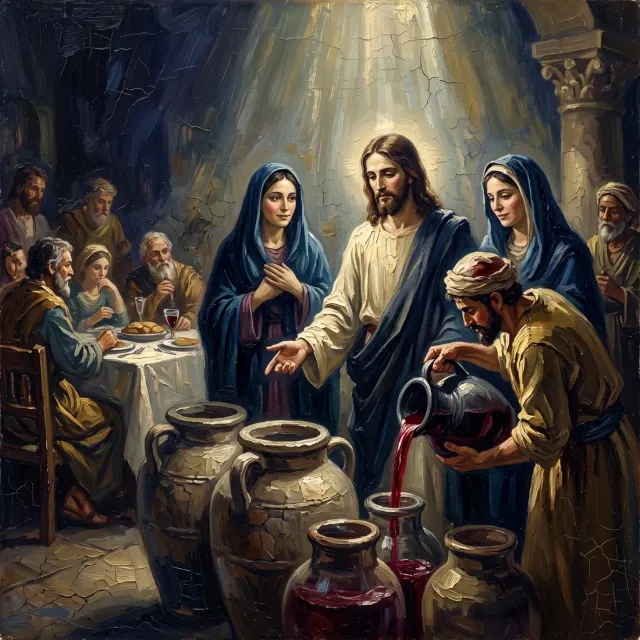
    The man responsible for the feast knows less than the servants carrying the water. John puts that detail in a parenthesis, but it rearranges the room. The ruler tastes the result and congratulates the bridegroom; the servants know where it came from. Mary has brought the lack of wine to Jesus without prescribing the solution. After his answer, she directs the servants toward his words, not toward a plan of her own. Her place in the sign is neither absent nor controlling. She names the need and leaves the action with him.

    Woman can sound brusque to modern ears, but the same address returns when Jesus provides for his mother at the cross in John 19:26. The question that follows does mark a boundary: his hour is not governed simply by a family request. John will identify that hour with glorification and death in 12:23-27. Here the sign reveals glory in advance, amid stone waterpots associated with purification and filled to the brim. The text gives abundance and unexpected quality, not merely enough liquid to rescue the arrangements. Yet the final verdict is not that the reception was saved. Jesus manifested his glory, and his disciples believed on him. The bridegroom gets the compliment. The disciples receive something considerably larger.

    Verse by verse

    1. 2:3

      Wanted wine means that the wine was lacking, not merely that someone preferred another drink. The text does not identify Mary as the host or organizer.

    2. 2:4

      Woman is also used in the caring address of John 19:26. The accompanying question at Cana distinguishes Jesus' mission and timing from ordinary family direction.

    3. 2:5

      Mary tells the servants to obey whatever Jesus says. She does not describe a miracle in advance or specify how the shortage should be resolved.

    4. 2:6

      The vessels are stone waterpots used in Jewish purification. Their stated purpose belongs to the sign's setting and should not be replaced with ordinary wine storage.

    5. 2:9-11

      John explicitly distinguishes what the ruler does not know from what the servants know. The closing verse identifies glory and belief as the sign's consequence.

    John 2:1-11

    King James Version · 11 verses

    2:1And the third day there was a marriage in Cana of Galilee; and the mother of Jesus was there:

    2:2And both Jesus was called, and his disciples, to the marriage.

    2:3And when they wanted wine, the mother of Jesus saith unto him, They have no wine.

    2:4Jesus saith unto her, Woman, what have I to do with thee? mine hour is not yet come.

    2:5His mother saith unto the servants, Whatsoever he saith unto you, do it.

    2:6And there were set there six waterpots of stone, after the manner of the purifying of the Jews, containing two or three firkins apiece.

    2:7Jesus saith unto them, Fill the waterpots with water. And they filled them up to the brim.

    2:8And he saith unto them, Draw out now, and bear unto the governor of the feast. And they bare it.

    2:9When the ruler of the feast had tasted the water that was made wine, and knew not whence it was: (but the servants which drew the water knew;) the governor of the feast called the bridegroom,

    2:10And saith unto him, Every man at the beginning doth set forth good wine; and when men have well drunk, then that which is worse: but thou hast kept the good wine until now.

    2:11This beginning of miracles did Jesus in Cana of Galilee, and manifested forth his glory; and his disciples believed on him.

    John 2:1-11: Whatever he says to you, do it
  5. 05

    John 19:25-27

    Woman, behold your son

    She is standing by the cross. He arranges her care between two sentences of his own execution, and from that hour the disciple takes her to his own home.

    A dying son arranges somewhere for his mother to belong. The scale of John's claims about Jesus does not make that practical provision too small to record. Immediately before this scene, soldiers divide his clothing. Here he gives neither clothing nor property, but a relationship: his mother is entrusted to the beloved disciple, and the disciple is addressed as her son. The two statements belong together. Mary is not simply an obligation handed over; a place within a household is being formed.

    John records her standing by the cross without supplying a speech, a collapse or an account of her inner thoughts. The restraint is not a denial of the suffering. It lets the visible fact stand: his mother is there. Woman recalls his address at Cana, where his hour had not yet come. Now, within the passion, he speaks again and the disciple acts from that hour. Interpretations that see a wider picture of the believing community begin from this concrete act of care; they should not erase it. Acts 1:14 later names Mary among those continuing together in prayer, alongside the apostles and Jesus' brethren. The cross is not her last named appearance in Scripture. Nor does Scripture provide the date or circumstances of her death. What this passage gives is exact and sufficient: she is seen, addressed and received.

    Verse by verse

    1. 19:25

      The punctuation and grouping of the women's names permit readings of three or four women. The presence of Jesus' mother is not in doubt.

    2. 19:26

      The beloved disciple is traditionally identified as John son of Zebedee. This verse itself describes him by his relationship to Jesus, not by name.

    3. 19:27

      The act of taking Mary into his own household begins from that hour. The passage does not identify a later residence or describe the remainder of her life.

    John 19:25-27

    King James Version · 3 verses

    19:25Now there stood by the cross of Jesus his mother, and his mother’s sister, Mary the wife of Cleophas, and Mary Magdalene.

    19:26When Jesus therefore saw his mother, and the disciple standing by, whom he loved, he saith unto his mother, Woman, behold thy son!

    19:27Then saith he to the disciple, Behold thy mother! And from that hour that disciple took her unto his own home.

    John 19:25-27: Woman, behold your son

Why it matters

Her song in Luke 1 is the longest speech by a woman in the New Testament and it is almost entirely made of the Old: Hannah, the psalms, the prophets. It is not a lullaby either. Twice Luke says she kept these things and pondered them in her heart, which is his way of telling you where he got the material. She is at the first sign at Cana, she is outside the door when he is teaching, and she is standing by the cross at the end.

16 songs

The music

Every song in the catalogue whose passage falls inside these chapters.

  1. Matthew 1:18-25

    Emmanuel in Joseph's Dream

  2. Matthew 1-2; Luke 2:1-38

    Glory in the Highest

  3. Matthew 2:1-23

    The Star and the Sword

    Play here
    Open song pageRead lyrics
  4. Luke 1:5-25

    A Son Named John

    Play here
    Open song pageRead lyrics
  5. Luke 1

    Be It Unto Me

  6. Luke 1:39-56

    Blessed Among Women

    Play here
    Open song pageRead lyrics
  7. Luke 1:57-80

    His Name Is John

    Play here
    Open song pageRead lyrics
  8. Luke 1:26-38

    The Annunciation

    Play here
    Open song pageRead lyrics
  9. Luke 2:21-40

    A Light to Lighten the Gentiles

    Play here
    Open song pageRead lyrics
  10. Luke 2:1-7

    Born in Bethlehem

    Play here
    Open song pageRead lyrics
  11. Luke 2:8-20

    Glory in the Highest

    Play here
    Open song pageRead lyrics
  12. Luke 2:41-52

    My Father's Business

    Play here
    Open song pageRead lyrics
  13. John 2:1-11

    The First Sign

  14. John 2:13-25

    The Zeal of Thine House

    Play here
    Open song pageRead lyrics
  15. John 2:1-12

    Whatsover He Saith Unto You

    Play here
    Open song pageRead lyrics
  16. John 19:1-37

    It is Finished

    Play here
    Open song pageRead lyrics

Nearby

All the people

Report an error on this page