

New · FreePlay The Witnesses The in-depth puzzle battle quest through Bible history

People of the Bible

Simeon

Was promised he would not die before he had seen it, and spent the rest of his life going to the temple.

Simeon is just and devout and waiting for the consolation of Israel, and it had been revealed to him that he would not see death before he had seen the Lord’s Christ. He comes by the Spirit into the temple on the day a poor couple arrive to do what the law required, with two turtledoves rather than a lamb because that is what they can afford. He takes the child up in his arms, and the first thing he says is that he is ready to go.

Where he appearsLuke 2

Scroll down to the account
Simeon

The movements, in the order the text gives them.

The Account of Simeon

  1. 01

    Luke 2:25-27

    Waiting for the consolation

    Three things are said about him before he speaks: just, devout, and waiting. The Holy Ghost was upon him, and he came by the Spirit into the temple on exactly the right day.

    Luke identifies Simeon by what he is waiting for, not by his age or his office. Neither of those is supplied. What matters is that he is just and devout, and that Israel's consolation is still, to him, something worth expecting. Consolation is not merely a quieter state of mind. Isaiah 40 opens with comfort for God's people and the announcement that the Lord is coming. Simeon's expectation belongs to that large horizon.

    The Holy Ghost appears in each of these three verses: upon him, revealing the promise to him, then bringing him into the temple. The repetition explains the recognition that follows. This is not a man who happens to be unusually good at identifying important babies. Luke attributes his presence and his understanding to the Spirit. The promise is also quite specific. He will see the Lord's Christ before he dies. It gives him an encounter, not a date, an age, or an exemption from death.

    Meanwhile, the parents enter to do what the law requires. Their obedience and Simeon's Spirit-led arrival meet in the same place. Luke has not arranged a contest between the law and the Spirit. Both bring attention to the child.

    Verse by verse

    1. 2:25

      Luke does not identify Simeon as a priest or give his age. Familiar depictions of an elderly priest go beyond these verses.

    2. 2:26

      Christ means anointed one. The promise concerns seeing the Messiah before death, not seeing every part of his ministry completed.

    3. 2:27

      The parents are fulfilling the requirements described in Luke 2:22-24; Simeon arrives under the Spirit's guidance. The two descriptions are complementary here.
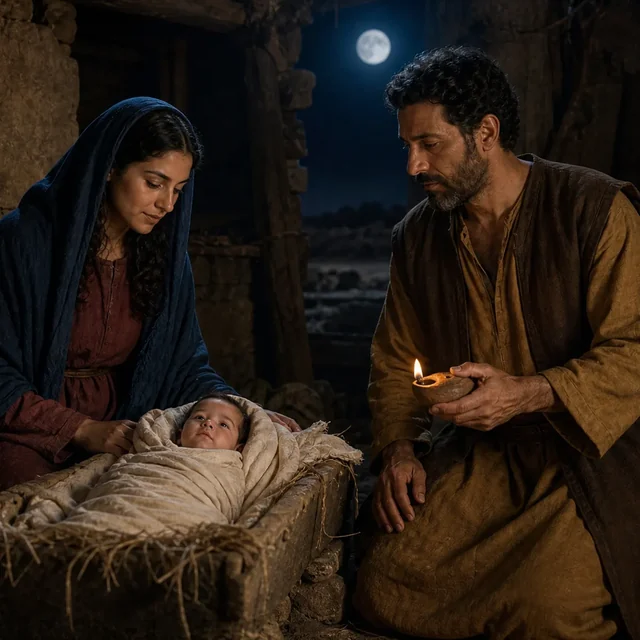
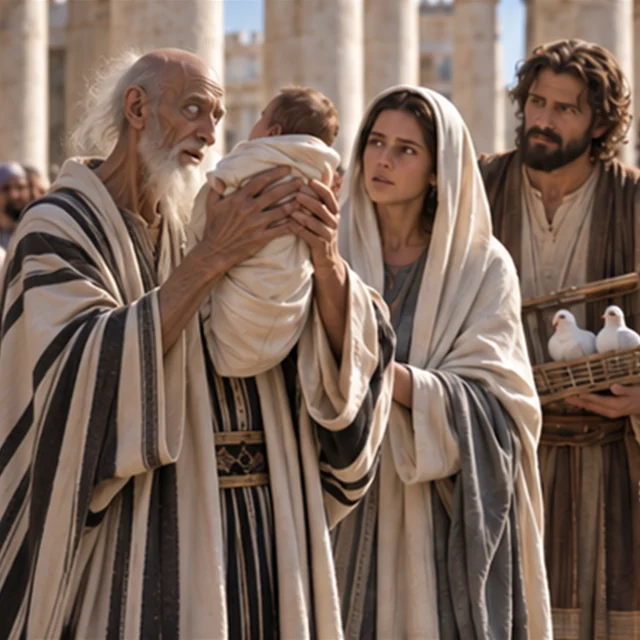
    Luke 2:25-27

    King James Version · 3 verses

    2:25And, behold, there was a man in Jerusalem, whose name was Simeon; and the same man was just and devout, waiting for the consolation of Israel: and the Holy Ghost was upon him.

    2:26And it was revealed unto him by the Holy Ghost, that he should not see death, before he had seen the Lord’s Christ.

    2:27And he came by the Spirit into the temple: and when the parents brought in the child Jesus, to do for him after the custom of the law,

    Luke 2:25-27: Waiting for the consolation
  2. 02

    Luke 2:28-32

    Now let your servant depart in peace

    He takes the child in his arms and asks to be released. Mine eyes have seen your salvation, prepared before the face of all people, a light to the Gentiles and the glory of Israel.

    Simeon calls the child in his arms salvation. Not a sign that salvation might eventually become possible, but thy salvation, present enough to be held. The scale of his language makes the physical detail matter. His hands receive one child; his words reach all people. The temple ceremony has not changed its outward size. Its significance has.

    Now lettest thou thy servant depart in peace is not a report that Simeon dies that afternoon. Luke gives no such conclusion. It is the speech of a servant whose master's promise has been fulfilled. According to thy word is the hinge: what God had said Simeon would see has now passed before his eyes. The peace rests on that correspondence between promise and sight, not on a stated weariness with living. Luke does not supply a private explanation where Simeon has already supplied a public one.

    The prayer then refuses to keep the event private. Salvation is prepared before the face of all people, light for the Gentiles and glory for Israel. Isaiah 49:6 had joined light to the nations with salvation reaching the earth's ends. Simeon places that reach inside Israel's hope, not against it. Israel's glory and the Gentiles' light stand together in his final sentence. The child is small enough for his arms. The promise is not.

    Verse by verse

    1. 2:28

      The child is physically in Simeon's arms when he speaks of seeing salvation. Luke keeps the bodily detail beside the worldwide claim.

    2. 2:29

      Depart translates a verb used for releasing or dismissing. Simeon speaks of peaceful release after the fulfillment of the promise, without a recorded death scene.

    3. 2:32

      Isaiah 49:6 supplies the language of light to the Gentiles; Acts 13:47 quotes that verse in connection with the mission to the nations.

    Luke 2:28-32

    King James Version · 5 verses

    2:28Then took he him up in his arms, and blessed God, and said,

    2:29Lord, now lettest thou thy servant depart in peace, according to thy word:

    2:30For mine eyes have seen thy salvation,

    2:31Which thou hast prepared before the face of all people;

    2:32A light to lighten the Gentiles, and the glory of thy people Israel.

    Luke 2:28-32: Now let your servant depart in peace
  3. 03

    Luke 2:33-35

    Set for the fall and rising of many

    The parents marvel. He blesses them and then turns to Mary alone, and the blessing turns into a warning about division, about a sign spoken against, and about a sword.

    The blessing does not make the prophecy comfortable. Simeon blesses the parents, then turns specifically to Mary and speaks of opposition, falling, and a sword. The same man who has just called the child light for the Gentiles does not mistake that light for universal applause. A sign can be given by God and spoken against by people. Rejection will not, by itself, disprove the promise.

    The fall and rising again of many recalls the unsettling side of Israel's prophetic hope. Isaiah 8:14-15 describes the Lord as a sanctuary and also a stone over which many stumble. Simeon's words likewise refuse a single, uncomplicated response. Readers differ over whether falling and rising describe different people or humiliation followed by restoration within the same people. The verse does not map every individual into a category. It does announce that this child will not leave Israel unchanged.

    Mary is not placed safely outside that disturbance. The sword reaches her own soul also. The language names personal anguish, not a recorded physical wound or a second saving sacrifice. John 19:25 places her beside the cross, giving the warning a terrible concrete setting without exhausting every possible reference. The final emphasis is exposure: the thoughts of many hearts are revealed. Responses to Jesus disclose the people responding. Simeon has blessed this family without concealing the cost.

    Verse by verse

    1. 2:34

      The fall and rising have been read as different outcomes for different people, or as judgment followed by restoration. The wording does not explicitly settle that distinction.

    2. 2:34-35

      The sign is opposed; opposition is not presented as proof that God has failed. Isaiah 8:14-15 provides a related pattern of sanctuary and stumbling.

    3. 2:35

      The sword pierces Mary's soul. The verse does not predict her death by a literal sword; John 19:25 records her presence at Jesus' cross.

    Luke 2:33-35

    King James Version · 3 verses

    2:33And Joseph and his mother marvelled at those things which were spoken of him.

    2:34And Simeon blessed them, and said unto Mary his mother, Behold, this child is set for the fall and rising again of many in Israel; and for a sign which shall be spoken against;

    2:35(Yea, a sword shall pierce through thy own soul also,) that the thoughts of many hearts may be revealed.

    Luke 2:33-35: Set for the fall and rising of many

Why it matters

His song is thirty-two words and it is the only place in the nativity where the nations are put first: a light to lighten the Gentiles, and the glory of your people Israel. Then he blesses the parents and says something to the mother alone that nobody would want to hear on that day, about a child set for the fall and rising again of many, a sign spoken against, and a sword through her own soul.

4 songs

The music

Every song in the catalogue whose passage falls inside these chapters.

  1. Luke 2:21-40

    A Light to Lighten the Gentiles

    Play here
    Open song pageRead lyrics
  2. Luke 2:1-7

    Born in Bethlehem

    Play here
    Open song pageRead lyrics
  3. Luke 2:8-20

    Glory in the Highest

    Play here
    Open song pageRead lyrics
  4. Luke 2:41-52

    My Father's Business

    Play here
    Open song pageRead lyrics

Nearby

All the people

Report an error on this page