

New · FreePlay The Witnesses The in-depth puzzle battle quest through Bible history

People of the Bible

Anna the prophetess

Eighty-four years old, widowed after seven years of marriage, and in the temple when it happened.

Anna gets three verses and every one of them is specific. She is a prophetess, daughter of Phanuel, of the tribe of Asher, one of the northern tribes that had been scattered for seven hundred years. She was married seven years and has been a widow ever since, and she departs not from the temple but serves God with fastings and prayers night and day. She comes in at that instant, and she does two things: she gives thanks, and she tells everybody who was waiting.

Where she appearsLuke 2

Scroll down to the account
Anna the prophetess

The movements, in the order the text gives them.

The Account of Anna the prophetess

  1. 01

    Luke 2:36-37

    She departed not from the temple

    The details are exact: the tribe, the father, seven years of marriage, and eighty-four years of widowhood spent fasting and praying night and day.

    Anna receives a name, a father's name, a tribe, and a prophetic title before she receives a line of action. Luke has no intention of leaving her as an anonymous elderly woman in the background. A daughter of Asher stands in Jerusalem's temple, recognizable within Israel's history and carrying a ministry of her own. Prophetess is Luke's description, not a compliment invented after her death.

    Seven years of marriage are followed by a long widowhood. The eighty-four years can be read as her age or as the duration of that widowhood; the wording has produced both readings. A precise reconstructed birthday would claim more than the passage permits. Her great age, however, is explicit. So is what fills her time: fasting and prayer, night and day. Luke calls this service to God. He does not describe her as merely waiting for something useful to do.

    Departed not from the temple makes its place in her life unmistakable, though no room, sleeping arrangement, or official appointment is specified. Her devotion is sustained, concrete, and active. The years have not made her a spectator.

    Verse by verse

    1. 2:36

      Asher is the tribe named Aser in this KJV passage. Anna is not identified as belonging to the priestly tribe of Levi.

    2. 2:36-37

      The seven years describe her married life, not her age at marriage. Readers differ over whether eighty-four gives her total age or the years of widowhood.

    3. 2:37

      The Greek verb latreuo describes religious service or worship. Luke applies it to her fasting and prayers, without assigning her a priestly office.
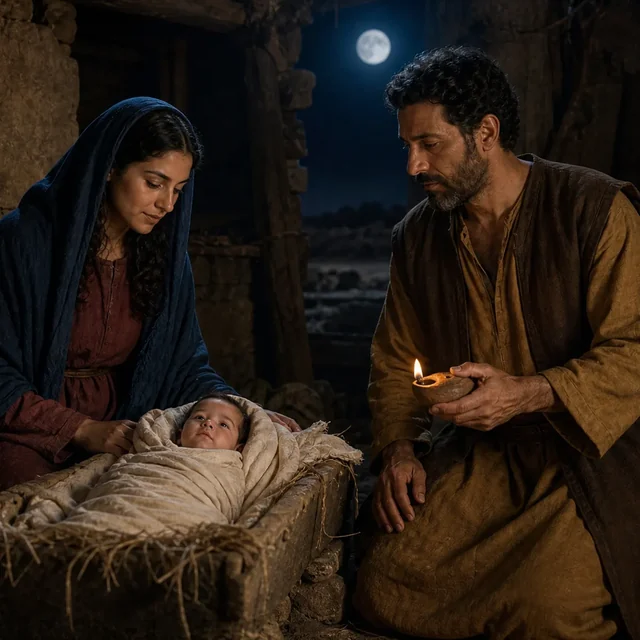
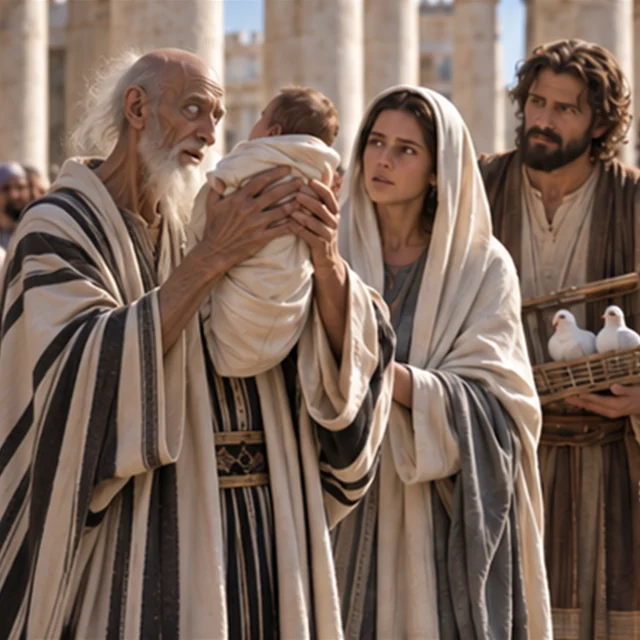
    Luke 2:36-37

    King James Version · 2 verses

    2:36And there was one Anna, a prophetess, the daughter of Phanuel, of the tribe of Aser: she was of a great age, and had lived with an husband seven years from her virginity;

    2:37And she was a widow of about fourscore and four years, which departed not from the temple, but served God with fastings and prayers night and day.

    Luke 2:36-37: She departed not from the temple
  2. 02

    Luke 2:38

    She coming in that instant

    The timing is the whole verse. She arrives while Simeon is still there, gives thanks to the Lord, and speaks of him to all who looked for redemption in Jerusalem.

    A lifetime of devotion meets one particular instant. Anna comes up while the encounter with Simeon is taking place, and her first recorded response is thanksgiving. The timing belongs to the point. The child has not yet taught in the temple or performed a public sign there. Mary and Joseph have brought him under the requirements of the law, and this prophetess recognizes reason to praise God in their arrival.

    Luke gives Simeon's words at length but does not quote Anna's prayer. That difference in the record is not a difference between a speaking man and a silent woman: the same verse explicitly says that she spoke. Her exact sentences are simply not preserved. The contents must not be supplied by an imaginary speech, however attractive the occasion might be.

    Gave thanks likewise places her praise beside what has just been heard. A second named witness joins the recognition of the child. Luke does not make her ask permission, earn attention through a new miracle, or explain her entire prophetic career. The introduction has established who she is. Here, she gives thanks.

    Verse by verse

    1. 2:38

      That instant links Anna's arrival to the encounter just described. The Greek expression is literally that very hour, not a measured number of seconds.

    2. 2:38

      Luke records Anna's thanksgiving without preserving its exact words. Her prayer must not be reconstructed as a quotation.

    Luke 2:38

    King James Version · 1 verse

    2:38And she coming in that instant gave thanks likewise unto the Lord, and spake of him to all them that looked for redemption in Jerusalem.

    Luke 2:38: She coming in that instant
  3. 03

    Luke 2:38

    To all that looked for redemption

    There was a group of people waiting, and she knew who they were. She is the first to carry the news to anyone outside the room.

    The people waiting for redemption now have someone to speak to them about the child. Anna's thanksgiving does not stay between herself and God. Luke turns immediately from what she says in praise to whom she addresses: all them that looked for redemption in Jerusalem. Their expectation existed before her announcement. What she supplies is its connection to this particular person.

    That small group description matters to the larger Gospel. Jerusalem will contain opposition to Jesus, but Luke does not make the city a single undifferentiated voice. Here are people within it waiting for God's deliverance, and a prophetess speaking to them. Their names and numbers are not given. Neither are their exact expectations about how redemption must unfold. Anna's words cannot be expanded into a complete political program or a detailed explanation of the cross.

    Luke 24:21 returns to the hope that Jesus would redeem Israel, now spoken in disappointment on the road to Emmaus. Jesus answers by explaining suffering and glory from Scripture. Anna's audience stands near the beginning of that same vocabulary of hope. Her recorded contribution is precise: she speaks of him. The expectation has a name and a face.

    Verse by verse

    1. 2:38

      The Greek verb for her speaking is imperfect, presenting the activity as ongoing rather than merely recording one isolated sentence. It does not specify how many days she spoke.

    2. 2:38

      The KJV reads redemption in Jerusalem. Greek manuscripts also preserve a form without the preposition, commonly understood as redemption of Jerusalem.

    3. 2:38

      Luke 24:21 and 24:26-27 return to Israel's redemption and explain the Messiah's suffering within that hope. Anna herself is not named again in Scripture.

    Luke 2:38

    King James Version · 1 verse

    2:38And she coming in that instant gave thanks likewise unto the Lord, and spake of him to all them that looked for redemption in Jerusalem.

    Luke 2:38: To all that looked for redemption

Why it matters

Luke pairs her with Simeon deliberately, a man and a woman, and gives her the part that carries further. Simeon says his piece and is ready to depart; Anna speaks of the child to all them that looked for redemption in Jerusalem, which makes her the first person in the gospels to tell anyone else. Her tribe is worth noticing too: Asher had been gone since the Assyrians, and Luke names it without comment.

4 songs

The music

Every song in the catalogue whose passage falls inside these chapters.

  1. Luke 2:21-40

    A Light to Lighten the Gentiles

    Play here
    Open song pageRead lyrics
  2. Luke 2:1-7

    Born in Bethlehem

    Play here
    Open song pageRead lyrics
  3. Luke 2:8-20

    Glory in the Highest

    Play here
    Open song pageRead lyrics
  4. Luke 2:41-52

    My Father's Business

    Play here
    Open song pageRead lyrics

Nearby

All the people

Report an error on this page