New · FreePlay The Witnesses The in-depth puzzle battle quest through Bible history

People of the Bible

Ruth

A Moabite widow with no reason to stay, who would not be sent home.

Ruth marries into a family of foreigners who came to Moab because of a famine, and within ten years the father and both sons are dead. Her mother in law tells both daughters in law to go back to their mothers’ houses and find husbands, and means it, and one of them goes. Ruth does not. What she says instead is the most quoted speech in the book and it is a vow of nationality and of burial, not of affection. Then she follows an old woman into a country that has no obligation to her, and goes out to glean behind the reapers in a field she picks by chance.

Where she appearsRuth 1 to 4

Scroll down to the account
Ruth

The movements, in the order the text gives them.

The Account of Ruth

  1. 01

    Ruth 1:8-18

    Where you go, I will go

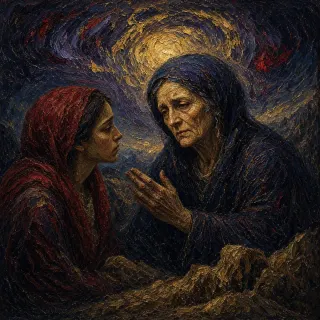
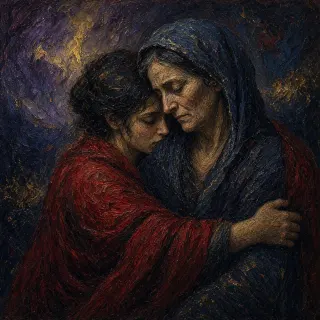
    Naomi releases them twice and argues her own case for why staying makes no sense. Orpah kisses her and leaves. Ruth clings to her and swears by the LORD with a curse on herself if anything but death parts them.

    These words are addressed to a mother-in-law, not a bridegroom. Ruth is not promising to build a household with a man who can offer her a future; she is refusing to leave a widow who has just argued, at considerable length, that she has no future to offer. Naomi's argument removes one possible husband after another, even the imaginary sons of an impossible remarriage. Ruth answers without asking for a husband at all.

    The pledge widens as it goes: journey, lodging, people, God, death, burial. A temporary escort could end at Bethlehem. Shared burial cannot be described as a short visit. Ruth also invokes the LORD as the witness and enforcer of her commitment, naming the God she has just chosen rather than merely expressing affection for Naomi.

    Orpah's kiss is not erased to make Ruth's cleaving look stronger. Both women weep; both have already been praised for kindness. What distinguishes Ruth is the attachment she will not relinquish. Naomi finally stops arguing. Ruth has answered the calculation with a commitment.

    Verse by verse

    1. 1:8

      Naomi explicitly credits both daughters-in-law with kindness to the dead and to herself. The passage does not introduce Orpah as an uncaring contrast.

    2. 1:9

      The requested "rest" is located in a husband's household. It means settled security here, not merely relief from travel.

    3. 1:17

      The reference to burial extends the pledge beyond accompanying Naomi home. Ruth commits her own place among the dead to the same people and land.

    4. 1:18

      Naomi stops trying to persuade Ruth to turn back. The verse does not say the two never speak again.

    Ruth 1:8-18

    King James Version · 11 verses

    1:8And Naomi said unto her two daughters in law, Go, return each to her mother’s house: the LORD deal kindly with you, as ye have dealt with the dead, and with me.

    1:9The LORD grant you that ye may find rest, each of you in the house of her husband. Then she kissed them; and they lifted up their voice, and wept.

    1:10And they said unto her, Surely we will return with thee unto thy people.

    1:11And Naomi said, Turn again, my daughters: why will ye go with me? are there yet any more sons in my womb, that they may be your husbands?

    1:12Turn again, my daughters, go your way; for I am too old to have an husband. If I should say, I have hope, if I should have an husband also to night, and should also bear sons;

    1:13Would ye tarry for them till they were grown? would ye stay for them from having husbands? nay, my daughters; for it grieveth me much for your sakes that the hand of the LORD is gone out against me.

    1:14And they lifted up their voice, and wept again: and Orpah kissed her mother in law; but Ruth clave unto her.

    1:15And she said, Behold, thy sister in law is gone back unto her people, and unto her gods: return thou after thy sister in law.

    1:16And Ruth said, Intreat me not to leave thee, or to return from following after thee: for whither thou goest, I will go; and where thou lodgest, I will lodge: thy people shall be my people, and thy God my God:

    1:17Where thou diest, will I die, and there will I be buried: the LORD do so to me, and more also, if ought but death part thee and me.

    1:18When she saw that she was stedfastly minded to go with her, then she left speaking unto her.

  2. 02

    Ruth 2:1-13

    She happened on the field

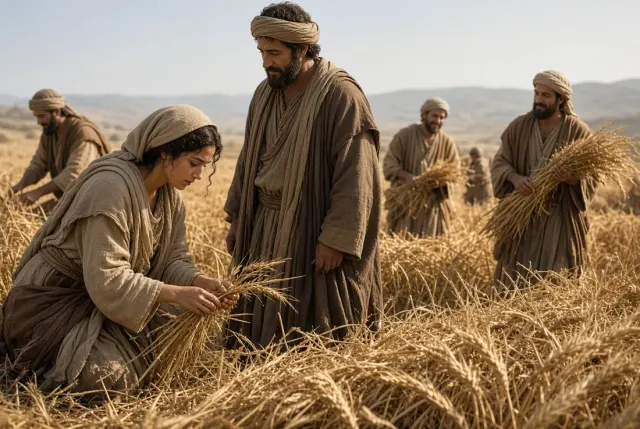
    She goes out to glean and the Book of Ruth says her chance took her to the part of the field belonging to Boaz. He asks who she is and then tells her he has heard everything she did.

    The chapter introduces Boaz before Ruth reaches his field. That order gives the reader a piece of information the working woman has not yet been shown to possess: the owner belongs to Elimelech's family. Ruth goes looking for permission to gather grain, not for a named relative or a marriage arrangement. The family connection stands behind her apparent good fortune without replacing the ordinary acts of asking, walking, and working.

    When the overseer identifies her, he begins with Moab. When Boaz explains his attention, he begins with what she has done for Naomi. The foreign origin remains true, but it is no longer the whole description. His kindness is also unusually concrete: company with the women, orders preventing the men from touching her, access to their drawn water. The blessing about shelter under the LORD's wings comes after shelter has begun to acquire practical form.

    Ruth calls herself a stranger and marvels that she has been noticed. Boaz's answer gives the reason in public actions, not appearance. Her loyalty arrived in Bethlehem before she reached his field.

    Verse by verse

    1. 2:2

      Gleaning means collecting grain left by the harvesters. Leviticus 19:9-10 and Deuteronomy 24:19 reserve such provision for vulnerable people, including the stranger and widow.

    2. 2:7

      The overseer describes work continuing from morning with a short rest. The verse does not make Ruth an employee hired for wages.

    3. 2:9

      Boaz's orders establish protection as well as permission to gather. Water already drawn by the workers is made available to her.

    4. 2:11

      The description of leaving parents and native land recalls the kind of departure commanded to Abram in Genesis 12:1. The comparison concerns the wording of departure, not an identical commission.

    Ruth 2:1-13: She happened on the field

    Ruth 2:1-13

    King James Version · 13 verses

    2:1And Naomi had a kinsman of her husband’s, a mighty man of wealth, of the family of Elimelech; and his name was Boaz.

    2:2And Ruth the Moabitess said unto Naomi, Let me now go to the field, and glean ears of corn after him in whose sight I shall find grace. And she said unto her, Go, my daughter.

    2:3And she went, and came, and gleaned in the field after the reapers: and her hap was to light on a part of the field belonging unto Boaz, who was of the kindred of Elimelech.

    2:4And, behold, Boaz came from Beth-lehem, and said unto the reapers, The LORD be with you. And they answered him, The LORD bless thee.

    2:5Then said Boaz unto his servant that was set over the reapers, Whose damsel is this?

    2:6And the servant that was set over the reapers answered and said, It is the Moabitish damsel that came back with Naomi out of the country of Moab:

    2:7And she said, I pray you, let me glean and gather after the reapers among the sheaves: so she came, and hath continued even from the morning until now, that she tarried a little in the house.

    2:8Then said Boaz unto Ruth, Hearest thou not, my daughter? Go not to glean in another field, neither go from hence, but abide here fast by my maidens:

    2:9Let thine eyes be on the field that they do reap, and go thou after them: have I not charged the young men that they shall not touch thee? and when thou art athirst, go unto the vessels, and drink of that which the young men have drawn.

    2:10Then she fell on her face, and bowed herself to the ground, and said unto him, Why have I found grace in thine eyes, that thou shouldest take knowledge of me, seeing I am a stranger?

    2:11And Boaz answered and said unto her, It hath fully been shewed me, all that thou hast done unto thy mother in law since the death of thine husband: and how thou hast left thy father and thy mother, and the land of thy nativity, and art come unto a people which thou knewest not heretofore.

    2:12The LORD recompense thy work, and a full reward be given thee of the LORD God of Israel, under whose wings thou art come to trust.

    2:13Then she said, Let me find favour in thy sight, my lord; for that thou hast comforted me, and for that thou hast spoken friendly unto thine handmaid, though I be not like unto one of thine handmaidens.


  3. 03

    Ruth 2:14-23

    Handfuls left on purpose

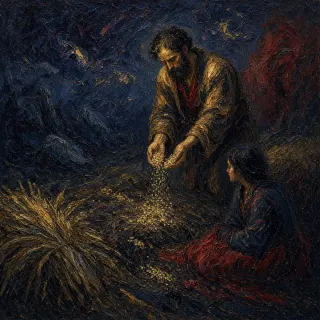
    He tells the young men to pull stalks out of the bundles and leave them for her, and not to reproach her. She beats out an ephah, which is far more than a day of gleaning should yield.

    Boaz arranges for his workers to become less efficient. Grain is to be pulled out and left where Ruth can gather it, and the men are forbidden to turn the arrangement into an occasion for rebuke. This is not carelessness in the harvest. It is deliberate provision, with Ruth's access protected by the owner's orders.

    The movement of food deserves attention. At the meal Ruth eats enough and has some left; at home she gives Naomi what she saved. The barley she beats out is a second provision, not a replacement for that carried meal. The loyalty declared on the road has become food brought through a doorway.

    Only after seeing the produce does Naomi learn the name Boaz. Her blessing then reaches beyond the day's hunger to kindness toward the living and the dead, because this generous landowner belongs to the family whose future appeared closed. Yet the chapter does not skip directly to marriage. Ruth keeps gleaning through barley and wheat harvests and continues living with Naomi. The ordinary work remains in the account.

    Verse by verse

    1. 2:14

      "Was sufficed, and left" means that Ruth had enough to eat and food remaining. Verse 18 identifies the saved portion given to Naomi.

    2. 2:16

      The handfuls are left "of purpose," deliberately. Boaz goes beyond merely permitting collection of accidental leftovers.

    3. 2:20

      The grammar allows the continuing kindness to be associated with the LORD or with Boaz. The blessing brings divine provision and human action closely together without making the antecedent completely explicit.

    4. 2:23

      Both barley and wheat harvests are named. The closing verse covers a sustained period of work, not another detail of the first afternoon.

    Ruth 2:14-23

    King James Version · 10 verses

    2:14And Boaz said unto her, At mealtime come thou hither, and eat of the bread, and dip thy morsel in the vinegar. And she sat beside the reapers: and he reached her parched corn, and she did eat, and was sufficed, and left.

    2:15And when she was risen up to glean, Boaz commanded his young men, saying, Let her glean even among the sheaves, and reproach her not:

    2:16And let fall also some of the handfuls of purpose for her, and leave them, that she may glean them, and rebuke her not.

    2:17So she gleaned in the field until even, and beat out that she had gleaned: and it was about an ephah of barley.

    2:18And she took it up, and went into the city: and her mother in law saw what she had gleaned: and she brought forth, and gave to her that she had reserved after she was sufficed.

    2:19And her mother in law said unto her, Where hast thou gleaned to day? and where wroughtest thou? blessed be he that did take knowledge of thee. And she shewed her mother in law with whom she had wrought, and said, The man’s name with whom I wrought to day is Boaz.

    2:20And Naomi said unto her daughter in law, Blessed be he of the LORD, who hath not left off his kindness to the living and to the dead. And Naomi said unto her, The man is near of kin unto us, one of our next kinsmen.

    2:21And Ruth the Moabitess said, He said unto me also, Thou shalt keep fast by my young men, until they have ended all my harvest.

    2:22And Naomi said unto Ruth her daughter in law, It is good, my daughter, that thou go out with his maidens, that they meet thee not in any other field.

    2:23So she kept fast by the maidens of Boaz to glean unto the end of barley harvest and of wheat harvest; and dwelt with her mother in law.

  4. 04

    Ruth 3:1-11

    Spread your covering over me

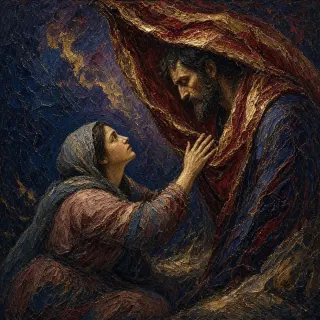
    At the threshing floor she uses his own words back to him: he had said she came under the LORD’s wings, and she asks him to spread his wing over her, and names him as a redeemer.

    Naomi says Boaz will tell Ruth what to do. Ruth reaches the threshing floor and tells Boaz what she is asking him to do. She follows the plan, but she is not a silent object inside it. Her name, her request, and the reason for that request all come from her own mouth.

    The reason is kinship. Spreading his covering over her would be more than lending a cold woman a blanket, because she immediately identifies him as a family redeemer. The language turns the earlier blessing about shelter into a request for a particular man's protection and marriage commitment. The midnight setting carries risk, but the recorded conversation is remarkably definite about obligation and reputation.

    Boaz does not answer by praising her appearance. He calls this a further act of kindness and names her standing in the community. The foreign widow who asked why anyone noticed her is now described as a woman whose worth the town knows. Her approach is private; her character is not unknown.

    Verse by verse

    1. 3:1

      Naomi's search for "rest" resumes the wish of Ruth 1:9 for a secure household. It is not a proposal that Ruth stop working for a day.

    2. 3:7-8

      The text says that Ruth uncovers Boaz's feet and lies there. It does not state that intercourse occurs; marriage and intercourse are expressly reported in 4:13.

    3. 3:9

      The family redeemer, goel, acts to preserve family interests. The precise relationship between this marriage arrangement and the land-redemption laws requires the further explanation in chapter 4.

    4. 3:11

      "Virtuous woman" translates eshet hayil, a woman of worth or strength. Hayil also describes Boaz in 2:1; the two are paired in vocabulary as well as in the account.

    Ruth 3:1-11

    King James Version · 11 verses

    3:1Then Naomi her mother in law said unto her, My daughter, shall I not seek rest for thee, that it may be well with thee?

    3:2And now is not Boaz of our kindred, with whose maidens thou wast? Behold, he winnoweth barley to night in the threshingfloor.

    3:3Wash thyself therefore, and anoint thee, and put thy raiment upon thee, and get thee down to the floor: but make not thyself known unto the man, until he shall have done eating and drinking.

    3:4And it shall be, when he lieth down, that thou shalt mark the place where he shall lie, and thou shalt go in, and uncover his feet, and lay thee down; and he will tell thee what thou shalt do.

    3:5And she said unto her, All that thou sayest unto me I will do.

    3:6And she went down unto the floor, and did according to all that her mother in law bade her.

    3:7And when Boaz had eaten and drunk, and his heart was merry, he went to lie down at the end of the heap of corn: and she came softly, and uncovered his feet, and laid her down.

    3:8And it came to pass at midnight, that the man was afraid, and turned himself: and, behold, a woman lay at his feet.

    3:9And he said, Who art thou? And she answered, I am Ruth thine handmaid: spread therefore thy skirt over thine handmaid; for thou art a near kinsman.

    3:10And he said, Blessed be thou of the LORD, my daughter: for thou hast shewed more kindness in the latter end than at the beginning, inasmuch as thou followedst not young men, whether poor or rich.

    3:11And now, my daughter, fear not; I will do to thee all that thou requirest: for all the city of my people doth know that thou art a virtuous woman.

  5. 05

    Ruth 4:13-17

    Better to you than seven sons

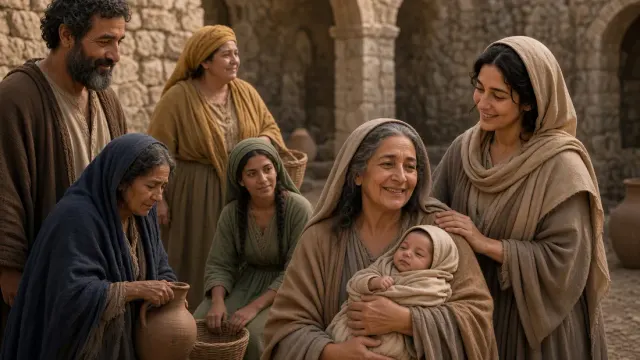
    The women of Bethlehem name the child, which is unusual, and they say it to Naomi about Ruth. Obed is the father of Jesse, and Jesse is the father of David.

    The child is Ruth's, but the congratulations turn toward Naomi. That shift is not a confusion of mothers. The women have understood what this birth means for the household that returned from Moab without its men. The one who described herself as empty now holds a child in her bosom.

    Even here, however, Ruth is not reduced to the means of producing a son. The women explicitly name her love and call her better to Naomi than seven sons. In an account deeply concerned with preserving a man's name, the foreign daughter-in-law receives the extraordinary assessment. The child brings restoration; the woman's faithful presence has already made that restoration possible.

    The final identification moves from the lap to the family line: Obed, Jesse, David. Ruth's earlier pledge had named Naomi's people; the final genealogy now places her own descendants among them. The Book of Ruth closes the distance between a widow gathering grain and the ancestry of Israel's king with three names.

    Verse by verse

    1. 4:13

      The LORD is expressly said to give conception. The verse reports a birth after marriage without specifying Ruth's age or diagnosing her earlier childlessness.

    2. 4:15

      "Better to thee than seven sons" is the women's assessment of Ruth's value to Naomi. It is not a count of sons Naomi once possessed.

    3. 4:16

      Naomi becomes the child's caregiver. The verse does not say she gives birth to him or requires the assumption that she breastfeeds him.

    4. 4:17

      "A son born to Naomi" describes the restoration of her household. Verse 13 has already identified Ruth as the biological mother.

    Ruth 4:13-17

    King James Version · 5 verses

    4:13So Boaz took Ruth, and she was his wife: and when he went in unto her, the LORD gave her conception, and she bare a son.

    4:14And the women said unto Naomi, Blessed be the LORD, which hath not left thee this day without a kinsman, that his name may be famous in Israel.

    4:15And he shall be unto thee a restorer of thy life, and a nourisher of thine old age: for thy daughter in law, which loveth thee, which is better to thee than seven sons, hath born him.

    4:16And Naomi took the child, and laid it in her bosom, and became nurse unto it.

    4:17And the women her neighbours gave it a name, saying, There is a son born to Naomi; and they called his name Obed: he is the father of Jesse, the father of David.

    Ruth 4:13-17: Better to you than seven sons

Why it matters

The book is four chapters long, it happens during the time of the judges, and nothing miraculous occurs in it at all. What it describes is the law working as it was meant to: the corners of the field left unharvested, the kinsman with a right to redeem, the elders at the gate. A Moabite woman, from a people specifically excluded, becomes the great grandmother of David, and Matthew names her in the genealogy of Jesus.

9 songs

The music

Every song in the catalogue whose passage falls inside these chapters.

  1. Ruth 1:1-7

    Call Me Mara

  2. Ruth 1:1-4:22

    Ruth, Redeemed in the Harvest

  3. Ruth 1-4

    Where You Go

  4. Ruth 1:8-22

    Where You Go, I Will Go

  5. Ruth 2:14-23

    Handfuls on Purpose

  6. Ruth 2:1-13

    Under His Wings

  7. Ruth 3:1-9

    Spread Your Covering

  8. Ruth 3:10-4:12

    The Redeemer at the Gate

  9. Ruth 4:13-22

    A Son Has Been Born

Nearby

All the people

Report an error on this page