New · FreePlay The Witnesses The in-depth puzzle battle quest through Bible history

People of the Bible

Boaz

Kept the law past the point the law required, and then went to the gate and did it properly.

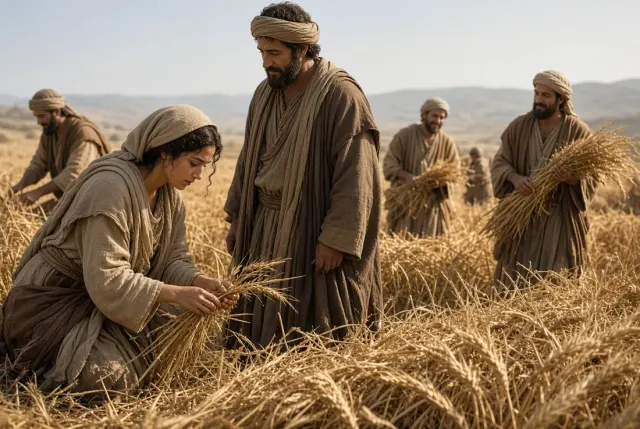
Boaz is a man of standing in Bethlehem and he arrives in the account greeting his harvesters, which is the first thing we learn about him. He notices a stranger in his field and asks who she is before he speaks to her. Then he does more than the gleaning law asks: he tells her to stay, gives her water and a place at the meal, and quietly instructs the young men to leave extra for her. When she comes to the threshing floor at night, his answer is not to take what is offered but to name a nearer relative who has first right, and to settle it publicly in the morning.

Where he appearsRuth 2 to 4

Scroll down to the account
Boaz

The movements, in the order the text gives them.

The Account of Boaz

  1. 01

    Ruth 2:4-12

    The LORD be with you

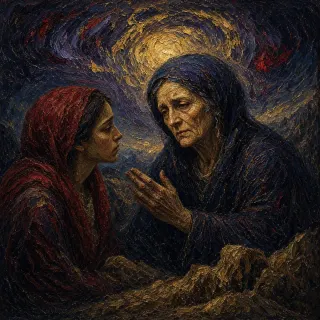
    He greets the reapers and they answer him, which tells you what kind of household this is. He has already heard what Ruth did for Naomi, and says so before she asks for anything.

    Boaz begins with a blessing, but he does not leave it hanging in the air. Before the conversation is over, it has acquired a field, drinking water, and an order to the young men not to touch Ruth. Under whose wings thou art come to trust is beautiful language. In this exchange, shelter also has working arrangements.

    The foreman identifies her as the Moabite woman who came with Naomi; Boaz answers her astonishment by naming what she has done. He knows about the dead husband, the abandoned homeland, and the mother-in-law she has supported. Nothing is said about her appearance. The grounds he gives for his attention are her actions. There is a quiet shift in the encounter: Ruth calls herself a stranger, while the owner of the field speaks to her as my daughter. Her place among his workers is made explicit before she gathers another handful.

    Verse by verse

    1. 2:5

      Whose damsel asks about her social and household connection, which the foreman answers by identifying her relationship to Naomi.

    2. 2:9

      The command not to touch her supplies protection; it does not establish that these workers have already assaulted her.

    3. 2:11

      Boaz explicitly bases his response on reported conduct toward Naomi, not on a description of Ruth's beauty.

    4. 2:12

      The wings image returns in 3:9 through the Hebrew kanaph, used there for the covering Ruth asks Boaz to spread over her.

    Ruth 2:4-12

    King James Version · 9 verses

    2:4And, behold, Boaz came from Beth-lehem, and said unto the reapers, The LORD be with you. And they answered him, The LORD bless thee.

    2:5Then said Boaz unto his servant that was set over the reapers, Whose damsel is this?

    2:6And the servant that was set over the reapers answered and said, It is the Moabitish damsel that came back with Naomi out of the country of Moab:

    2:7And she said, I pray you, let me glean and gather after the reapers among the sheaves: so she came, and hath continued even from the morning until now, that she tarried a little in the house.

    2:8Then said Boaz unto Ruth, Hearest thou not, my daughter? Go not to glean in another field, neither go from hence, but abide here fast by my maidens:

    2:9Let thine eyes be on the field that they do reap, and go thou after them: have I not charged the young men that they shall not touch thee? and when thou art athirst, go unto the vessels, and drink of that which the young men have drawn.

    2:10Then she fell on her face, and bowed herself to the ground, and said unto him, Why have I found grace in thine eyes, that thou shouldest take knowledge of me, seeing I am a stranger?

    2:11And Boaz answered and said unto her, It hath fully been shewed me, all that thou hast done unto thy mother in law since the death of thine husband: and how thou hast left thy father and thy mother, and the land of thy nativity, and art come unto a people which thou knewest not heretofore.

    2:12The LORD recompense thy work, and a full reward be given thee of the LORD God of Israel, under whose wings thou art come to trust.

  2. 02

    Ruth 2:14-16

    Let her glean among the sheaves

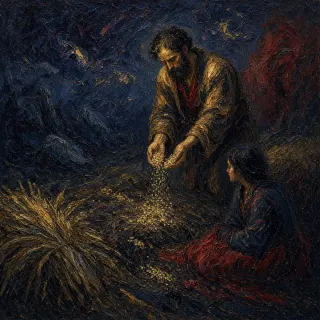
    Gleaning law covers the edges and the dropped stalks. He sends her into the standing sheaves and has handfuls pulled out for her on purpose, with orders that nobody shame her.

    He reached her parched corn. The landowner does more than permit a gleaner to eat somewhere nearby; he gives her food at the workers' meal. The sequence is generous without becoming vague: she eats, has enough, and has something left. Verse 18 identifies where that remainder goes. Naomi eats from this welcome, too.

    Then Boaz gives instructions whose point is that the harvesters should become less efficient on purpose. Leave some of the crop where Ruth can gather it. The accidental leftovers of ordinary gleaning are now being arranged. But food is only half the order: reproach her not, then rebuke her not. She is not to receive grain accompanied by insults. The commands make provision concrete, and they do not let the men separate the gift from the way she is treated.

    Verse by verse

    1. 2:14

      Parched corn means roasted grain, not specifically the maize called corn in modern American English.

    2. 2:14

      Left means she had food remaining after eating her fill. Verse 18 says she gave that remainder to Naomi.

    3. 2:15

      Even among the sheaves extends her permitted access into the gathered crop, rather than limiting her to scattered remnants.

    4. 2:16

      Of purpose means deliberately. The workers are ordered to leave grain, not merely overlook an occasional dropped stalk.

    Ruth 2:14-16

    King James Version · 3 verses

    2:14And Boaz said unto her, At mealtime come thou hither, and eat of the bread, and dip thy morsel in the vinegar. And she sat beside the reapers: and he reached her parched corn, and she did eat, and was sufficed, and left.

    2:15And when she was risen up to glean, Boaz commanded his young men, saying, Let her glean even among the sheaves, and reproach her not:

    2:16And let fall also some of the handfuls of purpose for her, and leave them, that she may glean them, and rebuke her not.

    Ruth 2:14-16: Let her glean among the sheaves
  3. 03

    Ruth 3:8-13

    There is a kinsman nearer than I

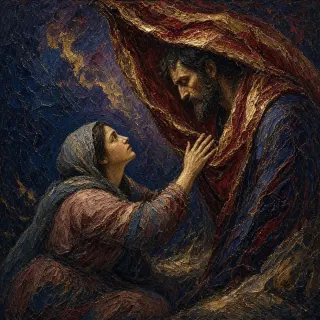
    Startled awake at midnight he blesses her, promises to do everything she asks, and then immediately names the obstacle rather than hiding it. He sends her home before it is light enough to be recognised.

    The most important interruption in this midnight conversation is a relative who is not there. Howbeit there is a kinsman nearer than I. Boaz accepts Ruth's request as a family matter and immediately acknowledges the prior claim that could prevent him from carrying it out himself. The oath that follows is strong, but it is not unconditional.

    His description of Ruth also refuses to let the unusual setting define her character. All the city knows she is a virtuous woman. That reputation was established in public before this private encounter, and he brings it into the conversation rather than treating her presence as grounds for accusation. His praise of her latter kindness concerns her choice to pursue this family connection rather than young men, rich or poor. The text supplies no ages and no account of who first fell in love. It does supply a promise with the legal obstacle stated plainly.

    Verse by verse

    1. 3:9

      Near kinsman translates goel, a family redeemer. Ruth identifies the capacity in which she asks Boaz to act.

    2. 3:10

      The comparison with young men suggests a difference of age or generation, but neither person's age is stated.

    3. 3:11

      Virtuous woman translates eshet hayil, a woman of worth or strength, using the same noun applied to Boaz in 2:1.

    4. 3:12

      A nearer relative has priority. Boaz is not identified as a brother of Ruth's dead husband.

    5. 3:13

      As the LORD liveth solemnly guarantees his commitment if the nearer relative declines; it does not erase that condition.

    Ruth 3:8-13

    King James Version · 6 verses

    3:8And it came to pass at midnight, that the man was afraid, and turned himself: and, behold, a woman lay at his feet.

    3:9And he said, Who art thou? And she answered, I am Ruth thine handmaid: spread therefore thy skirt over thine handmaid; for thou art a near kinsman.

    3:10And he said, Blessed be thou of the LORD, my daughter: for thou hast shewed more kindness in the latter end than at the beginning, inasmuch as thou followedst not young men, whether poor or rich.

    3:11And now, my daughter, fear not; I will do to thee all that thou requirest: for all the city of my people doth know that thou art a virtuous woman.

    3:12And now it is true that I am thy near kinsman: howbeit there is a kinsman nearer than I.

    3:13Tarry this night, and it shall be in the morning, that if he will perform unto thee the part of a kinsman, well; let him do the kinsman’s part: but if he will not do the part of a kinsman to thee, then will I do the part of a kinsman to thee, as the LORD liveth: lie down until the morning.

    Ruth 3:8-13: There is a kinsman nearer than I
  4. 04

    Ruth 4:1-12

    The sandal at the gate

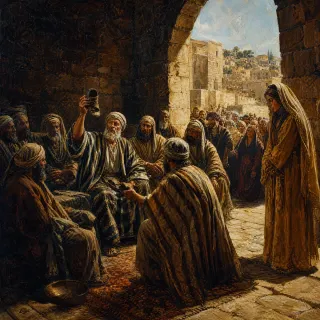
    He sets it up in the open with ten elders. The nearer redeemer wants the field until the widow comes attached to it, then withdraws and hands over his sandal, and the whole town witnesses the transfer.

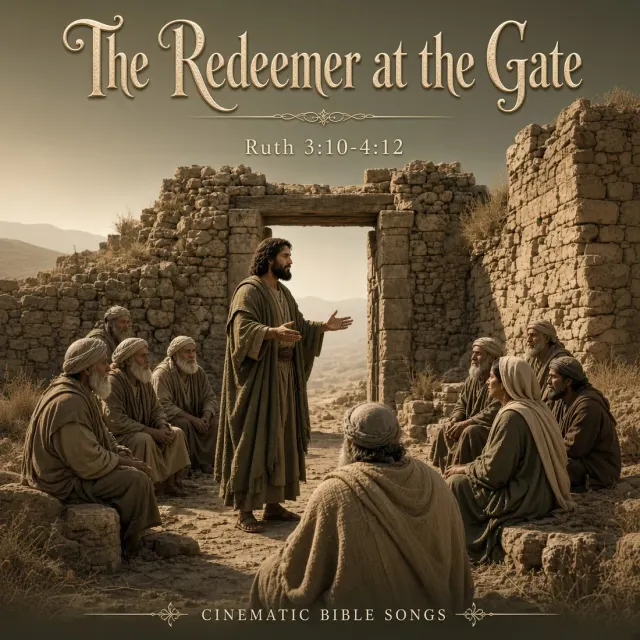
    The private promise goes straight to a public place. Ten elders sit down, the nearer relative is offered his right, and Boaz states the conditions before witnesses. He does not treat the midnight exchange as permission to bypass the rest of the family. The land and the obligation to preserve the dead man's name are brought into the same transaction.

    The other man wants to protect his own inheritance, but the Book of Ruth never gives his name. Such a one is almost painfully apt in a scene so concerned with names surviving. Boaz's declaration repeats ye are witnesses this day, and the people answer with exactly the recognition he has requested. Their blessing places the Moabite woman beside Rachel, Leah, and Tamar in the language of building a household. Matthew 1:5 later names Boaz and Ruth together in the genealogy of Jesus. The family business at this gate was not a small matter.

    Verse by verse

    1. 4:1

      Such a one renders the Hebrew placeholder peloni almoni, rather like so-and-so. It is not the man's personal name.

    2. 4:4

      Advertise means inform or bring to someone's attention, not promote a product.

    3. 4:5

      Land redemption and preservation of the dead man's family are joined here. Leviticus 25 and Deuteronomy 25 supply related laws, not a single identical procedure.

    4. 4:10

      Mahlon is explicitly identified as Ruth's dead husband here; 1:4 did not assign each wife to a named son.

    5. 4:12

      Pharez is Perez, the son born to Tamar and Judah in Genesis 38. Ruth 4:18 begins the closing genealogy with him.

    Ruth 4:1-12: The sandal at the gate

    Ruth 4:1-12

    King James Version · 12 verses

    4:1Then went Boaz up to the gate, and sat him down there: and, behold, the kinsman of whom Boaz spake came by; unto whom he said, Ho, such a one! turn aside, sit down here. And he turned aside, and sat down.

    4:2And he took ten men of the elders of the city, and said, Sit ye down here. And they sat down.

    4:3And he said unto the kinsman, Naomi, that is come again out of the country of Moab, selleth a parcel of land, which was our brother Elimelech’s:

    4:4And I thought to advertise thee, saying, Buy it before the inhabitants, and before the elders of my people. If thou wilt redeem it, redeem it: but if thou wilt not redeem it, then tell me, that I may know: for there is none to redeem it beside thee; and I am after thee. And he said, I will redeem it.

    4:5Then said Boaz, What day thou buyest the field of the hand of Naomi, thou must buy it also of Ruth the Moabitess, the wife of the dead, to raise up the name of the dead upon his inheritance.

    4:6And the kinsman said, I cannot redeem it for myself, lest I mar mine own inheritance: redeem thou my right to thyself; for I cannot redeem it.

    4:7Now this was the manner in former time in Israel concerning redeeming and concerning changing, for to confirm all things; a man plucked off his shoe, and gave it to his neighbour: and this was a testimony in Israel.

    4:8Therefore the kinsman said unto Boaz, Buy it for thee. So he drew off his shoe.

    4:9And Boaz said unto the elders, and unto all the people, Ye are witnesses this day, that I have bought all that was Elimelech’s, and all that was Chilion’s and Mahlon’s, of the hand of Naomi.

    4:10Moreover Ruth the Moabitess, the wife of Mahlon, have I purchased to be my wife, to raise up the name of the dead upon his inheritance, that the name of the dead be not cut off from among his brethren, and from the gate of his place: ye are witnesses this day.

    4:11And all the people that were in the gate, and the elders, said, We are witnesses. The LORD make the woman that is come into thine house like Rachel and like Leah, which two did build the house of Israel: and do thou worthily in Ephratah, and be famous in Beth-lehem:

    4:12And let thy house be like the house of Pharez, whom Tamar bare unto Judah, of the seed which the LORD shall give thee of this young woman.


Why it matters

Nothing Boaz does is spectacular and all of it is deliberate. The book uses him to show what the law looks like when someone keeps it generously rather than minimally, and the scene at the gate is the closest thing the Old Testament has to a property transaction recorded in full, sandal and all. He is the son of Rahab and the great grandfather of David, which puts two foreign women on either side of him in the same genealogy.

7 songs

The music

Every song in the catalogue whose passage falls inside these chapters.

  1. Ruth 1:1-4:22

    Ruth, Redeemed in the Harvest

  2. Ruth 1-4

    Where You Go

  3. Ruth 2:14-23

    Handfuls on Purpose

  4. Ruth 2:1-13

    Under His Wings

  5. Ruth 3:1-9

    Spread Your Covering

  6. Ruth 3:10-4:12

    The Redeemer at the Gate

  7. Ruth 4:13-22

    A Son Has Been Born

Nearby

All the people

Report an error on this page