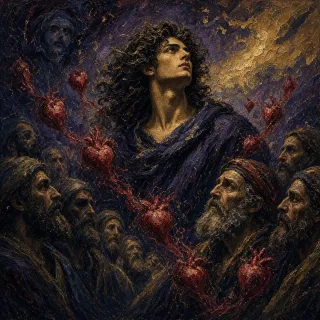
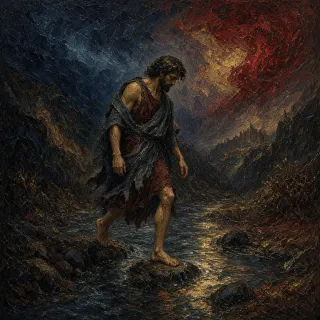
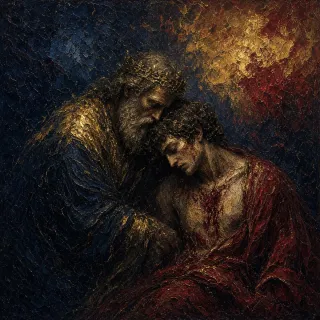
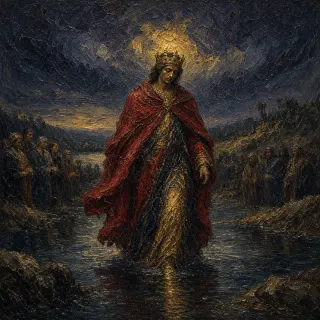
New · FreePlay The Witnesses The in-depth puzzle battle quest through Bible history

People of the Bible

David

Shepherd, outlaw, poet, king and murderer, and the one the rest of the Bible keeps measuring kings against.

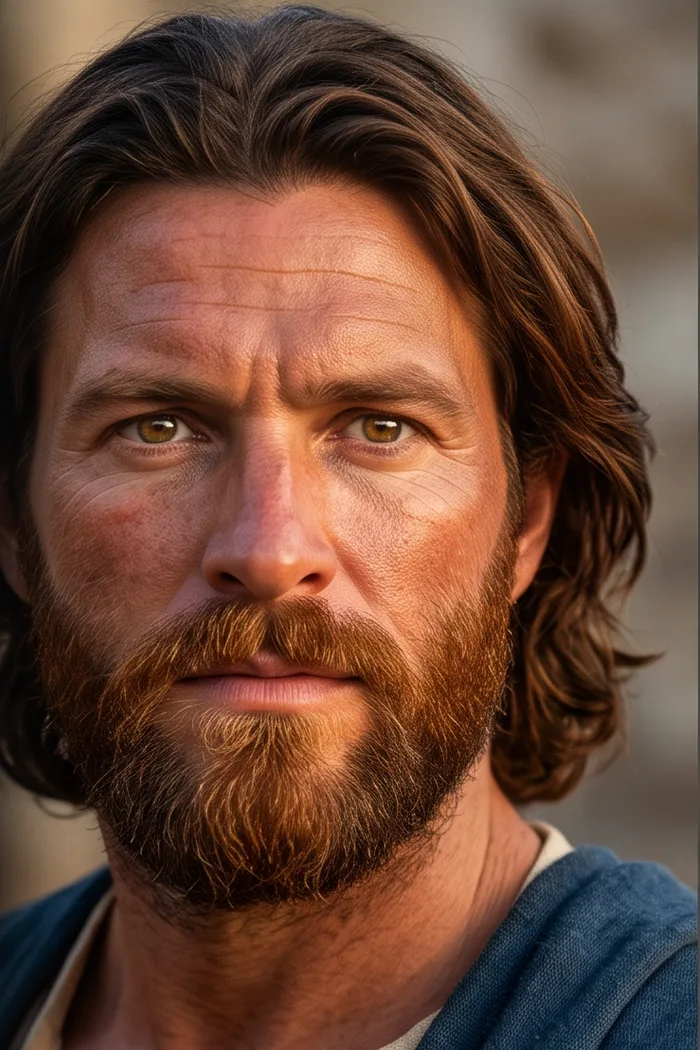
David is the eighth son, the one left with the sheep when the prophet comes to the house. From there he is a harpist in the court of the man who will spend years trying to kill him, a giant killer, a mercenary captain, a fugitive with four hundred men in debt and distress, a king at thirty, and the man who brings the ark into Jerusalem dancing in a linen ephod. He is also the man who sends for another man’s wife and then arranges for the husband to be killed at the front, and spends the rest of his reign living inside the consequences.

Where he appears1 Samuel 16 to 31 · 2 Samuel 1 to 24 · 1 Kings 1 to 2 · 1 Chronicles 11 to 29

Scroll down to the account
David

The movements, in the order the text gives them.

The Account of David

  1. 01

    1 Samuel 16:1-13

    Sent for from the sheep

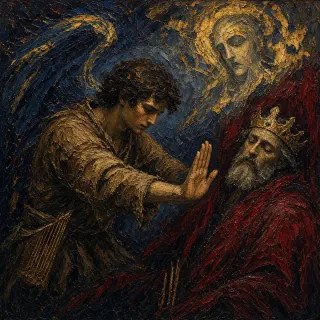
    Seven brothers pass and none is chosen. Nobody had thought to bring him in from the flock, and they do not sit down to eat until he arrives.

    Seven sons pass before Samuel while the next king is still looking after the sheep. Jesse has brought the family, or what he considers enough of it. The prophet has brought a horn of oil and, judging by his first look at Eliab, some of his old expectations. Height catches his attention again. The LORD stops the selection before another impressive exterior can settle it.

    David's own good looks are then described quite freely. The contrast is not between handsome men and worthy ones, as though an attractive face were a spiritual handicap. It is between what people can see and what God sees. David is not chosen because Samuel finally learns to judge appearances more accurately. Samuel has to be told.

    The waiting matters. Nobody sits down until the youngest arrives; the household must make room for the son absent from its presentation. Yet the oil does not immediately give David a court, a crown, or command of Saul's army. The change named here is the coming of the Spirit of the LORD from that day forward. Psalm 78:70-72 later preserves the movement beautifully: from tending sheep to feeding Israel, with the heart and the hands both involved.

    Verse by verse

    1. 16:1

      The king is one the LORD has provided among Jesse's sons. Samuel is sent to recognize that choice, not to run an independent search.

    2. 16:7

      The heart here concerns the person beyond outward appearance. The verse does not say that David will be incapable of grave wrongdoing.

    3. 16:11

      No age is supplied for David at this anointing. The thirty years in 2 Samuel 5:4 belong to the beginning of his reign.

    4. 16:13

      Romans 1:3 identifies Jesus as David's descendant according to the flesh. Acts 2:30-31 connects the promised occupant of David's throne with Christ and his resurrection.

    1 Samuel 16:1-13

    King James Version · 13 verses

    16:1And the LORD said unto Samuel, How long wilt thou mourn for Saul, seeing I have rejected him from reigning over Israel? fill thine horn with oil, and go, I will send thee to Jesse the Beth-lehemite: for I have provided me a king among his sons.

    16:2And Samuel said, How can I go? if Saul hear it, he will kill me. And the LORD said, Take an heifer with thee, and say, I am come to sacrifice to the LORD.

    16:3And call Jesse to the sacrifice, and I will shew thee what thou shalt do: and thou shalt anoint unto me him whom I name unto thee.

    16:4And Samuel did that which the LORD spake, and came to Beth-lehem. And the elders of the town trembled at his coming, and said, Comest thou peaceably?

    16:5And he said, Peaceably: I am come to sacrifice unto the LORD: sanctify yourselves, and come with me to the sacrifice. And he sanctified Jesse and his sons, and called them to the sacrifice.

    16:6And it came to pass, when they were come, that he looked on Eliab, and said, Surely the LORD’s anointed is before him.

    16:7But the LORD said unto Samuel, Look not on his countenance, or on the height of his stature; because I have refused him: for the LORD seeth not as man seeth; for man looketh on the outward appearance, but the LORD looketh on the heart.

    16:8Then Jesse called Abinadab, and made him pass before Samuel. And he said, Neither hath the LORD chosen this.

    16:9Then Jesse made Shammah to pass by. And he said, Neither hath the LORD chosen this.

    16:10Again, Jesse made seven of his sons to pass before Samuel. And Samuel said unto Jesse, The LORD hath not chosen these.

    16:11And Samuel said unto Jesse, Are here all thy children? And he said, There remaineth yet the youngest, and, behold, he keepeth the sheep. And Samuel said unto Jesse, Send and fetch him: for we will not sit down till he come hither.

    16:12And he sent, and brought him in. Now he was ruddy, and withal of a beautiful countenance, and goodly to look to. And the LORD said, Arise, anoint him: for this is he.

    16:13Then Samuel took the horn of oil, and anointed him in the midst of his brethren: and the Spirit of the LORD came upon David from that day forward. So Samuel rose up, and went to Ramah.

  2. 02

    1 Samuel 17:32-51

    You come with a sword, I come in the name

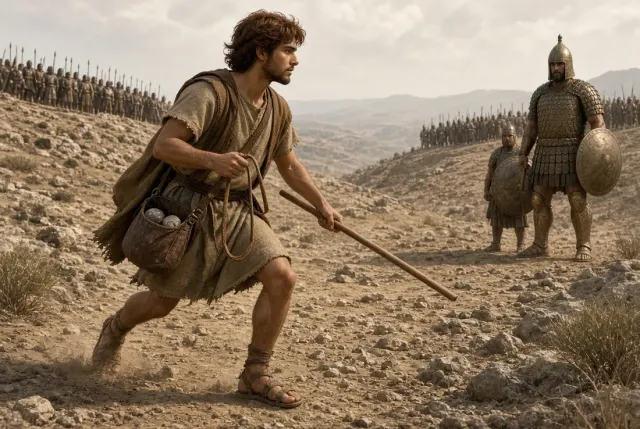
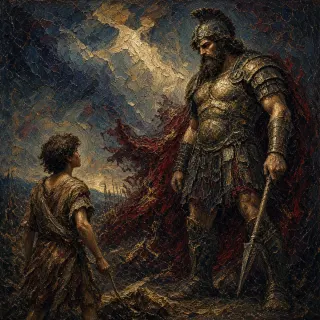
    He refuses armour that does not fit, picks five stones out of a brook, and runs towards the giant. The speech before it is longer than the fight.

    David's answer to Saul is not that experience does not matter. It is that Saul has overlooked his. The shepherd has pursued predators, pulled a sheep out of a mouth, and struck an animal that turned on him. He describes dangerous work with physical precision, then identifies the LORD as the one who delivered him. His confidence has a history, and it is not a history of standing safely behind someone else's shield.

    The armour scene sharpens the distinction. David tries Saul's equipment and takes it off because he has not proved it. The passage does not say that it is comically enormous or that he cannot lift the sword. He refuses an unfamiliar way of fighting, not fighting itself. The staff, shepherd's bag, and selected stones are working equipment, not an absence of equipment.

    Then David's speech moves beyond the personal contest. The earth is to know that there is a God in Israel, and this assembly that the LORD does not save by sword and spear. He says this while preparing to use a sling. Dependence on God and deliberate action stand in the same sentence of his life. When the Philistine advances, David runs towards him. The confidence has feet.

    Verse by verse

    1. 17:34-37

      The accounts of the lion and bear are David's testimony to Saul. He explicitly credits his deliverance to the LORD.

    2. 17:39

      Proved means tried or tested. The stated problem is unfamiliarity with Saul's equipment, not its size.

    3. 17:40

      Five stones are selected, but no reason is given for that number. The passage does not connect them with five members of a giant family.

    4. 17:47

      The claim concerns the LORD's power to save, not a rule forbidding weapons. David uses a sling and then Goliath's sword.

    5. 17:37

      Hebrews 11:32 names David among its examples of faith. It does not isolate this combat as the only event meant by that inclusion.

    1 Samuel 17:32-51: You come with a sword, I come in the name

    1 Samuel 17:32-51

    King James Version · 20 verses

    17:32And David said to Saul, Let no man’s heart fail because of him; thy servant will go and fight with this Philistine.

    17:33And Saul said to David, Thou art not able to go against this Philistine to fight with him: for thou art but a youth, and he a man of war from his youth.

    17:34And David said unto Saul, Thy servant kept his father’s sheep, and there came a lion, and a bear, and took a lamb out of the flock:

    17:35And I went out after him, and smote him, and delivered it out of his mouth: and when he arose against me, I caught him by his beard, and smote him, and slew him.

    17:36Thy servant slew both the lion and the bear: and this uncircumcised Philistine shall be as one of them, seeing he hath defied the armies of the living God.

    17:37David said moreover, The LORD that delivered me out of the paw of the lion, and out of the paw of the bear, he will deliver me out of the hand of this Philistine. And Saul said unto David, Go, and the LORD be with thee.

    17:38And Saul armed David with his armour, and he put an helmet of brass upon his head; also he armed him with a coat of mail.

    17:39And David girded his sword upon his armour, and he assayed to go; for he had not proved it. And David said unto Saul, I cannot go with these; for I have not proved them. And David put them off him.

    17:40And he took his staff in his hand, and chose him five smooth stones out of the brook, and put them in a shepherd’s bag which he had, even in a scrip; and his sling was in his hand: and he drew near to the Philistine.

    17:41And the Philistine came on and drew near unto David; and the man that bare the shield went before him.

    17:42And when the Philistine looked about, and saw David, he disdained him: for he was but a youth, and ruddy, and of a fair countenance.

    17:43And the Philistine said unto David, Am I a dog, that thou comest to me with staves? And the Philistine cursed David by his gods.

    17:44And the Philistine said to David, Come to me, and I will give thy flesh unto the fowls of the air, and to the beasts of the field.

    17:45Then said David to the Philistine, Thou comest to me with a sword, and with a spear, and with a shield: but I come to thee in the name of the LORD of hosts, the God of the armies of Israel, whom thou hast defied.

    17:46This day will the LORD deliver thee into mine hand; and I will smite thee, and take thine head from thee; and I will give the carcases of the host of the Philistines this day unto the fowls of the air, and to the wild beasts of the earth; that all the earth may know that there is a God in Israel.

    17:47And all this assembly shall know that the LORD saveth not with sword and spear: for the battle is the LORD’s, and he will give you into our hands.

    17:48And it came to pass, when the Philistine arose, and came and drew nigh to meet David, that David hasted, and ran toward the army to meet the Philistine.

    17:49And David put his hand in his bag, and took thence a stone, and slang it, and smote the Philistine in his forehead, that the stone sunk into his forehead; and he fell upon his face to the earth.

    17:50So David prevailed over the Philistine with a sling and with a stone, and smote the Philistine, and slew him; but there was no sword in the hand of David.

    17:51Therefore David ran, and stood upon the Philistine, and took his sword, and drew it out of the sheath thereof, and slew him, and cut off his head therewith. And when the Philistines saw their champion was dead, they fled.

  3. 03

    1 Samuel 24:1-22

    I will not stretch out my hand

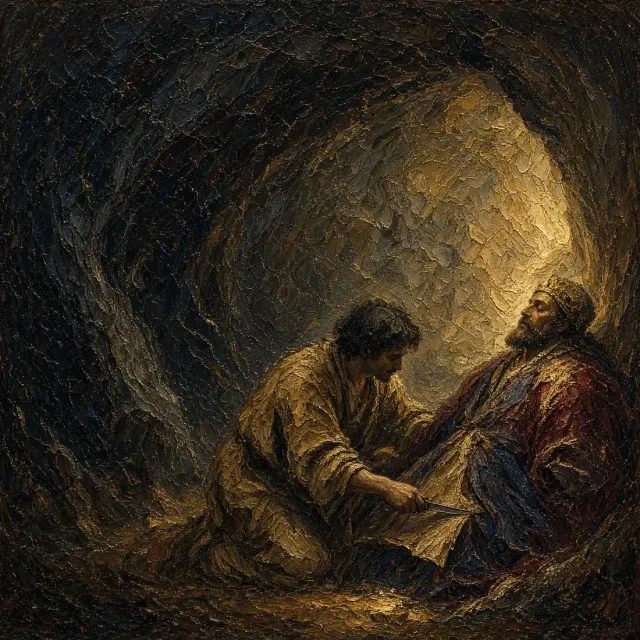
    Saul walks alone into the cave where David is hiding. David cuts a corner off his robe and his conscience troubles him for that, and he calls out to him afterwards from a safe distance.

    David's men see a promise fulfilled. David sees a king he must not kill. The same unguarded moment produces two opposite readings, and the chapter does not turn opportunity into permission merely because the opportunity is extraordinary. Saul has brought three thousand chosen men to hunt David, then entered David's hiding place for bodily privacy. The army has not made its king invulnerable.

    The piece of robe is small enough to carry and serious enough to trouble David's heart. It proves he could have done more, but even that limited act requires the restraint which his men lack. He checks himself and then checks them. Mercy here is not simply declining to strike; it includes preventing other hands from doing the striking.

    Outside the cave, the language becomes painfully familial. David calls Saul my father; Saul answers with my son David. The tears and admission of wrongdoing belong to Saul himself, not to an invented explanation of his motives. They are substantial, but the ending refuses to make them a complete settlement. Saul goes home. David and his men go up to the hold. A spared life, an oath, and an acknowledgment of the future kingdom have not yet made the wilderness safe.

    Verse by verse

    1. 24:3

      Cover his feet is a euphemism for relieving himself, also found in Judges 3:24. The verse does not say Saul was asleep.

    2. 24:4

      The men interpret the occasion as the fulfillment of a divine promise. Their words are not a new command from the LORD to kill Saul.

    3. 24:5

      David's heart smites him because he has cut Saul's robe. The text gives remorse for the act, not fear of being discovered.

    4. 24:21-22

      Seed means descendants in Saul's request. David swears the oath, but the two parties still leave for different places.

    1 Samuel 24:1-22: I will not stretch out my hand

    1 Samuel 24:1-22

    King James Version · 22 verses

    24:1And it came to pass, when Saul was returned from following the Philistines, that it was told him, saying, Behold, David is in the wilderness of En-gedi.

    24:2Then Saul took three thousand chosen men out of all Israel, and went to seek David and his men upon the rocks of the wild goats.

    24:3And he came to the sheepcotes by the way, where was a cave; and Saul went in to cover his feet: and David and his men remained in the sides of the cave.

    24:4And the men of David said unto him, Behold the day of which the LORD said unto thee, Behold, I will deliver thine enemy into thine hand, that thou mayest do to him as it shall seem good unto thee. Then David arose, and cut off the skirt of Saul’s robe privily.

    24:5And it came to pass afterward, that David’s heart smote him, because he had cut off Saul’s skirt.

    24:6And he said unto his men, The LORD forbid that I should do this thing unto my master, the LORD’s anointed, to stretch forth mine hand against him, seeing he is the anointed of the LORD.

    24:7So David stayed his servants with these words, and suffered them not to rise against Saul. But Saul rose up out of the cave, and went on his way.

    24:8David also arose afterward, and went out of the cave, and cried after Saul, saying, My lord the king. And when Saul looked behind him, David stooped with his face to the earth, and bowed himself.

    24:9And David said to Saul, Wherefore hearest thou men’s words, saying, Behold, David seeketh thy hurt?

    24:10Behold, this day thine eyes have seen how that the LORD had delivered thee to day into mine hand in the cave: and some bade me kill thee: but mine eye spared thee; and I said, I will not put forth mine hand against my lord; for he is the LORD’s anointed.

    24:11Moreover, my father, see, yea, see the skirt of thy robe in my hand: for in that I cut off the skirt of thy robe, and killed thee not, know thou and see that there is neither evil nor transgression in mine hand, and I have not sinned against thee; yet thou huntest my soul to take it.

    24:12The LORD judge between me and thee, and the LORD avenge me of thee: but mine hand shall not be upon thee.

    24:13As saith the proverb of the ancients, Wickedness proceedeth from the wicked: but mine hand shall not be upon thee.

    24:14After whom is the king of Israel come out? after whom dost thou pursue? after a dead dog, after a flea.

    24:15The LORD therefore be judge, and judge between me and thee, and see, and plead my cause, and deliver me out of thine hand.

    24:16And it came to pass, when David had made an end of speaking these words unto Saul, that Saul said, Is this thy voice, my son David? And Saul lifted up his voice, and wept.

    24:17And he said to David, Thou art more righteous than I: for thou hast rewarded me good, whereas I have rewarded thee evil.

    24:18And thou hast shewed this day how that thou hast dealt well with me: forasmuch as when the LORD had delivered me into thine hand, thou killedst me not.

    24:19For if a man find his enemy, will he let him go well away? wherefore the LORD reward thee good for that thou hast done unto me this day.

    24:20And now, behold, I know well that thou shalt surely be king, and that the kingdom of Israel shall be established in thine hand.

    24:21Swear now therefore unto me by the LORD, that thou wilt not cut off my seed after me, and that thou wilt not destroy my name out of my father’s house.

    24:22And David sware unto Saul. And Saul went home; but David and his men gat them up unto the hold.

  4. 04

    2 Samuel 6:12-23

    Dancing before the ark

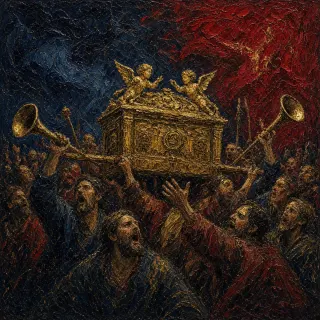
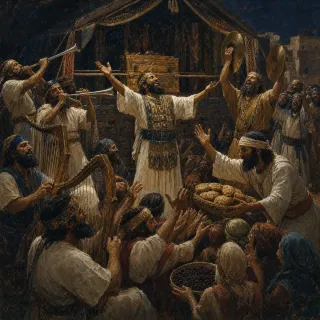
    He brings the ark up with shouting and the sound of the trumpet, dances with all his might in a linen ephod, and answers his wife’s contempt by saying he will be more undignified than this.

    The king comes home to bless his household after giving the city bread. That movement matters: David's celebration is not confined to his own body or his own triumph. Men and women receive food, the people receive a blessing, and the ark stands in the tent prepared for it. The king's joy has become a public meal before it becomes a household quarrel.

    Michal watches from a window; David dances before the LORD. Those two positions frame the dispute. Her speech measures the king's display by the eyes of the servants' women. His answer identifies a different audience and names the divine choice that placed him before her father and his house. The exchange is therefore about more than whether a dance looked dignified. The language of the previous dynasty sits inside an argument between husband and wife.

    The linen ephod is specified. David is not described as wearing nothing, and Michal's accusation should not erase the garment the chapter has just named. Nor does joy cancel the gravity of the ark: the earlier death of Uzzah and the three months at Obed-edom's house remain part of this same chapter. The procession reaches Jerusalem. The blessing at David's own door meets contempt instead.

    Verse by verse

    1. 6:13

      A sacrifice follows the bearers' first six paces. This verse does not explicitly say that sacrifices were repeated every six paces throughout the journey.

    2. 6:14

      The linen ephod is an actual garment. First Chronicles 15:27 supplies the additional detail of a fine-linen robe.

    3. 6:21

      Before the LORD is David's own explanation of his dancing. His answer also explicitly contrasts his selection with Saul's house.

    4. 6:23

      Michal's childlessness is stated, but its mechanism is not. The verse does not describe a medical cause or explicitly say that David ceased marital relations with her.

    2 Samuel 6:12-23

    King James Version · 12 verses

    6:12And it was told king David, saying, The LORD hath blessed the house of Obed-edom, and all that pertaineth unto him, because of the ark of God. So David went and brought up the ark of God from the house of Obed-edom into the city of David with gladness.

    6:13And it was so, that when they that bare the ark of the LORD had gone six paces, he sacrificed oxen and fatlings.

    6:14And David danced before the LORD with all his might; and David was girded with a linen ephod.

    6:15So David and all the house of Israel brought up the ark of the LORD with shouting, and with the sound of the trumpet.

    6:16And as the ark of the LORD came into the city of David, Michal Saul’s daughter looked through a window, and saw king David leaping and dancing before the LORD; and she despised him in her heart.

    6:17And they brought in the ark of the LORD, and set it in his place, in the midst of the tabernacle that David had pitched for it: and David offered burnt offerings and peace offerings before the LORD.

    6:18And as soon as David had made an end of offering burnt offerings and peace offerings, he blessed the people in the name of the LORD of hosts.

    6:19And he dealt among all the people, even among the whole multitude of Israel, as well to the women as men, to every one a cake of bread, and a good piece of flesh, and a flagon of wine. So all the people departed every one to his house.

    6:20Then David returned to bless his household. And Michal the daughter of Saul came out to meet David, and said, How glorious was the king of Israel to day, who uncovered himself to day in the eyes of the handmaids of his servants, as one of the vain fellows shamelessly uncovereth himself!

    6:21And David said unto Michal, It was before the LORD, which chose me before thy father, and before all his house, to appoint me ruler over the people of the LORD, over Israel: therefore will I play before the LORD.

    6:22And I will yet be more vile than thus, and will be base in mine own sight: and of the maidservants which thou hast spoken of, of them shall I be had in honour.

    6:23Therefore Michal the daughter of Saul had no child unto the day of her death.

  5. 05

    2 Samuel 11:1-12:14

    You are the man

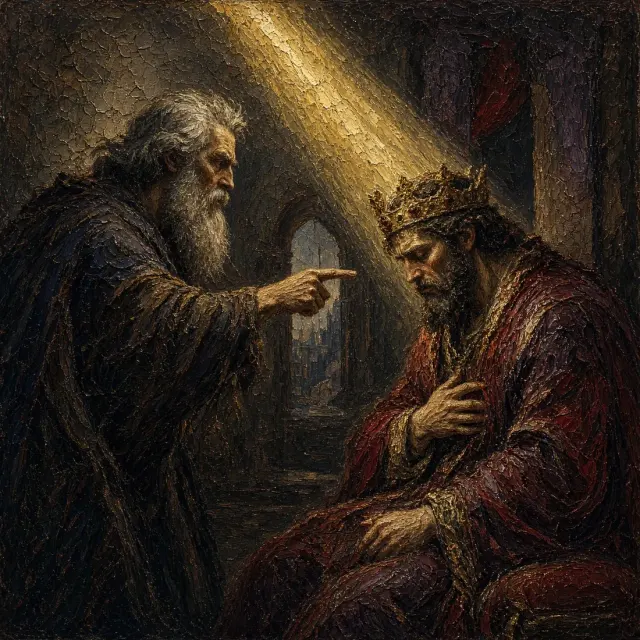
    At the time when kings go out to battle, he stays home. What follows is adultery, an attempted cover up, and a letter carried by the man it condemns. Nathan tells him an account and he passes sentence on himself.

    David sends almost everything except himself. He sends the army, sends to inquire about the woman, sends messengers to take her, sends for her husband, and sends the letter that arranges his death. Royal power keeps other people moving while David remains in Jerusalem. Then the next chapter opens with the LORD sending Nathan. The king no longer controls who arrives or what the visitor has come to say.

    Uriah's refusal to go home exposes the contrast without requiring him to know about the adultery. He names the ark, Israel, Judah, and the men camping in the open. Their conditions govern what he will allow himself. David has already taken another man's wife while those men are away; now he cannot persuade that husband to sleep with his own. The letter goes in Uriah's hand, and the killing draws other soldiers into its cost. David's reply makes the sword sound indiscriminate: it devours one as well as another. Nathan puts the agency back where it belongs. David has killed Uriah with the sword of the children of Ammon. Distance from the battlefield has not removed him from the act.

    The poor man's lamb brings David to judgment before he recognizes himself as the accused. Once Nathan names him, the elaborate chain of messages contracts to a plain confession: I have sinned against the LORD. Forgiveness is announced just as plainly. But the threatened sword within his house and the death of the child remain. The passage gives neither an innocent king nor an easy ending. Pardon is not presented as the cancellation of everything his actions have set in motion.

    Verse by verse

    1. 11:3

      The report identifies Bathsheba as Uriah's wife before David sends for her. Her marriage is not information that reaches him after the encounter.

    2. 11:4

      The verse records David's sending and taking, but gives no account of Bathsheba's wishes or consent. It does not describe her bathing as an attempt to attract him.

    3. 11:17

      Other servants of David die with Uriah. The account does not reduce the casualties to the one man named in the letter.

    4. 12:9

      Nathan attributes the killing to David even though Ammonite soldiers inflicted the fatal violence. The accusation follows responsibility through the intermediaries.

    5. 12:13

      Psalm 51's heading places that prayer after Nathan's confrontation, and verse 14 names bloodguiltiness. Romans 4:6-8 also cites David's words about forgiveness, there drawing on Psalm 32.

    6. 12:14

      The announced death is a judgment connected to David's conduct. The child is not accused of committing his father's sin.

    2 Samuel 11:1-12:14: You are the man

    2 Samuel 11:1-12:14

    King James Version · 41 verses

    11:1And it came to pass, after the year was expired, at the time when kings go forth to battle, that David sent Joab, and his servants with him, and all Israel; and they destroyed the children of Ammon, and besieged Rabbah. But David tarried still at Jerusalem.

    11:2And it came to pass in an eveningtide, that David arose from off his bed, and walked upon the roof of the king’s house: and from the roof he saw a woman washing herself; and the woman was very beautiful to look upon.

    11:3And David sent and enquired after the woman. And one said, Is not this Bath-sheba, the daughter of Eliam, the wife of Uriah the Hittite?

    11:4And David sent messengers, and took her; and she came in unto him, and he lay with her; for she was purified from her uncleanness: and she returned unto her house.

    11:5And the woman conceived, and sent and told David, and said, I am with child.

    11:6And David sent to Joab, saying, Send me Uriah the Hittite. And Joab sent Uriah to David.

    11:7And when Uriah was come unto him, David demanded of him how Joab did, and how the people did, and how the war prospered.

    11:8And David said to Uriah, Go down to thy house, and wash thy feet. And Uriah departed out of the king’s house, and there followed him a mess of meat from the king.

    11:9But Uriah slept at the door of the king’s house with all the servants of his lord, and went not down to his house.

    11:10And when they had told David, saying, Uriah went not down unto his house, David said unto Uriah, Camest thou not from thy journey? why then didst thou not go down unto thine house?

    11:11And Uriah said unto David, The ark, and Israel, and Judah, abide in tents; and my lord Joab, and the servants of my lord, are encamped in the open fields; shall I then go into mine house, to eat and to drink, and to lie with my wife? as thou livest, and as thy soul liveth, I will not do this thing.

    11:12And David said to Uriah, Tarry here to day also, and to morrow I will let thee depart. So Uriah abode in Jerusalem that day, and the morrow.

    11:13And when David had called him, he did eat and drink before him; and he made him drunk: and at even he went out to lie on his bed with the servants of his lord, but went not down to his house.

    11:14And it came to pass in the morning, that David wrote a letter to Joab, and sent it by the hand of Uriah.

    11:15And he wrote in the letter, saying, Set ye Uriah in the forefront of the hottest battle, and retire ye from him, that he may be smitten, and die.

    11:16And it came to pass, when Joab observed the city, that he assigned Uriah unto a place where he knew that valiant men were.

    11:17And the men of the city went out, and fought with Joab: and there fell some of the people of the servants of David; and Uriah the Hittite died also.

    11:18Then Joab sent and told David all the things concerning the war;

    11:19And charged the messenger, saying, When thou hast made an end of telling the matters of the war unto the king,

    11:20And if so be that the king’s wrath arise, and he say unto thee, Wherefore approached ye so nigh unto the city when ye did fight? knew ye not that they would shoot from the wall?

    11:21Who smote Abimelech the son of Jerubbesheth? did not a woman cast a piece of a millstone upon him from the wall, that he died in Thebez? why went ye nigh the wall? then say thou, Thy servant Uriah the Hittite is dead also.

    11:22So the messenger went, and came and shewed David all that Joab had sent him for.

    11:23And the messenger said unto David, Surely the men prevailed against us, and came out unto us into the field, and we were upon them even unto the entering of the gate.

    11:24And the shooters shot from off the wall upon thy servants; and some of the king’s servants be dead, and thy servant Uriah the Hittite is dead also.

    11:25Then David said unto the messenger, Thus shalt thou say unto Joab, Let not this thing displease thee, for the sword devoureth one as well as another: make thy battle more strong against the city, and overthrow it: and encourage thou him.

    11:26And when the wife of Uriah heard that Uriah her husband was dead, she mourned for her husband.

    11:27And when the mourning was past, David sent and fetched her to his house, and she became his wife, and bare him a son. But the thing that David had done displeased the LORD.

    12:1And the LORD sent Nathan unto David. And he came unto him, and said unto him, There were two men in one city; the one rich, and the other poor.

    12:2The rich man had exceeding many flocks and herds:

    12:3But the poor man had nothing, save one little ewe lamb, which he had bought and nourished up: and it grew up together with him, and with his children; it did eat of his own meat, and drank of his own cup, and lay in his bosom, and was unto him as a daughter.

    12:4And there came a traveller unto the rich man, and he spared to take of his own flock and of his own herd, to dress for the wayfaring man that was come unto him; but took the poor man’s lamb, and dressed it for the man that was come to him.

    12:5And David’s anger was greatly kindled against the man; and he said to Nathan, As the LORD liveth, the man that hath done this thing shall surely die:

    12:6And he shall restore the lamb fourfold, because he did this thing, and because he had no pity.

    12:7And Nathan said to David, Thou art the man. Thus saith the LORD God of Israel, I anointed thee king over Israel, and I delivered thee out of the hand of Saul;

    12:8And I gave thee thy master’s house, and thy master’s wives into thy bosom, and gave thee the house of Israel and of Judah; and if that had been too little, I would moreover have given unto thee such and such things.

    12:9Wherefore hast thou despised the commandment of the LORD, to do evil in his sight? thou hast killed Uriah the Hittite with the sword, and hast taken his wife to be thy wife, and hast slain him with the sword of the children of Ammon.

    12:10Now therefore the sword shall never depart from thine house; because thou hast despised me, and hast taken the wife of Uriah the Hittite to be thy wife.

    12:11Thus saith the LORD, Behold, I will raise up evil against thee out of thine own house, and I will take thy wives before thine eyes, and give them unto thy neighbour, and he shall lie with thy wives in the sight of this sun.

    12:12For thou didst it secretly: but I will do this thing before all Israel, and before the sun.

    12:13And David said unto Nathan, I have sinned against the LORD. And Nathan said unto David, The LORD also hath put away thy sin; thou shalt not die.

    12:14Howbeit, because by this deed thou hast given great occasion to the enemies of the LORD to blaspheme, the child also that is born unto thee shall surely die.


  6. 06

    2 Samuel 18:19-33

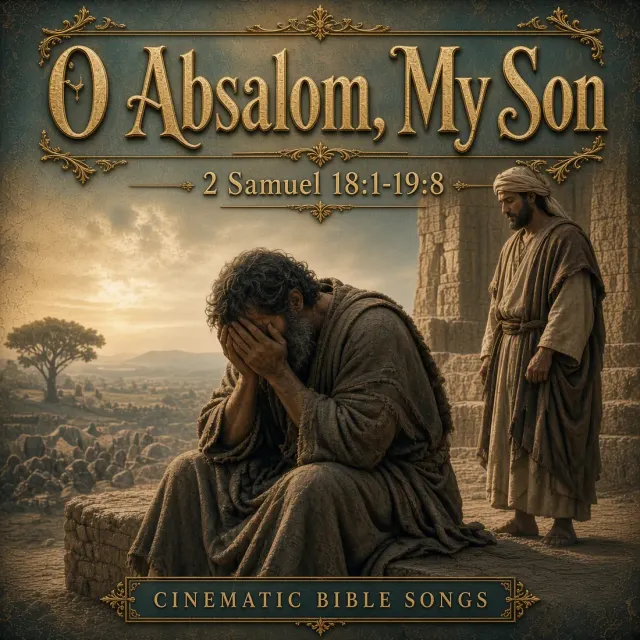
    O Absalom, my son, my son

    His son has taken the kingdom and is dead in a wood, and the army has just won a battle for him. He goes up to the chamber over the gate, and the victory turns to mourning for everyone.
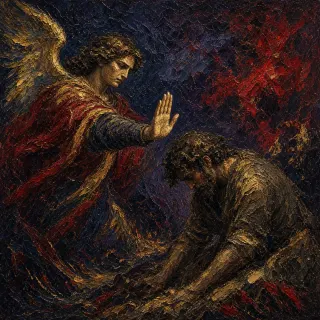
    Ahimaaz wins the race and still cannot give the king the answer he wants. David takes the runner's good character as a reason to expect good tidings, but a good messenger cannot make every part of a victory good. Both reports announce deliverance from enemies. David keeps returning to the safety of one man.
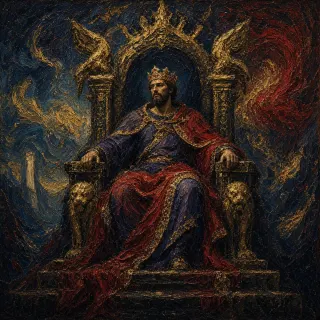
    That man has led the rebellion against him. The passage does not hide the contradiction between the army's success and the father's loss, or solve it by making one of them unreal. Ahimaaz speaks of a great tumult and declines to identify its meaning, although Joab has already told him that the king's son is dead. The second messenger answers indirectly, wishing Absalom's fate on all the king's enemies. The courtesy is enough. David understands.

    Then the setting contracts from the battlefield and the watching gate to the chamber above it. Names and kinship replace the language of victory. My son occurs five times in the final verse; the sentence keeps returning to the relationship the battle has not abolished. David wishes he had died instead. It is a father's impossible exchange, not a report that such an exchange was available. The kingdom has survived, and the king goes upstairs to weep.

    Verse by verse

    1. 18:20

      Joab has already told Ahimaaz that the king's son is dead. His later incomplete answer should not be explained simply as ignorance of that fact.

    2. 18:21

      The Hebrew designation behind Cushi is the Cushite. The KJV presents it in the form of a name.

    3. 18:32

      The messenger conveys the death through a wish that the king's enemies become as Absalom is. He does not directly utter the words that Absalom has died.

    4. 18:33

      David's wish to die in his son's place expresses grief. The verse does not turn the wish into an accomplished substitution or a promise that death can be reversed.

    2 Samuel 18:19-33: O Absalom, my son, my son

    2 Samuel 18:19-33

    King James Version · 15 verses

    18:19Then said Ahimaaz the son of Zadok, Let me now run, and bear the king tidings, how that the LORD hath avenged him of his enemies.

    18:20And Joab said unto him, Thou shalt not bear tidings this day, but thou shalt bear tidings another day: but this day thou shalt bear no tidings, because the king’s son is dead.

    18:21Then said Joab to Cushi, Go tell the king what thou hast seen. And Cushi bowed himself unto Joab, and ran.

    18:22Then said Ahimaaz the son of Zadok yet again to Joab, But howsoever, let me, I pray thee, also run after Cushi. And Joab said, Wherefore wilt thou run, my son, seeing that thou hast no tidings ready?

    18:23But howsoever, said he, let me run. And he said unto him, Run. Then Ahimaaz ran by the way of the plain, and overran Cushi.

    18:24And David sat between the two gates: and the watchman went up to the roof over the gate unto the wall, and lifted up his eyes, and looked, and behold a man running alone.

    18:25And the watchman cried, and told the king. And the king said, If he be alone, there is tidings in his mouth. And he came apace, and drew near.

    18:26And the watchman saw another man running: and the watchman called unto the porter, and said, Behold another man running alone. And the king said, He also bringeth tidings.

    18:27And the watchman said, Me thinketh the running of the foremost is like the running of Ahimaaz the son of Zadok. And the king said, He is a good man, and cometh with good tidings.

    18:28And Ahimaaz called, and said unto the king, All is well. And he fell down to the earth upon his face before the king, and said, Blessed be the LORD thy God, which hath delivered up the men that lifted up their hand against my lord the king.

    18:29And the king said, Is the young man Absalom safe? And Ahimaaz answered, When Joab sent the king’s servant, and me thy servant, I saw a great tumult, but I knew not what it was.

    18:30And the king said unto him, Turn aside, and stand here. And he turned aside, and stood still.

    18:31And, behold, Cushi came; and Cushi said, Tidings, my lord the king: for the LORD hath avenged thee this day of all them that rose up against thee.

    18:32And the king said unto Cushi, Is the young man Absalom safe? And Cushi answered, The enemies of my lord the king, and all that rise against thee to do thee hurt, be as that young man is.

    18:33And the king was much moved, and went up to the chamber over the gate, and wept: and as he went, thus he said, O my son Absalom, my son, my son Absalom! would God I had died for thee, O Absalom, my son, my son!

Why it matters

Half the Psalms carry his name and the prophets measure every king after him by whether he walked as David did, which is an odd standard for a man whose worst sin is recorded in full. That is the point. The account keeps both: a covenant that his house and his throne will be established forever, and a chapter where a prophet tells him an account about a lamb and then says you are the man. Every genealogy of Jesus runs through him, and the title son of David follows Jesus through all four gospels.

50 songs

The music

Every song in the catalogue whose passage falls inside these chapters.

  1. 1 Samuel 16:1-23

    The LORD Looketh on the Heart

  2. 1 Samuel 16

    The Shepherd Anointed

  3. 1 Samuel 17:40-49

    Run at the Giant

  4. 1 Samuel 17

    The Giant Fell

  5. 1 Samuel 17:1-58

    Who Is This Uncircumcised Philistine?

    Play hereOpen song pageRead lyrics
  6. 1 Samuel 18-23

    Covenant of Brothers

  7. 1 Samuel 18:1-20:42

    Knit to the Soul of David

  8. 1 Samuel 21:1-22:23

    Bread, Sword, and the Cave

  9. 1 Samuel 23:1-24:22

    I Will Not Stretch Forth My Hand

  10. 1 Samuel 24; 26

    I Will Not Touch the Lord's Anointed

  11. 1 Samuel 25:1-27:12

    Blessed Be Thy Advice

  12. 1 Samuel 28:1-31:13

    The Glory of Israel upon Gilboa

  13. 1 Samuel 28; 31

    The Last Night of Saul

  14. 1 Samuel 28

    The Witch of Endor

  15. 1 Samuel 30

    David Recovered All

  16. 2 Samuel 1:1-24:25

    2 Samuel, The Throne of David

  17. 2 Samuel 1:1-2:11

    How Are the Mighty Fallen

  18. 2 Samuel 2:12-4:12

    The House of David Grew Stronger

  19. 2 Samuel 5:1-6:23

    Bring Up the Ark with Shouting

  20. 2 Samuel 5:22-25

    Sound in the Treetops

  21. 2 Samuel 5

    Zion Taken

  22. 2 Samuel 6

    The Ark Came Dancing

  23. 2 Samuel 7

    A House and a Throne

  24. 2 Samuel 7:1-29

    A House Established unto David

  25. 2 Samuel 8:1-9:13

    At the King's Table Continually

  26. 2 Samuel 10:1-11:27

    The Sword Shall Never Depart

  27. 2 Samuel 11-12

    Thou Art the Man

  28. 2 Samuel 13-19

    O Absalom

  29. 2 Samuel 13:1-39

    Tamar's Desolation

  30. 2 Samuel 14:1-15:12

    He Stole the Hearts of Israel

  31. 2 Samuel 15:13-17:29

    Barefoot over the Brook Kidron

  32. 2 Samuel 18:1-19:8

    O Absalom, My Son

  33. 2 Samuel 19:9-20:26

    The King Came Again to Jordan

  34. 2 Samuel 21:1-14

    Rizpah Kept Watch

  35. 2 Samuel 21:1-22:51

    The LORD Is My Rock

  36. 2 Samuel 23:8-39

    David's Mighty Men

  37. 2 Samuel 23:1-39

    Men Whose Hearts Were as Lions

  38. 2 Samuel 24:1-25

    Stay Now Thine Hand

  39. 1 Kings 1:1-2:46

    Solomon Sat upon the Throne

  40. 1 Chronicles 11:1-12:40

    Men of War with a Perfect Heart

  41. 1 Chronicles 13:1-14:17

    Touch Not the Ark

  42. 1 Chronicles 15:1-16:6

    Strength and Gladness in His Place

  43. 1 Chronicles 16:7-43

    Give Thanks unto the LORD

  44. 1 Chronicles 17:1-27

    A House Established Forever

  45. 1 Chronicles 18:1-20:8

    The Crown of Rabbah

  46. 1 Chronicles 21:1-22:1

    The Place Where the Plague Was Stayed

  47. 1 Chronicles 22:1-19

    Arise and Build the Sanctuary

  48. 1 Chronicles 23:1-27:34

    Courses Set in Order

  49. 1 Chronicles 28:1-21

    The Pattern by the Spirit

  50. 1 Chronicles 29:1-30

    With a Perfect Heart They Offered

The videos

The videos

Every release whose passage falls inside these chapters, playing here.

Nearby

All the people

Report an error on this page