New · FreePlay The Witnesses The in-depth puzzle battle quest through Bible history

People of the Bible

Bathsheba

Is given no words at all in the chapter she is famous for, and secures the throne in the one where she speaks.

Bathsheba is introduced through someone else’s eyes, from a roof, and the grammar of the chapter is relentless about who is doing things: he sent, he took, she came. She is the wife of one of David’s thirty mighty men and the daughter of another, so the house she is taken from is not anonymous. Her husband is killed by arrangement, she mourns, and she is brought to the palace. The child dies. Years later, when David is old and another son is already being proclaimed king, she walks into the bedchamber and calls in a promise.

Where she appears2 Samuel 11 to 12 · 1 Kings 1 to 2

Scroll down to the account
Bathsheba

The movements, in the order the text gives them.

The Account of Bathsheba

  1. 01

    2 Samuel 11:1-5

    He sent, he took

    The chapter tells us who she is by naming two men, and then describes a sequence in which every verb belongs to the king. Her only words are four: I am with child.

    Bathsheba's first recorded words are four words long: I am with child. Before that message, David sees, inquires, sends, takes, and lies with her. She is identified by her father and her husband before she is brought to the king. Her marriage is not a complication discovered afterwards. It is part of the information he already possesses.

    The account gives no conversation at the palace and no access to her wishes. It also gives no reason to turn her bath into a calculated performance for David. The man on the roof is the one whose gaze the passage follows. Her coming when messengers bring her cannot, by itself, settle questions about consent; neither can silence be filled with a speech the text never records. The imbalance is visible in the actions it does record. A king sends. A married woman is taken.

    Then she returns unto her house. The visit ends, but its consequence crosses the distance back to the palace. This time Bathsheba sends the message. Its brevity is not insignificance: the entire arrangement David has controlled now confronts him with a fact that will not remain inside that room.

    Verse by verse

    1. 11:2

      David is on the palace roof. The text does not say that Bathsheba is bathing on a roof or deliberately displaying herself to him.

    2. 11:3

      The answer identifies her as the wife of Uriah the Hittite before the king takes her. Her husband's identity is known at the outset.

    3. 11:4

      The language of purification concerns ritual uncleanness, a category addressed in Leviticus 15. It is not a declaration that the sexual encounter is morally pure.

    4. 11:5

      This is direct speech attributed to Bathsheba, conveyed by a message. The chapter does not leave her entirely without words.

    2 Samuel 11:1-5

    King James Version · 5 verses

    11:1And it came to pass, after the year was expired, at the time when kings go forth to battle, that David sent Joab, and his servants with him, and all Israel; and they destroyed the children of Ammon, and besieged Rabbah. But David tarried still at Jerusalem.

    11:2And it came to pass in an eveningtide, that David arose from off his bed, and walked upon the roof of the king’s house: and from the roof he saw a woman washing herself; and the woman was very beautiful to look upon.

    11:3And David sent and enquired after the woman. And one said, Is not this Bath-sheba, the daughter of Eliam, the wife of Uriah the Hittite?

    11:4And David sent messengers, and took her; and she came in unto him, and he lay with her; for she was purified from her uncleanness: and she returned unto her house.

    11:5And the woman conceived, and sent and told David, and said, I am with child.

    2 Samuel 11:1-5: He sent, he took
  2. 02

    2 Samuel 11:14-27

    The letter her husband carried

    Uriah refuses to go home while the ark is in a tent, twice, sober and drunk. He then carries his own death warrant to Joab, and afterwards she mourns for him.

    Uriah carries the order for his own death, but Bathsheba does not appear inside the arrangement that kills him. David writes, Joab positions the men, a messenger reports the fighting, and the king supplies the words meant to make the loss acceptable. The passage does not make her a partner in that correspondence. Her next recorded action is mourning her husband.

    That word must be allowed its full weight. It is not described as pretence, and the account does not reveal whether she knows how his death was arranged. The king's instructions are available to the reader, not automatically to everyone living inside their consequences. Uriah is not the only casualty either. Other servants of David die near the wall. The private concealment has acquired additional households of the bereaved.

    After the mourning, David sends again and brings Bathsheba into his house. Marriage and birth give the events an outward sequence that could look settled: widow, wife, mother. The last sentence refuses that settlement. The thing that David had done displeased the LORD. The judgment names David's deed, not a romantic destiny shared by two people who were always meant to meet. The marriage has not made the killing disappear.

    Verse by verse

    1. 11:14

      The letter is sent by the hand of Uriah. The verse does not say whether he could read it or knew what it contained.

    2. 11:17

      The fighting kills other royal servants as well as Uriah. Their deaths are part of the recorded cost, even though their names are not supplied.

    3. 11:26

      Bathsheba mourns Uriah as her husband. Neither insincere grief nor knowledge of David's plan is attributed to her.

    4. 11:27

      The length of the mourning period is not specified. The final divine assessment explicitly concerns what David had done.

    2 Samuel 11:14-27

    King James Version · 14 verses

    11:14And it came to pass in the morning, that David wrote a letter to Joab, and sent it by the hand of Uriah.

    11:15And he wrote in the letter, saying, Set ye Uriah in the forefront of the hottest battle, and retire ye from him, that he may be smitten, and die.

    11:16And it came to pass, when Joab observed the city, that he assigned Uriah unto a place where he knew that valiant men were.

    11:17And the men of the city went out, and fought with Joab: and there fell some of the people of the servants of David; and Uriah the Hittite died also.

    11:18Then Joab sent and told David all the things concerning the war;

    11:19And charged the messenger, saying, When thou hast made an end of telling the matters of the war unto the king,

    11:20And if so be that the king’s wrath arise, and he say unto thee, Wherefore approached ye so nigh unto the city when ye did fight? knew ye not that they would shoot from the wall?

    11:21Who smote Abimelech the son of Jerubbesheth? did not a woman cast a piece of a millstone upon him from the wall, that he died in Thebez? why went ye nigh the wall? then say thou, Thy servant Uriah the Hittite is dead also.

    11:22So the messenger went, and came and shewed David all that Joab had sent him for.

    11:23And the messenger said unto David, Surely the men prevailed against us, and came out unto us into the field, and we were upon them even unto the entering of the gate.

    11:24And the shooters shot from off the wall upon thy servants; and some of the king’s servants be dead, and thy servant Uriah the Hittite is dead also.

    11:25Then David said unto the messenger, Thus shalt thou say unto Joab, Let not this thing displease thee, for the sword devoureth one as well as another: make thy battle more strong against the city, and overthrow it: and encourage thou him.

    11:26And when the wife of Uriah heard that Uriah her husband was dead, she mourned for her husband.

    11:27And when the mourning was past, David sent and fetched her to his house, and she became his wife, and bare him a son. But the thing that David had done displeased the LORD.

  3. 03

    2 Samuel 12:15-25

    The seven days

    The child sickens and David fasts on the ground, then gets up and eats when it dies, which nobody understands. Then he goes to comfort her, and Solomon is born.

    The child is introduced here as the child that Uriah's wife bare unto David. Even after the marriage, the wording keeps the violated marriage in view. Then the child becomes ill, and the long account follows David's fasting, his refusal of food, and the servants' fear of telling him that the child has died. Bathsheba's own conduct during these days is not described. That silence limits the account; it does not measure the mother's grief.

    David explains the change that puzzles his servants. While the child lived, he sought mercy; after the death, he cannot bring him back. Washing, worshipping, and eating are not presented as evidence that the child did not matter. They follow his recognition that the petition can no longer have the same outcome. The text does not soften the death into a misunderstanding or put a charge of wrongdoing against the child.

    Only then does David comfort Bathsheba. The verb acknowledges that there is sorrow to be addressed, not a vacancy to be efficiently filled. Solomon's birth is followed by the striking declaration that the LORD loved him, and by a name delivered through Nathan. The prophet associated with the sentence of judgment now carries a name of love. The second child is welcomed without the first child's loss being explained away.

    Verse by verse

    1. 12:15

      The Book of Second Samuel explicitly attributes the child's illness to the LORD. It does not accuse the child of David's conduct.

    2. 12:18

      The seventh day belongs to the sequence of illness and fasting. The verse does not explicitly identify it as the seventh day after birth or establish whether circumcision had occurred.

    3. 12:23

      I shall go to him at minimum recognizes that David too will die and cannot retrieve the child. Readers differ on whether it also expresses a specific expectation of reunion; the verse does not describe that reunion.

    4. 12:24-25

      Solomon and Jedidiah refer to the same child. No exact interval between the first child's death and Solomon's birth is supplied.

    2 Samuel 12:15-25

    King James Version · 11 verses

    12:15And Nathan departed unto his house. And the LORD struck the child that Uriah’s wife bare unto David, and it was very sick.

    12:16David therefore besought God for the child; and David fasted, and went in, and lay all night upon the earth.

    12:17And the elders of his house arose, and went to him, to raise him up from the earth: but he would not, neither did he eat bread with them.

    12:18And it came to pass on the seventh day, that the child died. And the servants of David feared to tell him that the child was dead: for they said, Behold, while the child was yet alive, we spake unto him, and he would not hearken unto our voice: how will he then vex himself, if we tell him that the child is dead?

    12:19But when David saw that his servants whispered, David perceived that the child was dead: therefore David said unto his servants, Is the child dead? And they said, He is dead.

    12:20Then David arose from the earth, and washed, and anointed himself, and changed his apparel, and came into the house of the LORD, and worshipped: then he came to his own house; and when he required, they set bread before him, and he did eat.

    12:21Then said his servants unto him, What thing is this that thou hast done? thou didst fast and weep for the child, while it was alive; but when the child was dead, thou didst rise and eat bread.

    12:22And he said, While the child was yet alive, I fasted and wept: for I said, Who can tell whether GOD will be gracious to me, that the child may live?

    12:23But now he is dead, wherefore should I fast? can I bring him back again? I shall go to him, but he shall not return to me.

    12:24And David comforted Bath-sheba his wife, and went in unto her, and lay with her: and she bare a son, and he called his name Solomon: and the LORD loved him.

    12:25And he sent by the hand of Nathan the prophet; and he called his name Jedidiah, because of the LORD.

  4. 04

    1 Kings 1:11-31

    Did you not swear to me

    Adonijah is being proclaimed king a mile away. She goes in first, sets out what happens to her and Solomon if this stands, and Nathan follows to confirm it. David swears the oath again that day.

    Bathsheba enters the old king's chamber with more than a request for her son's advancement. Nathan has named the danger to both their lives, and she makes that danger explicit: once David dies, she and Solomon may be counted offenders. The identity of the next king can change their standing without changing anything they have done. The banquet outside the chamber is not merely a family celebration.

    Her speech holds together an oath, a list of invitees, and an absence. David swore that Solomon would reign; Adonijah has assembled royal sons, a priest, and the commander; Solomon was not invited. The omission does real work. She is not asking David to speculate about a distant possibility. She presents a succession already being enacted without his declared authorization and asks him to state who will occupy his throne.

    Nathan arrives as arranged, but Bathsheba is not left outside the final answer. David calls her back and renews the oath to her directly. The important addition is this day. A promise about the future becomes an instruction for the present. Her closing bow keeps the court's formal language intact, yet the exchange has altered what will happen beyond the chamber. She has secured more than another reassuring sentence.

    Verse by verse

    1. 1:12

      Nathan names the preservation of Bathsheba's life and Solomon's life as the purpose of his counsel. The danger is not introduced merely by later interpretation.

    2. 1:17

      The earlier oath is reported here rather than preserved in an earlier scene. David explicitly acknowledges and renews it in verse 30.

    3. 1:21

      The Hebrew word rendered offenders denotes people treated as guilty. Bathsheba describes the status she fears under the rival succession, not a confession of a new offence.

    4. 1:30

      This day turns the renewed oath into an immediate undertaking. The anointing instructions that follow in verses 32-35 specify how it will be carried out.

    1 Kings 1:11-31: Did you not swear to me

    1 Kings 1:11-31

    King James Version · 21 verses

    1:11Wherefore Nathan spake unto Bath-sheba the mother of Solomon, saying, Hast thou not heard that Adonijah the son of Haggith doth reign, and David our lord knoweth it not?

    1:12Now therefore come, let me, I pray thee, give thee counsel, that thou mayest save thine own life, and the life of thy son Solomon.

    1:13Go and get thee in unto king David, and say unto him, Didst not thou, my lord, O king, swear unto thine handmaid, saying, Assuredly Solomon thy son shall reign after me, and he shall sit upon my throne? why then doth Adonijah reign?

    1:14Behold, while thou yet talkest there with the king, I also will come in after thee, and confirm thy words.

    1:15And Bath-sheba went in unto the king into the chamber: and the king was very old; and Abishag the Shunammite ministered unto the king.

    1:16And Bath-sheba bowed, and did obeisance unto the king. And the king said, What wouldest thou?

    1:17And she said unto him, My lord, thou swarest by the LORD thy God unto thine handmaid, saying, Assuredly Solomon thy son shall reign after me, and he shall sit upon my throne.

    1:18And now, behold, Adonijah reigneth; and now, my lord the king, thou knowest it not:

    1:19And he hath slain oxen and fat cattle and sheep in abundance, and hath called all the sons of the king, and Abiathar the priest, and Joab the captain of the host: but Solomon thy servant hath he not called.

    1:20And thou, my lord, O king, the eyes of all Israel are upon thee, that thou shouldest tell them who shall sit on the throne of my lord the king after him.

    1:21Otherwise it shall come to pass, when my lord the king shall sleep with his fathers, that I and my son Solomon shall be counted offenders.

    1:22And, lo, while she yet talked with the king, Nathan the prophet also came in.

    1:23And they told the king, saying, Behold Nathan the prophet. And when he was come in before the king, he bowed himself before the king with his face to the ground.

    1:24And Nathan said, My lord, O king, hast thou said, Adonijah shall reign after me, and he shall sit upon my throne?

    1:25For he is gone down this day, and hath slain oxen and fat cattle and sheep in abundance, and hath called all the king’s sons, and the captains of the host, and Abiathar the priest; and, behold, they eat and drink before him, and say, God save king Adonijah.

    1:26But me, even me thy servant, and Zadok the priest, and Benaiah the son of Jehoiada, and thy servant Solomon, hath he not called.

    1:27Is this thing done by my lord the king, and thou hast not shewed it unto thy servant, who should sit on the throne of my lord the king after him?

    1:28Then king David answered and said, Call me Bath-sheba. And she came into the king’s presence, and stood before the king.

    1:29And the king sware, and said, As the LORD liveth, that hath redeemed my soul out of all distress,

    1:30Even as I sware unto thee by the LORD God of Israel, saying, Assuredly Solomon thy son shall reign after me, and he shall sit upon my throne in my stead; even so will I certainly do this day.

    1:31Then Bath-sheba bowed with her face to the earth, and did reverence to the king, and said, Let my lord king David live for ever.


Why it matters

Two chapters, two completely different positions. In 2 Samuel 11 everything is done to her and she says one sentence of four words, that she is pregnant. In 1 Kings 1 she is the one who moves first, names the danger to herself and her son plainly, and gets Solomon on the throne before the rival’s feast has finished. Matthew names her in the genealogy of Jesus, and does it by naming her husband instead, which keeps the crime in the record.

3 songs

The music

Every song in the catalogue whose passage falls inside these chapters.

  1. 2 Samuel 10:1-11:27

    The Sword Shall Never Depart

  2. 2 Samuel 11-12

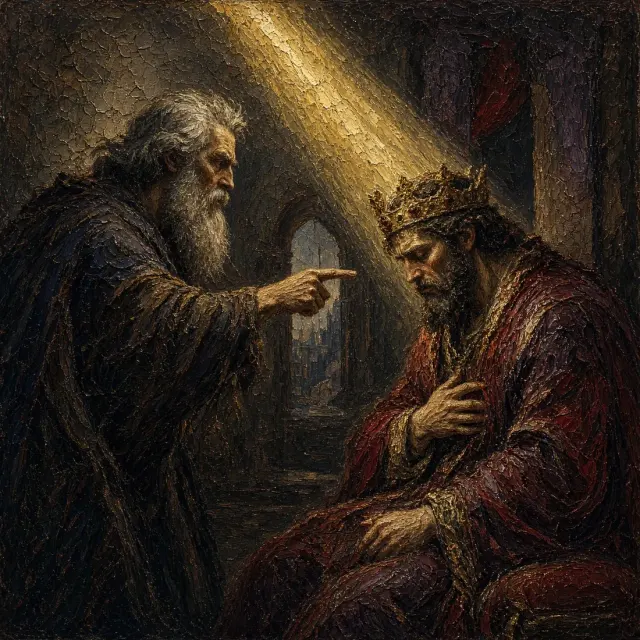
    Thou Art the Man

  3. 1 Kings 1:1-2:46

    Solomon Sat upon the Throne

Nearby

All the people

Report an error on this page