New · FreePlay The Witnesses The in-depth puzzle battle quest through Bible history

People of the Bible

Jonathan

Gave away the throne he was born to, garment by garment, and meant it.

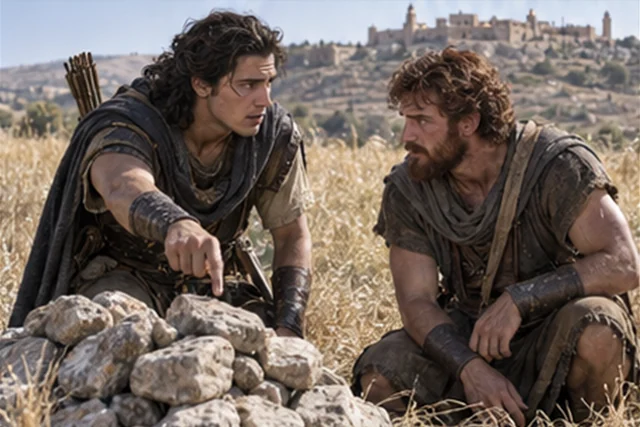
Jonathan is Saul’s heir and the best soldier in the book before David arrives. He climbs a cliff with one armour bearer on the reasoning that it may be the LORD will work for us, for there is no restraint to the LORD to save by many or by few, and starts a rout. He eats honey on a day his father has cursed anyone who eats, and the army has to buy his life back. Then David kills Goliath, and Jonathan takes off his robe, his armour, his sword, his bow and his belt and gives them to him, which is what a man does when he is handing over a succession.

Where he appears1 Samuel 13 to 14 · 1 Samuel 18 to 20 · 1 Samuel 23 · 1 Samuel 31

Scroll down to the account
Jonathan

The movements, in the order the text gives them.

The Account of Jonathan

  1. 01

    1 Samuel 14:1-15

    There is no restraint to the LORD

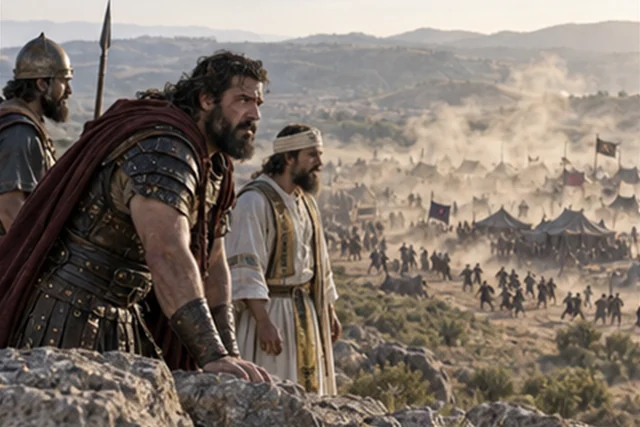
    He and his armour bearer climb between two crags on a sign they invent themselves. Twenty men fall in half an acre and the whole Philistine camp panics.

    Jonathan's confidence begins with it may be. He is certain that the LORD is not limited by the size of an army; he does not pretend to possess an advance guarantee for every move he makes. Those two things belong together. The possibility is enough to set him moving, but he still proposes a sign and tells his armourbearer exactly when they will climb and when they will stay where they are.

    The terrain makes the undertaking wonderfully unceremonious. Israel's prince reaches the enemy on his hands and feet. No procession, no elevated platform, and very little opportunity to look princely. The Philistines invite the two Hebrews up because they think the men have finally emerged from their hiding holes. Jonathan hears the same invitation as the agreed signal. Their contempt gives him his cue.

    The armourbearer is not scenery. He answers with a commitment of his own, follows the climb, and participates in the fighting. The first twenty deaths occupy a small patch of ground; then the account widens abruptly to camp, field, raiders, people, and the shaking earth. What begins with two men is not explained as twenty men somehow frightening an entire army by themselves. The widening belongs to the LORD's deliverance, which verse 23 names outright.

    Verse by verse

    1. 14:1

      The text says Jonathan did not tell his father. It gives no conversation in which Saul refuses permission and no explicit motive for the secrecy.

    2. 14:6

      It may be preserves contingency; no restraint denies that the LORD depends on superior numbers. Jonathan does not confuse those two claims.

    3. 14:8

      Discover ourselves means reveal their presence to the garrison, not find out something about their own identities.

    4. 14:14

      The area is described by the amount a yoke of oxen might plow. The verse does not provide modern survey measurements precise enough to justify an exact conversion.

    1 Samuel 14:1-15: There is no restraint to the LORD

    1 Samuel 14:1-15

    King James Version · 15 verses

    14:1Now it came to pass upon a day, that Jonathan the son of Saul said unto the young man that bare his armour, Come, and let us go over to the Philistines’ garrison, that is on the other side. But he told not his father.

    14:2And Saul tarried in the uttermost part of Gibeah under a pomegranate tree which is in Migron: and the people that were with him were about six hundred men;

    14:3And Ahiah, the son of Ahitub, I-chabod’s brother, the son of Phinehas, the son of Eli, the LORD’s priest in Shiloh, wearing an ephod. And the people knew not that Jonathan was gone.

    14:4And between the passages, by which Jonathan sought to go over unto the Philistines’ garrison, there was a sharp rock on the one side, and a sharp rock on the other side: and the name of the one was Bozez, and the name of the other Seneh.

    14:5The forefront of the one was situate northward over against Michmash, and the other southward over against Gibeah.

    14:6And Jonathan said to the young man that bare his armour, Come, and let us go over unto the garrison of these uncircumcised: it may be that the LORD will work for us: for there is no restraint to the LORD to save by many or by few.

    14:7And his armourbearer said unto him, Do all that is in thine heart: turn thee; behold, I am with thee according to thy heart.

    14:8Then said Jonathan, Behold, we will pass over unto these men, and we will discover ourselves unto them.

    14:9If they say thus unto us, Tarry until we come to you; then we will stand still in our place, and will not go up unto them.

    14:10But if they say thus, Come up unto us; then we will go up: for the LORD hath delivered them into our hand: and this shall be a sign unto us.

    14:11And both of them discovered themselves unto the garrison of the Philistines: and the Philistines said, Behold, the Hebrews come forth out of the holes where they had hid themselves.

    14:12And the men of the garrison answered Jonathan and his armourbearer, and said, Come up to us, and we will shew you a thing. And Jonathan said unto his armourbearer, Come up after me: for the LORD hath delivered them into the hand of Israel.

    14:13And Jonathan climbed up upon his hands and upon his feet, and his armourbearer after him: and they fell before Jonathan; and his armourbearer slew after him.

    14:14And that first slaughter, which Jonathan and his armourbearer made, was about twenty men, within as it were an half acre of land, which a yoke of oxen might plow.

    14:15And there was trembling in the host, in the field, and among all the people: the garrison, and the spoilers, they also trembled, and the earth quaked: so it was a very great trembling.

  2. 02

    1 Samuel 14:24-45

    The honey and the oath

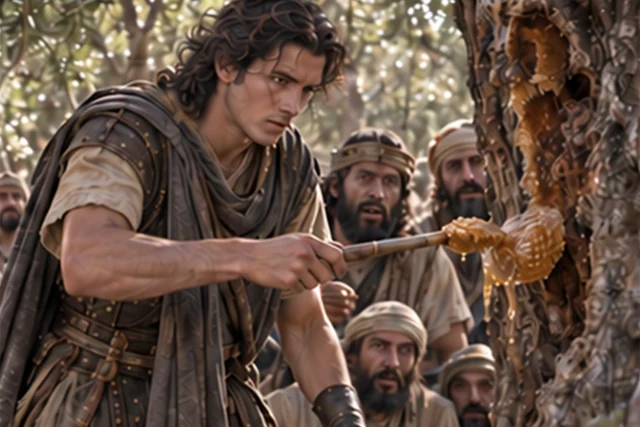
    He did not hear the curse, tastes honey on the end of his staff, and says plainly that his father has troubled the land. The people ransom him rather than let him die.

    The honey is available. That is what makes the army's hunger so pointed. It lies in the wood, within reach of men who have been fighting, but Saul's oath keeps their hands away from their mouths. Jonathan has not heard the oath. A little honey restores him, and his renewed eyes become visible evidence against the policy that has left the others faint.

    His protest is not that victory is unimportant. It is that the prohibition has made the pursuit less effective. The exhausted men eventually rush upon the captured animals and eat with the blood, a transgression the passage explicitly names. Saul then investigates the unanswered inquiry to God and identifies Jonathan by lot. The king's son, who helped bring deliverance, now faces death for tasting food during the day of that deliverance.

    The people finally refuse. Their argument is theological before it is sentimental: Jonathan has wrought with God this day. Saul invokes the living LORD to pronounce death; the people invoke the living LORD to forbid even one hair of Jonathan's head from falling. The oath is not allowed the last word simply because a king pronounced it. Israel's rescuer must now be rescued from Israel's king.

    Verse by verse

    1. 14:27

      Jonathan had not heard the prohibition when he ate. The text does not describe deliberate defiance of an oath he already knew.

    2. 14:29

      The brightness of his eyes expresses renewed vitality in contrast to the faint soldiers. No special medicinal or supernatural property is assigned to this honey.

    3. 14:33

      Eating with the blood is expressly called sin against the LORD. That stated offense should not be confused with Saul's separate prohibition of all food until evening.

    4. 14:43

      Jonathan admits the act and its threatened consequence. The verse does not say that he accepts the oath as a wise or just policy.

    5. 14:45

      Both Saul and the people appeal to the living LORD in their opposing declarations. The people's stated ground is Jonathan's participation in the deliverance God has given.

    1 Samuel 14:24-45: The honey and the oath

    1 Samuel 14:24-45

    King James Version · 22 verses

    14:24And the men of Israel were distressed that day: for Saul had adjured the people, saying, Cursed be the man that eateth any food until evening, that I may be avenged on mine enemies. So none of the people tasted any food.

    14:25And all they of the land came to a wood; and there was honey upon the ground.

    14:26And when the people were come into the wood, behold, the honey dropped; but no man put his hand to his mouth: for the people feared the oath.

    14:27But Jonathan heard not when his father charged the people with the oath: wherefore he put forth the end of the rod that was in his hand, and dipped it in an honeycomb, and put his hand to his mouth; and his eyes were enlightened.

    14:28Then answered one of the people, and said, Thy father straitly charged the people with an oath, saying, Cursed be the man that eateth any food this day. And the people were faint.

    14:29Then said Jonathan, My father hath troubled the land: see, I pray you, how mine eyes have been enlightened, because I tasted a little of this honey.

    14:30How much more, if haply the people had eaten freely to day of the spoil of their enemies which they found? for had there not been now a much greater slaughter among the Philistines?

    14:31And they smote the Philistines that day from Michmash to Aijalon: and the people were very faint.

    14:32And the people flew upon the spoil, and took sheep, and oxen, and calves, and slew them on the ground: and the people did eat them with the blood.

    14:33Then they told Saul, saying, Behold, the people sin against the LORD, in that they eat with the blood. And he said, Ye have transgressed: roll a great stone unto me this day.

    14:34And Saul said, Disperse yourselves among the people, and say unto them, Bring me hither every man his ox, and every man his sheep, and slay them here, and eat; and sin not against the LORD in eating with the blood. And all the people brought every man his ox with him that night, and slew them there.

    14:35And Saul built an altar unto the LORD: the same was the first altar that he built unto the LORD.

    14:36And Saul said, Let us go down after the Philistines by night, and spoil them until the morning light, and let us not leave a man of them. And they said, Do whatsoever seemeth good unto thee. Then said the priest, Let us draw near hither unto God.

    14:37And Saul asked counsel of God, Shall I go down after the Philistines? wilt thou deliver them into the hand of Israel? But he answered him not that day.

    14:38And Saul said, Draw ye near hither, all the chief of the people: and know and see wherein this sin hath been this day.

    14:39For, as the LORD liveth, which saveth Israel, though it be in Jonathan my son, he shall surely die. But there was not a man among all the people that answered him.

    14:40Then said he unto all Israel, Be ye on one side, and I and Jonathan my son will be on the other side. And the people said unto Saul, Do what seemeth good unto thee.

    14:41Therefore Saul said unto the LORD God of Israel, Give a perfect lot. And Saul and Jonathan were taken: but the people escaped.

    14:42And Saul said, Cast lots between me and Jonathan my son. And Jonathan was taken.

    14:43Then Saul said to Jonathan, Tell me what thou hast done. And Jonathan told him, and said, I did but taste a little honey with the end of the rod that was in mine hand, and, lo, I must die.

    14:44And Saul answered, God do so and more also: for thou shalt surely die, Jonathan.

    14:45And the people said unto Saul, Shall Jonathan die, who hath wrought this great salvation in Israel? God forbid: as the LORD liveth, there shall not one hair of his head fall to the ground; for he hath wrought with God this day. So the people rescued Jonathan, that he died not.

  3. 03

    1 Samuel 18:1-4

    The robe, the sword, the bow and the belt

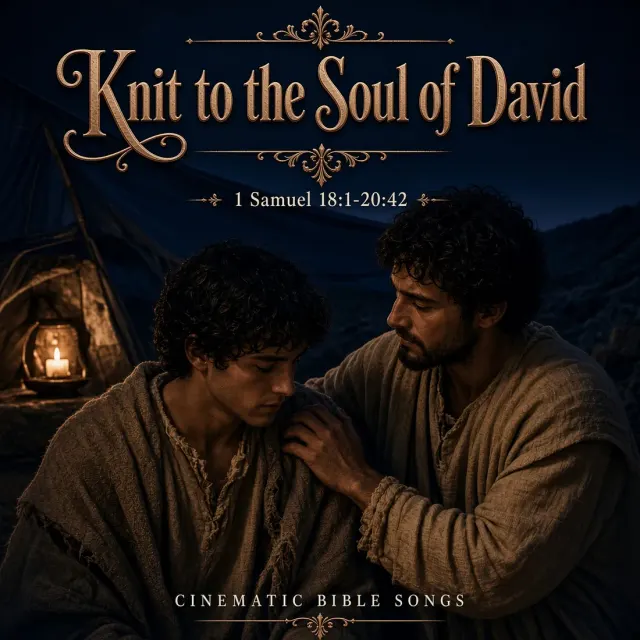
    His soul is knit to David’s. He strips off everything that marks him as the king’s son and gives it away, and the text lists each item separately.

    Jonathan's affection acquires an inventory. Robe, garments, sword, bow, girdle. The passage does not leave love floating in a fine sentence about souls; it puts the prince's possessions into David's hands. Each item makes the relationship visible, and several belong to the military identity Jonathan has already earned in battle.

    Saul takes David into permanent royal service, while Jonathan gives. That contrast is present in the adjacent verses without requiring every gift to be treated as a legal document. The robe and weapons can reasonably be read as honoring David and recognizing his standing, but the text does not call this a formal abdication. Jonathan's explicit statement that David will be king comes in 23:17. The earlier gesture is substantial enough without inserting a coronation ceremony into four verses.

    The covenant is explained by love, not reduced to calculation. Jonathan loved him as his own soul appears twice, surrounding the making of the covenant. Nothing in the passage supplies a bargaining speech or a list of benefits Jonathan expects in return. The prince does not merely admire David's victory from a safe distance. He begins to attach his own life to the victor's.

    Verse by verse

    1. 18:1

      Soul translates nephesh, which can denote the person or life, not merely a separable inward component. The phrase describes Jonathan's attachment to David as a person.

    2. 18:2

      Saul no longer allows David to return to his father's house. The verse describes a change in David's household attachment and service.

    3. 18:3

      The covenant is explicitly linked to Jonathan's love. Its complete terms are not listed in these four verses.

    4. 18:4

      Girdle means a belt or sash. A symbolic recognition of David is a reading of the gifts; a formal legal surrender of the throne is not expressly stated here.

    1 Samuel 18:1-4

    King James Version · 4 verses

    18:1And it came to pass, when he had made an end of speaking unto Saul, that the soul of Jonathan was knit with the soul of David, and Jonathan loved him as his own soul.

    18:2And Saul took him that day, and would let him go no more home to his father’s house.

    18:3Then Jonathan and David made a covenant, because he loved him as his own soul.

    18:4And Jonathan stripped himself of the robe that was upon him, and gave it to David, and his garments, even to his sword, and to his bow, and to his girdle.

    1 Samuel 18:1-4: The robe, the sword, the bow and the belt
  4. 04

    1 Samuel 20:1-42

    The arrows in the field

    He tests his father, gets a spear thrown at him, and goes out with a boy and a bow to signal a verdict he cannot say aloud. Then he sends the boy away and they weep together.

    The empty chair does the first dangerous work. On the first day Saul explains David's absence as ritual uncleanness; on the second, he demands an answer. Jonathan begins the chapter certain that his father would not conceal such a plan from him. By the time a javelin comes toward him at the table, that certainty is finished. Saul has made his intended treatment of David visible by attempting to strike David's defender.

    The king states the cost of Jonathan's loyalty with exceptional plainness: while David lives, Jonathan and his kingdom will not be established. Jonathan answers about David's innocence, not about the inconvenience to his own succession. His fierce anger and grief are given by the text; no invented inner speech is needed. He leaves the meal uneaten.

    The arrows carry a message that the boy collecting them cannot understand. Then the boy is sent away, and the carefully arranged signal gives way to an unhidden farewell: bows, kisses, and tears. Yet the final words are not only about separation. The oath reaches their descendants. Jonathan is securing kindness for a household whose future no longer depends on his becoming king. The men go in different directions with an obligation that is meant to outlive them both.

    Verse by verse

    1. 20:5

      The new moon marks the beginning of the month. The passage places David under an expectation of attendance at the king's meal.

    2. 20:14-15

      Jonathan asks for protection for himself and continuing kindness to his household, including the time when David's enemies have been removed.

    3. 20:26

      Saul's first explanation is that David is ritually unclean. That is Saul's thought, not the actual reason the account has given for David's absence.

    4. 20:33

      Saul throws the javelin at Jonathan in this verse. This is distinct from the earlier attempts against David.

    5. 20:40

      Artillery here means the bow and its equipment, not modern guns or cannon.

    6. 20:42

      This is not their last recorded meeting. In 23:16-18 Jonathan meets David in the wood, strengthens his hand in God, and again makes a covenant with him.

    1 Samuel 20:1-42: The arrows in the field

    1 Samuel 20:1-42

    King James Version · 42 verses

    20:1And David fled from Naioth in Ramah, and came and said before Jonathan, What have I done? what is mine iniquity? and what is my sin before thy father, that he seeketh my life?

    20:2And he said unto him, God forbid; thou shalt not die: behold, my father will do nothing either great or small, but that he will shew it me: and why should my father hide this thing from me? it is not so.

    20:3And David sware moreover, and said, Thy father certainly knoweth that I have found grace in thine eyes; and he saith, Let not Jonathan know this, lest he be grieved: but truly as the LORD liveth, and as thy soul liveth, there is but a step between me and death.

    20:4Then said Jonathan unto David, Whatsoever thy soul desireth, I will even do it for thee.

    20:5And David said unto Jonathan, Behold, to morrow is the new moon, and I should not fail to sit with the king at meat: but let me go, that I may hide myself in the field unto the third day at even.

    20:6If thy father at all miss me, then say, David earnestly asked leave of me that he might run to Beth-lehem his city: for there is a yearly sacrifice there for all the family.

    20:7If he say thus, It is well; thy servant shall have peace: but if he be very wroth, then be sure that evil is determined by him.

    20:8Therefore thou shalt deal kindly with thy servant; for thou hast brought thy servant into a covenant of the LORD with thee: notwithstanding, if there be in me iniquity, slay me thyself; for why shouldest thou bring me to thy father?

    20:9And Jonathan said, Far be it from thee: for if I knew certainly that evil were determined by my father to come upon thee, then would not I tell it thee?

    20:10Then said David to Jonathan, Who shall tell me? or what if thy father answer thee roughly?

    20:11And Jonathan said unto David, Come, and let us go out into the field. And they went out both of them into the field.

    20:12And Jonathan said unto David, O LORD God of Israel, when I have sounded my father about to morrow any time, or the third day, and, behold, if there be good toward David, and I then send not unto thee, and shew it thee;

    20:13The LORD do so and much more to Jonathan: but if it please my father to do thee evil, then I will shew it thee, and send thee away, that thou mayest go in peace: and the LORD be with thee, as he hath been with my father.

    20:14And thou shalt not only while yet I live shew me the kindness of the LORD, that I die not:

    20:15But also thou shalt not cut off thy kindness from my house for ever: no, not when the LORD hath cut off the enemies of David every one from the face of the earth.

    20:16So Jonathan made a covenant with the house of David, saying, Let the LORD even require it at the hand of David’s enemies.

    20:17And Jonathan caused David to swear again, because he loved him: for he loved him as he loved his own soul.

    20:18Then Jonathan said to David, To morrow is the new moon: and thou shalt be missed, because thy seat will be empty.

    20:19And when thou hast stayed three days, then thou shalt go down quickly, and come to the place where thou didst hide thyself when the business was in hand, and shalt remain by the stone Ezel.

    20:20And I will shoot three arrows on the side thereof, as though I shot at a mark.

    20:21And, behold, I will send a lad, saying, Go, find out the arrows. If I expressly say unto the lad, Behold, the arrows are on this side of thee, take them; then come thou: for there is peace to thee, and no hurt; as the LORD liveth.

    20:22But if I say thus unto the young man, Behold, the arrows are beyond thee; go thy way: for the LORD hath sent thee away.

    20:23And as touching the matter which thou and I have spoken of, behold, the LORD be between thee and me for ever.

    20:24So David hid himself in the field: and when the new moon was come, the king sat him down to eat meat.

    20:25And the king sat upon his seat, as at other times, even upon a seat by the wall: and Jonathan arose, and Abner sat by Saul’s side, and David’s place was empty.

    20:26Nevertheless Saul spake not any thing that day: for he thought, Something hath befallen him, he is not clean; surely he is not clean.

    20:27And it came to pass on the morrow, which was the second day of the month, that David’s place was empty: and Saul said unto Jonathan his son, Wherefore cometh not the son of Jesse to meat, neither yesterday, nor to day?

    20:28And Jonathan answered Saul, David earnestly asked leave of me to go to Beth-lehem:

    20:29And he said, Let me go, I pray thee; for our family hath a sacrifice in the city; and my brother, he hath commanded me to be there: and now, if I have found favour in thine eyes, let me get away, I pray thee, and see my brethren. Therefore he cometh not unto the king’s table.

    20:30Then Saul’s anger was kindled against Jonathan, and he said unto him, Thou son of the perverse rebellious woman, do not I know that thou hast chosen the son of Jesse to thine own confusion, and unto the confusion of thy mother’s nakedness?

    20:31For as long as the son of Jesse liveth upon the ground, thou shalt not be established, nor thy kingdom. Wherefore now send and fetch him unto me, for he shall surely die.

    20:32And Jonathan answered Saul his father, and said unto him, Wherefore shall he be slain? what hath he done?

    20:33And Saul cast a javelin at him to smite him: whereby Jonathan knew that it was determined of his father to slay David.

    20:34So Jonathan arose from the table in fierce anger, and did eat no meat the second day of the month: for he was grieved for David, because his father had done him shame.

    20:35And it came to pass in the morning, that Jonathan went out into the field at the time appointed with David, and a little lad with him.

    20:36And he said unto his lad, Run, find out now the arrows which I shoot. And as the lad ran, he shot an arrow beyond him.

    20:37And when the lad was come to the place of the arrow which Jonathan had shot, Jonathan cried after the lad, and said, Is not the arrow beyond thee?

    20:38And Jonathan cried after the lad, Make speed, haste, stay not. And Jonathan’s lad gathered up the arrows, and came to his master.

    20:39But the lad knew not any thing: only Jonathan and David knew the matter.

    20:40And Jonathan gave his artillery unto his lad, and said unto him, Go, carry them to the city.

    20:41And as soon as the lad was gone, David arose out of a place toward the south, and fell on his face to the ground, and bowed himself three times: and they kissed one another, and wept one with another, until David exceeded.

    20:42And Jonathan said to David, Go in peace, forasmuch as we have sworn both of us in the name of the LORD, saying, The LORD be between me and thee, and between my seed and thy seed for ever. And he arose and departed: and Jonathan went into the city.

  5. 05

    1 Samuel 31:1-6

    Gilboa

    He dies with his brothers and his father on the same mountain on the same day. David’s lament names him last and longest: your love to me was wonderful.

    Jonathan's death receives no speech. His name stands in a list of three brothers killed by the Philistines, and the account moves on to their father. The brevity is severe precisely because the earlier chapters have given him so much to say. The man who imagined standing next to David as king in 23:17 dies beside the family whose succession David will replace.

    The passage does not accuse Jonathan of choosing the wrong side, nor does it explain his final thoughts about Saul. It records his presence and his death. Loyalty to David had not removed him from Israel's army or erased his relationship to his father. A battlefield death is not supplied with a private moral verdict simply because a reader can imagine one.

    David's lament in the next book gives the loss its own voice: the bow of Jonathan turned not back; in their death Saul and Jonathan were not divided. Those words do not turn every earlier disagreement into harmony. They honor the fallen together. The battle account names Jonathan among the dead. David's lament names what his death has taken away.

    Verse by verse

    1. 31:2

      Jonathan, Abinadab, and Melchishua are the three sons named as killed. Saul's surviving son Ishbosheth appears in 2 Samuel 2:8-10.

    2. 31:3

      The archers' attack and grievous wounding in this verse concern Saul. The manner of Jonathan's individual death is not described beyond the Philistines killing him.

    3. 31:6

      Second Samuel 4:4 says Jonathan's son Mephibosheth was five when the news arrived. His injury occurred during his nurse's hurried flight, not in the battle itself.

    4. 31:6

      Second Samuel 21:12-14 records David later bringing the bones of Saul and Jonathan from Jabesh-gilead to the family tomb in Zelah. Gilboa is not their final burial place.

    1 Samuel 31:1-6

    King James Version · 6 verses

    31:1Now the Philistines fought against Israel: and the men of Israel fled from before the Philistines, and fell down slain in mount Gilboa.

    31:2And the Philistines followed hard upon Saul and upon his sons; and the Philistines slew Jonathan, and Abinadab, and Malchi-shua, Saul’s sons.

    31:3And the battle went sore against Saul, and the archers hit him; and he was sore wounded of the archers.

    31:4Then said Saul unto his armourbearer, Draw thy sword, and thrust me through therewith; lest these uncircumcised come and thrust me through, and abuse me. But his armourbearer would not; for he was sore afraid. Therefore Saul took a sword, and fell upon it.

    31:5And when his armourbearer saw that Saul was dead, he fell likewise upon his sword, and died with him.

    31:6So Saul died, and his three sons, and his armourbearer, and all his men, that same day together.

    1 Samuel 31:1-6: Gilboa

Why it matters

Jonathan is the one person in the account who has everything to lose by David succeeding and is glad about it anyway. He says it in as many words: you shall be king over Israel, and I shall be next to you. He warns David, he argues with his father about him, he takes a spear thrown at him for it, and he goes out to the wilderness one last time to strengthen his hand in God. Then he dies beside the father who never listened to him.

5 songs

The music

Every song in the catalogue whose passage falls inside these chapters.

  1. 1 Samuel 13; 15

    Better Than Sacrifice

  2. 1 Samuel 13:1-14:52

    There Is No Restraint to the LORD

  3. 1 Samuel 18-23

    Covenant of Brothers

  4. 1 Samuel 18:1-20:42

    Knit to the Soul of David

  5. 1 Samuel 23:1-24:22

    I Will Not Stretch Forth My Hand

Nearby

All the people

Report an error on this page