2:7And fifty men of the sons of the prophets went, and stood to view afar off: and they two stood by Jordan.
2:8And Elijah took his mantle, and wrapped it together, and smote the waters, and they were divided hither and thither, so that they two went over on dry ground.
2:9And it came to pass, when they were gone over, that Elijah said unto Elisha, Ask what I shall do for thee, before I be taken away from thee. And Elisha said, I pray thee, let a double portion of thy spirit be upon me.
2:10And he said, Thou hast asked a hard thing: nevertheless, if thou see me when I am taken from thee, it shall be so unto thee; but if not, it shall not be so.
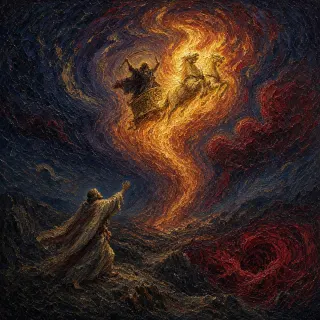
2:11And it came to pass, as they still went on, and talked, that, behold, there appeared a chariot of fire, and horses of fire, and parted them both asunder; and Elijah went up by a whirlwind into heaven.
2:12And Elisha saw it, and he cried, My father, my father, the chariot of Israel, and the horsemen thereof. And he saw him no more: and he took hold of his own clothes, and rent them in two pieces.
2:13He took up also the mantle of Elijah that fell from him, and went back, and stood by the bank of Jordan;
2:14And he took the mantle of Elijah that fell from him, and smote the waters, and said, Where is the LORD God of Elijah? and when he also had smitten the waters, they parted hither and thither: and Elisha went over.

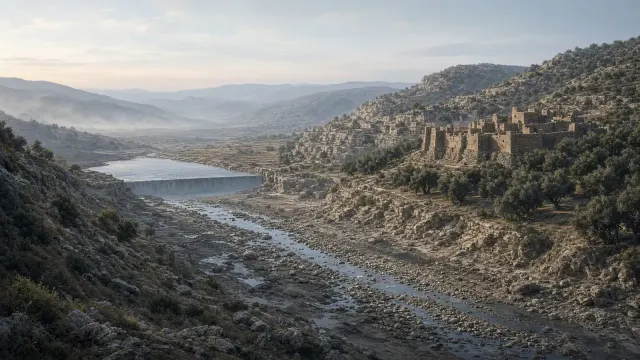

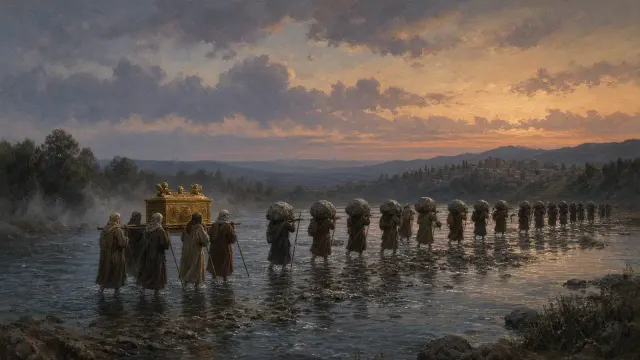


The priests get their feet wet before anybody gets a dry road. That order matters. Joshua 3:13 has already placed the promise at the moment their feet rest in the water, and verse 15 carefully records that they do. The parenthesis about harvest prevents a convenient misunderstanding: this is not a nation finding an unusually shallow ford. The Jordan is overflowing its banks.
The centre of the crossing is not Joshua waving a weapon but the ark of the covenant, carried by priests who stand still while everybody else moves. Dry ground appears twice in verse 17, first beneath the priests and then beneath the people. The passage holds those two positions together until the last person is across. Leadership here is publicly confirmed, but the achievement is not credited to a leader's ingenuity. God had promised to establish Joshua as Moses' successor in 3:7; 4:14 explicitly says that this happened. The river becomes the place where Israel learns that Moses' death did not end the presence that led them.