New · FreePlay The Witnesses The in-depth puzzle battle quest through Bible history

People of the Bible

Joshua

Spent forty years as the assistant who did not leave the tent, and then led the crossing.

Also called Hoshea, son of Nun

Joshua is first seen picking men to fight Amalek while Moses watches from a hill. After that he is mostly in the background and always close: on the mountain when Moses goes up, still at the tent when everyone else has gone back to their own, one of twelve sent to look at the land and one of two who came back saying it could be done. He waits out the forty years that sentence entails. Then Moses dies, and the first thing he is told is to be strong and courageous, three times in one chapter.

Where he appearsExodus 17 · Exodus 24 · Exodus 32 to 33 · Numbers 13 to 14 · Numbers 27 · Deuteronomy 31 to 34 · Joshua 1 to 24

Scroll down to the account
Joshua

The movements, in the order the text gives them.

The Account of Joshua

  1. 01

    Exodus 17:8-13

    Till the sun goes down

    His first appearance is a battle in the valley while the outcome is decided on the hilltop by whether two arms stay up. He wins, and is told to write it down.

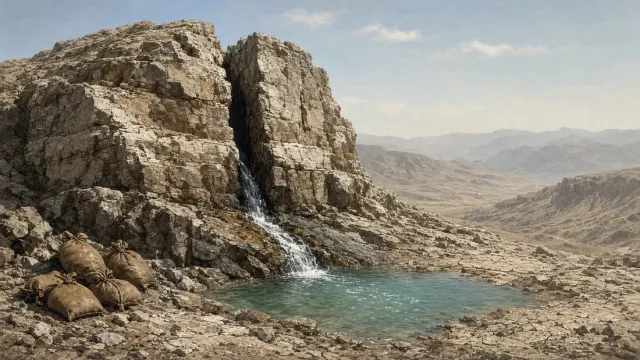
    Joshua gets the sword; Moses gets the hill. The Book of Exodus keeps looking from one to the other, refusing to let this become a victory belonging to the man with the weapon alone. Joshua chooses men and fights as instructed. Above him, the rod is specifically the rod of God, the same rod brought into the preceding scene at the rock. The fighting is real, but its outcome cannot be explained by Joshua's strength alone.

    Then the account gives Moses a thoroughly human problem: his arms get heavy. No speech cures that. Aaron and Hur find a stone for him to sit on and support his hands, one man on each side. The extraordinary event includes some very ordinary assistance. The passage does not record a prayer or explain a mechanical power in the gesture; it does explicitly connect Israel's fortunes with the raised hand. Dependence is visible, and so is exhaustion.

    At the end, Joshua receives the credit appropriate to his task: he discomfited Amalek with the edge of the sword. The men on the hill have not made the soldiers unnecessary, and the soldiers have not made the hill irrelevant. This is Joshua's first appearance in Scripture. He enters as a commander who obeys, in a victory that requires more hands than his.

    Verse by verse

    1. 17:8

      Deuteronomy 25:17-18 adds that Amalek attacked the weary people at the rear. Exodus names the encounter without giving that detail here.

    2. 17:9

      This is Joshua's first named appearance in Scripture. His age and previous military training are not supplied.

    3. 17:10

      Hur is named but not identified by family relationship in this passage. The text does not call him Miriam's husband.

    4. 17:11

      The raised hand accompanies Israel's advantage. No spoken prayer is recorded, and the precise significance of the gesture is not separately explained.

    5. 17:12

      Stayed up means supported or held up. Moses sits while Aaron and Hur sustain his hands; the account does not conceal his physical limitation.

    6. 17:13

      Discomfited means defeated or routed, not merely embarrassed. Verse 14 then specifically orders that this event be rehearsed in Joshua's hearing.

    Exodus 17:8-13

    King James Version · 6 verses

    17:8Then came Amalek, and fought with Israel in Rephidim.

    17:9And Moses said unto Joshua, Choose us out men, and go out, fight with Amalek: to morrow I will stand on the top of the hill with the rod of God in mine hand.

    17:10So Joshua did as Moses had said to him, and fought with Amalek: and Moses, Aaron, and Hur went up to the top of the hill.

    17:11And it came to pass, when Moses held up his hand, that Israel prevailed: and when he let down his hand, Amalek prevailed.

    17:12But Moses’ hands were heavy; and they took a stone, and put it under him, and he sat thereon; and Aaron and Hur stayed up his hands, the one on the one side, and the other on the other side; and his hands were steady until the going down of the sun.

    17:13And Joshua discomfited Amalek and his people with the edge of the sword.

    Exodus 17:8-13: Till the sun goes down
  2. 02

    Numbers 13:1-14:10

    Two reports out of twelve

    Ten men describe giants and a land that eats its inhabitants. He and Caleb tear their clothes and say the LORD is with us, and the congregation picks up stones.

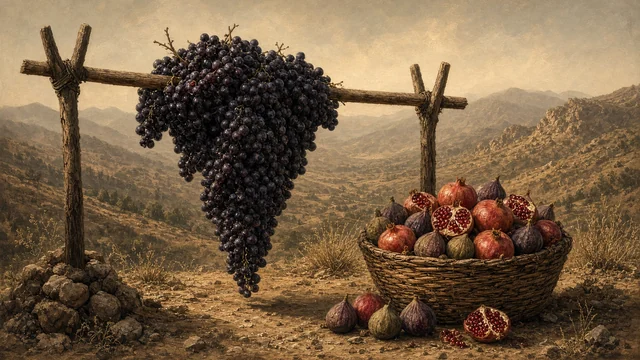
    The grapes are not in dispute. Everyone has seen the fruit, and the returning scouts agree that the land is rich. The argument begins with nevertheless. Strong people, walled cities, descendants of Anak: Joshua and Caleb do not produce a second landscape with smaller walls. They dispute the conclusion drawn from the landscape already described. At the beginning, God calls it the land which I give. The inspection was never presented as a vote on whether that gift was possible.

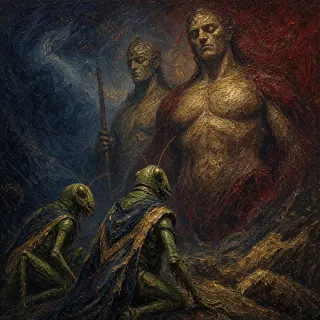
    The report then outruns what the scouts can actually establish. Being like grasshoppers in their own sight becomes being grasshoppers in the inhabitants' sight as well. Their account supplies the enemy's opinion without showing how they learned it. Meanwhile, a land whose fruit needed two carriers has become a land that eats its inhabitants. Caleb is the first to interrupt that verdict. Joshua joins him explicitly in the next chapter, with torn clothes and an insistence that the land is exceeding good. Their answer rests on the LORD's presence, not on pretending that the opposition is imaginary.

    The quarrel also develops a sharp reversal of its own language. A land that supposedly eats people is answered with enemies described as bread. Yet the decisive sentence is the LORD is with us, not a claim that Israel has suddenly grown taller. The congregation wants a new captain to take it back to Egypt, then calls for the two men to be stoned. Joshua's obedience does not make him popular. Before the gathering can turn that threat into the outcome, the glory of the LORD appears before all Israel.

    Verse by verse

    1. 13:16

      Jehoshua and Joshua are forms of the same name, not two different scouts. His tribal affiliation is Ephraim in 13:8.

    2. 13:23-24

      Eshcol means cluster; the place-name is explained by the grapes. The Hebrew geographical term can mean valley or streambed, reflected in the KJV margin beside brook.

    3. 13:30

      Caleb speaks first in this chapter. Joshua is expressly joined with him in 14:6-9, so the speeches should not be assigned to Joshua alone.

    4. 13:33

      The words about the inhabitants' opinion belong to the scouts' report. The passage does not independently confirm that assessment.

    5. 14:3

      The fear that their children will become prey is answered in 14:31: those children are the ones God says he will bring into the land.

    6. 14:9-10

      Defence translates a Hebrew word meaning shadow, an image of protection. The call to stone the speakers is followed immediately by the appearance of divine glory.

    Numbers 13:1-14:10: Two reports out of twelve

    Numbers 13:1-14:10

    King James Version · 43 verses

    13:1And the LORD spake unto Moses, saying,

    13:2Send thou men, that they may search the land of Canaan, which I give unto the children of Israel: of every tribe of their fathers shall ye send a man, every one a ruler among them.

    13:3And Moses by the commandment of the LORD sent them from the wilderness of Paran: all those men were heads of the children of Israel.

    13:4And these were their names: of the tribe of Reuben, Shammua the son of Zaccur.

    13:5Of the tribe of Simeon, Shaphat the son of Hori.

    13:6Of the tribe of Judah, Caleb the son of Jephunneh.

    13:7Of the tribe of Issachar, Igal the son of Joseph.

    13:8Of the tribe of Ephraim, Oshea the son of Nun.

    13:9Of the tribe of Benjamin, Palti the son of Raphu.

    13:10Of the tribe of Zebulun, Gaddiel the son of Sodi.

    13:11Of the tribe of Joseph, namely, of the tribe of Manasseh, Gaddi the son of Susi.

    13:12Of the tribe of Dan, Ammiel the son of Gemalli.

    13:13Of the tribe of Asher, Sethur the son of Michael.

    13:14Of the tribe of Naphtali, Nahbi the son of Vophsi.

    13:15Of the tribe of Gad, Geuel the son of Machi.

    13:16These are the names of the men which Moses sent to spy out the land. And Moses called Oshea the son of Nun Jehoshua.

    13:17And Moses sent them to spy out the land of Canaan, and said unto them, Get you up this way southward, and go up into the mountain:

    13:18And see the land, what it is; and the people that dwelleth therein, whether they be strong or weak, few or many;

    13:19And what the land is that they dwell in, whether it be good or bad; and what cities they be that they dwell in, whether in tents, or in strong holds;

    13:20And what the land is, whether it be fat or lean, whether there be wood therein, or not. And be ye of good courage, and bring of the fruit of the land. Now the time was the time of the firstripe grapes.

    13:21So they went up, and searched the land from the wilderness of Zin unto Rehob, as men come to Hamath.

    13:22And they ascended by the south, and came unto Hebron; where Ahiman, Sheshai, and Talmai, the children of Anak, were. (Now Hebron was built seven years before Zoan in Egypt.)

    13:23And they came unto the brook of Eshcol, and cut down from thence a branch with one cluster of grapes, and they bare it between two upon a staff; and they brought of the pomegranates, and of the figs.

    13:24The place was called the brook Eshcol, because of the cluster of grapes which the children of Israel cut down from thence.

    13:25And they returned from searching of the land after forty days.

    13:26And they went and came to Moses, and to Aaron, and to all the congregation of the children of Israel, unto the wilderness of Paran, to Kadesh; and brought back word unto them, and unto all the congregation, and shewed them the fruit of the land.

    13:27And they told him, and said, We came unto the land whither thou sentest us, and surely it floweth with milk and honey; and this is the fruit of it.

    13:28Nevertheless the people be strong that dwell in the land, and the cities are walled, and very great: and moreover we saw the children of Anak there.

    13:29The Amalekites dwell in the land of the south: and the Hittites, and the Jebusites, and the Amorites, dwell in the mountains: and the Canaanites dwell by the sea, and by the coast of Jordan.

    13:30And Caleb stilled the people before Moses, and said, Let us go up at once, and possess it; for we are well able to overcome it.

    13:31But the men that went up with him said, We be not able to go up against the people; for they are stronger than we.

    13:32And they brought up an evil report of the land which they had searched unto the children of Israel, saying, The land, through which we have gone to search it, is a land that eateth up the inhabitants thereof; and all the people that we saw in it are men of a great stature.

    13:33And there we saw the giants, the sons of Anak, which come of the giants: and we were in our own sight as grasshoppers, and so we were in their sight.

    14:1And all the congregation lifted up their voice, and cried; and the people wept that night.

    14:2And all the children of Israel murmured against Moses and against Aaron: and the whole congregation said unto them, Would God that we had died in the land of Egypt! or would God we had died in this wilderness!

    14:3And wherefore hath the LORD brought us unto this land, to fall by the sword, that our wives and our children should be a prey? were it not better for us to return into Egypt?

    14:4And they said one to another, Let us make a captain, and let us return into Egypt.

    14:5Then Moses and Aaron fell on their faces before all the assembly of the congregation of the children of Israel.

    14:6And Joshua the son of Nun, and Caleb the son of Jephunneh, which were of them that searched the land, rent their clothes:

    14:7And they spake unto all the company of the children of Israel, saying, The land, which we passed through to search it, is an exceeding good land.

    14:8If the LORD delight in us, then he will bring us into this land, and give it us; a land which floweth with milk and honey.

    14:9Only rebel not ye against the LORD, neither fear ye the people of the land; for they are bread for us: their defence is departed from them, and the LORD is with us: fear them not.

    14:10But all the congregation bade stone them with stones. And the glory of the LORD appeared in the tabernacle of the congregation before all the children of Israel.

  3. 03

    Deuteronomy 31:1-8

    The charge in front of everyone

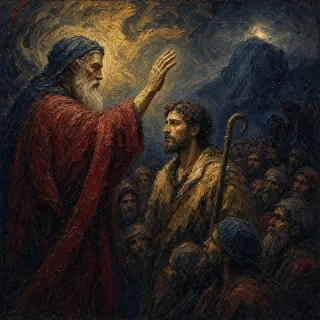
    Moses, at a hundred and twenty, calls him out before all Israel and tells him he will go with this people into the land. The commission is public, so nobody can dispute it later.

    The promise does not retire when Moses does. That is the force of the repeated before thee: the LORD will cross ahead of Israel, and Joshua will cross ahead of Israel. The same movement is described at two different levels. Joshua receives the visible leadership; he does not become the source of the promise. Moses' exclusion from the crossing is stated without disguise, but the land still belongs to the undertaking God made to the fathers.

    Be strong and of a good courage is first addressed to the people, then to Joshua in their sight. It is not a private compliment about an unusually fearless temperament. The reason given is that the LORD goes with them and will not forsake them. Public words matter here. The man remembered in Exodus 33:11 as the assistant who remained at the tent is now summoned in front of all Israel. No quiet arrangement leaves the congregation guessing who has been entrusted with the task.

    There is also a precise limit to Joshua's commission: he is to bring this people into their inheritance. The speech does not offer an unlimited warrant for whatever a successful commander might later prefer. The land, the people, the promise, and the commandments are already named. Moses cannot accompany them across the river. Joshua can. Neither fact changes who goes before them.

    Verse by verse

    1. 31:2

      Moses gives his age as 120. Deuteronomy 34:7 still describes his sight and strength as undiminished, so this verse should not be expanded into an invented account of physical collapse.

    2. 31:3

      The LORD and Joshua are both said to go before Israel, but not as interchangeable leaders. Divine action grounds Joshua's assigned task.

    3. 31:6

      The encouragement first addresses Israel collectively. Joshua receives the same charge personally in verse 7.

    4. 31:7

      In the sight of all Israel marks a public commission. Numbers 27:18-23 also records Joshua's appointment before Eleazar and the congregation, with Moses laying hands on him.

    5. 31:8

      The promise of unfailing presence recurs in Joshua 1:5. The repetition connects the succession to Moses rather than presenting Joshua as a fresh beginning without obligations.

    Deuteronomy 31:1-8

    King James Version · 8 verses

    31:1And Moses went and spake these words unto all Israel.

    31:2And he said unto them, I am an hundred and twenty years old this day; I can no more go out and come in: also the LORD hath said unto me, Thou shalt not go over this Jordan.

    31:3The LORD thy God, he will go over before thee, and he will destroy these nations from before thee, and thou shalt possess them: and Joshua, he shall go over before thee, as the LORD hath said.

    31:4And the LORD shall do unto them as he did to Sihon and to Og, kings of the Amorites, and unto the land of them, whom he destroyed.

    31:5And the LORD shall give them up before your face, that ye may do unto them according unto all the commandments which I have commanded you.

    31:6Be strong and of a good courage, fear not, nor be afraid of them: for the LORD thy God, he it is that doth go with thee; he will not fail thee, nor forsake thee.

    31:7And Moses called unto Joshua, and said unto him in the sight of all Israel, Be strong and of a good courage: for thou must go with this people unto the land which the LORD hath sworn unto their fathers to give them; and thou shalt cause them to inherit it.

    31:8And the LORD, he it is that doth go before thee; he will be with thee, he will not fail thee, neither forsake thee: fear not, neither be dismayed.

    Deuteronomy 31:1-8: The charge in front of everyone
  4. 04

    Joshua 3:1-4:24

    The river standing in a heap

    At harvest, with the Jordan over its banks, the priests carry the ark in first and the water stops upstream. Twelve stones come out of the riverbed so that children will ask about them.

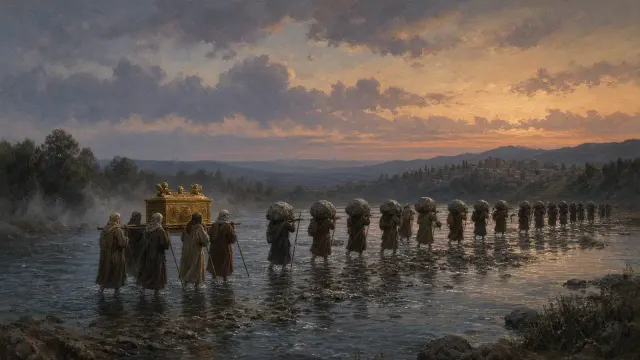
    The first feet into the Jordan do not land on a conveniently exposed riverbed. They touch floodwater. Only then does the account describe the upstream flow stopping and the people crossing on dry ground. That order matters, as does the parenthesis about harvest: the river is overflowing its banks, not shrinking to an easy ford. Joshua gives commands, but the object at the front is the ark of the covenant, borne by priests. The crossing is arranged around the presence of the Lord of all the earth, not around the spectacle of a new commander.

    The priests enter first and then remain in the middle while everyone else passes. Their standing still makes the people's movement possible. The chapter returns repeatedly to their feet, the dry ground, and the completion of the crossing; the waters return when those feet reach the bank. Meanwhile, God explicitly establishes Joshua's standing before Israel, as he had promised in 3:7. The comparison with Moses is not an association imposed afterward. It is one of the stated purposes of the event.

    Then comes an assignment that requires shoulders rather than swords: twelve men carry twelve stones from the river. One for each tribe, not one monument to Joshua alone. The stones are intended to provoke questions from children who did not witness the crossing, and the answer must explain what God did. The closing explanation reaches backward to the Red sea and outward to all the peoples of the earth. Israel's passage has an audience beyond the people who made it. The river resumes its course. The account of the crossing is to remain.

    Verse by verse

    1. 3:4

      The distance of about two thousand cubits lets the people see the route while keeping their distance from the ark. The verse gives the distance without a modern unit conversion.

    2. 3:11

      Lord of all the earth is the title used here and again in 3:13. The scope of that title anticipates the worldwide purpose stated in 4:24.

    3. 3:15-16

      Adam is a city in this verse, not the first man. The sea of the plain is identified within the verse itself as the salt sea.

    4. 4:9

      The KJV describes twelve stones set in the river here, as distinct from the twelve carried out and erected at Gilgal in 4:20. The text does not provide a modern identification of either group.

    5. 4:12-13

      The warriors from Reuben, Gad, and half Manasseh cross to assist the other tribes despite their eastern inheritance. About forty thousand is the figure for this armed contingent, not the total population crossing.

    6. 4:23-24

      The comparison with the Red sea is explicit, not merely a resemblance. Knowledge of the LORD's power among the peoples and enduring reverence within Israel are both named purposes.

    Joshua 3:1-4:24: The river standing in a heap

    Joshua 3:1-4:24

    King James Version · 41 verses

    3:1And Joshua rose early in the morning; and they removed from Shittim, and came to Jordan, he and all the children of Israel, and lodged there before they passed over.

    3:2And it came to pass after three days, that the officers went through the host;

    3:3And they commanded the people, saying, When ye see the ark of the covenant of the LORD your God, and the priests the Levites bearing it, then ye shall remove from your place, and go after it.

    3:4Yet there shall be a space between you and it, about two thousand cubits by measure: come not near unto it, that ye may know the way by which ye must go: for ye have not passed this way heretofore.

    3:5And Joshua said unto the people, Sanctify yourselves: for to morrow the LORD will do wonders among you.

    3:6And Joshua spake unto the priests, saying, Take up the ark of the covenant, and pass over before the people. And they took up the ark of the covenant, and went before the people.

    3:7And the LORD said unto Joshua, This day will I begin to magnify thee in the sight of all Israel, that they may know that, as I was with Moses, so I will be with thee.

    3:8And thou shalt command the priests that bear the ark of the covenant, saying, When ye are come to the brink of the water of Jordan, ye shall stand still in Jordan.

    3:9And Joshua said unto the children of Israel, Come hither, and hear the words of the LORD your God.

    3:10And Joshua said, Hereby ye shall know that the living God is among you, and that he will without fail drive out from before you the Canaanites, and the Hittites, and the Hivites, and the Perizzites, and the Girgashites, and the Amorites, and the Jebusites.

    3:11Behold, the ark of the covenant of the Lord of all the earth passeth over before you into Jordan.

    3:12Now therefore take you twelve men out of the tribes of Israel, out of every tribe a man.

    3:13And it shall come to pass, as soon as the soles of the feet of the priests that bear the ark of the LORD, the Lord of all the earth, shall rest in the waters of Jordan, that the waters of Jordan shall be cut off from the waters that come down from above; and they shall stand upon an heap.

    3:14And it came to pass, when the people removed from their tents, to pass over Jordan, and the priests bearing the ark of the covenant before the people;

    3:15And as they that bare the ark were come unto Jordan, and the feet of the priests that bare the ark were dipped in the brim of the water, (for Jordan overfloweth all his banks all the time of harvest,)

    3:16That the waters which came down from above stood and rose up upon an heap very far from the city Adam, that is beside Zaretan: and those that came down toward the sea of the plain, even the salt sea, failed, and were cut off: and the people passed over right against Jericho.

    3:17And the priests that bare the ark of the covenant of the LORD stood firm on dry ground in the midst of Jordan, and all the Israelites passed over on dry ground, until all the people were passed clean over Jordan.

    4:1And it came to pass, when all the people were clean passed over Jordan, that the LORD spake unto Joshua, saying,

    4:2Take you twelve men out of the people, out of every tribe a man,

    4:3And command ye them, saying, Take you hence out of the midst of Jordan, out of the place where the priests’ feet stood firm, twelve stones, and ye shall carry them over with you, and leave them in the lodging place, where ye shall lodge this night.

    4:4Then Joshua called the twelve men, whom he had prepared of the children of Israel, out of every tribe a man:

    4:5And Joshua said unto them, Pass over before the ark of the LORD your God into the midst of Jordan, and take ye up every man of you a stone upon his shoulder, according unto the number of the tribes of the children of Israel:

    4:6That this may be a sign among you, that when your children ask their fathers in time to come, saying, What mean ye by these stones?

    4:7Then ye shall answer them, That the waters of Jordan were cut off before the ark of the covenant of the LORD; when it passed over Jordan, the waters of Jordan were cut off: and these stones shall be for a memorial unto the children of Israel for ever.

    4:8And the children of Israel did so as Joshua commanded, and took up twelve stones out of the midst of Jordan, as the LORD spake unto Joshua, according to the number of the tribes of the children of Israel, and carried them over with them unto the place where they lodged, and laid them down there.

    4:9And Joshua set up twelve stones in the midst of Jordan, in the place where the feet of the priests which bare the ark of the covenant stood: and they are there unto this day.

    4:10For the priests which bare the ark stood in the midst of Jordan, until every thing was finished that the LORD commanded Joshua to speak unto the people, according to all that Moses commanded Joshua: and the people hasted and passed over.

    4:11And it came to pass, when all the people were clean passed over, that the ark of the LORD passed over, and the priests, in the presence of the people.

    4:12And the children of Reuben, and the children of Gad, and half the tribe of Manasseh, passed over armed before the children of Israel, as Moses spake unto them:

    4:13About forty thousand prepared for war passed over before the LORD unto battle, to the plains of Jericho.

    4:14On that day the LORD magnified Joshua in the sight of all Israel; and they feared him, as they feared Moses, all the days of his life.

    4:15And the LORD spake unto Joshua, saying,

    4:16Command the priests that bear the ark of the testimony, that they come up out of Jordan.

    4:17Joshua therefore commanded the priests, saying, Come ye up out of Jordan.

    4:18And it came to pass, when the priests that bare the ark of the covenant of the LORD were come up out of the midst of Jordan, and the soles of the priests’ feet were lifted up unto the dry land, that the waters of Jordan returned unto their place, and flowed over all his banks, as they did before.

    4:19And the people came up out of Jordan on the tenth day of the first month, and encamped in Gilgal, in the east border of Jericho.

    4:20And those twelve stones, which they took out of Jordan, did Joshua pitch in Gilgal.

    4:21And he spake unto the children of Israel, saying, When your children shall ask their fathers in time to come, saying, What mean these stones?

    4:22Then ye shall let your children know, saying, Israel came over this Jordan on dry land.

    4:23For the LORD your God dried up the waters of Jordan from before you, until ye were passed over, as the LORD your God did to the Red sea, which he dried up from before us, until we were gone over:

    4:24That all the people of the earth might know the hand of the LORD, that it is mighty: that ye might fear the LORD your God for ever.

  5. 05

    Joshua 6:1-21

    The seventh circuit

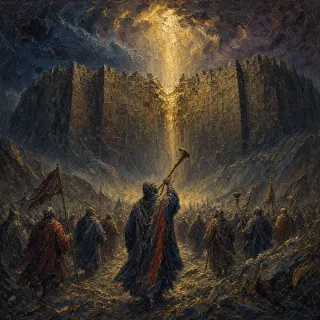
    Six days of walking around a shut city in silence, then seven times on the seventh day, then trumpets and a shout. It is the least military way to take a fortress imaginable.

    Jericho is shut, but the first divine announcement treats the city as already given. The commands that follow do not read like instructions for battering the gates: priests, horns, the ark, repeated circuits. The armed men have a place, but they do not determine the arrangement. Joshua has just bowed before the captain of the LORD's host in 5:13-15. At Jericho, the man commanding Israel is still a man receiving orders.

    The people's silence is precise, not absolute silence around the city. The priests keep blowing the horns; the people must withhold their voices until the command. Six days bring one circuit each, and the seventh brings seven. The repeated sevens govern the timing and procession, but the account supplies no explanation about sound waves bringing masonry down. The wall falls as God said it would, and the people enter straight before them. The Book of Joshua describes a promised act accomplished through commanded obedience, not a demolition technique waiting to be rediscovered.

    The account does not stop at the fallen wall. The city is devoted to the LORD, so its wealth is not available as private plunder; the specified metals go into his treasury. Verse 21 then names the human cost without disguising it: men and women, young and old, are killed, along with the animals. The wording cannot honestly be reduced to defeated soldiers or an emptied fortress. Rahab and those sheltered with her are the explicit exception, because she hid the messengers. The same command that places the city under destruction requires her preservation. Both belong to this passage, and neither can be edited out to make the other easier.

    Verse by verse

    1. 6:3-4

      There are thirteen circuits in total: one on each of six days, then seven on the seventh day. Seven circuits describes the final day, not the entire operation.

    2. 6:9

      Rereward is the rear guard, not a reward. The procession includes armed men before the priests and a rear guard after the ark.

    3. 6:10

      The prohibition concerns the people's voices. It does not silence the priests' horns, which are expressly sounding in verses 8-9 and 13.

    4. 6:17

      Hebrew herem describes what is devoted under a ban, here involving destruction rather than ordinary capture. Rahab's household is expressly exempted, fulfilling the protection sworn in Joshua 2:12-21.

    5. 6:19

      The silver, gold, brass, and iron are reserved for the LORD's treasury. Their preservation is not permission for individual soldiers to take valuables.

    6. 6:21

      The verse expressly includes both sexes and the young and old, not combatants alone. It gives no individual biographies or separate accusations against those killed.

    Joshua 6:1-21: The seventh circuit

    Joshua 6:1-21

    King James Version · 21 verses

    6:1Now Jericho was straitly shut up because of the children of Israel: none went out, and none came in.

    6:2And the LORD said unto Joshua, See, I have given into thine hand Jericho, and the king thereof, and the mighty men of valour.

    6:3And ye shall compass the city, all ye men of war, and go round about the city once. Thus shalt thou do six days.

    6:4And seven priests shall bear before the ark seven trumpets of rams’ horns: and the seventh day ye shall compass the city seven times, and the priests shall blow with the trumpets.

    6:5And it shall come to pass, that when they make a long blast with the ram’s horn, and when ye hear the sound of the trumpet, all the people shall shout with a great shout; and the wall of the city shall fall down flat, and the people shall ascend up every man straight before him.

    6:6And Joshua the son of Nun called the priests, and said unto them, Take up the ark of the covenant, and let seven priests bear seven trumpets of rams’ horns before the ark of the LORD.

    6:7And he said unto the people, Pass on, and compass the city, and let him that is armed pass on before the ark of the LORD.

    6:8And it came to pass, when Joshua had spoken unto the people, that the seven priests bearing the seven trumpets of rams’ horns passed on before the LORD, and blew with the trumpets: and the ark of the covenant of the LORD followed them.

    6:9And the armed men went before the priests that blew with the trumpets, and the rereward came after the ark, the priests going on, and blowing with the trumpets.

    6:10And Joshua had commanded the people, saying, Ye shall not shout, nor make any noise with your voice, neither shall any word proceed out of your mouth, until the day I bid you shout; then shall ye shout.

    6:11So the ark of the LORD compassed the city, going about it once: and they came into the camp, and lodged in the camp.

    6:12And Joshua rose early in the morning, and the priests took up the ark of the LORD.

    6:13And seven priests bearing seven trumpets of rams’ horns before the ark of the LORD went on continually, and blew with the trumpets: and the armed men went before them; but the rereward came after the ark of the LORD, the priests going on, and blowing with the trumpets.

    6:14And the second day they compassed the city once, and returned into the camp: so they did six days.

    6:15And it came to pass on the seventh day, that they rose early about the dawning of the day, and compassed the city after the same manner seven times: only on that day they compassed the city seven times.

    6:16And it came to pass at the seventh time, when the priests blew with the trumpets, Joshua said unto the people, Shout; for the LORD hath given you the city.

    6:17And the city shall be accursed, even it, and all that are therein, to the LORD: only Rahab the harlot shall live, she and all that are with her in the house, because she hid the messengers that we sent.

    6:18And ye, in any wise keep yourselves from the accursed thing, lest ye make yourselves accursed, when ye take of the accursed thing, and make the camp of Israel a curse, and trouble it.

    6:19But all the silver, and gold, and vessels of brass and iron, are consecrated unto the LORD: they shall come into the treasury of the LORD.

    6:20So the people shouted when the priests blew with the trumpets: and it came to pass, when the people heard the sound of the trumpet, and the people shouted with a great shout, that the wall fell down flat, so that the people went up into the city, every man straight before him, and they took the city.

    6:21And they utterly destroyed all that was in the city, both man and woman, young and old, and ox, and sheep, and ass, with the edge of the sword.

  6. 06

    Joshua 24:1-28

    As for me and my house

    Old, at Shechem, he recites the whole history from Abraham forward and then tells them to choose. When they say they will serve the LORD he warns them they are not able, and writes it in the book anyway.

    Joshua's famous declaration about his house comes after a long speech in which God is the one doing the giving. I took, I gave, I sent, I brought: the history is not arranged as Joshua's retirement tribute. It begins with Abraham's family serving other gods beyond the river and ends with Israel eating from vineyards it did not plant. Even the conquest is denied the status of a self-made achievement. Before Joshua asks for a declaration of allegiance, the grounds for that allegiance have been laid out.

    The people's first enthusiastic answer does not bring the proceedings to a comfortable close. Joshua answers that they cannot serve the LORD, because he is holy and jealous, then spells out the consequence of forsaking him. This is not a casual choice among interchangeable local gods. The warning refuses to treat spoken agreement as sufficient by itself. Verse 23 gives that refusal teeth: the strange gods are among them. The problem is not confined to distant ancestors on the other side of the river. The assembly can say the right thing and still have something to put away.

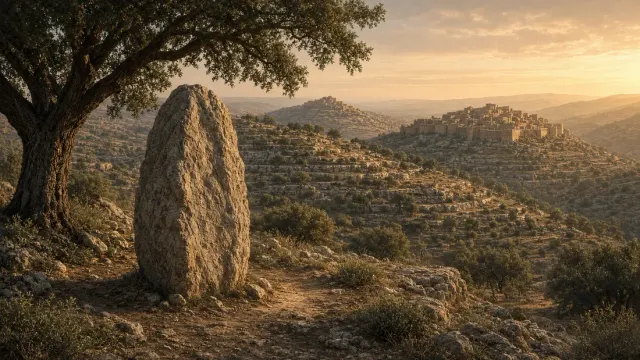
    Joshua therefore makes their words part of a covenant, records them, and sets up a stone as a witness. The stone has heard, in the vivid language of the ceremony; it stands where later denial must meet a public reminder. The people have also named themselves witnesses against themselves. His household declaration belongs inside this demanding exchange, not apart from it as an ornamental slogan. Then he sends them to their inheritances. Land has been received; loyalty has been pledged. The stone remains to testify to what was said.

    Verse by verse

    1. 24:2

      The flood here means the river, conventionally the Euphrates, not Noah's flood. Terah and his family lived beyond it before Abraham's migration.

    2. 24:12

      Not with thy sword, nor with thy bow assigns the decisive victory to God. It does not erase the fighting expressly described elsewhere in the same book.

    3. 24:15

      House means Joshua's household, not merely the building. His declaration is a commitment of allegiance, not a prediction guaranteeing every descendant's future conduct.

    4. 24:19-20

      The warning concerns forsaking the LORD for other gods after receiving his gifts. It should not be detached from that condition and turned into a claim that the book recognizes no possibility of forgiveness.

    5. 24:23

      Among you makes the demand immediate. The passage does not say that foreign worship exists only in the memory of distant ancestors.

    6. 24:26-27

      The stone functions as a public covenant witness. Saying that it heard gives the memorial a voice in the ceremony; the text does not describe a device or a living deity.

    Joshua 24:1-28: As for me and my house

    Joshua 24:1-28

    King James Version · 28 verses

    24:1And Joshua gathered all the tribes of Israel to Shechem, and called for the elders of Israel, and for their heads, and for their judges, and for their officers; and they presented themselves before God.

    24:2And Joshua said unto all the people, Thus saith the LORD God of Israel, Your fathers dwelt on the other side of the flood in old time, even Terah, the father of Abraham, and the father of Nachor: and they served other gods.

    24:3And I took your father Abraham from the other side of the flood, and led him throughout all the land of Canaan, and multiplied his seed, and gave him Isaac.

    24:4And I gave unto Isaac Jacob and Esau: and I gave unto Esau mount Seir, to possess it; but Jacob and his children went down into Egypt.

    24:5I sent Moses also and Aaron, and I plagued Egypt, according to that which I did among them: and afterward I brought you out.

    24:6And I brought your fathers out of Egypt: and ye came unto the sea; and the Egyptians pursued after your fathers with chariots and horsemen unto the Red sea.

    24:7And when they cried unto the LORD, he put darkness between you and the Egyptians, and brought the sea upon them, and covered them; and your eyes have seen what I have done in Egypt: and ye dwelt in the wilderness a long season.

    24:8And I brought you into the land of the Amorites, which dwelt on the other side Jordan; and they fought with you: and I gave them into your hand, that ye might possess their land; and I destroyed them from before you.

    24:9Then Balak the son of Zippor, king of Moab, arose and warred against Israel, and sent and called Balaam the son of Beor to curse you:

    24:10But I would not hearken unto Balaam; therefore he blessed you still: so I delivered you out of his hand.

    24:11And ye went over Jordan, and came unto Jericho: and the men of Jericho fought against you, the Amorites, and the Perizzites, and the Canaanites, and the Hittites, and the Girgashites, the Hivites, and the Jebusites; and I delivered them into your hand.

    24:12And I sent the hornet before you, which drave them out from before you, even the two kings of the Amorites; but not with thy sword, nor with thy bow.

    24:13And I have given you a land for which ye did not labour, and cities which ye built not, and ye dwell in them; of the vineyards and oliveyards which ye planted not do ye eat.

    24:14Now therefore fear the LORD, and serve him in sincerity and in truth: and put away the gods which your fathers served on the other side of the flood, and in Egypt; and serve ye the LORD.

    24:15And if it seem evil unto you to serve the LORD, choose you this day whom ye will serve; whether the gods which your fathers served that were on the other side of the flood, or the gods of the Amorites, in whose land ye dwell: but as for me and my house, we will serve the LORD.

    24:16And the people answered and said, God forbid that we should forsake the LORD, to serve other gods;

    24:17For the LORD our God, he it is that brought us up and our fathers out of the land of Egypt, from the house of bondage, and which did those great signs in our sight, and preserved us in all the way wherein we went, and among all the people through whom we passed:

    24:18And the LORD drave out from before us all the people, even the Amorites which dwelt in the land: therefore will we also serve the LORD; for he is our God.

    24:19And Joshua said unto the people, Ye cannot serve the LORD: for he is an holy God; he is a jealous God; he will not forgive your transgressions nor your sins.

    24:20If ye forsake the LORD, and serve strange gods, then he will turn and do you hurt, and consume you, after that he hath done you good.

    24:21And the people said unto Joshua, Nay; but we will serve the LORD.

    24:22And Joshua said unto the people, Ye are witnesses against yourselves that ye have chosen you the LORD, to serve him. And they said, We are witnesses.

    24:23Now therefore put away, said he, the strange gods which are among you, and incline your heart unto the LORD God of Israel.

    24:24And the people said unto Joshua, The LORD our God will we serve, and his voice will we obey.

    24:25So Joshua made a covenant with the people that day, and set them a statute and an ordinance in Shechem.

    24:26And Joshua wrote these words in the book of the law of God, and took a great stone, and set it up there under an oak, that was by the sanctuary of the LORD.

    24:27And Joshua said unto all the people, Behold, this stone shall be a witness unto us; for it hath heard all the words of the LORD which he spake unto us: it shall be therefore a witness unto you, lest ye deny your God.

    24:28So Joshua let the people depart, every man unto his inheritance.

Why it matters

Joshua is the succession that works. Everything the exodus promised, land and rest and a place to put the ark, arrives under him, and the book that carries his name ends with the nation standing at Shechem choosing whom it will serve. He is also the counterweight to Moses: no signs, no burning bush, no face to face conversation, just a man told to keep a book of law in his mouth day and night and to go and take what was promised.

27 songs

The music

Every song in the catalogue whose passage falls inside these chapters.

  1. Exodus 15:22-17:16

    Bread from Heaven, Water from Stone

  2. Exodus 16:1-17:7

    Bread from Heaven

  3. Exodus 17:8-13

    Till the Sun Goes Down

  4. Exodus 32

    The Calf of Gold

  5. Exodus 33-34

    Show Me Thy Glory

  6. Numbers 13-14

    Giants in the Land

  7. Numbers 13:1-14:45

    We Were as Grasshoppers

  8. Numbers 25:1-27:23

    A Shepherd for the Congregation

  9. Deuteronomy 31:1-32:52

    Let Heaven and Earth Hear

  10. Deuteronomy 31-34

    Upon Mount Nebo

  11. Deuteronomy 33:1-34:12

    No Prophet Like Moses

  12. Joshua 1:1-2:24

    Be Strong and Very Courageous

  13. Joshua 1:1-24:33

    Joshua, Walls of Jericho

  14. Joshua 2

    A Cord of Scarlet

  15. Joshua 3-4

    Stones from the Jordan

  16. Joshua 3:1-4:24

    The Ark Goes Forth

    Play here
    Open song pageRead lyrics
  17. Joshua 3:1-4:24

    Twelve Stones from the River

    Play hereOpen song pageRead lyrics
  18. Joshua 5:1-6:27

    The Seventh Circuit

  19. Joshua 5:13-6:27

    The Walls Came Down

  20. Joshua 6

    The Walls Come Down

  21. Joshua 7:1-8:29

    The Hidden Thing

  22. Joshua 8:30-9:27

    We Asked No Counsel

  23. Joshua 10

    Sun, Stand Still

  24. Joshua 11:1-12:24

    Thirty-One Kings

  25. Joshua 13:1-19:51

    Give Me This Mountain

  26. Joshua 20:1-22:34

    The Altar Called Witness

  27. Joshua 23-24

    As for Me and My House

The videos

The videos

Every release whose passage falls inside these chapters, playing here.

Nearby

All the people

Report an error on this page