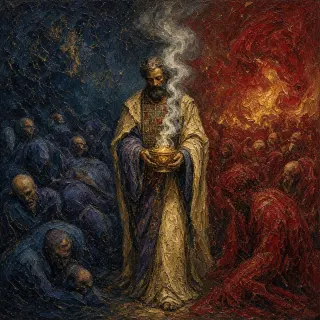
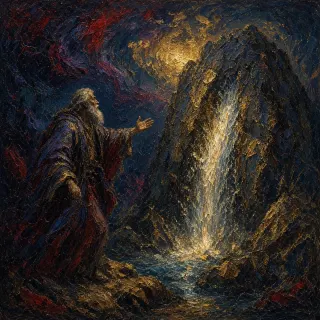
New · FreePlay The Witnesses The in-depth puzzle battle quest through Bible history

People of the Bible

Aaron

Moses' mouth before Pharaoh, the maker of the golden calf, and the first high priest of Israel, whose rod budded and whose garments passed to his son on a mountain.

Also called The Levite; the first high priest; father of Nadab, Abihu, Eleazar and Ithamar

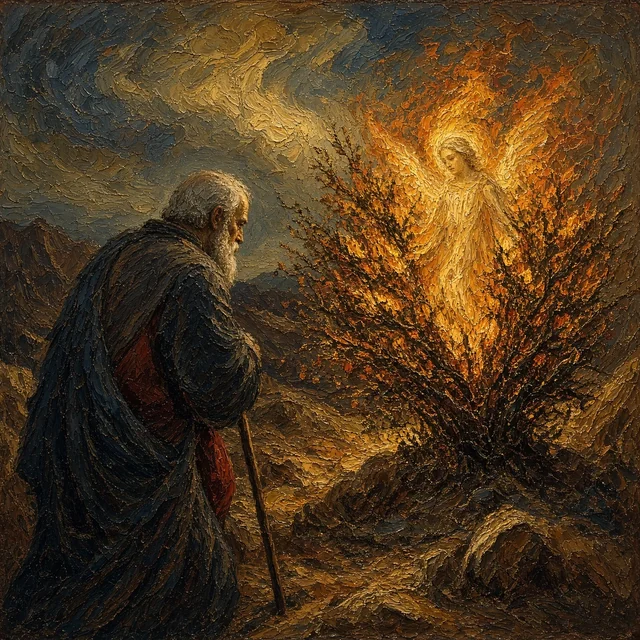
Aaron is the elder brother of Moses, three years older, son of Amram and Jochebed of the tribe of Levi. When Moses pleads at the burning bush that he is slow of speech, God answers that Aaron the Levite can speak well and is already on his way to meet him. Aaron becomes Moses' mouth: he speaks to the elders, he speaks to Pharaoh, and it is his rod that becomes a serpent, turns the Nile to blood, and brings up frogs and lice. He and Hur hold up Moses' hands at Rephidim, and he goes up Sinai with Nadab, Abihu and seventy elders and sees the God of Israel. Then, while Moses is on the mountain forty days, the people crowd him, and he takes their gold earrings and makes a molten calf, builds an altar before it, and proclaims a feast. His excuse to Moses, I cast it into the fire, and there came out this calf, is the worst sentence he ever says.

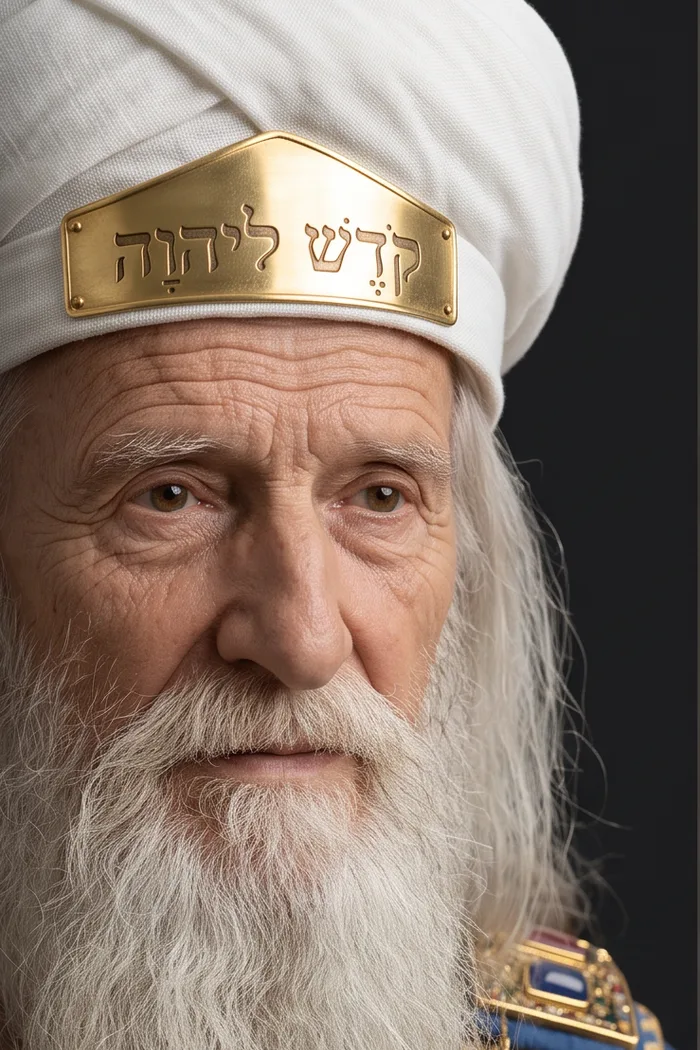
He is not punished. Instead God makes him high priest, dresses him in the ephod, the breastplate with twelve stones, the mitre with holiness to the LORD on its plate, and anoints him with oil. His two eldest sons die before the LORD on the day of his consecration for offering strange fire, and he holds his peace. He and Miriam speak against Moses, and it is Miriam who is struck. Korah challenges his priesthood, and Aaron runs into the plague with a censer and stands between the dead and the living, and his rod alone of twelve buds, blossoms and bears almonds overnight. He shares Moses' sin at Meribah. On Mount Hor, in sight of the congregation, Moses strips him of his garments and puts them on Eleazar, and he dies there at a hundred and twenty-three, and Israel weeps thirty days.

Where he appearsExodus 4 to 17 · Exodus 28 to 32 · Leviticus 8 to 10 · Numbers 12 to 20

Scroll down to the account
Aaron

The movements, in the order the text gives them.

The Account of Aaron

  1. 01

    Exodus 4:10-17, 27-31

    He can speak well

    When Moses says he is slow of speech, the LORD's anger is kindled and he answers: is not Aaron the Levite thy brother? He shall be thy spokesman, and thou shalt be to him instead of God. Aaron meets Moses in the mount of God and kisses him, and speaks all the words to the elders of Israel.

    Before Aaron speaks a word, God speaks about the way he speaks. He can speak well. Moses has spent the conversation explaining why his own mouth disqualifies him; the answer names another mouth without releasing Moses from the commission. Aaron is help, not an escape clause. The promise then embraces both brothers: God will be with each man's mouth. Neither is left to manufacture the message.

    There is a warmer detail tucked inside that arrangement. Aaron is already coming to meet Moses, and God explicitly says that the meeting will gladden his heart. The kiss at the mountain belongs to the account, not to an imagined scene added around it. Before the public spokesman stands before the elders, a brother welcomes a brother.

    Aaron's first recorded address carries words received through Moses, and the people's response fixes attention beyond either speaker. They bow because the LORD has visited their affliction. The eloquent man succeeds without becoming the subject of his own announcement.

    Verse by verse

    1. 4:14

      Aaron is introduced as the Levite, before the instructions establishing his priestly office. The anger in this verse is directed at Moses.

    2. 4:15

      The promise concerns both mouths, not merely Aaron replacing an inadequate Moses. The commission remains shared but the roles remain distinct.

    3. 4:27

      Micah 6:4 later names Moses, Aaron, and Miriam together as leaders sent before Israel. Aaron is not erased from the memory of the deliverance.

    4. 4:31

      The stated grounds for worship are divine visitation and attention to Israel's affliction, not a verdict on Aaron's eloquence.

    Exodus 4:10-17, 27-31

    King James Version · 13 verses

    4:10And Moses said unto the LORD, O my Lord, I am not eloquent, neither heretofore, nor since thou hast spoken unto thy servant: but I am slow of speech, and of a slow tongue.

    4:11And the LORD said unto him, Who hath made man’s mouth? or who maketh the dumb, or deaf, or the seeing, or the blind? have not I the LORD?

    4:12Now therefore go, and I will be with thy mouth, and teach thee what thou shalt say.

    4:13And he said, O my Lord, send, I pray thee, by the hand of him whom thou wilt send.

    4:14And the anger of the LORD was kindled against Moses, and he said, Is not Aaron the Levite thy brother? I know that he can speak well. And also, behold, he cometh forth to meet thee: and when he seeth thee, he will be glad in his heart.

    4:15And thou shalt speak unto him, and put words in his mouth: and I will be with thy mouth, and with his mouth, and will teach you what ye shall do.

    4:16And he shall be thy spokesman unto the people: and he shall be, even he shall be to thee instead of a mouth, and thou shalt be to him instead of God.

    4:17And thou shalt take this rod in thine hand, wherewith thou shalt do signs.

    4:27And the LORD said to Aaron, Go into the wilderness to meet Moses. And he went, and met him in the mount of God, and kissed him.

    4:28And Moses told Aaron all the words of the LORD who had sent him, and all the signs which he had commanded him.

    4:29And Moses and Aaron went and gathered together all the elders of the children of Israel:

    4:30And Aaron spake all the words which the LORD had spoken unto Moses, and did the signs in the sight of the people.

    4:31And the people believed: and when they heard that the LORD had visited the children of Israel, and that he had looked upon their affliction, then they bowed their heads and worshipped.

  2. 02

    Exodus 7:1-12

    The rod that swallowed the others

    God makes Moses a god to Pharaoh and Aaron his prophet. Before Pharaoh, Aaron casts down his rod and it becomes a serpent; the magicians do likewise, and Aaron's rod swallows up their rods. Aaron is eighty-three, Moses eighty.

    Aaron is eighty-three when he stands before Pharaoh. The elder brother is speaking for the younger, and neither is beginning this assignment early. The ages give the scene a useful solidity: these are two old men carrying a command into a royal court, not promising youths being discovered.

    The contest does not begin with Egypt unable to answer. Its magicians reproduce the sign. The Book of Exodus grants that plainly, then makes the distinction equally plain: Aaron's rod swallowed up their rods. Even after the staffs have become serpents, the sentence calls them rods. The objects carried into the room as instruments of authority remain the objects at issue. Several become one rod's meal.

    Aaron's part is exact rather than flamboyant. He casts down what he has been told to cast down, before the people named in the instruction. His authority is not established by a more impressive speech. It rests on the command he obeys and on what happens to the staff.

    Verse by verse

    1. 7:1

      Aaron as prophet explains his spokesman role. Exodus 4:16 supplies the parallel description, Moses' mouth.

    2. 7:7

      Aaron is three years older than Moses: eighty-three beside eighty. The text gives their ages at this confrontation, not their ages at some earlier calling.

    3. 7:11

      The chapter reports the magicians' action without explaining its mechanism. A specific trick or technique would be an addition to the passage.

    4. 7:12

      The rod is expressly called Aaron's. The account does not authorize treating every rod in the brothers' history as automatically the same object.

    Exodus 7:1-12

    King James Version · 12 verses

    7:1And the LORD said unto Moses, See, I have made thee a god to Pharaoh: and Aaron thy brother shall be thy prophet.

    7:2Thou shalt speak all that I command thee: and Aaron thy brother shall speak unto Pharaoh, that he send the children of Israel out of his land.

    7:3And I will harden Pharaoh’s heart, and multiply my signs and my wonders in the land of Egypt.

    7:4But Pharaoh shall not hearken unto you, that I may lay my hand upon Egypt, and bring forth mine armies, and my people the children of Israel, out of the land of Egypt by great judgments.

    7:5And the Egyptians shall know that I am the LORD, when I stretch forth mine hand upon Egypt, and bring out the children of Israel from among them.

    7:6And Moses and Aaron did as the LORD commanded them, so did they.

    7:7And Moses was fourscore years old, and Aaron fourscore and three years old, when they spake unto Pharaoh.

    7:8And the LORD spake unto Moses and unto Aaron, saying,

    7:9When Pharaoh shall speak unto you, saying, Shew a miracle for you: then thou shalt say unto Aaron, Take thy rod, and cast it before Pharaoh, and it shall become a serpent.

    7:10And Moses and Aaron went in unto Pharaoh, and they did so as the LORD had commanded: and Aaron cast down his rod before Pharaoh, and before his servants, and it became a serpent.

    7:11Then Pharaoh also called the wise men and the sorcerers: now the magicians of Egypt, they also did in like manner with their enchantments.

    7:12For they cast down every man his rod, and they became serpents: but Aaron’s rod swallowed up their rods.

  3. 03

    Exodus 7:19-8:19

    Blood, frogs, lice

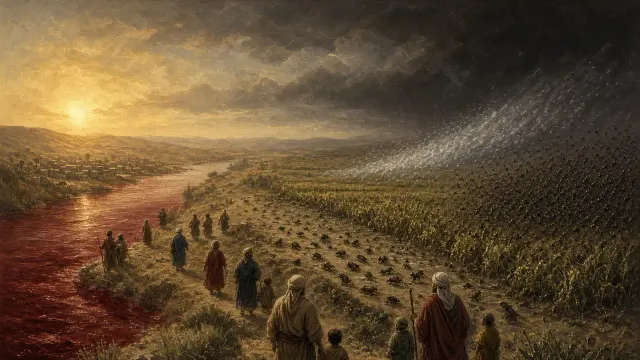
    At Moses' word Aaron stretches his rod over the waters of Egypt and they become blood; over the streams and frogs cover the land; he smites the dust and it becomes lice on man and beast. The magicians say: this is the finger of God.

    Egypt's magicians can produce more frogs. That is an impressive way to make an existing problem worse. Pharaoh needs the frogs removed, and for that he summons Moses and Aaron. The distinction between reproducing a calamity and commanding its end gives the episode its dry edge.

    Aaron is no silent extra beside the better-known brother. The instructions repeatedly name his hand and his rod: over Egypt's waters, over its streams and ponds, against the dust. The reach moves from the river into kitchens and bedrooms, then onto bodies. Pharaoh's bed and the kneading troughs belong to the same invaded country. Rank provides no frog-free enclosure.

    The brothers' work is also differentiated. Aaron stretches out his hand; Moses cries to the LORD for relief. When the magicians finally fail to reproduce the lice, their own explanation names the finger of God. Recognition has reached the court's specialists. Release still has not reached Israel. Pharaoh's hardened response outlasts the explanations available to his servants.

    Verse by verse

    1. 7:19

      The judgment includes water in wooden and stone vessels. The wording carries the disruption beyond the river into stored household supplies.

    2. 8:9

      Glory over me introduces Pharaoh's opportunity to name the time for the prayer. His answer in the next verse is tomorrow.

    3. 8:15

      Here Pharaoh hardens his own heart when relief arrives. The passage itself includes human refusal, not only earlier announcements of divine hardening.

    4. 8:16

      The Hebrew kinnim is rendered lice in the KJV and is also understood as gnats. An exact modern insect identification is uncertain.

    Exodus 7:19-8:19: Blood, frogs, lice

    Exodus 7:19-8:19

    King James Version · 26 verses

    7:19And the LORD spake unto Moses, Say unto Aaron, Take thy rod, and stretch out thine hand upon the waters of Egypt, upon their streams, upon their rivers, and upon their ponds, and upon all their pools of water, that they may become blood; and that there may be blood throughout all the land of Egypt, both in vessels of wood, and in vessels of stone.

    7:20And Moses and Aaron did so, as the LORD commanded; and he lifted up the rod, and smote the waters that were in the river, in the sight of Pharaoh, and in the sight of his servants; and all the waters that were in the river were turned to blood.

    7:21And the fish that was in the river died; and the river stank, and the Egyptians could not drink of the water of the river; and there was blood throughout all the land of Egypt.

    7:22And the magicians of Egypt did so with their enchantments: and Pharaoh’s heart was hardened, neither did he hearken unto them; as the LORD had said.

    7:23And Pharaoh turned and went into his house, neither did he set his heart to this also.

    7:24And all the Egyptians digged round about the river for water to drink; for they could not drink of the water of the river.

    7:25And seven days were fulfilled, after that the LORD had smitten the river.

    8:1And the LORD spake unto Moses, Go unto Pharaoh, and say unto him, Thus saith the LORD, Let my people go, that they may serve me.

    8:2And if thou refuse to let them go, behold, I will smite all thy borders with frogs:

    8:3And the river shall bring forth frogs abundantly, which shall go up and come into thine house, and into thy bedchamber, and upon thy bed, and into the house of thy servants, and upon thy people, and into thine ovens, and into thy kneadingtroughs:

    8:4And the frogs shall come up both on thee, and upon thy people, and upon all thy servants.

    8:5And the LORD spake unto Moses, Say unto Aaron, Stretch forth thine hand with thy rod over the streams, over the rivers, and over the ponds, and cause frogs to come up upon the land of Egypt.

    8:6And Aaron stretched out his hand over the waters of Egypt; and the frogs came up, and covered the land of Egypt.

    8:7And the magicians did so with their enchantments, and brought up frogs upon the land of Egypt.

    8:8Then Pharaoh called for Moses and Aaron, and said, Intreat the LORD, that he may take away the frogs from me, and from my people; and I will let the people go, that they may do sacrifice unto the LORD.

    8:9And Moses said unto Pharaoh, Glory over me: when shall I intreat for thee, and for thy servants, and for thy people, to destroy the frogs from thee and thy houses, that they may remain in the river only?

    8:10And he said, To morrow. And he said, Be it according to thy word: that thou mayest know that there is none like unto the LORD our God.

    8:11And the frogs shall depart from thee, and from thy houses, and from thy servants, and from thy people; they shall remain in the river only.

    8:12And Moses and Aaron went out from Pharaoh: and Moses cried unto the LORD because of the frogs which he had brought against Pharaoh.

    8:13And the LORD did according to the word of Moses; and the frogs died out of the houses, out of the villages, and out of the fields.

    8:14And they gathered them together upon heaps: and the land stank.

    8:15But when Pharaoh saw that there was respite, he hardened his heart, and hearkened not unto them; as the LORD had said.

    8:16And the LORD said unto Moses, Say unto Aaron, Stretch out thy rod, and smite the dust of the land, that it may become lice throughout all the land of Egypt.

    8:17And they did so; for Aaron stretched out his hand with his rod, and smote the dust of the earth, and it became lice in man, and in beast; all the dust of the land became lice throughout all the land of Egypt.

    8:18And the magicians did so with their enchantments to bring forth lice, but they could not: so there were lice upon man, and upon beast.

    8:19Then the magicians said unto Pharaoh, This is the finger of God: and Pharaoh’s heart was hardened, and he hearkened not unto them; as the LORD had said.

  4. 04

    Exodus 17:8-13

    Holding up the hands

    Against Amalek, Moses stands on the hill with the rod of God, and when his hands grow heavy Aaron and Hur set a stone under him and hold up his hands, one on each side, steady until the going down of the sun. Joshua prevails.

    For once, Aaron's useful contribution is not his mouth. It is his arms. The man introduced as a speaker spends this battle holding up someone else's hands, and the Book of Exodus treats that work as part of the victory, not as background assistance beneath notice.

    The practical details refuse to float away into an emblem. Moses' hands are heavy. A stone has to be brought so that he can sit. Aaron and Hur take opposite sides, and the arrangement has to last until sunset. A moment of encouragement would not have done the job. The difficulty is bodily, and the support has to stay bodily too.

    Joshua is fighting below while these three remain above. The passage joins those activities without confusing them: the sword is Joshua's, the rod is in Moses' hand, and Aaron and Hur supply the steadiness Moses cannot maintain alone. Aaron receives neither the commander's position nor the central raised staff. He holds his place beside them.

    Verse by verse

    1. 17:9

      The rod is called the rod of God. The passage does not describe a weapon in Aaron's hand or give him command of the fighting men.

    2. 17:10

      Hur is named without a genealogy or family relationship here. Identifying him as Miriam's husband goes beyond what this passage supplies.

    3. 17:11

      Raised hands are often associated with prayer in Scripture, but this account records neither a prayer nor its words. Its explicit emphasis is the hands and the battle.

    4. 17:12

      Until the going down of the sun specifies duration. Aaron and Hur's support is sustained, not a single ceremonial gesture.

    Exodus 17:8-13

    King James Version · 6 verses

    17:8Then came Amalek, and fought with Israel in Rephidim.

    17:9And Moses said unto Joshua, Choose us out men, and go out, fight with Amalek: to morrow I will stand on the top of the hill with the rod of God in mine hand.

    17:10So Joshua did as Moses had said to him, and fought with Amalek: and Moses, Aaron, and Hur went up to the top of the hill.

    17:11And it came to pass, when Moses held up his hand, that Israel prevailed: and when he let down his hand, Amalek prevailed.

    17:12But Moses’ hands were heavy; and they took a stone, and put it under him, and he sat thereon; and Aaron and Hur stayed up his hands, the one on the one side, and the other on the other side; and his hands were steady until the going down of the sun.

    17:13And Joshua discomfited Amalek and his people with the edge of the sword.

    Exodus 17:8-13: Holding up the hands
  5. 05

    Exodus 24:1-11

    He saw the God of Israel

    Aaron, Nadab, Abihu and seventy elders go up with Moses and see the God of Israel, with under his feet as it were a paved work of sapphire. God does not lay his hand on them, and they eat and drink.

    The description spends more words on what lies beneath God's feet than on God's appearance. Sapphire-like pavement, clear as heaven: the precision is remarkable, and so is the restraint. Aaron is among men said to have seen the God of Israel, but the passage does not supply a face for a painter to complete. It gives the encounter without pretending to exhaust what was encountered.

    They also eat and drink. That ordinary pair of verbs stands beside the extraordinary statement that God did not lay his hand upon them. The meal is not casual access to a dangerous place. It follows the reading of the covenant, the people's assent, and the sprinkling of blood. Aaron comes as an invited participant in a relationship publicly established.

    The invitation names his sons Nadab and Abihu too, while keeping a distinction between the larger group and Moses' approach. This is genuine privilege, not unrestricted access. Aaron's later failure at the calf cannot be explained as simple ignorance of whom Israel has met. His name is already on this mountain's guest list.

    Verse by verse

    1. 24:1

      Nadab and Abihu are specifically included with Aaron. The invitation does not name his other two sons, Eleazar and Ithamar.

    2. 24:5

      Young men offer sacrifices here, before Aaron's formal installation. The verse does not identify Aaron as the officiant at these offerings.

    3. 24:10

      The text says they saw God; Exodus 33:20 later restricts seeing God's face. The distinction should not be flattened into either a complete portrait or a denial of this encounter.

    4. 24:11

      Laid not his hand means that the nobles were not struck down. It is a statement of their preservation, not a description of a gesture of welcome.

    Exodus 24:1-11

    King James Version · 11 verses

    24:1And he said unto Moses, Come up unto the LORD, thou, and Aaron, Nadab, and Abihu, and seventy of the elders of Israel; and worship ye afar off.

    24:2And Moses alone shall come near the LORD: but they shall not come nigh; neither shall the people go up with him.

    24:3And Moses came and told the people all the words of the LORD, and all the judgments: and all the people answered with one voice, and said, All the words which the LORD hath said will we do.

    24:4And Moses wrote all the words of the LORD, and rose up early in the morning, and builded an altar under the hill, and twelve pillars, according to the twelve tribes of Israel.

    24:5And he sent young men of the children of Israel, which offered burnt offerings, and sacrificed peace offerings of oxen unto the LORD.

    24:6And Moses took half of the blood, and put it in basons; and half of the blood he sprinkled on the altar.

    24:7And he took the book of the covenant, and read in the audience of the people: and they said, All that the LORD hath said will we do, and be obedient.

    24:8And Moses took the blood, and sprinkled it on the people, and said, Behold the blood of the covenant, which the LORD hath made with you concerning all these words.

    24:9Then went up Moses, and Aaron, Nadab, and Abihu, and seventy of the elders of Israel:

    24:10And they saw the God of Israel: and there was under his feet as it were a paved work of a sapphire stone, and as it were the body of heaven in his clearness.

    24:11And upon the nobles of the children of Israel he laid not his hand: also they saw God, and did eat and drink.

  6. 06

    Exodus 32

    The golden calf

    The people gather to Aaron: up, make us gods. He tells them to break off their golden earrings, fashions the gold with a graving tool into a molten calf, builds an altar, and proclaims a feast to the LORD. When Moses demands what the people did to him, Aaron says he cast the gold into the fire, and there came out this calf. Moses saw that the people were naked, for Aaron had made them naked.

    Aaron's explanation loses one very important craftsman: Aaron. Verse 4 gives him the gold and a graving tool. Verse 24 gives the fire the entire production contract: there came out this calf. Between the making and the explaining, the maker nearly disappears. The Book of Exodus does not lose track of him. Its last verse returns to the calf, which Aaron made.

    His announcement of a feast to the LORD makes the failure more pointed, not less. The divine name remains on the celebration while the people credit a manufactured image with their deliverance. This is not safely reduced to somebody accidentally choosing the wrong label. Aaron has supplied an object, an altar, and an appointed festival. His conduct organizes the people's demand into worship.

    The chapter refuses to let the absurd excuse soften the consequences. Moses calls the offense a great sin. About three thousand men fall, and a plague follows. Aaron survives, but survival is not the chapter's declaration of innocence. The man appointed to speak has offered an explanation that his own recorded actions contradict.

    Verse by verse

    1. 32:4

      The verse expressly attributes the shaping and making to Aaron. His later account must be read against these stated actions.

    2. 32:5

      Aaron names the festival for the LORD. That wording matters, but it does not make the image or the worship authorized.

    3. 32:6

      Paul quotes the eating, drinking, and rising to play in 1 Corinthians 10:7, explicitly identifying the episode with idolatry.

    4. 32:24

      The claim that the calf came out of the fire omits the workmanship recorded in verse 4. The contradiction is inside Aaron's own account of events.

    5. 32:35

      Acts 7:40-41 also recalls the demand made to Aaron and the calf. Neither later prominence nor priestly office removes this act from Scripture's record.

    Exodus 32: The golden calf

    Exodus 32

    King James Version · 35 verses

    32:1And when the people saw that Moses delayed to come down out of the mount, the people gathered themselves together unto Aaron, and said unto him, Up, make us gods, which shall go before us; for as for this Moses, the man that brought us up out of the land of Egypt, we wot not what is become of him.

    32:2And Aaron said unto them, Break off the golden earrings, which are in the ears of your wives, of your sons, and of your daughters, and bring them unto me.

    32:3And all the people brake off the golden earrings which were in their ears, and brought them unto Aaron.

    32:4And he received them at their hand, and fashioned it with a graving tool, after he had made it a molten calf: and they said, These be thy gods, O Israel, which brought thee up out of the land of Egypt.

    32:5And when Aaron saw it, he built an altar before it; and Aaron made proclamation, and said, To morrow is a feast to the LORD.

    32:6And they rose up early on the morrow, and offered burnt offerings, and brought peace offerings; and the people sat down to eat and to drink, and rose up to play.

    32:7And the LORD said unto Moses, Go, get thee down; for thy people, which thou broughtest out of the land of Egypt, have corrupted themselves:

    32:8They have turned aside quickly out of the way which I commanded them: they have made them a molten calf, and have worshipped it, and have sacrificed thereunto, and said, These be thy gods, O Israel, which have brought thee up out of the land of Egypt.

    32:9And the LORD said unto Moses, I have seen this people, and, behold, it is a stiffnecked people:

    32:10Now therefore let me alone, that my wrath may wax hot against them, and that I may consume them: and I will make of thee a great nation.

    32:11And Moses besought the LORD his God, and said, LORD, why doth thy wrath wax hot against thy people, which thou hast brought forth out of the land of Egypt with great power, and with a mighty hand?

    32:12Wherefore should the Egyptians speak, and say, For mischief did he bring them out, to slay them in the mountains, and to consume them from the face of the earth? Turn from thy fierce wrath, and repent of this evil against thy people.

    32:13Remember Abraham, Isaac, and Israel, thy servants, to whom thou swarest by thine own self, and saidst unto them, I will multiply your seed as the stars of heaven, and all this land that I have spoken of will I give unto your seed, and they shall inherit it for ever.

    32:14And the LORD repented of the evil which he thought to do unto his people.

    32:15And Moses turned, and went down from the mount, and the two tables of the testimony were in his hand: the tables were written on both their sides; on the one side and on the other were they written.

    32:16And the tables were the work of God, and the writing was the writing of God, graven upon the tables.

    32:17And when Joshua heard the noise of the people as they shouted, he said unto Moses, There is a noise of war in the camp.

    32:18And he said, It is not the voice of them that shout for mastery, neither is it the voice of them that cry for being overcome: but the noise of them that sing do I hear.

    32:19And it came to pass, as soon as he came nigh unto the camp, that he saw the calf, and the dancing: and Moses’ anger waxed hot, and he cast the tables out of his hands, and brake them beneath the mount.

    32:20And he took the calf which they had made, and burnt it in the fire, and ground it to powder, and strawed it upon the water, and made the children of Israel drink of it.

    32:21And Moses said unto Aaron, What did this people unto thee, that thou hast brought so great a sin upon them?

    32:22And Aaron said, Let not the anger of my lord wax hot: thou knowest the people, that they are set on mischief.

    32:23For they said unto me, Make us gods, which shall go before us: for as for this Moses, the man that brought us up out of the land of Egypt, we wot not what is become of him.

    32:24And I said unto them, Whosoever hath any gold, let them break it off. So they gave it me: then I cast it into the fire, and there came out this calf.

    32:25And when Moses saw that the people were naked; (for Aaron had made them naked unto their shame among their enemies:)

    32:26Then Moses stood in the gate of the camp, and said, Who is on the LORD’s side? let him come unto me. And all the sons of Levi gathered themselves together unto him.

    32:27And he said unto them, Thus saith the LORD God of Israel, Put every man his sword by his side, and go in and out from gate to gate throughout the camp, and slay every man his brother, and every man his companion, and every man his neighbour.

    32:28And the children of Levi did according to the word of Moses: and there fell of the people that day about three thousand men.

    32:29For Moses had said, Consecrate yourselves to day to the LORD, even every man upon his son, and upon his brother; that he may bestow upon you a blessing this day.

    32:30And it came to pass on the morrow, that Moses said unto the people, Ye have sinned a great sin: and now I will go up unto the LORD; peradventure I shall make an atonement for your sin.

    32:31And Moses returned unto the LORD, and said, Oh, this people have sinned a great sin, and have made them gods of gold.

    32:32Yet now, if thou wilt forgive their sin; and if not, blot me, I pray thee, out of thy book which thou hast written.

    32:33And the LORD said unto Moses, Whosoever hath sinned against me, him will I blot out of my book.

    32:34Therefore now go, lead the people unto the place of which I have spoken unto thee: behold, mine Angel shall go before thee: nevertheless in the day when I visit I will visit their sin upon them.

    32:35And the LORD plagued the people, because they made the calf, which Aaron made.

  7. 07

    Exodus 28-29; Leviticus 8

    Garments for glory and beauty

    God commands garments for Aaron: the ephod, the breastplate of judgement with twelve stones for the twelve tribes and the Urim and Thummim, the robe with bells and pomegranates, the mitre with a gold plate engraved holiness to the LORD. Moses washes him, clothes him, pours the anointing oil on his head, and consecrates him and his sons for seven days.

    Aaron's most conspicuous ornaments carry other people's names. Six on one shoulder, six on the other, and twelve stones over his heart: the beauty of the clothing serves a representative task. Israel enters the sanctuary in the names borne by its priest. Even the gold on his forehead declares HOLINESS TO THE LORD, not the excellence of the man wearing it. Exodus 28:38 assigns him responsibility for iniquity attached to holy gifts. The splendid outfit is not a certificate of personal flawlessness.

    The order of the books matters here. The instructions in Exodus 28 and 29 precede the golden calf; their enactment in Leviticus 8 follows it. Aaron's installation is neither the reward for making the calf nor evidence that the offense never mattered. The man who shaped an unauthorized image now stands while Moses washes, dresses, and anoints him according to a received command. Before he ministers for others, a sin offering is made for the priests themselves. He receives the office. He does not confer it on himself.

    Then blood reaches his ear, thumb, and toe, and oil and altar blood are sprinkled on the garments. These clothes are made for service, not for remaining untouched in a display case. Seven days at the entrance follow, under an explicit warning against leaving. The closing purpose in Exodus 29 is God's dwelling among the people brought out of Egypt. Aaron's glory and beauty belong inside that purpose, carrying names, responsibility, and limits.

    Verse by verse

    1. 28:12

      The shoulder stones are memorial stones bearing Israel's names. Verse 29 repeats the memorial function over Aaron's heart.

    2. 28:30

      The Urim and Thummim are placed in the breastplate of judgment. Their precise appearance and operating procedure are not explained in these instructions.

    3. 28:38

      Aaron bears the iniquity of the holy things. The inscription concerns consecration and representation, not a claim that the wearer cannot sin.

    4. 29:9

      Hebrews 5:4 names Aaron as the example of a man called by God to priestly honor rather than taking that honor for himself.

    5. 8:12

      Psalm 133:2 makes the oil descending over Aaron's beard and garments an image of brothers dwelling in unity. His anointing becomes part of Israel's sung memory.

    6. 8:23

      The blood marks the right ear, right thumb, and right great toe. The text specifies these locations without supplying an allegorical explanation for each.

    Exodus 28-29; Leviticus 8

    King James Version · 125 verses

    28:1And take thou unto thee Aaron thy brother, and his sons with him, from among the children of Israel, that he may minister unto me in the priest’s office, even Aaron, Nadab and Abihu, Eleazar and Ithamar, Aaron’s sons.

    28:2And thou shalt make holy garments for Aaron thy brother for glory and for beauty.

    28:3And thou shalt speak unto all that are wise hearted, whom I have filled with the spirit of wisdom, that they may make Aaron’s garments to consecrate him, that he may minister unto me in the priest’s office.

    28:4And these are the garments which they shall make; a breastplate, and an ephod, and a robe, and a broidered coat, a mitre, and a girdle: and they shall make holy garments for Aaron thy brother, and his sons, that he may minister unto me in the priest’s office.

    28:5And they shall take gold, and blue, and purple, and scarlet, and fine linen.

    28:6And they shall make the ephod of gold, of blue, and of purple, of scarlet, and fine twined linen, with cunning work.

    28:7It shall have the two shoulderpieces thereof joined at the two edges thereof; and so it shall be joined together.

    28:8And the curious girdle of the ephod, which is upon it, shall be of the same, according to the work thereof; even of gold, of blue, and purple, and scarlet, and fine twined linen.

    28:9And thou shalt take two onyx stones, and grave on them the names of the children of Israel:

    28:10Six of their names on one stone, and the other six names of the rest on the other stone, according to their birth.

    28:11With the work of an engraver in stone, like the engravings of a signet, shalt thou engrave the two stones with the names of the children of Israel: thou shalt make them to be set in ouches of gold.

    28:12And thou shalt put the two stones upon the shoulders of the ephod for stones of memorial unto the children of Israel: and Aaron shall bear their names before the LORD upon his two shoulders for a memorial.

    28:13And thou shalt make ouches of gold;

    28:14And two chains of pure gold at the ends; of wreathen work shalt thou make them, and fasten the wreathen chains to the ouches.

    28:15And thou shalt make the breastplate of judgment with cunning work; after the work of the ephod thou shalt make it; of gold, of blue, and of purple, and of scarlet, and of fine twined linen, shalt thou make it.

    28:16Foursquare it shall be being doubled; a span shall be the length thereof, and a span shall be the breadth thereof.

    28:17And thou shalt set in it settings of stones, even four rows of stones: the first row shall be a sardius, a topaz, and a carbuncle: this shall be the first row.

    28:18And the second row shall be an emerald, a sapphire, and a diamond.

    28:19And the third row a ligure, an agate, and an amethyst.

    28:20And the fourth row a beryl, and an onyx, and a jasper: they shall be set in gold in their inclosings.

    28:21And the stones shall be with the names of the children of Israel, twelve, according to their names, like the engravings of a signet; every one with his name shall they be according to the twelve tribes.

    28:22And thou shalt make upon the breastplate chains at the ends of wreathen work of pure gold.

    28:23And thou shalt make upon the breastplate two rings of gold, and shalt put the two rings on the two ends of the breastplate.

    28:24And thou shalt put the two wreathen chains of gold in the two rings which are on the ends of the breastplate.

    28:25And the other two ends of the two wreathen chains thou shalt fasten in the two ouches, and put them on the shoulderpieces of the ephod before it.

    28:26And thou shalt make two rings of gold, and thou shalt put them upon the two ends of the breastplate in the border thereof, which is in the side of the ephod inward.

    28:27And two other rings of gold thou shalt make, and shalt put them on the two sides of the ephod underneath, toward the forepart thereof, over against the other coupling thereof, above the curious girdle of the ephod.

    28:28And they shall bind the breastplate by the rings thereof unto the rings of the ephod with a lace of blue, that it may be above the curious girdle of the ephod, and that the breastplate be not loosed from the ephod.

    28:29And Aaron shall bear the names of the children of Israel in the breastplate of judgment upon his heart, when he goeth in unto the holy place, for a memorial before the LORD continually.

    28:30And thou shalt put in the breastplate of judgment the Urim and the Thummim; and they shall be upon Aaron’s heart, when he goeth in before the LORD: and Aaron shall bear the judgment of the children of Israel upon his heart before the LORD continually.

    28:31And thou shalt make the robe of the ephod all of blue.

    28:32And there shall be an hole in the top of it, in the midst thereof: it shall have a binding of woven work round about the hole of it, as it were the hole of an habergeon, that it be not rent.

    28:33And beneath upon the hem of it thou shalt make pomegranates of blue, and of purple, and of scarlet, round about the hem thereof; and bells of gold between them round about:

    28:34A golden bell and a pomegranate, a golden bell and a pomegranate, upon the hem of the robe round about.

    28:35And it shall be upon Aaron to minister: and his sound shall be heard when he goeth in unto the holy place before the LORD, and when he cometh out, that he die not.

    28:36And thou shalt make a plate of pure gold, and grave upon it, like the engravings of a signet, HOLINESS TO THE LORD.

    28:37And thou shalt put it on a blue lace, that it may be upon the mitre; upon the forefront of the mitre it shall be.

    28:38And it shall be upon Aaron’s forehead, that Aaron may bear the iniquity of the holy things, which the children of Israel shall hallow in all their holy gifts; and it shall be always upon his forehead, that they may be accepted before the LORD.

    28:39And thou shalt embroider the coat of fine linen, and thou shalt make the mitre of fine linen, and thou shalt make the girdle of needlework.

    28:40And for Aaron’s sons thou shalt make coats, and thou shalt make for them girdles, and bonnets shalt thou make for them, for glory and for beauty.

    28:41And thou shalt put them upon Aaron thy brother, and his sons with him; and shalt anoint them, and consecrate them, and sanctify them, that they may minister unto me in the priest’s office.

    28:42And thou shalt make them linen breeches to cover their nakedness; from the loins even unto the thighs they shall reach:

    28:43And they shall be upon Aaron, and upon his sons, when they come in unto the tabernacle of the congregation, or when they come near unto the altar to minister in the holy place; that they bear not iniquity, and die: it shall be a statute for ever unto him and his seed after him.

    29:1And this is the thing that thou shalt do unto them to hallow them, to minister unto me in the priest’s office: Take one young bullock, and two rams without blemish,

    29:2And unleavened bread, and cakes unleavened tempered with oil, and wafers unleavened anointed with oil: of wheaten flour shalt thou make them.

    29:3And thou shalt put them into one basket, and bring them in the basket, with the bullock and the two rams.

    29:4And Aaron and his sons thou shalt bring unto the door of the tabernacle of the congregation, and shalt wash them with water.

    29:5And thou shalt take the garments, and put upon Aaron the coat, and the robe of the ephod, and the ephod, and the breastplate, and gird him with the curious girdle of the ephod:

    29:6And thou shalt put the mitre upon his head, and put the holy crown upon the mitre.

    29:7Then shalt thou take the anointing oil, and pour it upon his head, and anoint him.

    29:8And thou shalt bring his sons, and put coats upon them.

    29:9And thou shalt gird them with girdles, Aaron and his sons, and put the bonnets on them: and the priest’s office shall be theirs for a perpetual statute: and thou shalt consecrate Aaron and his sons.

    29:10And thou shalt cause a bullock to be brought before the tabernacle of the congregation: and Aaron and his sons shall put their hands upon the head of the bullock.

    29:11And thou shalt kill the bullock before the LORD, by the door of the tabernacle of the congregation.

    29:12And thou shalt take of the blood of the bullock, and put it upon the horns of the altar with thy finger, and pour all the blood beside the bottom of the altar.

    29:13And thou shalt take all the fat that covereth the inwards, and the caul that is above the liver, and the two kidneys, and the fat that is upon them, and burn them upon the altar.

    29:14But the flesh of the bullock, and his skin, and his dung, shalt thou burn with fire without the camp: it is a sin offering.

    29:15Thou shalt also take one ram; and Aaron and his sons shall put their hands upon the head of the ram.

    29:16And thou shalt slay the ram, and thou shalt take his blood, and sprinkle it round about upon the altar.

    29:17And thou shalt cut the ram in pieces, and wash the inwards of him, and his legs, and put them unto his pieces, and unto his head.

    29:18And thou shalt burn the whole ram upon the altar: it is a burnt offering unto the LORD: it is a sweet savour, an offering made by fire unto the LORD.

    29:19And thou shalt take the other ram; and Aaron and his sons shall put their hands upon the head of the ram.

    29:20Then shalt thou kill the ram, and take of his blood, and put it upon the tip of the right ear of Aaron, and upon the tip of the right ear of his sons, and upon the thumb of their right hand, and upon the great toe of their right foot, and sprinkle the blood upon the altar round about.

    29:21And thou shalt take of the blood that is upon the altar, and of the anointing oil, and sprinkle it upon Aaron, and upon his garments, and upon his sons, and upon the garments of his sons with him: and he shall be hallowed, and his garments, and his sons, and his sons’ garments with him.

    29:22Also thou shalt take of the ram the fat and the rump, and the fat that covereth the inwards, and the caul above the liver, and the two kidneys, and the fat that is upon them, and the right shoulder; for it is a ram of consecration:

    29:23And one loaf of bread, and one cake of oiled bread, and one wafer out of the basket of the unleavened bread that is before the LORD:

    29:24And thou shalt put all in the hands of Aaron, and in the hands of his sons; and shalt wave them for a wave offering before the LORD.

    29:25And thou shalt receive them of their hands, and burn them upon the altar for a burnt offering, for a sweet savour before the LORD: it is an offering made by fire unto the LORD.

    29:26And thou shalt take the breast of the ram of Aaron’s consecration, and wave it for a wave offering before the LORD: and it shall be thy part.

    29:27And thou shalt sanctify the breast of the wave offering, and the shoulder of the heave offering, which is waved, and which is heaved up, of the ram of the consecration, even of that which is for Aaron, and of that which is for his sons:

    29:28And it shall be Aaron’s and his sons’ by a statute for ever from the children of Israel: for it is an heave offering: and it shall be an heave offering from the children of Israel of the sacrifice of their peace offerings, even their heave offering unto the LORD.

    29:29And the holy garments of Aaron shall be his sons’ after him, to be anointed therein, and to be consecrated in them.

    29:30And that son that is priest in his stead shall put them on seven days, when he cometh into the tabernacle of the congregation to minister in the holy place.

    29:31And thou shalt take the ram of the consecration, and seethe his flesh in the holy place.

    29:32And Aaron and his sons shall eat the flesh of the ram, and the bread that is in the basket, by the door of the tabernacle of the congregation.

    29:33And they shall eat those things wherewith the atonement was made, to consecrate and to sanctify them: but a stranger shall not eat thereof, because they are holy.

    29:34And if ought of the flesh of the consecrations, or of the bread, remain unto the morning, then thou shalt burn the remainder with fire: it shall not be eaten, because it is holy.

    29:35And thus shalt thou do unto Aaron, and to his sons, according to all things which I have commanded thee: seven days shalt thou consecrate them.

    29:36And thou shalt offer every day a bullock for a sin offering for atonement: and thou shalt cleanse the altar, when thou hast made an atonement for it, and thou shalt anoint it, to sanctify it.

    29:37Seven days thou shalt make an atonement for the altar, and sanctify it; and it shall be an altar most holy: whatsoever toucheth the altar shall be holy.

    29:38Now this is that which thou shalt offer upon the altar; two lambs of the first year day by day continually.

    29:39The one lamb thou shalt offer in the morning; and the other lamb thou shalt offer at even:

    29:40And with the one lamb a tenth deal of flour mingled with the fourth part of an hin of beaten oil; and the fourth part of an hin of wine for a drink offering.

    29:41And the other lamb thou shalt offer at even, and shalt do thereto according to the meat offering of the morning, and according to the drink offering thereof, for a sweet savour, an offering made by fire unto the LORD.

    29:42This shall be a continual burnt offering throughout your generations at the door of the tabernacle of the congregation before the LORD: where I will meet you, to speak there unto thee.

    29:43And there I will meet with the children of Israel, and the tabernacle shall be sanctified by my glory.

    29:44And I will sanctify the tabernacle of the congregation, and the altar: I will sanctify also both Aaron and his sons, to minister to me in the priest’s office.

    29:45And I will dwell among the children of Israel, and will be their God.

    29:46And they shall know that I am the LORD their God, that brought them forth out of the land of Egypt, that I may dwell among them: I am the LORD their God.

    8:1And the LORD spake unto Moses, saying,

    8:2Take Aaron and his sons with him, and the garments, and the anointing oil, and a bullock for the sin offering, and two rams, and a basket of unleavened bread;

    8:3And gather thou all the congregation together unto the door of the tabernacle of the congregation.

    8:4And Moses did as the LORD commanded him; and the assembly was gathered together unto the door of the tabernacle of the congregation.

    8:5And Moses said unto the congregation, This is the thing which the LORD commanded to be done.

    8:6And Moses brought Aaron and his sons, and washed them with water.

    8:7And he put upon him the coat, and girded him with the girdle, and clothed him with the robe, and put the ephod upon him, and he girded him with the curious girdle of the ephod, and bound it unto him therewith.

    8:8And he put the breastplate upon him: also he put in the breastplate the Urim and the Thummim.

    8:9And he put the mitre upon his head; also upon the mitre, even upon his forefront, did he put the golden plate, the holy crown; as the LORD commanded Moses.

    8:10And Moses took the anointing oil, and anointed the tabernacle and all that was therein, and sanctified them.

    8:11And he sprinkled thereof upon the altar seven times, and anointed the altar and all his vessels, both the laver and his foot, to sanctify them.

    8:12And he poured of the anointing oil upon Aaron’s head, and anointed him, to sanctify him.

    8:13And Moses brought Aaron’s sons, and put coats upon them, and girded them with girdles, and put bonnets upon them; as the LORD commanded Moses.

    8:14And he brought the bullock for the sin offering: and Aaron and his sons laid their hands upon the head of the bullock for the sin offering.

    8:15And he slew it; and Moses took the blood, and put it upon the horns of the altar round about with his finger, and purified the altar, and poured the blood at the bottom of the altar, and sanctified it, to make reconciliation upon it.

    8:16And he took all the fat that was upon the inwards, and the caul above the liver, and the two kidneys, and their fat, and Moses burned it upon the altar.

    8:17But the bullock, and his hide, his flesh, and his dung, he burnt with fire without the camp; as the LORD commanded Moses.

    8:18And he brought the ram for the burnt offering: and Aaron and his sons laid their hands upon the head of the ram.

    8:19And he killed it; and Moses sprinkled the blood upon the altar round about.

    8:20And he cut the ram into pieces; and Moses burnt the head, and the pieces, and the fat.

    8:21And he washed the inwards and the legs in water; and Moses burnt the whole ram upon the altar: it was a burnt sacrifice for a sweet savour, and an offering made by fire unto the LORD; as the LORD commanded Moses.

    8:22And he brought the other ram, the ram of consecration: and Aaron and his sons laid their hands upon the head of the ram.

    8:23And he slew it; and Moses took of the blood of it, and put it upon the tip of Aaron’s right ear, and upon the thumb of his right hand, and upon the great toe of his right foot.

    8:24And he brought Aaron’s sons, and Moses put of the blood upon the tip of their right ear, and upon the thumbs of their right hands, and upon the great toes of their right feet: and Moses sprinkled the blood upon the altar round about.

    8:25And he took the fat, and the rump, and all the fat that was upon the inwards, and the caul above the liver, and the two kidneys, and their fat, and the right shoulder:

    8:26And out of the basket of unleavened bread, that was before the LORD, he took one unleavened cake, and a cake of oiled bread, and one wafer, and put them on the fat, and upon the right shoulder:

    8:27And he put all upon Aaron’s hands, and upon his sons’ hands, and waved them for a wave offering before the LORD.

    8:28And Moses took them from off their hands, and burnt them on the altar upon the burnt offering: they were consecrations for a sweet savour: it is an offering made by fire unto the LORD.

    8:29And Moses took the breast, and waved it for a wave offering before the LORD: for of the ram of consecration it was Moses’ part; as the LORD commanded Moses.

    8:30And Moses took of the anointing oil, and of the blood which was upon the altar, and sprinkled it upon Aaron, and upon his garments, and upon his sons, and upon his sons’ garments with him; and sanctified Aaron, and his garments, and his sons, and his sons’ garments with him.

    8:31And Moses said unto Aaron and to his sons, Boil the flesh at the door of the tabernacle of the congregation: and there eat it with the bread that is in the basket of consecrations, as I commanded, saying, Aaron and his sons shall eat it.

    8:32And that which remaineth of the flesh and of the bread shall ye burn with fire.

    8:33And ye shall not go out of the door of the tabernacle of the congregation in seven days, until the days of your consecration be at an end: for seven days shall he consecrate you.

    8:34As he hath done this day, so the LORD hath commanded to do, to make an atonement for you.

    8:35Therefore shall ye abide at the door of the tabernacle of the congregation day and night seven days, and keep the charge of the LORD, that ye die not: for so I am commanded.

    8:36So Aaron and his sons did all things which the LORD commanded by the hand of Moses.

  8. 08

    Leviticus 9-10

    Fire from before the LORD, twice

    On the eighth day Aaron offers for himself and the people, lifts his hands and blesses them, and fire comes out from before the LORD and consumes the offering, and the people shout. Then Nadab and Abihu offer strange fire, and fire comes out from the LORD and devours them. Moses says, this is what the LORD spake: I will be sanctified in them that come nigh me. And Aaron held his peace.

    The fire comes from the same place twice. At the end of chapter 9 it consumes the offering and the people fall on their faces. At the beginning of chapter 10 it kills Aaron's sons. The break between chapters must not turn those into unrelated scenes. Aaron has just blessed the people and entered the tabernacle with Moses. The public beginning of his ministry now contains the deaths of Nadab and Abihu.

    And Aaron held his peace. The man introduced for his gift of speech is given a sentence of silence. The account does not translate that silence into an inner monologue. It does specify what follows: relatives carry the bodies away in their coats; Aaron and his surviving sons must not leave their post or adopt the prohibited signs of mourning. The wider congregation may grieve the deaths. The father remains under the obligations of his anointing.

    But silence is not Aaron's final contribution. When Moses challenges the handling of the sin offering, Aaron answers from the events of that day and questions whether eating it would have been acceptable. Moses accepts his explanation. The bereaved priest is neither reduced to a speechless emblem nor dismissed when he speaks. The chapter ends with his judgment heard.

    Verse by verse

    1. 10:1

      Strange fire is immediately defined by the words which he commanded them not. The text does not settle every proposed explanation of the precise ritual violation.

    2. 10:5

      The bodies are carried out in their coats. The account reports death by fire without saying that bodies and garments were reduced to ashes.

    3. 10:9

      The prohibition of wine on duty follows the deaths, but the text never explicitly says Nadab and Abihu had been drinking. That explanation is an inference, not a stated fact.

    4. 10:19

      Aaron addresses the acceptability of eating the offering after what has happened. Verse 20 records Moses' acceptance rather than a further rebuke.

    Leviticus 9-10: Fire from before the LORD, twice

    Leviticus 9-10

    King James Version · 44 verses

    9:1And it came to pass on the eighth day, that Moses called Aaron and his sons, and the elders of Israel;

    9:2And he said unto Aaron, Take thee a young calf for a sin offering, and a ram for a burnt offering, without blemish, and offer them before the LORD.

    9:3And unto the children of Israel thou shalt speak, saying, Take ye a kid of the goats for a sin offering; and a calf and a lamb, both of the first year, without blemish, for a burnt offering;

    9:4Also a bullock and a ram for peace offerings, to sacrifice before the LORD; and a meat offering mingled with oil: for to day the LORD will appear unto you.

    9:5And they brought that which Moses commanded before the tabernacle of the congregation: and all the congregation drew near and stood before the LORD.

    9:6And Moses said, This is the thing which the LORD commanded that ye should do: and the glory of the LORD shall appear unto you.

    9:7And Moses said unto Aaron, Go unto the altar, and offer thy sin offering, and thy burnt offering, and make an atonement for thyself, and for the people: and offer the offering of the people, and make an atonement for them; as the LORD commanded.

    9:8Aaron therefore went unto the altar, and slew the calf of the sin offering, which was for himself.

    9:9And the sons of Aaron brought the blood unto him: and he dipped his finger in the blood, and put it upon the horns of the altar, and poured out the blood at the bottom of the altar:

    9:10But the fat, and the kidneys, and the caul above the liver of the sin offering, he burnt upon the altar; as the LORD commanded Moses.

    9:11And the flesh and the hide he burnt with fire without the camp.

    9:12And he slew the burnt offering; and Aaron’s sons presented unto him the blood, which he sprinkled round about upon the altar.

    9:13And they presented the burnt offering unto him, with the pieces thereof, and the head: and he burnt them upon the altar.

    9:14And he did wash the inwards and the legs, and burnt them upon the burnt offering on the altar.

    9:15And he brought the people’s offering, and took the goat, which was the sin offering for the people, and slew it, and offered it for sin, as the first.

    9:16And he brought the burnt offering, and offered it according to the manner.

    9:17And he brought the meat offering, and took an handful thereof, and burnt it upon the altar, beside the burnt sacrifice of the morning.

    9:18He slew also the bullock and the ram for a sacrifice of peace offerings, which was for the people: and Aaron’s sons presented unto him the blood, which he sprinkled upon the altar round about,

    9:19And the fat of the bullock and of the ram, the rump, and that which covereth the inwards, and the kidneys, and the caul above the liver:

    9:20And they put the fat upon the breasts, and he burnt the fat upon the altar:

    9:21And the breasts and the right shoulder Aaron waved for a wave offering before the LORD; as Moses commanded.

    9:22And Aaron lifted up his hand toward the people, and blessed them, and came down from offering of the sin offering, and the burnt offering, and peace offerings.

    9:23And Moses and Aaron went into the tabernacle of the congregation, and came out, and blessed the people: and the glory of the LORD appeared unto all the people.

    9:24And there came a fire out from before the LORD, and consumed upon the altar the burnt offering and the fat: which when all the people saw, they shouted, and fell on their faces.

    10:1And Nadab and Abihu, the sons of Aaron, took either of them his censer, and put fire therein, and put incense thereon, and offered strange fire before the LORD, which he commanded them not.

    10:2And there went out fire from the LORD, and devoured them, and they died before the LORD.

    10:3Then Moses said unto Aaron, This is it that the LORD spake, saying, I will be sanctified in them that come nigh me, and before all the people I will be glorified. And Aaron held his peace.

    10:4And Moses called Mishael and Elzaphan, the sons of Uzziel the uncle of Aaron, and said unto them, Come near, carry your brethren from before the sanctuary out of the camp.

    10:5So they went near, and carried them in their coats out of the camp; as Moses had said.

    10:6And Moses said unto Aaron, and unto Eleazar and unto Ithamar, his sons, Uncover not your heads, neither rend your clothes; lest ye die, and lest wrath come upon all the people: but let your brethren, the whole house of Israel, bewail the burning which the LORD hath kindled.

    10:7And ye shall not go out from the door of the tabernacle of the congregation, lest ye die: for the anointing oil of the LORD is upon you. And they did according to the word of Moses.

    10:8And the LORD spake unto Aaron, saying,

    10:9Do not drink wine nor strong drink, thou, nor thy sons with thee, when ye go into the tabernacle of the congregation, lest ye die: it shall be a statute for ever throughout your generations:

    10:10And that ye may put difference between holy and unholy, and between unclean and clean;

    10:11And that ye may teach the children of Israel all the statutes which the LORD hath spoken unto them by the hand of Moses.
    10:12And Moses spake unto Aaron, and unto Eleazar and unto Ithamar, his sons that were left, Take the meat offering that remaineth of the offerings of the LORD made by fire, and eat it without leaven beside the altar: for it is most holy:

    10:13And ye shall eat it in the holy place, because it is thy due, and thy sons’ due, of the sacrifices of the LORD made by fire: for so I am commanded.

    10:14And the wave breast and heave shoulder shall ye eat in a clean place; thou, and thy sons, and thy daughters with thee: for they be thy due, and thy sons’ due, which are given out of the sacrifices of peace offerings of the children of Israel.

    10:15The heave shoulder and the wave breast shall they bring with the offerings made by fire of the fat, to wave it for a wave offering before the LORD; and it shall be thine, and thy sons’ with thee, by a statute for ever; as the LORD hath commanded.

    10:16And Moses diligently sought the goat of the sin offering, and, behold, it was burnt: and he was angry with Eleazar and Ithamar, the sons of Aaron which were left alive, saying,

    10:17Wherefore have ye not eaten the sin offering in the holy place, seeing it is most holy, and God hath given it you to bear the iniquity of the congregation, to make atonement for them before the LORD?

    10:18Behold, the blood of it was not brought in within the holy place: ye should indeed have eaten it in the holy place, as I commanded.

    10:19And Aaron said unto Moses, Behold, this day have they offered their sin offering and their burnt offering before the LORD; and such things have befallen me: and if I had eaten the sin offering to day, should it have been accepted in the sight of the LORD?

    10:20And when Moses heard that, he was content.

  9. 09

    Leviticus 16

    The Day of Atonement

    Aaron alone may go within the veil, once a year, in linen, with the blood of a bullock for himself and a goat for the people, and incense so that he does not die. He lays both hands on the live goat, confesses all the iniquities of Israel over it, and sends it away into the wilderness.

    The opening names Aaron's dead sons before it names the day's offerings. That is the setting for the warning that he must not enter whenever he pleases. His anointing has not made proximity harmless, and his priesthood has not given him unrestricted use of God's presence. The repeated phrase that he die not makes the instructions personal. This is also the preservation of Aaron.

    He enters in linen, with an offering for his own sin and his household before the people's offering. The man carrying Israel's case belongs among those who need atonement. Even the incense has a stated protective function: its cloud must cover the mercy seat. Nobody else may remain in the tabernacle during this work. His prominence is inseparable from the boundaries around him.

    Outside that inner work, both hands go onto the living goat, and Aaron confesses the people's iniquities, transgressions, and sins. The piled-up terms leave the action deliberately comprehensive. The goat carries them away to an uninhabited land. Aaron then washes and changes clothes again. The day demands his hands, voice, body, and obedience, and the annual command will outlast him. Its final verses already provide for the son who will take his place.

    Verse by verse

    1. 16:5

      The two goats are taken together for a sin offering, though their subsequent roles differ. They are not introduced as unrelated ceremonies.

    2. 16:8

      The Hebrew Azazel, rendered scapegoat in the KJV, is disputed: interpretations include removal and a wilderness being. The chapter clearly describes the live goat's departure, whatever interpretation of the term is adopted.

    3. 16:13

      The incense cloud is expressly linked to Aaron's survival. Its function here is not merely fragrance or atmosphere.

    4. 16:17

      The atonement includes Aaron, his household, and the congregation. His representative office does not exclude him from the need addressed by the rite.

    5. 16:34

      Hebrews 9:7 recalls the annual entry with blood for the priest and people; 9:12 contrasts it with Christ's entry by his own blood. The comparison belongs to Hebrews' argument, not to words spoken by Aaron.

    Leviticus 16: The Day of Atonement

    Leviticus 16

    King James Version · 34 verses

    16:1And the LORD spake unto Moses after the death of the two sons of Aaron, when they offered before the LORD, and died;

    16:2And the LORD said unto Moses, Speak unto Aaron thy brother, that he come not at all times into the holy place within the vail before the mercy seat, which is upon the ark; that he die not: for I will appear in the cloud upon the mercy seat.

    16:3Thus shall Aaron come into the holy place: with a young bullock for a sin offering, and a ram for a burnt offering.

    16:4He shall put on the holy linen coat, and he shall have the linen breeches upon his flesh, and shall be girded with a linen girdle, and with the linen mitre shall he be attired: these are holy garments; therefore shall he wash his flesh in water, and so put them on.

    16:5And he shall take of the congregation of the children of Israel two kids of the goats for a sin offering, and one ram for a burnt offering.

    16:6And Aaron shall offer his bullock of the sin offering, which is for himself, and make an atonement for himself, and for his house.

    16:7And he shall take the two goats, and present them before the LORD at the door of the tabernacle of the congregation.

    16:8And Aaron shall cast lots upon the two goats; one lot for the LORD, and the other lot for the scapegoat.

    16:9And Aaron shall bring the goat upon which the LORD’s lot fell, and offer him for a sin offering.

    16:10But the goat, on which the lot fell to be the scapegoat, shall be presented alive before the LORD, to make an atonement with him, and to let him go for a scapegoat into the wilderness.

    16:11And Aaron shall bring the bullock of the sin offering, which is for himself, and shall make an atonement for himself, and for his house, and shall kill the bullock of the sin offering which is for himself:

    16:12And he shall take a censer full of burning coals of fire from off the altar before the LORD, and his hands full of sweet incense beaten small, and bring it within the vail:

    16:13And he shall put the incense upon the fire before the LORD, that the cloud of the incense may cover the mercy seat that is upon the testimony, that he die not:

    16:14And he shall take of the blood of the bullock, and sprinkle it with his finger upon the mercy seat eastward; and before the mercy seat shall he sprinkle of the blood with his finger seven times.

    16:15Then shall he kill the goat of the sin offering, that is for the people, and bring his blood within the vail, and do with that blood as he did with the blood of the bullock, and sprinkle it upon the mercy seat, and before the mercy seat:

    16:16And he shall make an atonement for the holy place, because of the uncleanness of the children of Israel, and because of their transgressions in all their sins: and so shall he do for the tabernacle of the congregation, that remaineth among them in the midst of their uncleanness.

    16:17And there shall be no man in the tabernacle of the congregation when he goeth in to make an atonement in the holy place, until he come out, and have made an atonement for himself, and for his household, and for all the congregation of Israel.

    16:18And he shall go out unto the altar that is before the LORD, and make an atonement for it; and shall take of the blood of the bullock, and of the blood of the goat, and put it upon the horns of the altar round about.

    16:19And he shall sprinkle of the blood upon it with his finger seven times, and cleanse it, and hallow it from the uncleanness of the children of Israel.

    16:20And when he hath made an end of reconciling the holy place, and the tabernacle of the congregation, and the altar, he shall bring the live goat:

    16:21And Aaron shall lay both his hands upon the head of the live goat, and confess over him all the iniquities of the children of Israel, and all their transgressions in all their sins, putting them upon the head of the goat, and shall send him away by the hand of a fit man into the wilderness:

    16:22And the goat shall bear upon him all their iniquities unto a land not inhabited: and he shall let go the goat in the wilderness.

    16:23And Aaron shall come into the tabernacle of the congregation, and shall put off the linen garments, which he put on when he went into the holy place, and shall leave them there:

    16:24And he shall wash his flesh with water in the holy place, and put on his garments, and come forth, and offer his burnt offering, and the burnt offering of the people, and make an atonement for himself, and for the people.

    16:25And the fat of the sin offering shall he burn upon the altar.

    16:26And he that let go the goat for the scapegoat shall wash his clothes, and bathe his flesh in water, and afterward come into the camp.

    16:27And the bullock for the sin offering, and the goat for the sin offering, whose blood was brought in to make atonement in the holy place, shall one carry forth without the camp; and they shall burn in the fire their skins, and their flesh, and their dung.

    16:28And he that burneth them shall wash his clothes, and bathe his flesh in water, and afterward he shall come into the camp.

    16:29And this shall be a statute for ever unto you: that in the seventh month, on the tenth day of the month, ye shall afflict your souls, and do no work at all, whether it be one of your own country, or a stranger that sojourneth among you:

    16:30For on that day shall the priest make an atonement for you, to cleanse you, that ye may be clean from all your sins before the LORD.

    16:31It shall be a sabbath of rest unto you, and ye shall afflict your souls, by a statute for ever.

    16:32And the priest, whom he shall anoint, and whom he shall consecrate to minister in the priest’s office in his father’s stead, shall make the atonement, and shall put on the linen clothes, even the holy garments:

    16:33And he shall make an atonement for the holy sanctuary, and he shall make an atonement for the tabernacle of the congregation, and for the altar, and he shall make an atonement for the priests, and for all the people of the congregation.

    16:34And this shall be an everlasting statute unto you, to make an atonement for the children of Israel for all their sins once a year. And he did as the LORD commanded Moses.

  10. 10

    Numbers 6:22-27

    The blessing

    The LORD gives Aaron and his sons the words with which to bless Israel: the LORD bless thee, and keep thee; the LORD make his face shine upon thee, and be gracious unto thee; the LORD lift up his countenance upon thee, and give thee peace.

    Aaron receives the words, and the last sentence takes the result out of his hands. He and his sons are to pronounce the blessing; God says, and I will bless them. The distinction is small enough to miss and large enough to govern the whole passage. Aaron is not inventing a formula that obliges God to act. God gives him speech through which to declare what God himself will do. The man first appointed as another man's mouth now speaks a blessing whose source is explicitly beyond him.

    The three lines move through keeping, grace, and peace, with the LORD named each time. The middle of the blessing is remarkably personal: a shining face, a face lifted toward someone. Divine favor is expressed not merely as the delivery of useful things but as a favorable regard. The wording does not supply a schedule of wealth, immunity, or success. It gives the blessing its own terms.

    Aaron carries names on his shoulders and over his heart in Exodus 28. Here his speech places God's name upon Israel. The priest bears the people before God; the blessing names the people as God's. The name belongs to the whole congregation, not only to the man wearing the gold plate.

    Verse by verse

    1. 6:23

      The commission names Aaron and his sons, not Aaron alone. The blessing belongs to a continuing priestly responsibility.

    2. 6:24

      Keep carries the sense of guarding or preserving. The second verb is not simply another way to say bless.

    3. 6:26

      The Hebrew shalom can include soundness, welfare, and well-being, as well as peace. Absence of fighting does not exhaust its range.

    4. 6:27

      The priests put the name upon the people, but God is the subject of I will bless them. The verse distinguishes the spoken priestly act from its divine source.

    Numbers 6:22-27

    King James Version · 6 verses

    6:22And the LORD spake unto Moses, saying,

    6:23Speak unto Aaron and unto his sons, saying, On this wise ye shall bless the children of Israel, saying unto them,

    6:24The LORD bless thee, and keep thee:

    6:25The LORD make his face shine upon thee, and be gracious unto thee:

    6:26The LORD lift up his countenance upon thee, and give thee peace.

    6:27And they shall put my name upon the children of Israel; and I will bless them.

    Numbers 6:22-27: The blessing
  11. 11

    Numbers 12

    Against Moses, with Miriam

    Miriam and Aaron speak against Moses because of the Ethiopian woman, and say, hath the LORD spoken only by Moses? The LORD calls all three to the tabernacle door and defends Moses. Miriam becomes leprous; Aaron says to Moses, alas, my lord, lay not the sin upon us, and Moses prays for her.

    Aaron begins by questioning whether Moses is so exceptional. He ends by calling him my lord and asking for help. His own confession names both foolishness and sin. Whatever remains unexplained about the punishment, Aaron does not describe himself as an innocent bystander.

    The complaint opens with Moses' marriage and broadens into a claim about divine speech. God has spoken through Aaron and Miriam too. The answer does not deny that fact; it distinguishes Moses' commission. Dreams and visions are set beside speech mouth to mouth, without riddles. Moses' place is defended by God, not by a speech Moses delivers about his own importance. Aaron's ability to speak has never meant that every kind of speech carries the same authority.

    Miriam becomes leprous; Aaron does not. The chapter supplies no explanation that fully accounts for that difference, and a neat answer would say more than the passage. It does give Aaron's confession, his dreadful comparison with a half-consumed newborn, and Moses' appeal for healing. The family dispute has consequences for the entire camp: Israel does not move until Miriam returns. Seven days of delay are written into the journey. She is not left behind.

    Verse by verse

    1. 12:1

      The Cushite or Ethiopian woman is not named here. Identifying her with Zipporah or with another wife goes beyond what this verse itself settles.

    2. 12:7

      Hebrews 3:2 and 3:5 take up the description of Moses as faithful in God's house. The later comparison retains the language of this defense.

    3. 12:8

      Dark speeches means obscure sayings or riddles, not morally evil speech. The contrast concerns the clarity of revelation.

    4. 12:10

      Only Miriam is described as becoming leprous. The chapter does not explain Aaron's different physical outcome, although his confession explicitly acknowledges guilt.

    5. 12:15

      The whole people wait through Miriam's seven days outside the camp. Her exclusion is limited, and the journey resumes with her return.

    Numbers 12

    King James Version · 16 verses

    12:1And Miriam and Aaron spake against Moses because of the Ethiopian woman whom he had married: for he had married an Ethiopian woman.

    12:2And they said, Hath the LORD indeed spoken only by Moses? hath he not spoken also by us? And the LORD heard it.

    12:3(Now the man Moses was very meek, above all the men which were upon the face of the earth.)

    12:4And the LORD spake suddenly unto Moses, and unto Aaron, and unto Miriam, Come out ye three unto the tabernacle of the congregation. And they three came out.

    12:5And the LORD came down in the pillar of the cloud, and stood in the door of the tabernacle, and called Aaron and Miriam: and they both came forth.

    12:6And he said, Hear now my words: If there be a prophet among you, I the LORD will make myself known unto him in a vision, and will speak unto him in a dream.

    12:7My servant Moses is not so, who is faithful in all mine house.

    12:8With him will I speak mouth to mouth, even apparently, and not in dark speeches; and the similitude of the LORD shall he behold: wherefore then were ye not afraid to speak against my servant Moses?

    12:9And the anger of the LORD was kindled against them; and he departed.

    12:10And the cloud departed from off the tabernacle; and, behold, Miriam became leprous, white as snow: and Aaron looked upon Miriam, and, behold, she was leprous.

    12:11And Aaron said unto Moses, Alas, my lord, I beseech thee, lay not the sin upon us, wherein we have done foolishly, and wherein we have sinned.

    12:12Let her not be as one dead, of whom the flesh is half consumed when he cometh out of his mother’s womb.

    12:13And Moses cried unto the LORD, saying, Heal her now, O God, I beseech thee.

    12:14And the LORD said unto Moses, If her father had but spit in her face, should she not be ashamed seven days? let her be shut out from the camp seven days, and after that let her be received in again.

    12:15And Miriam was shut out from the camp seven days: and the people journeyed not till Miriam was brought in again.

    12:16And afterward the people removed from Hazeroth, and pitched in the wilderness of Paran.

  12. 12

    Numbers 16:1-40

    Korah

    Korah and his company say the whole congregation is holy and Moses and Aaron lift themselves up. Moses tells them to bring censers before the LORD in the morning, and who the LORD chooses shall be holy. The earth swallows Dathan and Abiram, and fire consumes the two hundred and fifty; their censers are beaten into plates for the altar as a memorial that no stranger, not of the seed of Aaron, come near to offer incense.

    Aaron's office is under attack, but he does not answer with a long defense of Aaron. Moses speaks, the challengers bring censers, and the question is placed before God. Korah is already a Levite, already separated for service at the tabernacle. The demand is not for a first place in the congregation but for the priesthood as well. The argument turns on whether the holiness of the whole people cancels the distinction of Aaron's appointment.

    When the congregation gathers against them and destruction is threatened, Moses and Aaron fall on their faces together. The man whose office is being contested appeals for the people assembled on the other side. That act belongs in his portrait just as firmly as the rod and the breastplate. His response to the challenge includes intercession.

    The judgment is not one undifferentiated spectacle. The earth opens beneath the households of Dathan and Abiram; fire consumes the two hundred and fifty offering incense. Wives and children have been named at the tent doors. Their presence must not disappear beneath a tidy description of a leadership dispute. Afterward, Eleazar collects the censers and has their metal made into a covering for the altar. The people die; the objects remain as a warning about approaching with incense outside Aaron's priestly line. There is no victory speech from Aaron. The altar bears the reminder.

    Verse by verse

    1. 16:10

      Moses distinguishes Korah's existing Levitical service from the additional claim to priesthood. The dispute occurs within the people and their sacred service.

    2. 16:3

      Psalm 106:16 recalls the opposition as envy of Moses and Aaron, calling Aaron the saint of the LORD. The same psalm recalls the calf in verse 19, so the title does not erase that failure.

    3. 16:30

      Quick means alive in this KJV usage. The statement concerns the condition of those descending into the pit, not merely their speed.

    4. 16:32

      Numbers 26:11 explicitly says that Korah's children did not die. The destruction described here should not be expanded into the extinction of every branch of his family.

    5. 16:35

      The fire killing the two hundred and fifty is distinguished from the opening of the earth. The chapter describes separate acts of judgment.

    6. 16:40

      Stranger is defined here by not belonging to Aaron's seed, not simply by foreign nationality. Jude 11 later recalls the rebellion under the KJV name Core.

    Numbers 16:1-40: Korah

    Numbers 16:1-40

    King James Version · 40 verses

    16:1Now Korah, the son of Izhar, the son of Kohath, the son of Levi, and Dathan and Abiram, the sons of Eliab, and On, the son of Peleth, sons of Reuben, took men:

    16:2And they rose up before Moses, with certain of the children of Israel, two hundred and fifty princes of the assembly, famous in the congregation, men of renown:

    16:3And they gathered themselves together against Moses and against Aaron, and said unto them, Ye take too much upon you, seeing all the congregation are holy, every one of them, and the LORD is among them: wherefore then lift ye up yourselves above the congregation of the LORD?

    16:4And when Moses heard it, he fell upon his face:

    16:5And he spake unto Korah and unto all his company, saying, Even to morrow the LORD will shew who are his, and who is holy; and will cause him to come near unto him: even him whom he hath chosen will he cause to come near unto him.

    16:6This do; Take you censers, Korah, and all his company;

    16:7And put fire therein, and put incense in them before the LORD to morrow: and it shall be that the man whom the LORD doth choose, he shall be holy: ye take too much upon you, ye sons of Levi.

    16:8And Moses said unto Korah, Hear, I pray you, ye sons of Levi:

    16:9Seemeth it but a small thing unto you, that the God of Israel hath separated you from the congregation of Israel, to bring you near to himself to do the service of the tabernacle of the LORD, and to stand before the congregation to minister unto them?

    16:10And he hath brought thee near to him, and all thy brethren the sons of Levi with thee: and seek ye the priesthood also?

    16:11For which cause both thou and all thy company are gathered together against the LORD: and what is Aaron, that ye murmur against him?

    16:12And Moses sent to call Dathan and Abiram, the sons of Eliab: which said, We will not come up:

    16:13Is it a small thing that thou hast brought us up out of a land that floweth with milk and honey, to kill us in the wilderness, except thou make thyself altogether a prince over us?

    16:14Moreover thou hast not brought us into a land that floweth with milk and honey, or given us inheritance of fields and vineyards: wilt thou put out the eyes of these men? we will not come up.

    16:15And Moses was very wroth, and said unto the LORD, Respect not thou their offering: I have not taken one ass from them, neither have I hurt one of them.

    16:16And Moses said unto Korah, Be thou and all thy company before the LORD, thou, and they, and Aaron, to morrow:

    16:17And take every man his censer, and put incense in them, and bring ye before the LORD every man his censer, two hundred and fifty censers; thou also, and Aaron, each of you his censer.

    16:18And they took every man his censer, and put fire in them, and laid incense thereon, and stood in the door of the tabernacle of the congregation with Moses and Aaron.

    16:19And Korah gathered all the congregation against them unto the door of the tabernacle of the congregation: and the glory of the LORD appeared unto all the congregation.

    16:20And the LORD spake unto Moses and unto Aaron, saying,

    16:21Separate yourselves from among this congregation, that I may consume them in a moment.

    16:22And they fell upon their faces, and said, O God, the God of the spirits of all flesh, shall one man sin, and wilt thou be wroth with all the congregation?

    16:23And the LORD spake unto Moses, saying,

    16:24Speak unto the congregation, saying, Get you up from about the tabernacle of Korah, Dathan, and Abiram.

    16:25And Moses rose up and went unto Dathan and Abiram; and the elders of Israel followed him.

    16:26And he spake unto the congregation, saying, Depart, I pray you, from the tents of these wicked men, and touch nothing of theirs, lest ye be consumed in all their sins.

    16:27So they gat up from the tabernacle of Korah, Dathan, and Abiram, on every side: and Dathan and Abiram came out, and stood in the door of their tents, and their wives, and their sons, and their little children.

    16:28And Moses said, Hereby ye shall know that the LORD hath sent me to do all these works; for I have not done them of mine own mind.

    16:29If these men die the common death of all men, or if they be visited after the visitation of all men; then the LORD hath not sent me.

    16:30But if the LORD make a new thing, and the earth open her mouth, and swallow them up, with all that appertain unto them, and they go down quick into the pit; then ye shall understand that these men have provoked the LORD.

    16:31And it came to pass, as he had made an end of speaking all these words, that the ground clave asunder that was under them:

    16:32And the earth opened her mouth, and swallowed them up, and their houses, and all the men that appertained unto Korah, and all their goods.

    16:33They, and all that appertained to them, went down alive into the pit, and the earth closed upon them: and they perished from among the congregation.

    16:34And all Israel that were round about them fled at the cry of them: for they said, Lest the earth swallow us up also.

    16:35And there came out a fire from the LORD, and consumed the two hundred and fifty men that offered incense.

    16:36And the LORD spake unto Moses, saying,

    16:37Speak unto Eleazar the son of Aaron the priest, that he take up the censers out of the burning, and scatter thou the fire yonder; for they are hallowed.

    16:38The censers of these sinners against their own souls, let them make them broad plates for a covering of the altar: for they offered them before the LORD, therefore they are hallowed: and they shall be a sign unto the children of Israel.

    16:39And Eleazar the priest took the brasen censers, wherewith they that were burnt had offered; and they were made broad plates for a covering of the altar:

    16:40To be a memorial unto the children of Israel, that no stranger, which is not of the seed of Aaron, come near to offer incense before the LORD; that he be not as Korah, and as his company: as the LORD said to him by the hand of Moses.
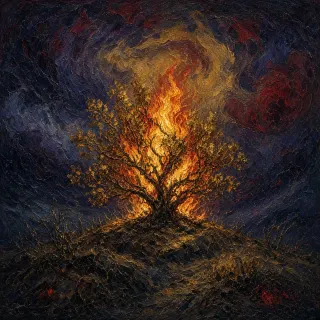
  13. 13

    Numbers 16:41-50

    Between the dead and the living

    The next day the congregation murmurs that Moses and Aaron have killed the people of the LORD, and a plague begins. Moses tells Aaron to take a censer with fire from the altar and run into the congregation. Aaron makes an atonement, stands between the dead and the living, and the plague is stayed. Fourteen thousand seven hundred have died.

    Aaron runs toward the people who have just accused him of killing the people of the LORD. The accusation is answered with neither a denial nor a demand for an apology. Moses tells him to take fire from the altar, add incense, and go quickly. Aaron runs. The movement is explicit, and it matters: the priest does not remain at the tabernacle while the plague advances through the congregation.

    The censer makes the passage especially severe. Incense has just figured in the deaths of the two hundred and fifty; here Aaron carries it in an act of atonement. The difference is not that incense has become a safer substance. This action follows Moses' command, uses fire from the altar, and is performed by the priest whose appointment was challenged. The shared ritual object does not make the two acts interchangeable.

    Between the dead and the living is not an ornamental description of his office. It locates his body. The plague stops at this intervention, but the dead are not described as returning to life. Fourteen thousand seven hundred have died, apart from the earlier judgment. Aaron returns to Moses; many others do not return anywhere. His answer to the accusation is where he stands.

    Verse by verse

    1. 16:46

      Moses specifies fire from the altar. The passage does not present Aaron as choosing an independent ritual of his own invention.

    2. 16:47

      Ran is the text's verb, not an embellishment. Aaron moves into the congregation where the plague has already begun.

    3. 16:49

      The fourteen thousand seven hundred deaths are additional to those connected with Korah's earlier challenge. Combining the figures without this distinction obscures the verse.

    4. 16:50

      The statement that the plague was stayed repeats verse 48 after Aaron returns. The return to the tabernacle is accompanied by a second notice that the plague has stopped.

    Numbers 16:41-50

    King James Version · 10 verses

    16:41But on the morrow all the congregation of the children of Israel murmured against Moses and against Aaron, saying, Ye have killed the people of the LORD.

    16:42And it came to pass, when the congregation was gathered against Moses and against Aaron, that they looked toward the tabernacle of the congregation: and, behold, the cloud covered it, and the glory of the LORD appeared.

    16:43And Moses and Aaron came before the tabernacle of the congregation.

    16:44And the LORD spake unto Moses, saying,

    16:45Get you up from among this congregation, that I may consume them as in a moment. And they fell upon their faces.

    16:46And Moses said unto Aaron, Take a censer, and put fire therein from off the altar, and put on incense, and go quickly unto the congregation, and make an atonement for them: for there is wrath gone out from the LORD; the plague is begun.

    16:47And Aaron took as Moses commanded, and ran into the midst of the congregation; and, behold, the plague was begun among the people: and he put on incense, and made an atonement for the people.

    16:48And he stood between the dead and the living; and the plague was stayed.

    16:49Now they that died in the plague were fourteen thousand and seven hundred, beside them that died about the matter of Korah.

    16:50And Aaron returned unto Moses unto the door of the tabernacle of the congregation: and the plague was stayed.

    Numbers 16:41-50: Between the dead and the living
  14. 14

    Numbers 17

    The rod that budded

    Twelve rods, one for each tribe, are laid before the testimony overnight, Aaron's for Levi. In the morning the rod of Aaron has budded, brought forth buds, bloomed blossoms and yielded almonds. It is kept before the testimony as a token against the rebels.

    Aaron contributes his name. The rod does the flowering. Each representative brings a staff identified by its owner's name, and Aaron's marks the house of Levi. The rods are laid together before the LORD. No speech from Aaron is recorded, no performance by which he distinguishes his piece of wood from the others. The decision is God's, and its evidence is visible.

    The next morning the description accumulates growth: buds, blossoms, almonds. The text is not satisfied with saying that the rod looks a little more promising. Moses brings out all the staffs, the men inspect them, and each takes his own. Aaron's rod is then returned before the testimony as a lasting reminder. The stated purpose is to stop the murmuring so that the people do not die. The sign of his appointment is living growth, preserved in the wake of mass death.

    The chapter does not end with applause for Aaron. It ends with the people afraid that any approach to the tabernacle means death. That unresolved fear matters. Numbers 18 immediately addresses Aaron about bearing the responsibility of the sanctuary and priesthood. The confirmed office is not merely a distinction to enjoy. Someone must answer for the approach to holy things, and Aaron is named.

    Verse by verse

    1. 17:3

      Aaron's name goes on the rod of Levi. His identification is personal, but the representation is tribal.

    2. 17:8

      The verse separately names buds, blossoms, and almonds. Reducing the sign to a leafy stick loses the fullness of its description.

    3. 17:10

      Hebrews 9:4 explicitly remembers Aaron's rod that budded among the objects associated with the ark. Here it is kept before the testimony as a warning against rebellion.

    4. 17:12-13

      The final speeches belong to the frightened people, not to a triumphant Aaron. The chapter records their alarm rather than pretending the sign immediately produces calm.

    Numbers 17

    King James Version · 13 verses

    17:1And the LORD spake unto Moses, saying,

    17:2Speak unto the children of Israel, and take of every one of them a rod according to the house of their fathers, of all their princes according to the house of their fathers twelve rods: write thou every man’s name upon his rod.

    17:3And thou shalt write Aaron’s name upon the rod of Levi: for one rod shall be for the head of the house of their fathers.

    17:4And thou shalt lay them up in the tabernacle of the congregation before the testimony, where I will meet with you.

    17:5And it shall come to pass, that the man’s rod, whom I shall choose, shall blossom: and I will make to cease from me the murmurings of the children of Israel, whereby they murmur against you.

    17:6And Moses spake unto the children of Israel, and every one of their princes gave him a rod apiece, for each prince one, according to their fathers’ houses, even twelve rods: and the rod of Aaron was among their rods.

    17:7And Moses laid up the rods before the LORD in the tabernacle of witness.

    17:8And it came to pass, that on the morrow Moses went into the tabernacle of witness; and, behold, the rod of Aaron for the house of Levi was budded, and brought forth buds, and bloomed blossoms, and yielded almonds.

    17:9And Moses brought out all the rods from before the LORD unto all the children of Israel: and they looked, and took every man his rod.

    17:10And the LORD said unto Moses, Bring Aaron’s rod again before the testimony, to be kept for a token against the rebels; and thou shalt quite take away their murmurings from me, that they die not.

    17:11And Moses did so: as the LORD commanded him, so did he.

    17:12And the children of Israel spake unto Moses, saying, Behold, we die, we perish, we all perish.

    17:13Whosoever cometh any thing near unto the tabernacle of the LORD shall die: shall we be consumed with dying?

  15. 15

    Numbers 20:1-13, 22-29

    Meribah, and Mount Hor

    At Meribah Aaron stands with Moses when the rock is struck, and is included in the sentence: ye shall not bring this congregation into the land. At Mount Hor the LORD says Aaron shall be gathered unto his people. Moses takes him and Eleazar up in the sight of all, strips Aaron of his garments and puts them on Eleazar, and Aaron dies on the top of the mount. All the house of Israel mourns thirty days.

    Water flows. Approval does not follow. The congregation and its animals drink abundantly, but the successful supply of water does not cancel God's judgment on Moses and Aaron. Moses is the one described as striking the rock; both brothers are addressed for failing to believe and sanctify God before Israel. Aaron's precise unrecorded action cannot be reconstructed with confidence. His accountability, however, is stated directly.

    The chapter opens with Miriam's death and closes with Aaron's. At Mount Hor the command becomes painfully physical: remove his garments and put them on Eleazar. Moses, who dressed Aaron for his consecration in Leviticus 8, now takes the garments off and clothes his son. The same hands attend the beginning and the end of Aaron's tenure. The robe passes to another body before its former wearer dies. Appointment to the priesthood has never meant exemption from death.

    Three men ascend in the sight of the congregation. Moses and Eleazar come down. The account does not supply Aaron's final speech, a private farewell, or the thoughts of the son receiving his clothes. It records obedience, death, descent, and thirty days of mourning by all Israel. The judgment at Meribah remains stated; so does the mourning. Neither is edited out to make the other easier. The priesthood comes down the mountain. Its first priest does not.

    Verse by verse

    1. 20:12

      God addresses Moses and Aaron together, although verse 11 names Moses as the one who strikes the rock. Shared judgment does not authorize inventing an identical action for Aaron.

    2. 20:24

      Gathered unto his people is paired here with exclusion from the land and death on the mountain. The wording does not place Aaron's grave in an ancestral family cemetery.

    3. 20:28

      Hebrews 7:23-24 explains the succession of many priests through death and contrasts it with Christ's continuing priesthood. Aaron's death and Eleazar's investiture give concrete form to the succession that argument describes.

    4. 20:28

      Aaron's line continues beyond the transfer of his garments: Luke 1:5 identifies Elisabeth as one of the daughters of Aaron. It does not mean she is his immediate daughter.

    5. 20:29

      All the house of Israel mourns for thirty days. The passage preserves public mourning without retracting the stated reason Aaron does not enter the land.

    Numbers 20:1-13, 22-29: Meribah, and Mount Hor

    Numbers 20:1-13, 22-29

    King James Version · 21 verses

    20:1Then came the children of Israel, even the whole congregation, into the desert of Zin in the first month: and the people abode in Kadesh; and Miriam died there, and was buried there.

    20:2And there was no water for the congregation: and they gathered themselves together against Moses and against Aaron.

    20:3And the people chode with Moses, and spake, saying, Would God that we had died when our brethren died before the LORD!

    20:4And why have ye brought up the congregation of the LORD into this wilderness, that we and our cattle should die there?

    20:5And wherefore have ye made us to come up out of Egypt, to bring us in unto this evil place? it is no place of seed, or of figs, or of vines, or of pomegranates; neither is there any water to drink.

    20:6And Moses and Aaron went from the presence of the assembly unto the door of the tabernacle of the congregation, and they fell upon their faces: and the glory of the LORD appeared unto them.

    20:7And the LORD spake unto Moses, saying,

    20:8Take the rod, and gather thou the assembly together, thou, and Aaron thy brother, and speak ye unto the rock before their eyes; and it shall give forth his water, and thou shalt bring forth to them water out of the rock: so thou shalt give the congregation and their beasts drink.

    20:9And Moses took the rod from before the LORD, as he commanded him.

    20:10And Moses and Aaron gathered the congregation together before the rock, and he said unto them, Hear now, ye rebels; must we fetch you water out of this rock?

    20:11And Moses lifted up his hand, and with his rod he smote the rock twice: and the water came out abundantly, and the congregation drank, and their beasts also.

    20:12And the LORD spake unto Moses and Aaron, Because ye believed me not, to sanctify me in the eyes of the children of Israel, therefore ye shall not bring this congregation into the land which I have given them.

    20:13This is the water of Meribah; because the children of Israel strove with the LORD, and he was sanctified in them.

    20:22And the children of Israel, even the whole congregation, journeyed from Kadesh, and came unto mount Hor.

    20:23And the LORD spake unto Moses and Aaron in mount Hor, by the coast of the land of Edom, saying,

    20:24Aaron shall be gathered unto his people: for he shall not enter into the land which I have given unto the children of Israel, because ye rebelled against my word at the water of Meribah.

    20:25Take Aaron and Eleazar his son, and bring them up unto mount Hor:

    20:26And strip Aaron of his garments, and put them upon Eleazar his son: and Aaron shall be gathered unto his people, and shall die there.

    20:27And Moses did as the LORD commanded: and they went up into mount Hor in the sight of all the congregation.

    20:28And Moses stripped Aaron of his garments, and put them upon Eleazar his son; and Aaron died there in the top of the mount: and Moses and Eleazar came down from the mount.

    20:29And when all the congregation saw that Aaron was dead, they mourned for Aaron thirty days, even all the house of Israel.

The people, the places and the rest of Scripture.

Reading Aaron closely

The people he dealt with

Moses is his younger brother and his master. God sets the terms at the bush, thou shalt be to him instead of God, and Aaron keeps them: he speaks Moses' words, performs Moses' signs, and takes Moses' rebuke at the calf without answering back. Only once does he speak against him, with Miriam, and he is the first to repent. The last thing Moses does for him is undress him on a mountain so that his son can be dressed.

Miriam is his elder sister, the prophetess who leads the women's song and then joins him against Moses. Elisheba, his wife, is from Judah, so that priest and king are joined at the first generation. Nadab and Abihu are the sons he loses on his first full day as priest; the text records no word from him. Eleazar is the son who inherits, and Ithamar the son who keeps the accounts of the tabernacle. Hur holds up Moses' other hand and later, by tradition, dies at the calf.
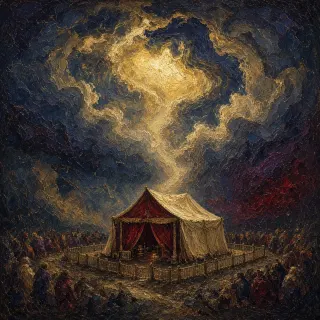
Pharaoh is the king he speaks to on Moses' behalf; the magicians of Egypt are his rivals in the first signs. Korah, his cousin, is the man who wants his office, and the two hundred and fifty princes die holding censers to prove they cannot have it. The congregation is the people he blesses, atones for, and, once, leads astray.

Exodus 4
Exodus 4

The calf and the censer

Aaron's account turns on two objects. The calf is his failure, and the narrative does not hide it: he took the gold, he fashioned it, he built the altar, he proclaimed the feast, and he lied about it. Deuteronomy says God would have destroyed him, and Moses prayed for Aaron also at the same time. He is spared, not excused, and the next thing that happens to him in the account is that he is made high priest. Readers have taken that order of events as the Bible's own comment on grace.

The censer is his vindication. When the plague breaks out after Korah, it is Aaron, not Moses, who runs into the dying crowd with fire and incense. The phrase the text uses, he stood between the dead and the living, is what a priest is for, and Hebrews says Christ does it once and for all. The rod that budded the next morning is the sign that his priesthood is God's choice, and it goes into the ark.

Exodus 4

What came before and what followed

Behind Aaron there is no priest in Israel at all. Sacrifice before Sinai is offered by fathers and elders; Jethro, a Midianite, offers the first sacrifice in Exodus 18. Aaron's consecration in Leviticus 8 creates the office, and Leviticus 10 shows at once how dangerous it is. After him the high priesthood runs through Eleazar to Phinehas, and later through Eli's house of Ithamar until Solomon puts Zadok, of Eleazar, in place. The sons of Aaron serve in the temple through the kings, the exile and the return, and the last high priests hold the office in the days of Jesus. Zacharias and Elisabeth, John the Baptist's parents, are of his line, so the man who announces the Lamb of God is a son of Aaron.

Exodus 4

Where the rest of Scripture reaches back

Psalm 99 names Moses and Aaron among his priests, and Psalm 106 remembers Aaron the saint of the LORD envied in the camp. Psalm 133 makes the oil running down his beard to the skirts of his garments the picture of brethren dwelling in unity. Psalms 115, 118 and 135 call on the house of Aaron to trust in the LORD. Micah 6 says God sent before his people Moses, Aaron and Miriam.

Hebrews reaches for him most. Christ glorified not himself to be made an high priest but was called, as was Aaron, and yet if perfection were by the Levitical priesthood, what further need was there that another priest should rise after the order of Melchisedec, and not be called after the order of Aaron. Aaron's priests were many because death stopped them; Christ continues. Aaron's rod that budded lies in the ark with the golden pot of manna. Stephen recalls the calf with the words the people said to Aaron, make us gods to go before us.
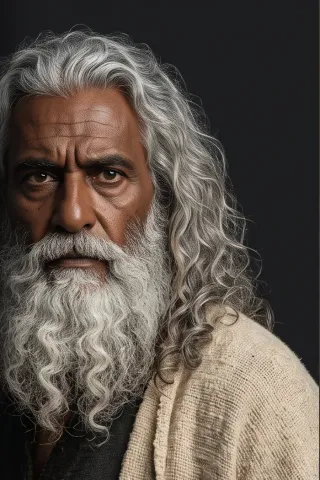
Exodus 5
Exodus 5

Why it matters

Aaron is the beginning of the priesthood. Every priest in Israel is a son of Aaron, every high priest wears his garments, and the Day of Atonement, the daily offerings, the blessing in Numbers 6, the LORD bless thee and keep thee, are all given to him and his sons. The Psalms call the priests the house of Aaron and the oil that ran down upon his beard the picture of unity. Hebrews builds its argument about Christ on him: no man takes this honour to himself but he that is called of God, as was Aaron; yet Christ is a priest after the order of Melchizedek, not of Aaron, because Aaron's priests died and offered for their own sins first. His budded rod is kept in the ark beside the manna and the tables, and Hebrews lists it there.
He is also the Bible's picture of a man who fails badly and is not discarded. The calf should have ended him; Deuteronomy says the LORD was very angry with Aaron to have destroyed him, and Moses prayed for Aaron. The same man who made the idol stands with a censer between the living and the dead and stops a plague. Micah names him with Moses and Miriam as one of the three God sent before his people, and Luke opens the gospel with a priest of the course of Abia whose wife was of the daughters of Aaron, the parents of John the Baptist.

27 songs

The music

Every song in the catalogue whose passage falls inside these chapters.

  1. Exodus 2:11-4:17

    Fire in the Bush

  2. Exodus 2:11-4:17

    Fire That Would Not Burn Away

  3. Exodus 4:18-6:30

    Bricks Without Straw

  4. Exodus 5:1-7:13

    Let the People Go

  5. Exodus 7:14-10:29

    Signs Upon Egypt

  6. Exodus 7:1-8:19

    The Finger of God

  7. Exodus 8:20-10:29

    A Difference in Goshen

  8. Exodus 11:1-12:36

    Blood upon the Door

  9. Exodus 11-12

    When the Blood Was Seen

  10. Exodus 12:31-13:22

    Out of the House of Bondage

  11. Exodus 12:37-15:21

    The Sea Stood Up

  12. Exodus 14:1-15:21

    A Way Through the Sea

  13. Exodus 14:13-31

    Stand Still and See

  14. Exodus 15:22-17:16

    Bread from Heaven, Water from Stone

  15. Exodus 16:1-17:7

    Bread from Heaven

  16. Exodus 17:8-13

    Till the Sun Goes Down

  17. Exodus 25:1-31:18

    Make Me a Sanctuary

  18. Exodus 32

    The Calf of Gold

  19. Leviticus 8:1-36

    Set Apart at the Door

  20. Leviticus 9:22-24

    Fire Fell on Carmel

    Play here
    Open song pageRead lyrics
  21. Leviticus 9:1-10:20

    Strange Fire

  22. Numbers 11:1-12:16

    Is the LORD's Hand Short?

  23. Numbers 13-14

    Giants in the Land

  24. Numbers 13:1-14:45

    We Were as Grasshoppers

  25. Numbers 15:1-17:13

    Between the Dead and the Living

  26. Numbers 16-17

    The Earth Opened

  27. Numbers 18:1-20:29

    Speak to the Rock

The videos

The videos

Every release whose passage falls inside these chapters, playing here.

Nearby

All the people

Report an error on this page