New · FreePlay The Witnesses The in-depth puzzle battle quest through Bible history

People of the Bible

Jochebed

Obeyed the letter of the order to put her son in the river, and built him something to float in.

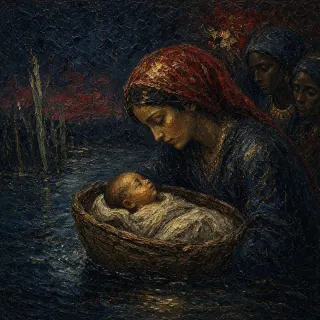
Jochebed is not named until long after the scene she is famous for. In Exodus 2 she is simply a woman of the house of Levi who has a son, sees that he is good, and hides him for three months. When she cannot hide him any longer she does exactly what the king commanded, and casts him into the Nile, inside a basket she has waterproofed with tar and pitch. The word for that basket is the same word used for Noah’s ark, and it is used nowhere else in the Bible.

Where she appearsExodus 1 to 2

Scroll down to the account
Jochebed

The movements, in the order the text gives them.

The Account of Jochebed

  1. 01

    Exodus 1:15-22

    The order, and the midwives

    Every Hebrew boy is to be thrown into the Nile. The midwives refuse first, and are dealt with kindly for it, and then the order is given to all the people.

    The danger facing Jochebed begins before her name or her child appears. Pharaoh orders the women who assist birth to make birth the point of death. The distinction is brutally exact: a daughter may live; a son must be killed. The Book of Exodus gives the two midwives their names, Shiphrah and Puah, while the king remains a title.

    Their refusal is explained just as exactly. They feared God. The text does not leave their reason to speculation, and it repeats that reason when describing God's favor toward them. Their answer to Pharaoh turns his assumptions about Hebrew women against his plan: the children are already born before the midwives arrive. The births he meant to control keep escaping him.

    The final command widens the danger from the delivery room to the whole population. All his people are now charged with casting sons into the river. That is the world into which Jochebed's child is born. The basket answers a command, not an accident.

    Verse by verse

    1. 1:15

      Shiphrah and Puah are the women named here. This passage does not explicitly identify either of them as Jochebed or Miriam.

    2. 1:17

      Fear of God is the stated reason for preserving the boys. The text openly commends their refusal to carry out the killing.

    3. 1:19

      The statement about rapid births is the midwives' answer to Pharaoh. The verse does not supply independent observations about every Hebrew delivery.

    4. 1:22

      All his people marks an escalation from instructions to the midwives. Drowning in the river is now commanded beyond the place of birth.

    Exodus 1:15-22

    King James Version · 8 verses

    1:15And the king of Egypt spake to the Hebrew midwives, of which the name of the one was Shiphrah, and the name of the other Puah:

    1:16And he said, When ye do the office of a midwife to the Hebrew women, and see them upon the stools; if it be a son, then ye shall kill him: but if it be a daughter, then she shall live.

    1:17But the midwives feared God, and did not as the king of Egypt commanded them, but saved the men children alive.

    1:18And the king of Egypt called for the midwives, and said unto them, Why have ye done this thing, and have saved the men children alive?

    1:19And the midwives said unto Pharaoh, Because the Hebrew women are not as the Egyptian women; for they are lively, and are delivered ere the midwives come in unto them.

    1:20Therefore God dealt well with the midwives: and the people multiplied, and waxed very mighty.

    1:21And it came to pass, because the midwives feared God, that he made them houses.

    1:22And Pharaoh charged all his people, saying, Every son that is born ye shall cast into the river, and every daughter ye shall save alive.

    Exodus 1:15-22: The order, and the midwives
  2. 02

    Exodus 2:1-4

    Three months, and a basket

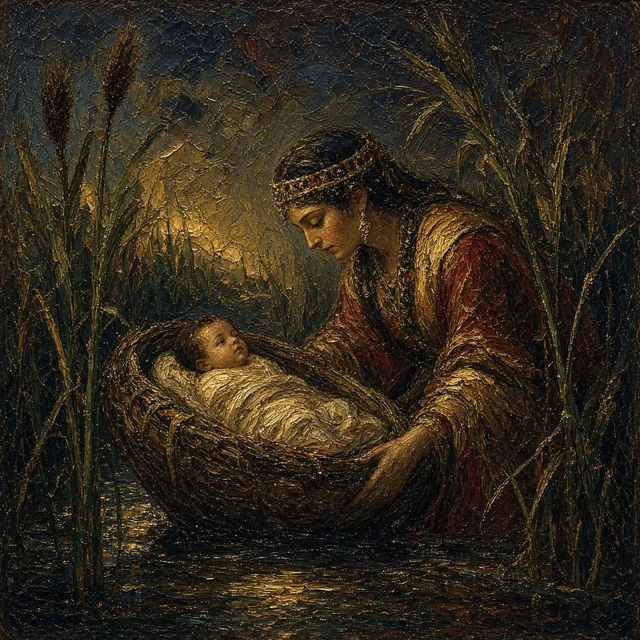
    She hides him as long as a newborn can be hidden, then coats a basket inside and out and puts it among the reeds at the edge of the river, and leaves his sister watching.

    Jochebed does not send the child on a voyage. She seals a small ark, places him inside, and sets it among the flags by the river's brink. The position matters. There is no current carrying him past crocodiles in this account, and no description of the mother watching him vanish downstream. The child is placed where his sister can watch.

    When she could not longer hide him names a practical limit, not a collapse of care. The same attention that kept him concealed now goes into reeds, sealing material, and a chosen position by the bank. The river Pharaoh selected for death becomes the place where she constructs a barrier against it. The water is outside. Her son is inside.

    Exodus calls him goodly and records the three months. Hebrews 11:23 later describes the hiding as the faith of his parents. Neither text says that Jochebed was given a preview of the burning bush. The action is already substantial without supplying her with the whole future.

    Verse by verse

    1. 2:1

      The parents are identified here by the house of Levi. Exodus 6:20 later supplies the names Amram and Jochebed.

    2. 2:2

      The three months belong to the period of hiding, not to the later nursing arrangement. Hebrews 11:23 attributes the hiding to both parents.

    3. 2:3

      Bulrushes represents papyrus; slime and pitch are sealing materials. Flags means the reeds or waterside plants, not banners.

    4. 2:4

      The sister remains to discover what will happen. The verse records observation, not certainty that the princess will arrive.

    Exodus 2:1-4

    King James Version · 4 verses

    2:1And there went a man of the house of Levi, and took to wife a daughter of Levi.

    2:2And the woman conceived, and bare a son: and when she saw him that he was a goodly child, she hid him three months.

    2:3And when she could not longer hide him, she took for him an ark of bulrushes, and daubed it with slime and with pitch, and put the child therein; and she laid it in the flags by the river’s brink.

    2:4And his sister stood afar off, to wit what would be done to him.

    Exodus 2:1-4: Three months, and a basket
  3. 03

    Exodus 2:7-10

    Paid to nurse her own son

    The daughter of Pharaoh takes him, and by way of the sister the child comes back to his mother with wages attached, until he is old enough to be given up a second time.

    The princess does not merely spare the child. She puts his own mother on the payroll to keep him alive. The reversal is exact enough without inventing a triumphant conversation for Jochebed: the royal daughter says for me, while the Book of Exodus has already identified the woman as the child's mother. The service commissioned by the princess is the care the mother was struggling to provide.

    Jochebed's words are not recorded. Her actions are: she takes him, nurses him, and, when he has grown, brings him to Pharaoh's daughter. The rescue does not end with the child remaining indefinitely in his birth household. He became her son names a real transfer, not a ceremonial visit.

    The passage gives Jochebed neither a speech about letting go nor a curriculum for the nursing years. It gives something more concrete: a child alive in her care, wages promised by the king's daughter, and the later act of bringing him back. Preservation and separation occupy the same brief account.

    Verse by verse

    1. 2:7-8

      The sister secures permission to fetch a nurse, then fetches the mother. The text does not record Jochebed arranging the princess's response in advance.

    2. 2:9

      The wages are promised by Pharaoh's daughter. No amount, payment schedule, or separate negotiation by Jochebed is given.

    3. 2:10

      The child grew does not specify the length of the nursing period. Acts 7:20-22 distinguishes his early care in his father's house from his later place as the princess's son and his Egyptian education.

    Exodus 2:7-10

    King James Version · 4 verses

    2:7Then said his sister to Pharaoh’s daughter, Shall I go and call to thee a nurse of the Hebrew women, that she may nurse the child for thee?

    2:8And Pharaoh’s daughter said to her, Go. And the maid went and called the child’s mother.

    2:9And Pharaoh’s daughter said unto her, Take this child away, and nurse it for me, and I will give thee thy wages. And the woman took the child, and nursed it.

    2:10And the child grew, and she brought him unto Pharaoh’s daughter, and he became her son. And she called his name Moses: and she said, Because I drew him out of the water.

    Exodus 2:7-10: Paid to nurse her own son

Why it matters

Everything the exodus becomes rests on three months of concealment and one piece of sealed basketwork. Scripture names her twice afterwards, in the genealogies, as the mother of Aaron, Moses and Miriam, which is a household that produced the priest, the lawgiver and the prophetess. Hebrews credits the hiding to faith and notes that his parents were not afraid of the king’s edict.

4 songs

The music

Every song in the catalogue whose passage falls inside these chapters.

  1. Exodus 1:1-2:10

    A Child Drawn from the River

  2. Exodus 1:1-2:10

    Drawn from the Water

  3. Exodus 2:11-4:17

    Fire in the Bush

  4. Exodus 2:11-4:17

    Fire That Would Not Burn Away

Nearby

All the people

Report an error on this page