


Numbers 16:1-11
All the congregation is holy
Two hundred and fifty men of renown stand with him. Moses answers by pointing out that Korah already has the thing he is demanding, and asks whether he is now seeking the priesthood too.
Verse by verse
- 16:1
Exodus 6:18-21 places Korah's father Izhar and Moses' father Amram among Kohath's sons. The opposition arises within the same extended Levitical family.
- 16:1
On the son of Peleth is named at the outset but is not given an individual outcome in this chapter. Later explanations of his disappearance are not details supplied here.
- 16:7
The charge of taking too much repeats the accusation in 16:3. The verbal reversal is visible in the KJV as well as in Hebrew.
- 16:10-11
Moses explicitly identifies a claim to the priesthood and opposition to the LORD, not merely a disagreement about personal prestige. Jude 11 later recalls Korah, spelled Core in the KJV, under the word gainsaying, resistance or contradiction.


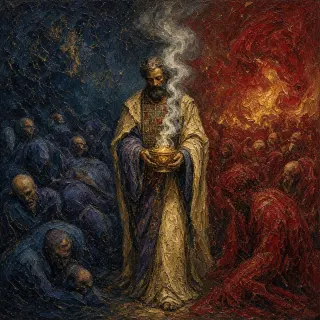



Korah's argument begins with something the law itself affirms: Israel is holy to God. The problem lies in what he makes that truth authorize. A congregation set apart for God is not the same thing as a congregation in which every person has been appointed to every sacred task. Moses eventually names the disputed claim without decoration: the priesthood also.
These are not men without standing. The two hundred and fifty are princes, famous in the congregation, men of renown. Korah himself is a Levite already brought near for sanctuary service. Moses' answer therefore does not begin by describing an outsider kept beyond the fence. It describes someone treating an existing privilege as too little because another office remains beyond it.
The accusation of taking too much then comes back across the argument in verse 7. Moses uses the challengers' own wording against them, but the decision is not left to the sharper reply. The LORD will show whom he has chosen. Censers become the test of the claim. Being able to hold one is not the same as being appointed to offer its incense.