New · FreePlay The Witnesses The in-depth puzzle battle quest through Bible history

People of the Bible

Samson

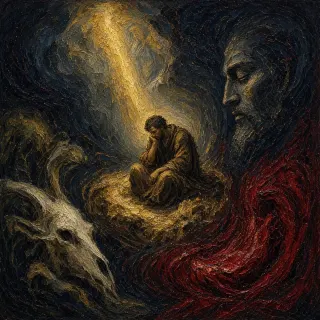
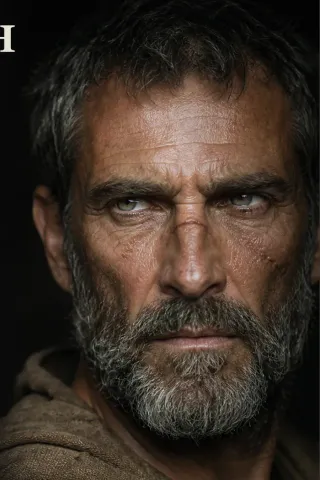
Was set apart before birth and spent his life breaking every term of it, and the strength never left until he told someone why.

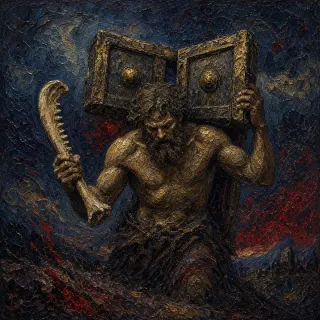
Samson is announced by a messenger to a woman who had no children, with instructions attached: no wine, no razor, a Nazirite from the womb. What follows is not the life those instructions suggest. He touches a lion’s carcass and eats honey out of it, marries outside the people, sets fields on fire with foxes, kills a thousand men with a jawbone, and carries the gates of Gaza uphill. The Spirit of the LORD keeps coming on him, and he keeps using it for grudges. He tells Delilah the secret on the fourth asking.

Where he appearsJudges 13 to 16

Scroll down to the account
Samson

The movements, in the order the text gives them.

The Account of Samson

  1. 01

    Judges 13:2-24

    No razor shall come on his head

    The messenger appears twice, and the second time to both parents. The instructions begin with the mother, before the child exists, and the last thing they see is fire going up from the rock.

    Manoah asks for the messenger to return, and the messenger returns to his wife. Again. The chapter gives Manoah a name and his wife the announcement, the instructions, and finally the clearest understanding of what has happened. When Manoah asks how to bring up the child, the answer sends him back to what she has already been told. Her account was not a preliminary version awaiting a more authoritative appointment.

    The encounter also changes category while the couple are watching. A proposed meal becomes an offering; the visitor refuses the food, directs the sacrifice to the LORD, and ascends in its flame. Manoah concludes that seeing God means death. His wife answers with the actual evidence: the accepted offering, the things shown, the promised child. A birth announcement would be a remarkably roundabout way of announcing the parents' immediate execution.

    Her reasoning is not the last word, however. The child is born, grows, and receives the LORD's blessing. The chapter ends the disagreement by reporting a life.

    Verse by verse

    1. 13:5

      Nazarite means someone set apart, not someone from Nazareth. Unlike the voluntary, time-limited vow described in Numbers 6, this dedication begins before birth and lasts for life.

    2. 13:5

      "Begin to deliver" sets a limit on the commission. Samson is not promised the complete removal of Philistine power.

    3. 13:19

      The "meat offering" is a grain offering, Hebrew minhah. It is distinguished here from the young goat.

    4. 13:23

      The wife argues from what the LORD has already accepted and disclosed. The passage supplies her reasoning, not merely a comforting response.

    Judges 13:2-24: No razor shall come on his head

    Judges 13:2-24

    King James Version · 23 verses

    13:2And there was a certain man of Zorah, of the family of the Danites, whose name was Manoah; and his wife was barren, and bare not.

    13:3And the angel of the LORD appeared unto the woman, and said unto her, Behold now, thou art barren, and bearest not: but thou shalt conceive, and bear a son.

    13:4Now therefore beware, I pray thee, and drink not wine nor strong drink, and eat not any unclean thing:

    13:5For, lo, thou shalt conceive, and bear a son; and no razor shall come on his head: for the child shall be a Nazarite unto God from the womb: and he shall begin to deliver Israel out of the hand of the Philistines.

    13:6Then the woman came and told her husband, saying, A man of God came unto me, and his countenance was like the countenance of an angel of God, very terrible: but I asked him not whence he was, neither told he me his name:

    13:7But he said unto me, Behold, thou shalt conceive, and bear a son; and now drink no wine nor strong drink, neither eat any unclean thing: for the child shall be a Nazarite to God from the womb to the day of his death.

    13:8Then Manoah intreated the LORD, and said, O my Lord, let the man of God which thou didst send come again unto us, and teach us what we shall do unto the child that shall be born.

    13:9And God hearkened to the voice of Manoah; and the angel of God came again unto the woman as she sat in the field: but Manoah her husband was not with her.

    13:10And the woman made haste, and ran, and shewed her husband, and said unto him, Behold, the man hath appeared unto me, that came unto me the other day.

    13:11And Manoah arose, and went after his wife, and came to the man, and said unto him, Art thou the man that spakest unto the woman? And he said, I am.

    13:12And Manoah said, Now let thy words come to pass. How shall we order the child, and how shall we do unto him?

    13:13And the angel of the LORD said unto Manoah, Of all that I said unto the woman let her beware.

    13:14She may not eat of any thing that cometh of the vine, neither let her drink wine or strong drink, nor eat any unclean thing: all that I commanded her let her observe.

    13:15And Manoah said unto the angel of the LORD, I pray thee, let us detain thee, until we shall have made ready a kid for thee.

    13:16And the angel of the LORD said unto Manoah, Though thou detain me, I will not eat of thy bread: and if thou wilt offer a burnt offering, thou must offer it unto the LORD. For Manoah knew not that he was an angel of the LORD.

    13:17And Manoah said unto the angel of the LORD, What is thy name, that when thy sayings come to pass we may do thee honour?

    13:18And the angel of the LORD said unto him, Why askest thou thus after my name, seeing it is secret?

    13:19So Manoah took a kid with a meat offering, and offered it upon a rock unto the LORD: and the angel did wondrously; and Manoah and his wife looked on.

    13:20For it came to pass, when the flame went up toward heaven from off the altar, that the angel of the LORD ascended in the flame of the altar. And Manoah and his wife looked on it, and fell on their faces to the ground.

    13:21But the angel of the LORD did no more appear to Manoah and to his wife. Then Manoah knew that he was an angel of the LORD.

    13:22And Manoah said unto his wife, We shall surely die, because we have seen God.

    13:23But his wife said unto him, If the LORD were pleased to kill us, he would not have received a burnt offering and a meat offering at our hands, neither would he have shewed us all these things, nor would as at this time have told us such things as these.

    13:24And the woman bare a son, and called his name Samson: and the child grew, and the LORD blessed him.

  2. 02

    Judges 14:5-9

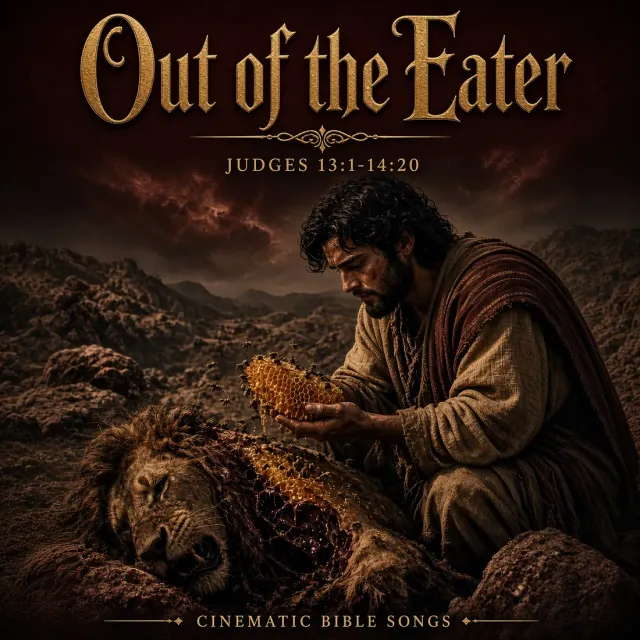
    Out of the eater, something to eat

    He tears a lion apart and says nothing about it. Later he goes back for the honey in the carcass, which no Nazirite should touch, and gives some to his parents without telling them where it came from.

    The first time, Samson tells his parents nothing about the lion. The second time, he gives them the honey and again tells them nothing about the lion. That repeated silence holds these verses together more tightly than the extraordinary feat does. The same hands that held no weapon now carry something sweet from a carcass. The parents receive the food without receiving its history.

    The Book of Judges names the Spirit of the LORD as the source of the strength, but it does not attach that explanation to Samson's return for honey. Those are different statements, and the passage keeps them different. The child whose separation was announced before birth now reaches into what the purity laws treat as unclean. There is no speech defending it, no account of a struggle over it, and no claim that his parents knowingly joined him. The honey is shared. The information is not.

    Verse by verse

    1. 14:6

      The text expressly attributes the feat to the Spirit of the LORD. It gives no description of Samson's physique.

    2. 14:8

      "After a time" leaves the interval unspecified. The passage does not say the honey appeared overnight.

    3. 14:9

      Leviticus 11:27-28 treats the carcasses of animals that walk on paws as unclean. This should not be confused with the specifically human death discussed in Numbers 6:6-7.

    4. 14:9

      The withheld information also supplies the private basis of Samson's riddle in Judges 14:14. His parents are not said to know that basis.

    Judges 14:5-9

    King James Version · 5 verses

    14:5Then went Samson down, and his father and his mother, to Timnath, and came to the vineyards of Timnath: and, behold, a young lion roared against him.

    14:6And the Spirit of the LORD came mightily upon him, and he rent him as he would have rent a kid, and he had nothing in his hand: but he told not his father or his mother what he had done.

    14:7And he went down, and talked with the woman; and she pleased Samson well.

    14:8And after a time he returned to take her, and he turned aside to see the carcase of the lion: and, behold, there was a swarm of bees and honey in the carcase of the lion.

    14:9And he took thereof in his hands, and went on eating, and came to his father and mother, and he gave them, and they did eat: but he told not them that he had taken the honey out of the carcase of the lion.

    Judges 14:5-9: Out of the eater, something to eat
  3. 03

    Judges 15:9-17

    The jawbone of a donkey

    Handed over bound by his own people, who are more afraid of the Philistines than of him. The ropes burn off his arms and he kills a thousand men with the first thing on the ground.

    Three thousand men of Judah arrive, but Samson has not acquired an army. They have come to arrest him. Their opening assumption is that Philistine rule must be accommodated, and the man disturbing that arrangement must be handed over. Israel supplies the cords for the capture of its own deliverer.

    The argument has another exact symmetry. The Philistines intend to do to Samson what he has done to them; Samson says he has done to them what they did to him. Both sides describe retaliation as an answer, though it keeps producing another attack. Against that repetition, the actual deliverance is strikingly unmanufactured: the Spirit comes upon him, the new cords fail, and the weapon is a bone he finds. No armory, no supporting troops. The victory speech credits his hand, but the next verse brings that same man to desperate thirst and an appeal to the LORD. A thousand enemies defeated has not made him self-sufficient.

    Verse by verse

    1. 15:11

      The three thousand are men of Judah, not the enemy force. Their purpose is surrendering Samson, not fighting beside him.

    2. 15:13

      Samson secures their promise not to kill him themselves. The text does not say he fights the men who bind him.

    3. 15:14

      The comparison with burned flax describes the cords becoming useless. It does not require an unmentioned fire at the scene.

    4. 15:17

      Ramathlehi means the height or hill of the jawbone. The name preserves the location's association with the improvised weapon.

    Judges 15:9-17

    King James Version · 9 verses

    15:9Then the Philistines went up, and pitched in Judah, and spread themselves in Lehi.

    15:10And the men of Judah said, Why are ye come up against us? And they answered, To bind Samson are we come up, to do to him as he hath done to us.

    15:11Then three thousand men of Judah went to the top of the rock Etam, and said to Samson, Knowest thou not that the Philistines are rulers over us? what is this that thou hast done unto us? And he said unto them, As they did unto me, so have I done unto them.

    15:12And they said unto him, We are come down to bind thee, that we may deliver thee into the hand of the Philistines. And Samson said unto them, Swear unto me, that ye will not fall upon me yourselves.

    15:13And they spake unto him, saying, No; but we will bind thee fast, and deliver thee into their hand: but surely we will not kill thee. And they bound him with two new cords, and brought him up from the rock.

    15:14And when he came unto Lehi, the Philistines shouted against him: and the Spirit of the LORD came mightily upon him, and the cords that were upon his arms became as flax that was burnt with fire, and his bands loosed from off his hands.

    15:15And he found a new jawbone of an ass, and put forth his hand, and took it, and slew a thousand men therewith.

    15:16And Samson said, With the jawbone of an ass, heaps upon heaps, with the jaw of an ass have I slain a thousand men.

    15:17And it came to pass, when he had made an end of speaking, that he cast away the jawbone out of his hand, and called that place Ramath-lehi.

  4. 04

    Judges 16:1-3

    The gates of Gaza

    The city locks its gate and waits for morning. At midnight he pulls the doors, posts and bar out of the ground and carries them to the top of a hill facing Hebron.

    The Gazites have planned for a man to leave by the gate. They have not planned for the gate to leave with the man. Doors, posts, bar and all: the list matters because Samson does not merely break a lock or slip through an opening. He carries away the very structure intended to control his exit.

    The timing is equally spare. They wait for morning; he rises at midnight. The passage does not add a battle with the watchmen, a warning speech, or a body count. It sets an encounter with a prostitute beside an astonishing escape and leaves both on the page. Strength has not disappeared, but neither has the Book of Judges made strength a verdict of approval. The feat is enormous. Its account occupies one verse.

    Verse by verse

    1. 16:1

      The woman in Gaza is called a prostitute but is not named. She is not identified as Delilah, who enters in verse 4.

    2. 16:2

      The planned killing is set for daylight. Samson leaves in the middle of the night instead.

    3. 16:3

      "Before Hebron" describes the hill's relation to Hebron without fixing a modern route or distance. The passage supplies no weight for the gate.

    Judges 16:1-3

    King James Version · 3 verses

    16:1Then went Samson to Gaza, and saw there an harlot, and went in unto her.

    16:2And it was told the Gazites, saying, Samson is come hither. And they compassed him in, and laid wait for him all night in the gate of the city, and were quiet all the night, saying, In the morning, when it is day, we shall kill him.

    16:3And Samson lay till midnight, and arose at midnight, and took the doors of the gate of the city, and the two posts, and went away with them, bar and all, and put them upon his shoulders, and carried them up to the top of an hill that is before Hebron.

    Judges 16:1-3: The gates of Gaza
  5. 05

    Judges 16:4-21

    Tell me where your great strength lies

    Three lies, each tested while he sleeps, each time men waiting in the room. On the fourth he tells the truth and wakes not knowing that the LORD has departed from him.

    The answers move closer to Samson's head. First fresh binding material, then unused ropes, then his actual hair woven into a loom. Delilah tests every proposed method, and he keeps supplying another. The Book of Judges does not explain that persistence by giving him a private motive. It makes the repetition visible and lets the danger accumulate in the details.

    Then "all his heart" appears again and again, while the Philistine lords arrive with money in their hand. His disclosure and their payment occupy the same little space. Delilah has asked for proof of love; what she obtains is the means of handing him over. The text says that he loved her. It does not say the reverse.

    The decisive explanation comes after the haircut. Samson expects to act as before, but the LORD has departed from him. Hair marks his consecration; it is not an independent supply of power. His enemies put out his eyes and take him to Gaza, the city whose gate he once carried away. This time he does not carry anything out. He grinds in its prison.

    Verse by verse

    1. 16:4

      Delilah's nationality and occupation are not stated. The passage does not call her Samson's wife or describe her as a prostitute.

    2. 16:11

      "Occupied" here means used. Samson proposes new ropes that have not previously been put to use.

    3. 16:17

      The confession returns to the dedication announced in Judges 13:5-7. Samson describes himself as set apart to God from the womb.

    4. 16:19

      Delilah summons a man and causes him to shave Samson. The verse does not say she personally cuts the hair.

    5. 16:20

      "Wist not" means did not know. The crucial ignorance concerns the LORD's departure, not merely the loss of hair.

    Judges 16:4-21: Tell me where your great strength lies

    Judges 16:4-21

    King James Version · 18 verses

    16:4And it came to pass afterward, that he loved a woman in the valley of Sorek, whose name was Delilah.

    16:5And the lords of the Philistines came up unto her, and said unto her, Entice him, and see wherein his great strength lieth, and by what means we may prevail against him, that we may bind him to afflict him: and we will give thee every one of us eleven hundred pieces of silver.

    16:6And Delilah said to Samson, Tell me, I pray thee, wherein thy great strength lieth, and wherewith thou mightest be bound to afflict thee.

    16:7And Samson said unto her, If they bind me with seven green withs that were never dried, then shall I be weak, and be as another man.

    16:8Then the lords of the Philistines brought up to her seven green withs which had not been dried, and she bound him with them.

    16:9Now there were men lying in wait, abiding with her in the chamber. And she said unto him, The Philistines be upon thee, Samson. And he brake the withs, as a thread of tow is broken when it toucheth the fire. So his strength was not known.

    16:10And Delilah said unto Samson, Behold, thou hast mocked me, and told me lies: now tell me, I pray thee, wherewith thou mightest be bound.

    16:11And he said unto her, If they bind me fast with new ropes that never were occupied, then shall I be weak, and be as another man.

    16:12Delilah therefore took new ropes, and bound him therewith, and said unto him, The Philistines be upon thee, Samson. And there were liers in wait abiding in the chamber. And he brake them from off his arms like a thread.

    16:13And Delilah said unto Samson, Hitherto thou hast mocked me, and told me lies: tell me wherewith thou mightest be bound. And he said unto her, If thou weavest the seven locks of my head with the web.

    16:14And she fastened it with the pin, and said unto him, The Philistines be upon thee, Samson. And he awaked out of his sleep, and went away with the pin of the beam, and with the web.

    16:15And she said unto him, How canst thou say, I love thee, when thine heart is not with me? thou hast mocked me these three times, and hast not told me wherein thy great strength lieth.

    16:16And it came to pass, when she pressed him daily with her words, and urged him, so that his soul was vexed unto death;

    16:17That he told her all his heart, and said unto her, There hath not come a razor upon mine head; for I have been a Nazarite unto God from my mother’s womb: if I be shaven, then my strength will go from me, and I shall become weak, and be like any other man.

    16:18And when Delilah saw that he had told her all his heart, she sent and called for the lords of the Philistines, saying, Come up this once, for he hath shewed me all his heart. Then the lords of the Philistines came up unto her, and brought money in their hand.

    16:19And she made him sleep upon her knees; and she called for a man, and she caused him to shave off the seven locks of his head; and she began to afflict him, and his strength went from him.

    16:20And she said, The Philistines be upon thee, Samson. And he awoke out of his sleep, and said, I will go out as at other times before, and shake myself. And he wist not that the LORD was departed from him.

    16:21But the Philistines took him, and put out his eyes, and brought him down to Gaza, and bound him with fetters of brass; and he did grind in the prison house.

  6. 06

    Judges 16:23-31

    Remember me, only this once

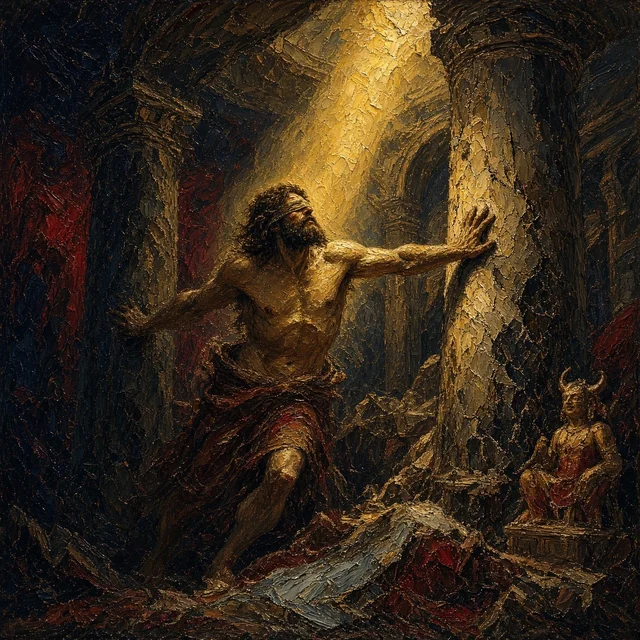
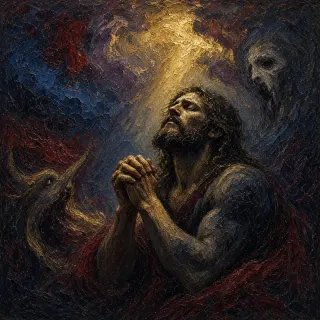
    Blind, grinding in a prison, brought out for entertainment between two pillars. His hair had begun to grow again. He asks for strength once, and the house falls on everyone in it including him.

    A hand that carried Gaza's gate now has to be led by a boy. The change is more exact than a general picture of humiliation: Samson needs another person to bring him within reach of the building he will bring down. Meanwhile, the celebration has turned his capture into a claim about gods. Dagon receives the credit twice before Samson addresses the LORD.

    This time Samson asks for strength instead of assuming it. The prayer also names revenge for his two eyes. Neither detail should be rubbed out to produce a tidier final portrait. He calls on God, asks to kill his captors, and explicitly accepts his own death with theirs. Men and women fill the building and its roof. The collapse kills the lords, the assembled people, and Samson; the text does not reduce the dead to an armed detachment.

    After that mass of deaths, the account narrows to a burial place and a father's name. His family carries him home to Manoah's tomb. The last measure of his life is not the size of the wreckage, but twenty years as Israel's judge.

    Verse by verse

    1. 16:25

      "Make us sport" means provide entertainment or amusement. The precise actions demanded of Samson are not described.

    2. 16:27

      About three thousand men and women are on the roof. That is not presented as the total number in the building or as an exact final death toll.

    3. 16:28

      The prayer expressly asks for vengeance for Samson's eyes. The text does not replace that stated motive with an unspoken, wholly different one.

    4. 16:31

      Hebrews 11:32 names Samson among figures remembered for faith. That later recognition does not require every act in Judges to be approved.

    5. 16:31

      The twenty years repeat Judges 15:20. These notices frame one period of judging; they are not two terms to be added together.

    Judges 16:23-31

    King James Version · 9 verses

    16:23Then the lords of the Philistines gathered them together for to offer a great sacrifice unto Dagon their god, and to rejoice: for they said, Our god hath delivered Samson our enemy into our hand.

    16:24And when the people saw him, they praised their god: for they said, Our god hath delivered into our hands our enemy, and the destroyer of our country, which slew many of us.

    16:25And it came to pass, when their hearts were merry, that they said, Call for Samson, that he may make us sport. And they called for Samson out of the prison house; and he made them sport: and they set him between the pillars.

    16:26And Samson said unto the lad that held him by the hand, Suffer me that I may feel the pillars whereupon the house standeth, that I may lean upon them.

    16:27Now the house was full of men and women; and all the lords of the Philistines were there; and there were upon the roof about three thousand men and women, that beheld while Samson made sport.

    16:28And Samson called unto the LORD, and said, O Lord GOD, remember me, I pray thee, and strengthen me, I pray thee, only this once, O God, that I may be at once avenged of the Philistines for my two eyes.

    16:29And Samson took hold of the two middle pillars upon which the house stood, and on which it was borne up, of the one with his right hand, and of the other with his left.

    16:30And Samson said, Let me die with the Philistines. And he bowed himself with all his might; and the house fell upon the lords, and upon all the people that were therein. So the dead which he slew at his death were more than they which he slew in his life.

    16:31Then his brethren and all the house of his father came down, and took him, and brought him up, and buried him between Zorah and Eshtaol in the buryingplace of Manoah his father. And he judged Israel twenty years.

Why it matters

Samson is the last judge in the book and the clearest sign of how far it has fallen: a deliverer who never leads anybody, whose exploits are private, and who dies in a Philistine temple asking to be remembered once more. Hebrews names him among the faithful. The account is careful that his strength was never in his hair, which is only the sign, and that what he actually lost was the LORD, and he did not know it.

4 songs

The music

Every song in the catalogue whose passage falls inside these chapters.

  1. Judges 13:1-14:20

    Out of the Eater

  2. Judges 13-16

    Strength in the Ruins

  3. Judges 15:1-16:3

    The Jawbone and the Gates

  4. Judges 16:4-31

    Remember Me Once More

Nearby

All the people

Report an error on this page