New · FreePlay The Witnesses The in-depth puzzle battle quest through Bible history

People of the Bible

Jephthah

Was thrown out for his mother, called back when they needed him, and made a vow he should never have made.

Jephthah is the son of a prostitute, driven out by his half brothers so he would not share the inheritance, and he ends up in the land of Tob at the head of a band of worthless men. When Ammon attacks, the elders who expelled him come and ask him to be their commander. He negotiates first, gets it in writing before the LORD at Mizpah, and then sends Ammon a long and careful history lesson about who has held what land for three hundred years. Then he vows that whatever comes out of his door to meet him will be the LORD’s.

Where he appearsJudges 10 to 12

Scroll down to the account
Jephthah

The movements, in the order the text gives them.

The Account of Jephthah

  1. 01

    Judges 11:1-11

    Driven out, then sent for

    The brothers expel him over his mother. Years later the same elders arrive in Tob. He asks them the obvious question, gets terms, and has them spoken before the LORD at Mizpah.

    The man denied a place in his father's house is offered the headship of Gilead. Nothing about his parentage has changed between those decisions. The Ammonite threat has. The Book of Judges calls him a mighty man of valour before identifying his mother as a harlot, while his brothers make his mother's position the reason to deny his inheritance. The opening gives both descriptions; the expulsion acts on only one of them.

    Jephthah does not receive the elders' invitation as though the earlier rejection never happened. He names it, and the terms become more explicit. Captain for the fighting becomes head over all the inhabitants of Gilead. He asks whether that standing will hold when the LORD gives victory, and the elders put their promise under the LORD's witness. Verse 11 then supplies the public action: the people make him head and captain, and he speaks before the LORD at Mizpeh. This is not an unqualified homecoming with the difficult conversation omitted. The return is negotiated, witnessed, and confirmed. The household refused him a share; the community now entrusts him with its command.

    Verse by verse

    1. 11:2

      Strange woman here renders another woman. The brothers distinguish Jephthah's mother from their own; the phrase alone does not establish her nationality.

    2. 11:3

      Vain men describes the band that gathers around Jephthah. The verse supplies no list of their expeditions or evidence for an invented campaign of helping the poor.

    3. 11:6

      Captain translates qatsin; head in 11:8 translates rosh. Verse 11 retains both titles when the people confirm the arrangement.

    4. 11:10-11

      The agreement is placed under the LORD's witness and spoken before him at Mizpeh. These words should not be confused with the separate vow in 11:30-31.

    5. 11:11

      First Samuel 12:11 later includes Jephthah among those the LORD sent to deliver Israel. That later description stands alongside this account of the elders fetching him.

    Judges 11:1-11

    King James Version · 11 verses

    11:1Now Jephthah the Gileadite was a mighty man of valour, and he was the son of an harlot: and Gilead begat Jephthah.

    11:2And Gilead’s wife bare him sons; and his wife’s sons grew up, and they thrust out Jephthah, and said unto him, Thou shalt not inherit in our father’s house; for thou art the son of a strange woman.

    11:3Then Jephthah fled from his brethren, and dwelt in the land of Tob: and there were gathered vain men to Jephthah, and went out with him.

    11:4And it came to pass in process of time, that the children of Ammon made war against Israel.

    11:5And it was so, that when the children of Ammon made war against Israel, the elders of Gilead went to fetch Jephthah out of the land of Tob:

    11:6And they said unto Jephthah, Come, and be our captain, that we may fight with the children of Ammon.

    11:7And Jephthah said unto the elders of Gilead, Did not ye hate me, and expel me out of my father’s house? and why are ye come unto me now when ye are in distress?

    11:8And the elders of Gilead said unto Jephthah, Therefore we turn again to thee now, that thou mayest go with us, and fight against the children of Ammon, and be our head over all the inhabitants of Gilead.

    11:9And Jephthah said unto the elders of Gilead, If ye bring me home again to fight against the children of Ammon, and the LORD deliver them before me, shall I be your head?

    11:10And the elders of Gilead said unto Jephthah, The LORD be witness between us, if we do not so according to thy words.

    11:11Then Jephthah went with the elders of Gilead, and the people made him head and captain over them: and Jephthah uttered all his words before the LORD in Mizpeh.

  2. 02

    Judges 11:12-28

    Three hundred years of argument

    Before fighting he sends messengers with the whole history: what Israel did not take, who was asked for passage, and why nobody raised this claim for three centuries.

    The fighter sends messengers before he sends an army. More space goes to this exchange about boundaries and remembered events than to the battle itself. The Ammonite king calls the disputed territory my land; Jephthah answers by identifying the people from whom Israel actually took it. Amorites and Ammonites are not interchangeable names. His case depends on the distinction.

    The route through the wilderness supplies the structure of the argument. Refused passage by Edom and Moab, Israel went around them. Sihon, however, assembled his people and attacked. Jephthah therefore describes Israel's possession as the result of the LORD delivering an attacking Amorite king, not an invasion that dispossessed Ammon. He adds the precedent of Balak and the long interval of occupation: three hundred years. The number is part of his challenge to a belated claim. It does not, on its own, supply a complete calendar for the Exodus and every judge.

    Chemosh introduces a real difficulty rather than a name to replace quietly: the speech addresses the Ammonite king with a deity elsewhere associated with Moab. Whatever explanation is adopted, the argument here is framed in terms of what each people understands its god to have granted. Jephthah ends by appealing to the LORD the Judge. The man appointed to lead Gilead submits the dispute to a judgment above his own. The king's refusal to hear ends the exchange, not a failure by Jephthah to make one. The chapter has given the war a long, carefully stated dispute before it gives it a battlefield.

    Verse by verse

    1. 11:13

      Arnon, Jabbok, and Jordan define the territory claimed in the king's answer. My land is his claim, which Jephthah then disputes.

    2. 11:19-22

      Sihon is called king of the Amorites. The present opponent is king of the children of Ammon; confusing those groups removes the central distinction in the reply.

    3. 11:24

      First Kings 11:5 and 11:7 associate Milcom with Ammon and Chemosh with Moab. Judges names Chemosh here without explaining the difference, and its name should be preserved.

    4. 11:25

      The question about Balak belongs to an argument over fighting for this territory. It does not deny the separate account of Balak seeking a curse through Balaam in Numbers 22-24.

    5. 11:26

      Three hundred years is the period asserted in Jephthah's speech. Converting it into an exact absolute date requires additional chronological assumptions.

    6. 11:27

      The LORD the Judge names the authority to whom Jephthah appeals. He does not present his own appointment as the final court for the dispute.

    Judges 11:12-28

    King James Version · 17 verses

    11:12And Jephthah sent messengers unto the king of the children of Ammon, saying, What hast thou to do with me, that thou art come against me to fight in my land?

    11:13And the king of the children of Ammon answered unto the messengers of Jephthah, Because Israel took away my land, when they came up out of Egypt, from Arnon even unto Jabbok, and unto Jordan: now therefore restore those lands again peaceably.

    11:14And Jephthah sent messengers again unto the king of the children of Ammon:

    11:15And said unto him, Thus saith Jephthah, Israel took not away the land of Moab, nor the land of the children of Ammon:

    11:16But when Israel came up from Egypt, and walked through the wilderness unto the Red sea, and came to Kadesh;

    11:17Then Israel sent messengers unto the king of Edom, saying, Let me, I pray thee, pass through thy land: but the king of Edom would not hearken thereto. And in like manner they sent unto the king of Moab: but he would not consent: and Israel abode in Kadesh.

    11:18Then they went along through the wilderness, and compassed the land of Edom, and the land of Moab, and came by the east side of the land of Moab, and pitched on the other side of Arnon, but came not within the border of Moab: for Arnon was the border of Moab.

    11:19And Israel sent messengers unto Sihon king of the Amorites, the king of Heshbon; and Israel said unto him, Let us pass, we pray thee, through thy land into my place.

    11:20But Sihon trusted not Israel to pass through his coast: but Sihon gathered all his people together, and pitched in Jahaz, and fought against Israel.

    11:21And the LORD God of Israel delivered Sihon and all his people into the hand of Israel, and they smote them: so Israel possessed all the land of the Amorites, the inhabitants of that country.

    11:22And they possessed all the coasts of the Amorites, from Arnon even unto Jabbok, and from the wilderness even unto Jordan.

    11:23So now the LORD God of Israel hath dispossessed the Amorites from before his people Israel, and shouldest thou possess it?

    11:24Wilt not thou possess that which Chemosh thy god giveth thee to possess? So whomsoever the LORD our God shall drive out from before us, them will we possess.

    11:25And now art thou any thing better than Balak the son of Zippor, king of Moab? did he ever strive against Israel, or did he ever fight against them,

    11:26While Israel dwelt in Heshbon and her towns, and in Aroer and her towns, and in all the cities that be along by the coasts of Arnon, three hundred years? why therefore did ye not recover them within that time?

    11:27Wherefore I have not sinned against thee, but thou doest me wrong to war against me: the LORD the Judge be judge this day between the children of Israel and the children of Ammon.

    11:28Howbeit the king of the children of Ammon hearkened not unto the words of Jephthah which he sent him.

  3. 03

    Judges 11:29-33

    The vow at Mizpah

    The Spirit comes on him and he vows anyway, promising whatever comes out of the doors of his house. The victory is total, twenty cities, and then he goes home.

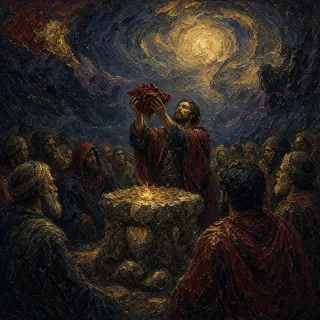
    The Spirit comes first. Jephthah's vow comes afterward. That order prevents the promise from being treated as the price that obtained the Spirit or as an instruction the Spirit is recorded giving. The Book of Judges says the LORD empowers him, then says Jephthah makes a vow. Those are distinct statements, not interchangeable explanations.

    The wording fastens a military return to a domestic doorway. What comes out to meet him is to belong to the LORD, and the KJV continues, I will offer it up for a burnt offering. The text does not name an animal Jephthah expects, give his private calculations, or record God demanding such a bargain. His words supply the condition and the offering. The battle account then attributes victory directly to the LORD, not to the value of the proposed sacrifice. Twenty cities fall within the campaign, but the promise is attached to his own house. Success against Ammon does not change what he has said. Nor does a granted victory turn every accompanying human promise into a divine command.

    Verse by verse

    1. 11:29

      The Spirit of the LORD comes upon Jephthah before the vow in 11:30. No divine speech in this passage commands the vow.

    2. 11:31

      Burnt offering translates olah, the ordinary term for that kind of sacrifice. Some interpreters take the joining word as or, but the KJV reads and.

    3. 11:31

      To meet me is part of the wording, not merely a reference to anything found outside. The text does not reveal what particular creature Jephthah expected.

    4. 11:32-33

      Victory is explicitly attributed to the LORD. The twenty in 11:33 counts cities, not years or a stated number of soldiers.

    Judges 11:29-33

    King James Version · 5 verses

    11:29Then the Spirit of the LORD came upon Jephthah, and he passed over Gilead, and Manasseh, and passed over Mizpeh of Gilead, and from Mizpeh of Gilead he passed over unto the children of Ammon.

    11:30And Jephthah vowed a vow unto the LORD, and said, If thou shalt without fail deliver the children of Ammon into mine hands,

    11:31Then it shall be, that whatsoever cometh forth of the doors of my house to meet me, when I return in peace from the children of Ammon, shall surely be the LORD’s, and I will offer it up for a burnt offering.

    11:32So Jephthah passed over unto the children of Ammon to fight against them; and the LORD delivered them into his hands.

    11:33And he smote them from Aroer, even till thou come to Minnith, even twenty cities, and unto the plain of the vineyards, with a very great slaughter. Thus the children of Ammon were subdued before the children of Israel.

    Judges 11:29-33: The vow at Mizpah
  4. 04

    Judges 11:34-40

    His daughter, with timbrels

    She is his only child. He tears his clothes and tells her he cannot go back. She asks for two months in the mountains, and afterwards the young women of Israel go out four days a year.

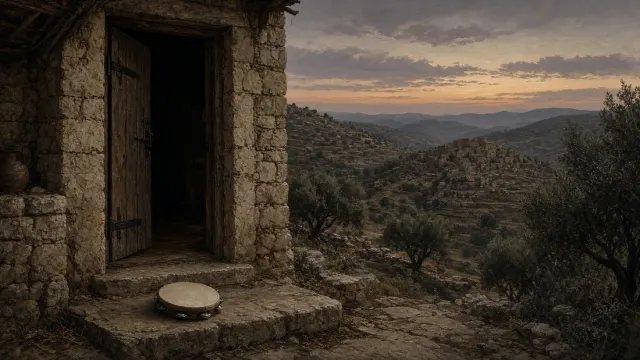
    She comes out with the instruments of victory, and her father tears his clothes. The greeting belongs to the same world as the women with timbrels and dances after deliverance in Exodus 15:20. Nothing in her welcome constitutes an offense. Yet Jephthah says she has brought him very low, before identifying the actual source of the disaster: his own opened mouth. The verse allows that contrast to stand without softening his words.

    Only child is immediately explained again: neither son nor daughter besides her. The emphasis on her virginity belongs beside that repeated statement. Her death ends not merely a possible marriage but the continuation of this household through its only child. After the two months, he did with her according to his vow points back to the burnt offering promised in verse 31. Read in that ordinary sense, it records her sacrifice. It does not describe a knife, an altar, a priest, or the physical procedure, and none should be supplied. The alternative interpretation of lifelong unmarried dedication is real, but it is an interpretation, not an explicit statement that she was sent to a sanctuary.

    The daughter's own words and requested time remain in the account. She does not disappear between the vow and its fulfillment. Nor does the passage finish by celebrating her father's victory. It finishes with the daughters of Israel returning each year to lament his daughter. The military leader has a name and a recorded term of office. She is unnamed, but the final observance in this chapter belongs to her.

    Verse by verse

    1. 11:34

      Only child is reinforced by the statement that there was neither another son nor another daughter. The text supplies neither her personal name nor her age.

    2. 11:35

      I cannot go back is Jephthah's statement. It is not a divine ruling that a prohibited human sacrifice becomes obligatory through a vow.

    3. 11:37-38

      The requested interval is two months, spent with her companions mourning her virginity. The passage does not describe a journey to a sanctuary.

    4. 11:39

      Adam Clarke's commentary argues for lifelong virginity rather than killing, using the vow's construction and she knew no man. The sacrificial reading instead takes fulfillment of the vow back to the burnt offering of 11:31.

    5. 11:40

      The Hebrew tanah can mean recount or commemorate; the KJV renders the same root rehearse in Judges 5:11. The word alone does not establish annual conversations with a living daughter.

    Judges 11:34-40

    King James Version · 7 verses

    11:34And Jephthah came to Mizpeh unto his house, and, behold, his daughter came out to meet him with timbrels and with dances: and she was his only child; beside her he had neither son nor daughter.

    11:35And it came to pass, when he saw her, that he rent his clothes, and said, Alas, my daughter! thou hast brought me very low, and thou art one of them that trouble me: for I have opened my mouth unto the LORD, and I cannot go back.

    11:36And she said unto him, My father, if thou hast opened thy mouth unto the LORD, do to me according to that which hath proceeded out of thy mouth; forasmuch as the LORD hath taken vengeance for thee of thine enemies, even of the children of Ammon.

    11:37And she said unto her father, Let this thing be done for me: let me alone two months, that I may go up and down upon the mountains, and bewail my virginity, I and my fellows.

    11:38And he said, Go. And he sent her away for two months: and she went with her companions, and bewailed her virginity upon the mountains.

    11:39And it came to pass at the end of two months, that she returned unto her father, who did with her according to his vow which he had vowed: and she knew no man. And it was a custom in Israel,

    11:40That the daughters of Israel went yearly to lament the daughter of Jephthah the Gileadite four days in a year.

    Judges 11:34-40: His daughter, with timbrels
  5. 05

    Judges 12:1-6

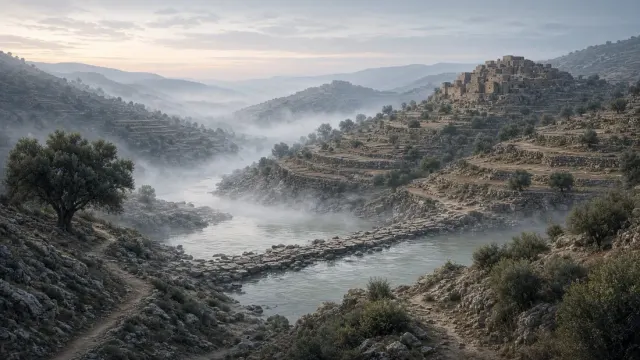
    Shibboleth at the fords

    Ephraim arrives after the battle to complain and threaten. Forty-two thousand die at the Jordan crossings over the pronunciation of a single word.

    The complaint sounds familiar, but the ending does not. Ephraim challenged Gideon about exclusion from battle in Judges 8:1-3, and his answer quieted their anger. Here the complaint arrives with a threat to burn Jephthah's house over him. His reply appeals to the aid he says he requested and did not receive. The chapter records his claim; it does not replay an earlier summons for independent comparison. Words about a victory over Ammon become a battle within Israel.

    The river crossings then make speech lethal. A man can deny being an Ephraimite, but his pronunciation supplies the identity his answer conceals. This is not a test of whether he knows a secret word: the required word is given to him. It is a test of whether his mouth can form it in the way the guards expect. Sibboleth is enough for them to seize and kill him. The forty-two thousand are the Ephraimite dead at that time, not a statement that every one died in this single testing procedure. A campaign that began with a call to protect Gilead ends with men of Israel policing the escape of other Israelites. The border being enforced is inside the people who have just defeated Ammon.

    Verse by verse

    1. 12:1

      The earlier Ephraimite complaint against Gideon appears in Judges 8:1-3. In this passage, the demand is accompanied by an explicit threat to burn Jephthah's house.

    2. 12:2

      Jephthah says that he called for Ephraim's help. Chapter 11 does not separately narrate that summons, so the statement should remain attributed to him.

    3. 12:3

      Hebrews 11:32 includes Jephthah, spelled Jephthae in the KJV, among figures associated with faith. The verse does not single out this civil conflict or his vow for approval.

    4. 12:6

      The test concerns pronunciation, not reading ability or a supplied medical diagnosis. The forty-two thousand are reported as those who fell at that time, not expressly all at the word test.

    5. 12:6

      The following verse gives Jephthah six years as judge and records his death. It does not close his account with a stated period in which the land had rest.

    Judges 12:1-6

    King James Version · 6 verses

    12:1And the men of Ephraim gathered themselves together, and went northward, and said unto Jephthah, Wherefore passedst thou over to fight against the children of Ammon, and didst not call us to go with thee? we will burn thine house upon thee with fire.

    12:2And Jephthah said unto them, I and my people were at great strife with the children of Ammon; and when I called you, ye delivered me not out of their hands.

    12:3And when I saw that ye delivered me not, I put my life in my hands, and passed over against the children of Ammon, and the LORD delivered them into my hand: wherefore then are ye come up unto me this day, to fight against me?

    12:4Then Jephthah gathered together all the men of Gilead, and fought with Ephraim: and the men of Gilead smote Ephraim, because they said, Ye Gileadites are fugitives of Ephraim among the Ephraimites, and among the Manassites.

    12:5And the Gileadites took the passages of Jordan before the Ephraimites: and it was so, that when those Ephraimites which were escaped said, Let me go over; that the men of Gilead said unto him, Art thou an Ephraimite? If he said, Nay;

    12:6Then said they unto him, Say now Shibboleth: and he said Sibboleth: for he could not frame to pronounce it right. Then they took him, and slew him at the passages of Jordan: and there fell at that time of the Ephraimites forty and two thousand.

    Judges 12:1-6: Shibboleth at the fords

Why it matters

Jephthah is the book at its darkest and the text does not comment. He is listed in Hebrews among the faithful, and his daughter comes out with tambourines, and the writer gives her the only voice in the scene worth having: she asks for two months, and the daughters of Israel keep a four day commemoration every year. Judges does not tell us what to think. It tells us what was vowed, what came out of the door, and what was done.

1 song

The music

Every song in the catalogue whose passage falls inside these chapters.

  1. Judges 10:1-12:7

    The Vow at Mizpeh

Nearby

All the people

Report an error on this page