New · FreePlay The Witnesses The in-depth puzzle battle quest through Bible history

People of the Bible

Abimelech

Took the crown his father refused, on one stone, from seventy brothers.

Abimelech is the son of Gideon by a concubine in Shechem. After his father dies he goes to his mother’s family and asks them a question designed to answer itself: is it better for seventy men to rule you, or one, and remember that I am your bone and your flesh. They give him silver from the temple of Baal-berith, he hires men with it, and he kills his brothers on one stone. Only the youngest escapes, and stands on a mountain and shouts a fable at the city about trees looking for a king.

Where he appearsJudges 9

Scroll down to the account
Abimelech

The movements, in the order the text gives them.

The Account of Abimelech

  1. 01

    Judges 9:1-6

    One stone, seventy brothers

    He borrows the argument of kinship and seventy pieces of silver from a pagan temple, hires worthless and reckless men, and makes himself king by a tree in Shechem.

    He is our brother finances the killing of his brethren. The two family connections are not the same: Abimelech approaches his mother's people at Shechem, then uses their support against his father's sons at Ophrah. The language of kinship is doing the recruiting while kinship itself supplies the victims. Nothing in the passage says that the seventy sons were preparing to rule as a committee. That is the alternative Abimelech presents, not a plan the Book of Judges independently reports.

    The accounting is painfully exact: seventy pieces of silver, men hired with temple money, seventy sons brought under one description, one stone. Jotham's survival is expressly preserved inside that description, so the repeated number must not erase the named exception. Gideon had refused the proposal that his son should rule in 8:23. This son obtains a crown through a different sequence: maternal relatives, a treasury, hired followers, his brothers' blood. Shechem makes him king after the killing. The order matters. The ceremony does not stand apart from the stone.

    Verse by verse

    1. 9:1

      Jerubbaal is Gideon, as Judges 8:35 explicitly states. Abimelech approaches the relatives of his mother, the woman associated with Shechem in 8:31.

    2. 9:2

      The proposed rule of seventy brothers is Abimelech's stated alternative. Their own intention to establish such a government is not recorded.

    3. 9:4

      The seventy pieces of silver come from Baalberith's temple and pay for the hired followers. The text does not assign one coin to each killing.

    4. 9:5

      The family is described with the number seventy, while Jotham is explicitly excepted as a survivor. The passage does not invite deleting that exception to make an exact casualty calculation.

    5. 9:6

      The men of Shechem and the house of Millo make Abimelech king. No divine command appointing him accompanies the ceremony.

    Judges 9:1-6

    King James Version · 6 verses

    9:1And Abimelech the son of Jerubbaal went to Shechem unto his mother’s brethren, and communed with them, and with all the family of the house of his mother’s father, saying,

    9:2Speak, I pray you, in the ears of all the men of Shechem, Whether is better for you, either that all the sons of Jerubbaal, which are threescore and ten persons, reign over you, or that one reign over you? remember also that I am your bone and your flesh.

    9:3And his mother’s brethren spake of him in the ears of all the men of Shechem all these words: and their hearts inclined to follow Abimelech; for they said, He is our brother.

    9:4And they gave him threescore and ten pieces of silver out of the house of Baal-berith, wherewith Abimelech hired vain and light persons, which followed him.

    9:5And he went unto his father’s house at Ophrah, and slew his brethren the sons of Jerubbaal, being threescore and ten persons, upon one stone: notwithstanding yet Jotham the youngest son of Jerubbaal was left; for he hid himself.

    9:6And all the men of Shechem gathered together, and all the house of Millo, and went, and made Abimelech king, by the plain of the pillar that was in Shechem.

    Judges 9:1-6: One stone, seventy brothers
  2. 02

    Judges 9:7-21

    The bramble that offered shade

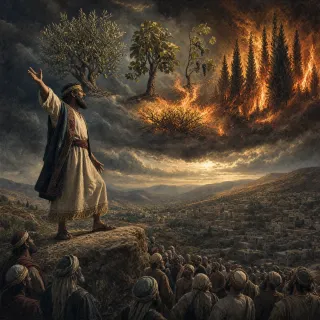
    Jotham survives and shouts down from Mount Gerizim. The olive, the fig and the vine all refuse the crown because they have useful work. The bramble accepts and threatens fire.

    The bramble offers the cedars shade. Jotham has saved that offer until the olive, fig, and vine have each named something useful they already produce: oil, sweetness, wine. The bramble names no comparable fruit. It offers shelter, immediately followed by a threat of fire. The protection and the destruction come from the same mouth, without so much as a change of speaker.

    Then the trees give way to names, and the accusation becomes impossible to miss. Gideon risked his life for the people now supporting the destruction of his house. Jotham repeats truly and sincerely around the account of the sons killed on one stone. Those words are a condition to be tested against a deed, not his endorsement of the coronation. His father's service and Shechem's repayment stand beside each other, and the distance between them is the point.

    The curse also travels in both directions. Fire is to come from Abimelech against Shechem and from Shechem against Abimelech. Neither side can purchase innocence by turning on the other. Judges 9:57 explicitly returns to Jotham's curse when the reckoning is complete. The speaker himself does not remain safely above the consequences: he flees to Beer for fear of his brother. The surviving son delivers the accusation, then has to escape.

    Verse by verse

    1. 9:7

      Jotham speaks from Mount Gerizim. His flight to Beer in 9:21 is part of the same passage, not evidence that his accusation was delivered without personal danger.

    2. 9:9

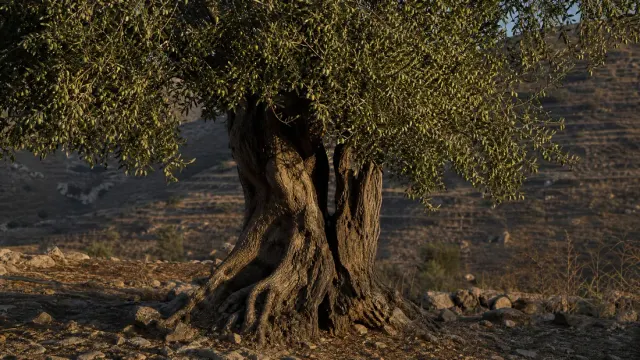
      The olive tree's fatness is its oil. The tree contrasts an existing product with the invitation to be elevated over its neighbors.

    3. 9:16-19

      Truly and sincerely introduces a condition, not a declaration that Shechem has acted faithfully. Jotham places the killing of Gideon's sons inside that condition.

    4. 9:18

      Jotham calls Abimelech the son of Gideon's maidservant. Judges 8:31 describes the woman as Gideon's concubine at Shechem.

    5. 9:20

      Both Abimelech and his supporters are named as sources and targets of destruction. The concluding judgment in 9:57 explicitly identifies Jotham's curse as fulfilled.

    Judges 9:7-21

    King James Version · 15 verses

    9:7And when they told it to Jotham, he went and stood in the top of mount Gerizim, and lifted up his voice, and cried, and said unto them, Hearken unto me, ye men of Shechem, that God may hearken unto you.

    9:8The trees went forth on a time to anoint a king over them; and they said unto the olive tree, Reign thou over us.

    9:9But the olive tree said unto them, Should I leave my fatness, wherewith by me they honour God and man, and go to be promoted over the trees?

    9:10And the trees said to the fig tree, Come thou, and reign over us.

    9:11But the fig tree said unto them, Should I forsake my sweetness, and my good fruit, and go to be promoted over the trees?

    9:12Then said the trees unto the vine, Come thou, and reign over us.

    9:13And the vine said unto them, Should I leave my wine, which cheereth God and man, and go to be promoted over the trees?

    9:14Then said all the trees unto the bramble, Come thou, and reign over us.

    9:15And the bramble said unto the trees, If in truth ye anoint me king over you, then come and put your trust in my shadow: and if not, let fire come out of the bramble, and devour the cedars of Lebanon.

    9:16Now therefore, if ye have done truly and sincerely, in that ye have made Abimelech king, and if ye have dealt well with Jerubbaal and his house, and have done unto him according to the deserving of his hands;

    9:17(For my father fought for you, and adventured his life far, and delivered you out of the hand of Midian:

    9:18And ye are risen up against my father’s house this day, and have slain his sons, threescore and ten persons, upon one stone, and have made Abimelech, the son of his maidservant, king over the men of Shechem, because he is your brother;)

    9:19If ye then have dealt truly and sincerely with Jerubbaal and with his house this day, then rejoice ye in Abimelech, and let him also rejoice in you:

    9:20But if not, let fire come out from Abimelech, and devour the men of Shechem, and the house of Millo; and let fire come out from the men of Shechem, and from the house of Millo, and devour Abimelech.

    9:21And Jotham ran away, and fled, and went to Beer, and dwelt there, for fear of Abimelech his brother.

  3. 03

    Judges 9:22-45

    Three years, then the ambush

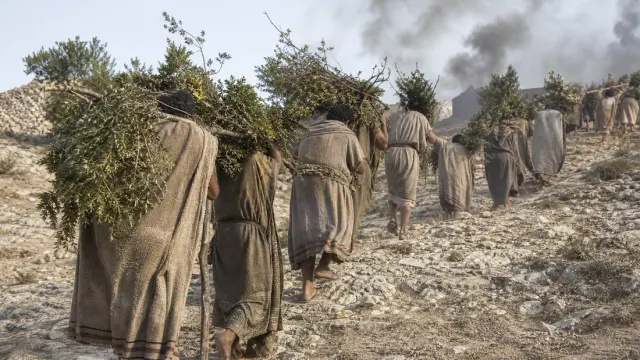
    The city that made him turns on him. He takes it, kills the people in it, pulls it down and sows it with salt, which is a thing done to land you never intend to use again.

    Three years have not settled the blood account. Before the ambushes and speeches begin, the Book of Judges states the reason for the breach: the killing is to be laid upon Abimelech and upon the men who helped him. The evil spirit is sent between the partners, and their shared enterprise breaks into treachery. The verse assigns responsibility to the hand that killed and the support that enabled it. The temple treasury has not become innocent money merely because time has passed.

    The city's language of belonging changes sides. Earlier, Abimelech was our brother; Gaal now emphasizes that he is Jerubbaal's son and invokes Hamor's people instead. The feast in the god's house supplies curses for the ruler whose rise a temple funded. Zebul, meanwhile, turns Gaal's boasting into a very practical appointment with an army. He first calls the approaching men mountain shadows, then urges Gaal to fight the people he has despised. The shadows have become inconveniently solid.

    Gaal's expulsion is not the end of the attack. On the morrow matters: the next day's victims are the people going into the fields, and Abimelech positions one force at the gate while the others kill outside. The city that made him king becomes the city he dismantles. Salt follows slaughter and demolition. This is not simply a contest between Abimelech and a rival who loses his place. The account follows the violence past the rival's departure and into the streets and fields of Shechem.

    Verse by verse

    1. 9:22

      The stated reign is three years. The verse does not add the formula that the land had rest, used elsewhere for periods after deliverance.

    2. 9:23

      Between Abimelech and the men of Shechem describes the sphere of the evil spirit's work. The verse does not describe an individual's possession or supply a medical diagnosis.

    3. 9:24

      The stated purpose includes judgment on both Abimelech and those who aided the killings. Shechem's later opposition does not remove its earlier participation.

    4. 9:27

      Trode the grapes describes pressing the harvest. The temple feast includes explicit curses against Abimelech.

    5. 9:34

      There are four companies in the ambush against Gaal, but three in 9:43. These belong to separate attacks, with the second placed on the following day.

    6. 9:45

      The salt belongs to the deliberate destruction of the city. The verse gives neither the amount scattered nor a measurement of the soil's later fertility.

    Judges 9:22-45: Three years, then the ambush

    Judges 9:22-45

    King James Version · 24 verses

    9:22When Abimelech had reigned three years over Israel,

    9:23Then God sent an evil spirit between Abimelech and the men of Shechem; and the men of Shechem dealt treacherously with Abimelech:

    9:24That the cruelty done to the threescore and ten sons of Jerubbaal might come, and their blood be laid upon Abimelech their brother, which slew them; and upon the men of Shechem, which aided him in the killing of his brethren.

    9:25And the men of Shechem set liers in wait for him in the top of the mountains, and they robbed all that came along that way by them: and it was told Abimelech.

    9:26And Gaal the son of Ebed came with his brethren, and went over to Shechem: and the men of Shechem put their confidence in him.

    9:27And they went out into the fields, and gathered their vineyards, and trode the grapes, and made merry, and went into the house of their god, and did eat and drink, and cursed Abimelech.

    9:28And Gaal the son of Ebed said, Who is Abimelech, and who is Shechem, that we should serve him? is not he the son of Jerubbaal? and Zebul his officer? serve the men of Hamor the father of Shechem: for why should we serve him?

    9:29And would to God this people were under my hand! then would I remove Abimelech. And he said to Abimelech, Increase thine army, and come out.

    9:30And when Zebul the ruler of the city heard the words of Gaal the son of Ebed, his anger was kindled.

    9:31And he sent messengers unto Abimelech privily, saying, Behold, Gaal the son of Ebed and his brethren be come to Shechem; and, behold, they fortify the city against thee.

    9:32Now therefore up by night, thou and the people that is with thee, and lie in wait in the field:

    9:33And it shall be, that in the morning, as soon as the sun is up, thou shalt rise early, and set upon the city: and, behold, when he and the people that is with him come out against thee, then mayest thou do to them as thou shalt find occasion.

    9:34And Abimelech rose up, and all the people that were with him, by night, and they laid wait against Shechem in four companies.

    9:35And Gaal the son of Ebed went out, and stood in the entering of the gate of the city: and Abimelech rose up, and the people that were with him, from lying in wait.

    9:36And when Gaal saw the people, he said to Zebul, Behold, there come people down from the top of the mountains. And Zebul said unto him, Thou seest the shadow of the mountains as if they were men.

    9:37And Gaal spake again and said, See there come people down by the middle of the land, and another company come along by the plain of Meonenim.

    9:38Then said Zebul unto him, Where is now thy mouth, wherewith thou saidst, Who is Abimelech, that we should serve him? is not this the people that thou hast despised? go out, I pray now, and fight with them.

    9:39And Gaal went out before the men of Shechem, and fought with Abimelech.

    9:40And Abimelech chased him, and he fled before him, and many were overthrown and wounded, even unto the entering of the gate.

    9:41And Abimelech dwelt at Arumah: and Zebul thrust out Gaal and his brethren, that they should not dwell in Shechem.

    9:42And it came to pass on the morrow, that the people went out into the field; and they told Abimelech.

    9:43And he took the people, and divided them into three companies, and laid wait in the field, and looked, and, behold, the people were come forth out of the city; and he rose up against them, and smote them.

    9:44And Abimelech, and the company that was with him, rushed forward, and stood in the entering of the gate of the city: and the two other companies ran upon all the people that were in the fields, and slew them.

    9:45And Abimelech fought against the city all that day; and he took the city, and slew the people that was therein, and beat down the city, and sowed it with salt.


  4. 04

    Judges 9:50-57

    The millstone at Thebez

    At the next tower a woman drops an upper millstone on his head. He calls his armour bearer to run him through so nobody can say a woman killed him, and the text records the request and then reports it anyway.

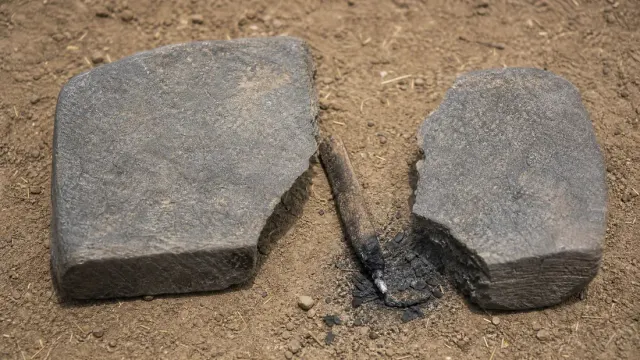
    The tower at Thebez looks like an opportunity to repeat the previous attack. At Shechem, branches and fire killed about a thousand men and women in their refuge. Here too the townspeople crowd into a tower, and Abimelech comes close to burn the door. The woman above him changes the outcome with an implement for grinding grain. A household stone strikes the man who killed his brothers upon one stone.

    His last command concerns the account people will give of his death. That men say not of me, A woman slew him states the reason for ordering his armourbearer to finish him. The Book of Judges records both the request and the woman who made it necessary. He can order the sword. He cannot order the record.

    When he dies, the men of Israel simply go home. The passage offers no transfer of the crown, no celebration of a deliverer, and no years of rest. Instead it returns to the father whose sons were killed and the city that helped kill them. God rendered is the book's own explanation, repeated for both sides. The ending is not merely that Abimelech's attack went wrong. The blood at the beginning has been brought back upon the people responsible for it.

    Verse by verse

    1. 9:51

      The tower receives the city's men and women. The text does not identify everyone sheltering there as a soldier.

    2. 9:53

      The Hebrew expression identifies an upper millstone. The KJV's all to brake means that the blow shattered his skull, not that the woman merely attempted to break it.

    3. 9:54

      Abimelech explicitly gives his reason for requesting death by his armourbearer: he wants to prevent the report that a woman killed him.

    4. 9:55

      The followers disperse after his death. Judges 10:1 then introduces Tola as arising to defend Israel after Abimelech.

    5. 9:56-57

      The closing verses attribute the reckoning to God and connect it to Jotham's curse. That interpretation is stated by the Book of Judges itself.

    Judges 9:50-57

    King James Version · 8 verses

    9:50Then went Abimelech to Thebez, and encamped against Thebez, and took it.

    9:51But there was a strong tower within the city, and thither fled all the men and women, and all they of the city, and shut it to them, and gat them up to the top of the tower.

    9:52And Abimelech came unto the tower, and fought against it, and went hard unto the door of the tower to burn it with fire.

    9:53And a certain woman cast a piece of a millstone upon Abimelech’s head, and all to brake his skull.

    9:54Then he called hastily unto the young man his armourbearer, and said unto him, Draw thy sword, and slay me, that men say not of me, A woman slew him. And his young man thrust him through, and he died.

    9:55And when the men of Israel saw that Abimelech was dead, they departed every man unto his place.

    9:56Thus God rendered the wickedness of Abimelech, which he did unto his father, in slaying his seventy brethren:

    9:57And all the evil of the men of Shechem did God render upon their heads: and upon them came the curse of Jotham the son of Jerubbaal.

    Judges 9:50-57: The millstone at Thebez

Why it matters

Judges puts Abimelech directly after the man who said the LORD would rule over you, and he is not called a judge at any point. He is the book’s argument about what kingship looks like when it is simply taken, and the fable of the bramble is the earliest political satire in the Bible. The end matches the beginning: he dies under a city wall from a millstone dropped by a woman, and asks his armour bearer to finish it so it will not be said a woman killed him.

1 song

The music

Every song in the catalogue whose passage falls inside these chapters.

  1. Judges 8:1-9:57

    The Bramble Took the Crown

Nearby

All the people

Report an error on this page