New · FreePlay The Witnesses The in-depth puzzle battle quest through Bible history

People of the Bible

Gideon

Was threshing wheat in a winepress to hide it, and was greeted as a mighty man of valour.

Also called Jerubbaal

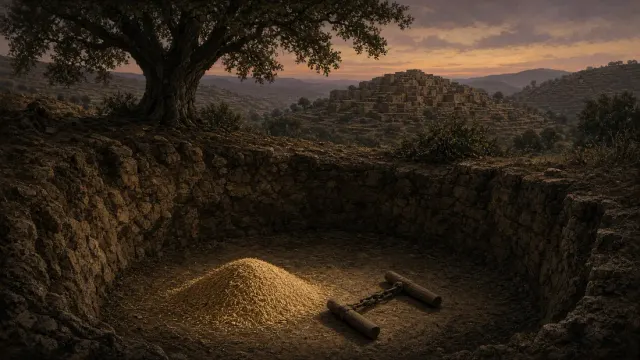
Gideon is hiding grain from Midianite raiders when he is addressed as a mighty man of valour, and his first response is an argument: if the LORD is with us, why has all this happened. He asks for a sign, then pulls down his father’s altar at night because he is afraid to do it by day, then asks for the fleece twice, wet then dry, to be sure. He is given thirty-two thousand men and told there are too many, twice, until three hundred are left holding trumpets and empty jars.

Where he appearsJudges 6 to 8

Scroll down to the account
Gideon

The movements, in the order the text gives them.

The Account of Gideon

  1. 01

    Judges 6:11-24

    Mighty man of valour

    The greeting does not match the scene. He answers with a complaint about the exodus and asks who he is, being the least in his father’s house, and asks for a sign before he will believe it.

    The mighty man of valour is protecting a wheat harvest from thieves. That is the scale of Gideon's world when the greeting arrives: not a battlefield, but enough grain to keep the Midianites from taking everything. His first answer is not about his own courage. He puts the promise beside the condition of Israel and finds the two painfully difficult to reconcile. The exodus his fathers described has become a memory; the raiders are present.

    The answer does not supply Gideon with a more impressive family tree. Surely I will be with thee. His objections concern what he possesses; the answer concerns who accompanies him. Then the meal changes character. Meat in a basket, broth in a pot, bread made from an ephah of flour: substantial hospitality in a country being stripped of food. Fire rises from the rock rather than from a fire Gideon has prepared. By the end, the man worried about surviving Midian is being assured that he will survive meeting God's messenger. The altar receives the name Peace before the fighting has begun.

    Verse by verse

    1. 6:11

      The verse gives the reason for the unusual threshing location: keeping the wheat from Midian. It does not say that Gideon has stopped working.

    2. 6:14

      The wording moves from the angel of the LORD to the LORD. The passage presents divine speech without explaining the messenger's identity in later doctrinal terms.

    3. 6:19

      An ephah is a dry measure, not a single cake. The quantity makes the provision conspicuous against the shortage described in 6:4-6.

    4. 6:24

      Jehovahshalom means the LORD is peace. The name answers the assurance in the preceding verse, not a military victory already achieved.

    Judges 6:11-24: Mighty man of valour

    Judges 6:11-24

    King James Version · 14 verses

    6:11And there came an angel of the LORD, and sat under an oak which was in Ophrah, that pertained unto Joash the Abi-ezrite: and his son Gideon threshed wheat by the winepress, to hide it from the Midianites.

    6:12And the angel of the LORD appeared unto him, and said unto him, The LORD is with thee, thou mighty man of valour.

    6:13And Gideon said unto him, Oh my Lord, if the LORD be with us, why then is all this befallen us? and where be all his miracles which our fathers told us of, saying, Did not the LORD bring us up from Egypt? but now the LORD hath forsaken us, and delivered us into the hands of the Midianites.

    6:14And the LORD looked upon him, and said, Go in this thy might, and thou shalt save Israel from the hand of the Midianites: have not I sent thee?

    6:15And he said unto him, Oh my Lord, wherewith shall I save Israel? behold, my family is poor in Manasseh, and I am the least in my father’s house.

    6:16And the LORD said unto him, Surely I will be with thee, and thou shalt smite the Midianites as one man.

    6:17And he said unto him, If now I have found grace in thy sight, then shew me a sign that thou talkest with me.

    6:18Depart not hence, I pray thee, until I come unto thee, and bring forth my present, and set it before thee. And he said, I will tarry until thou come again.

    6:19And Gideon went in, and made ready a kid, and unleavened cakes of an ephah of flour: the flesh he put in a basket, and he put the broth in a pot, and brought it out unto him under the oak, and presented it.

    6:20And the angel of God said unto him, Take the flesh and the unleavened cakes, and lay them upon this rock, and pour out the broth. And he did so.

    6:21Then the angel of the LORD put forth the end of the staff that was in his hand, and touched the flesh and the unleavened cakes; and there rose up fire out of the rock, and consumed the flesh and the unleavened cakes. Then the angel of the LORD departed out of his sight.

    6:22And when Gideon perceived that he was an angel of the LORD, Gideon said, Alas, O Lord GOD! for because I have seen an angel of the LORD face to face.

    6:23And the LORD said unto him, Peace be unto thee; fear not: thou shalt not die.

    6:24Then Gideon built an altar there unto the LORD, and called it Jehovah-shalom: unto this day it is yet in Ophrah of the Abi-ezrites.


  2. 02

    Judges 6:25-32

    The altar pulled down at night

    He obeys, but under cover of dark, because he is afraid of his family and the town. In the morning his father defends him with the best line in the chapter: if Baal is a god, let him contend for himself.

    The first altar Gideon must attack belongs to his father. Midian is the outside oppressor, but the rival worship is already at home. Even the materials change allegiance: the wooden cult object beside Baal's altar becomes fuel for an offering to the LORD. The passage does not merely put two shrines side by side. One is dismantled to supply the other.

    Gideon does this at night because he is afraid. The Book of Judges says so plainly, then says just as plainly that he did what was commanded. Fear and action occupy the same sentence. In the morning, Joash supplies the sharpest argument in the town. If Baal is a god, he can conduct his own case. The men demanding a death sentence have somehow become the deity's emergency repair crew. Gideon's new name preserves the challenge: let Baal contend. The altar has fallen, and the argument now belongs to the god whose defenders insist he needs their help.

    Verse by verse

    1. 6:25

      The Hebrew asherah lies behind grove. Here it is a wooden cult object that can be cut down and burned, not simply a patch of woodland.

    2. 6:27

      Gideon takes ten servants. This is a dangerous household operation, not a solitary act performed without witnesses.

    3. 6:31

      Joash defends his son by challenging Baal's ability to defend himself. The passage does not record a separate declaration of Joash's conversion.

    4. 6:32

      Jerubbaal is explained here through Baal contending. Samuel later remembers Gideon under this name in 1 Samuel 12:11.

    Judges 6:25-32

    King James Version · 8 verses

    6:25And it came to pass the same night, that the LORD said unto him, Take thy father’s young bullock, even the second bullock of seven years old, and throw down the altar of Baal that thy father hath, and cut down the grove that is by it:

    6:26And build an altar unto the LORD thy God upon the top of this rock, in the ordered place, and take the second bullock, and offer a burnt sacrifice with the wood of the grove which thou shalt cut down.

    6:27Then Gideon took ten men of his servants, and did as the LORD had said unto him: and so it was, because he feared his father’s household, and the men of the city, that he could not do it by day, that he did it by night.

    6:28And when the men of the city arose early in the morning, behold, the altar of Baal was cast down, and the grove was cut down that was by it, and the second bullock was offered upon the altar that was built.

    6:29And they said one to another, Who hath done this thing? And when they enquired and asked, they said, Gideon the son of Joash hath done this thing.

    6:30Then the men of the city said unto Joash, Bring out thy son, that he may die: because he hath cast down the altar of Baal, and because he hath cut down the grove that was by it.

    6:31And Joash said unto all that stood against him, Will ye plead for Baal? will ye save him? he that will plead for him, let him be put to death whilst it is yet morning: if he be a god, let him plead for himself, because one hath cast down his altar.

    6:32Therefore on that day he called him Jerubbaal, saying, Let Baal plead against him, because he hath thrown down his altar.

  3. 03

    Judges 6:36-40

    The fleece, twice

    Wet fleece on dry ground, then dry fleece on wet ground, with an apology before the second request. He is not rebuked for either.

    As thou hast said appears twice before the first drop of dew is measured. Gideon is not trying to discover an unknown assignment. He has already received it, already seen fire consume his offering, and already summoned men after the Spirit of the LORD came upon him in 6:34. The fleece asks for reassurance about a promise, not directions at a crossroads.

    The physical detail keeps the passage from floating away into an abstract discussion of doubt. A bowl full of water comes out of the wool. Then Gideon asks for the conditions to be reversed, adding a careful request that God not be angry. The second answer is reported without a lecture: And God did so that night. The Book of Judges gives neither a command for others to repeat this procedure nor a rebuke that it has not actually recorded. It gives a hesitant man, a repeated request and a second answered night.

    Verse by verse

    1. 6:36

      As thou hast said locates the request after an existing divine promise. Gideon is not using the fleece to choose between competing commands.

    2. 6:37

      The floor is a threshing floor. The test contrasts the wool with the surrounding ground, not with the floor of a bedroom.

    3. 6:39

      The Hebrew verb behind prove means test. Gideon explicitly asks permission for a further test rather than treating the procedure as an entitlement.

    4. 6:40

      The second sign reverses the first. No explanation of the physical process, and no general instruction about decision-making, is supplied.

    Judges 6:36-40

    King James Version · 5 verses

    6:36And Gideon said unto God, If thou wilt save Israel by mine hand, as thou hast said,

    6:37Behold, I will put a fleece of wool in the floor; and if the dew be on the fleece only, and it be dry upon all the earth beside, then shall I know that thou wilt save Israel by mine hand, as thou hast said.

    6:38And it was so: for he rose up early on the morrow, and thrust the fleece together, and wringed the dew out of the fleece, a bowl full of water.

    6:39And Gideon said unto God, Let not thine anger be hot against me, and I will speak but this once: let me prove, I pray thee, but this once with the fleece; let it now be dry only upon the fleece, and upon all the ground let there be dew.

    6:40And God did so that night: for it was dry upon the fleece only, and there was dew on all the ground.

    Judges 6:36-40: The fleece, twice
  4. 04

    Judges 7:1-8

    Too many, still too many

    Twenty-two thousand go home afraid. Ten thousand are cut to three hundred at a stream over how they drink. The reason given is that Israel must not boast that its own hand saved it.

    Too many is an extraordinary diagnosis for an army facing the host in that valley. The explanation arrives before the reductions: Israel must not say, Mine own hand hath saved me. Twenty-two thousand men leave, ten thousand remain, and even that remainder is too large. The arithmetic serves the stated purpose. It is not a recruiting advertisement for the finest three hundred soldiers.

    That matters at the water. The passage separates ways of drinking, but never says that one group is more alert, more disciplined or better trained. Those explanations add a military assessment the verses do not make. God names the three hundred as the men through whom he will deliver Israel. Their small number, not a certificate of superior technique, is the point established in verse 2. The dismissed men take the road home while the enemy remains in the valley. Nothing has been done to make the enemy smaller.

    Verse by verse

    1. 7:2

      The stated danger is Israel claiming the victory as its own achievement. This explanation controls the reading of both reductions.

    2. 7:6

      The three hundred bring their hands to their mouths. The verse does not describe them scanning the horizon or keeping a weapon ready.

    3. 7:7

      The three hundred are selected for this action, not identified as the only Israelites involved in the entire campaign; other men join the pursuit in 7:23-24.

    Judges 7:1-8

    King James Version · 8 verses

    7:1Then Jerubbaal, who is Gideon, and all the people that were with him, rose up early, and pitched beside the well of Harod: so that the host of the Midianites were on the north side of them, by the hill of Moreh, in the valley.

    7:2And the LORD said unto Gideon, The people that are with thee are too many for me to give the Midianites into their hands, lest Israel vaunt themselves against me, saying, Mine own hand hath saved me.

    7:3Now therefore go to, proclaim in the ears of the people, saying, Whosoever is fearful and afraid, let him return and depart early from mount Gilead. And there returned of the people twenty and two thousand; and there remained ten thousand.

    7:4And the LORD said unto Gideon, The people are yet too many; bring them down unto the water, and I will try them for thee there: and it shall be, that of whom I say unto thee, This shall go with thee, the same shall go with thee; and of whomsoever I say unto thee, This shall not go with thee, the same shall not go.

    7:5So he brought down the people unto the water: and the LORD said unto Gideon, Every one that lappeth of the water with his tongue, as a dog lappeth, him shalt thou set by himself; likewise every one that boweth down upon his knees to drink.

    7:6And the number of them that lapped, putting their hand to their mouth, were three hundred men: but all the rest of the people bowed down upon their knees to drink water.

    7:7And the LORD said unto Gideon, By the three hundred men that lapped will I save you, and deliver the Midianites into thine hand: and let all the other people go every man unto his place.

    7:8So the people took victuals in their hand, and their trumpets: and he sent all the rest of Israel every man unto his tent, and retained those three hundred men: and the host of Midian was beneath him in the valley.

  5. 05

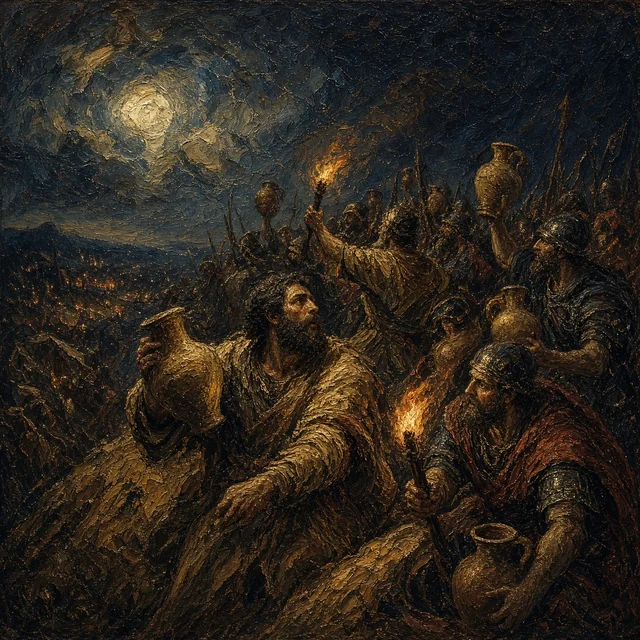
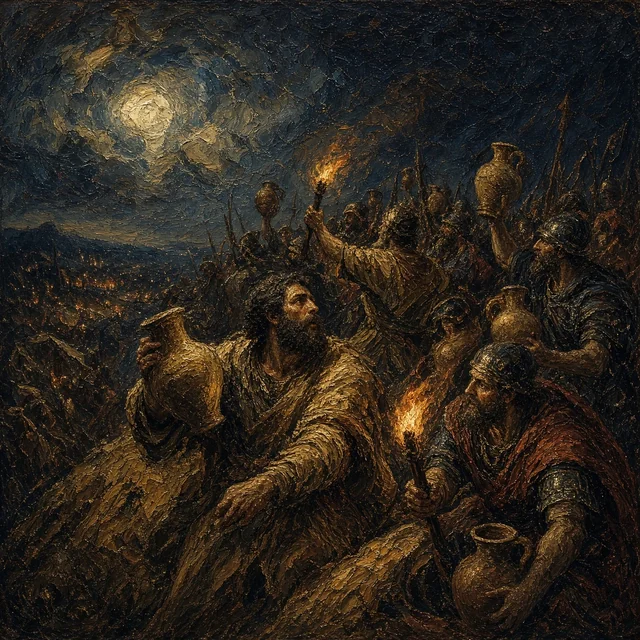
    Judges 7:16-22

    Trumpets, jars and torches

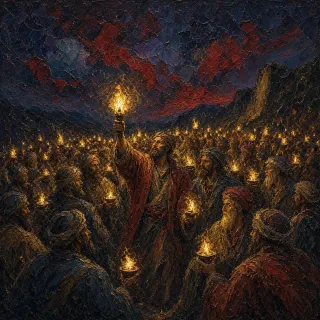
    Three hundred men surround a camp at the change of the watch, break the jars they were hiding the light in, and shout. The camp turns on itself in the dark.

    The swords are in the shout before they appear in the fighting. In the three hundred men's hands are trumpets and lights, carefully assigned to right and left. At the decisive moment their hands are occupied making noise and exposing flame, while verse 22 places the swords doing the killing inside the enemy host. The cry names the LORD and Gideon; the explanation names the LORD as the one who turns the camp against itself.

    There is a wonderfully exact contrast in the verbs. Gideon's men stood every man in his place. The host ran, and cried, and fled. Three companies create the disturbance, but they do not win this moment by charging through the camp. Even the timing is concrete: the middle watch has just been set. Sound, broken pottery and sudden light arrive together at a change of guard. The plan is coordinated. The deliverance is not credited to coordination alone.

    Verse by verse

    1. 7:16

      Each man receives a trumpet. The extraordinary distribution matters to the sound surrounding the camp; the text does not assign a supposed enemy estimate of the army's size.

    2. 7:19

      The middle watch marks a division of the night. The passage does not give a modern clock time.

    3. 7:21

      They stand in position while the enemy runs. This is the immediate scene, before the pursuit described in the following verses.

    4. 7:22

      The LORD set every man's sword against his fellow is the passage's explicit explanation of the rout, not merely a description of human tactics.

    Judges 7:16-22

    King James Version · 7 verses

    7:16And he divided the three hundred men into three companies, and he put a trumpet in every man’s hand, with empty pitchers, and lamps within the pitchers.

    7:17And he said unto them, Look on me, and do likewise: and, behold, when I come to the outside of the camp, it shall be that, as I do, so shall ye do.

    7:18When I blow with a trumpet, I and all that are with me, then blow ye the trumpets also on every side of all the camp, and say, The sword of the LORD, and of Gideon.

    7:19So Gideon, and the hundred men that were with him, came unto the outside of the camp in the beginning of the middle watch; and they had but newly set the watch: and they blew the trumpets, and brake the pitchers that were in their hands.

    7:20And the three companies blew the trumpets, and brake the pitchers, and held the lamps in their left hands, and the trumpets in their right hands to blow withal: and they cried, The sword of the LORD, and of Gideon.

    7:21And they stood every man in his place round about the camp: and all the host ran, and cried, and fled.

    7:22And the three hundred blew the trumpets, and the LORD set every man’s sword against his fellow, even throughout all the host: and the host fled to Beth-shittah in Zererath, and to the border of Abel-meholah, unto Tabbath.

    Judges 7:16-22: Trumpets, jars and torches
  6. 06

    Judges 8:22-27

    The ephod at Ophrah

    Asked to rule, he says the LORD will rule over them, and then asks each man for a gold earring from the plunder. What he makes with it becomes a snare to him and to his house.

    The refusal of a dynasty is followed immediately by a collection. Gideon will not rule, and neither will his son; the LORD shall rule. Then the garment goes down and the gold goes into it. The offer of kingship had credited Gideon with the deliverance, precisely the kind of misplaced credit the army's reduction was meant to prevent. His answer corrects that claim. What he makes afterward creates another problem.

    The ephod's exact shape is not supplied, and Gideon's private intention is not supplied either. Its effect is. All Israel went thither a whoring after it, and it became a snare to Gideon and his house. The Book of Judges does not need a theory about what he meant to accomplish when it has given that verdict. Ophrah is the place where he pulled down his father's altar. Now it is the destination of another faithless devotion. The old altar came down. The new snare stayed.

    Verse by verse

    1. 8:22

      The proposed rule extends to Gideon's son and grandson. Israel is offering hereditary authority, not simply asking him to lead another battle.

    2. 8:26

      The 1,700 shekels describe the collected earrings. The text does not give the ephod's dimensions or state how every part of the collection was incorporated.

    3. 8:27

      Ephod also names a priestly garment in Exodus 28:6. The word alone does not establish the construction or use of the object installed here.

    4. 8:27

      Hebrews 11:32 includes Gideon among figures remembered for faith. That recognition does not remove the judgment on this object in Judges 8:27.

    Judges 8:22-27

    King James Version · 6 verses

    8:22Then the men of Israel said unto Gideon, Rule thou over us, both thou, and thy son, and thy son’s son also: for thou hast delivered us from the hand of Midian.

    8:23And Gideon said unto them, I will not rule over you, neither shall my son rule over you: the LORD shall rule over you.

    8:24And Gideon said unto them, I would desire a request of you, that ye would give me every man the earrings of his prey. (For they had golden earrings, because they were Ishmaelites.)

    8:25And they answered, We will willingly give them. And they spread a garment, and did cast therein every man the earrings of his prey.

    8:26And the weight of the golden earrings that he requested was a thousand and seven hundred shekels of gold; beside ornaments, and collars, and purple raiment that was on the kings of Midian, and beside the chains that were about their camels’ necks.

    8:27And Gideon made an ephod thereof, and put it in his city, even in Ophrah: and all Israel went thither a whoring after it: which thing became a snare unto Gideon, and to his house.

    Judges 8:22-27: The ephod at Ophrah

Why it matters

The whole point of the reduction is stated outright: so that Israel cannot say its own hand saved it. Gideon is the judge most consistently given less than he asks for and more than he needs, and the victory is won by noise and light rather than by weapons. The end is bleaker. He refuses to be king in words that sound right, then makes an ephod out of the gold, and the country goes after it, and his own house does not survive him.

4 songs

The music

Every song in the catalogue whose passage falls inside these chapters.

  1. Judges 6-8

    God Only Needed Three Hundred

  2. Judges 6:1-40

    Mighty Man in the Winepress

  3. Judges 6-8

    Three Hundred Lamps

  4. Judges 8:1-9:57

    The Bramble Took the Crown

The videos

The videos

Every release whose passage falls inside these chapters, playing here.

Nearby

All the people

Report an error on this page