New · FreePlay The Witnesses The in-depth puzzle battle quest through Bible history

People of the Bible

Jacob

The heel-grabber who bought a birthright, stole a blessing, wrestled God at a river, and was renamed Israel.

Also called Israel; the father of the twelve tribes

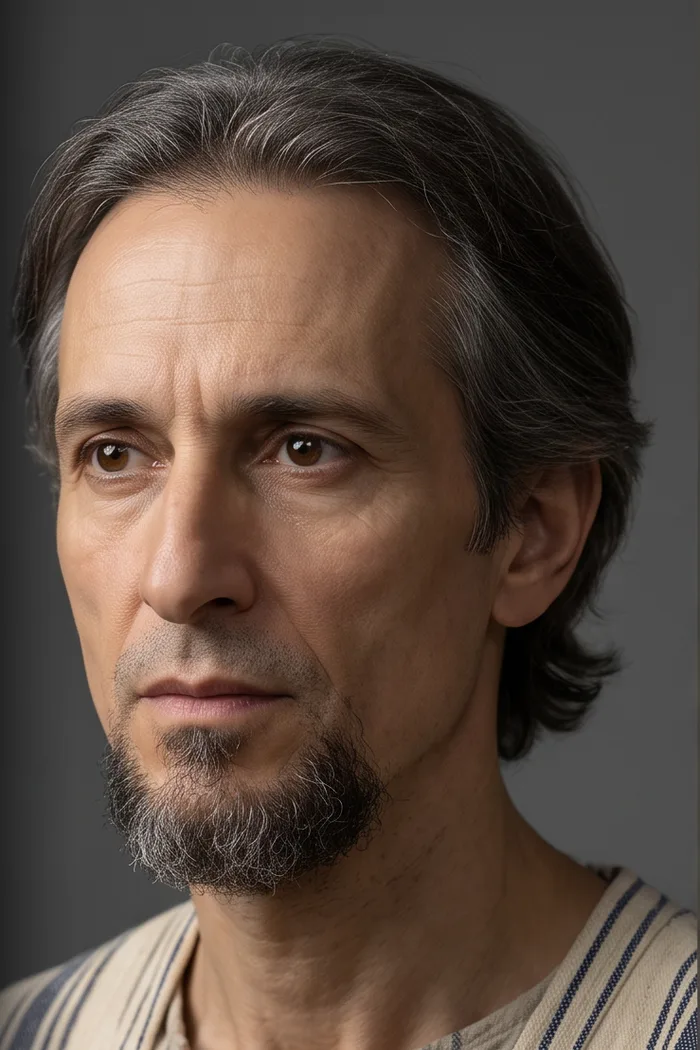
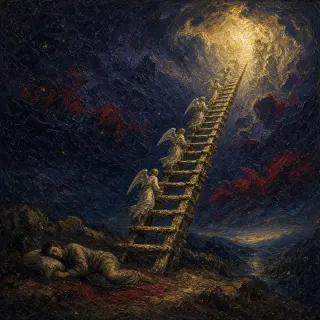
Jacob is the younger twin of Isaac and Rebekah, born holding his brother Esau's heel, and named for it. Before the birth God told Rebekah the elder would serve the younger, and Jacob spends the first half of his life making that happen by his own wits. He buys Esau's birthright for bread and lentil stew, and with his mother's help he dresses in Esau's clothes and takes the blessing from his blind father. Esau vows to kill him, and Jacob flees to Haran with nothing but a staff. On the way he sleeps at Bethel, sees a ladder to heaven with angels on it, and hears God give him the promise of Abraham.

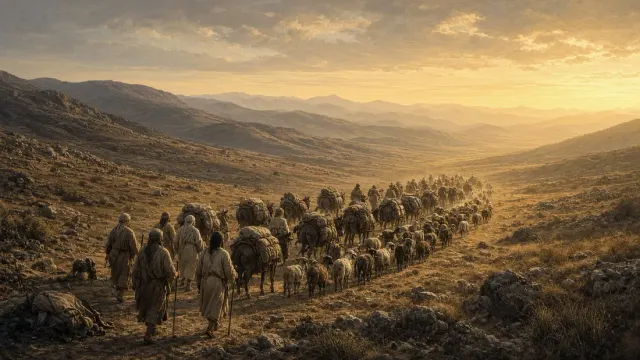
In Haran his uncle Laban deceives him in turn, giving him Leah in the dark when he has worked seven years for Rachel. He works seven more, and six beyond that for flocks, and comes home with two wives, two handmaids, eleven sons, a daughter, and great herds. The night before he meets Esau again he wrestles a man until dawn at the ford of Jabbok, is touched on the hip and lamed, and is given the name Israel, one who strives with God. Esau runs to meet him and weeps. The rest of his life is grief: Dinah is violated at Shechem, Rachel dies bearing Benjamin, and his favourite son Joseph is sold by his brothers and reported dead. Twenty-two years later he learns Joseph is alive and ruling Egypt, goes down to him at a hundred and thirty, blesses Pharaoh, blesses each of his sons, and dies at a hundred and forty-seven. His body is carried back to Machpelah in a great procession.

Where he appearsGenesis 25 to 49

Scroll down to the account
Jacob

The movements, in the order the text gives them.

The Account of Jacob

  1. 01

    Genesis 25:21-26

    Born holding a heel

    Rebekah's twins struggle in the womb, and the LORD tells her the elder shall serve the younger. Esau comes out red and hairy; Jacob follows with his hand on Esau's heel, and is named for it.

    Before either brother can claim first place, God has already spoken. Isaac and Rebekah have no children, and Isaac asks the LORD to change that. When Rebekah becomes pregnant, the struggle within her is so troubling that she asks God what it means. The answer reaches far beyond a difficult pregnancy. These children will become two peoples, and the older will serve the younger. Birth order will not decide everything.

    The birth gives that announcement a striking shape. Esau arrives first. Jacob follows with a hand around his brother's heel. His name echoes that heel, but the passage does not give the newborn a plan or a grudge. The struggle is real; a baby's secret thoughts are not supplied. The Book of Genesis begins this family history with a promise before it describes either man's choices. Paul makes that timing central in Romans 9:10-12: the announcement came before the twins had done good or evil. Jacob's place did not begin as a prize for good behavior.

    Verse by verse

    1. 25:21

      'Intreated' means pleaded with or earnestly asked. 'Barren' means that Rebekah had been unable to have children.

    2. 25:23

      The two nations are traced through Jacob and Esau: Israel and Edom. Genesis 36:1 explicitly identifies Esau as Edom.

    3. 25:26

      Jacob's name is linked here with the Hebrew aqeb, 'heel.' In Genesis 27:36, Esau turns the same word family into an accusation that Jacob has displaced him.

    Genesis 25:21-26

    King James Version · 6 verses

    25:21And Isaac intreated the LORD for his wife, because she was barren: and the LORD was intreated of him, and Rebekah his wife conceived.

    25:22And the children struggled together within her; and she said, If it be so, why am I thus? And she went to enquire of the LORD.

    25:23And the LORD said unto her, Two nations are in thy womb, and two manner of people shall be separated from thy bowels; and the one people shall be stronger than the other people; and the elder shall serve the younger.

    25:24And when her days to be delivered were fulfilled, behold, there were twins in her womb.

    25:25And the first came out red, all over like an hairy garment; and they called his name Esau.

    25:26And after that came his brother out, and his hand took hold on Esau’s heel; and his name was called Jacob: and Isaac was threescore years old when she bare them.

    Genesis 25:21-26: Born holding a heel
  2. 02

    Genesis 25:27-34

    Bread and lentils

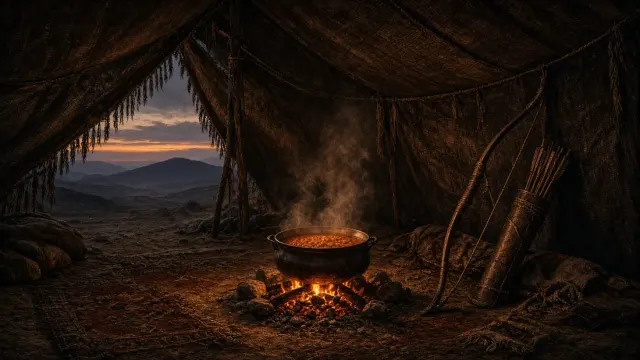
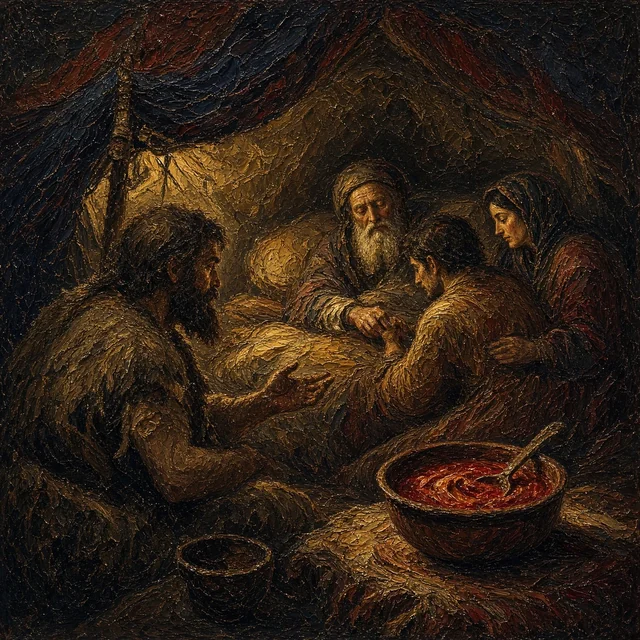
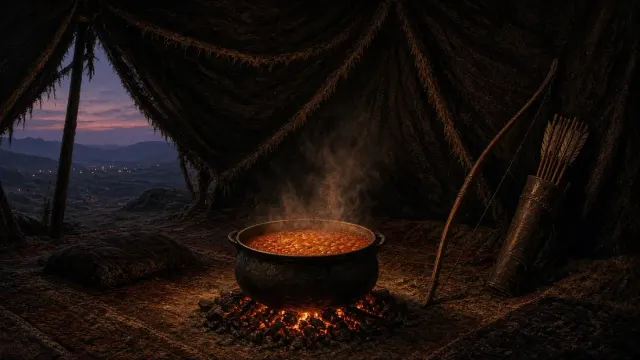
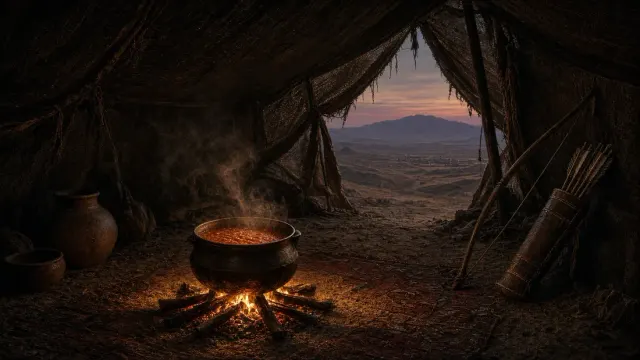
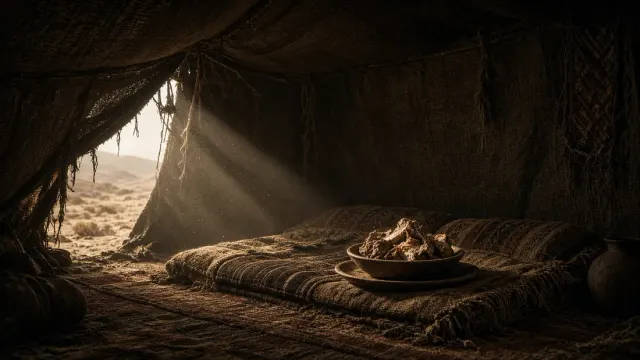
    Jacob is a plain man dwelling in tents; Esau a hunter. Esau comes in faint from the field and asks for the red stew. Jacob says, sell me this day thy birthright, and Esau swears it away. He eats, drinks, rises and goes his way, and the text says he despised his birthright.

    Jacob has dinner ready. Esau has something Jacob wants. The birthright is the oldest son's special place in the family and his claim in its inheritance. It is not the same event as Isaac's spoken blessing in chapter 27. Here, the brothers make a sale, and Jacob insists on an oath to seal it.

    The contrast between them has already divided the household. Esau is a skilled hunter; Jacob stays among the tents. Isaac favors Esau and enjoys his meat, while Rebekah favors Jacob. Now Esau comes in exhausted and speaks as though hunger has made his future rights useless. The passage reports his words without giving a medical account of how close he is to death. Jacob does not simply hand over lunch. He sets a price.

    The ending slows down just enough to name the food: bread and lentil stew. Then Esau eats, drinks, gets up, and leaves. The meal is small. The price is not. The Book of Genesis states its judgment plainly: Esau despised his birthright. What he treats as disposable is precisely what Jacob is determined to obtain.

    Verse by verse

    1. 25:27

      'Cunning' means skilled here, not necessarily dishonest. The Hebrew tam behind 'plain' does not mean stupid; it can describe completeness or integrity, as in Job 1:1.

    2. 25:29

      'Sod pottage' means cooked stew. Verse 34 identifies it as lentils, so the transaction does not involve a rare or lavish dish.

    3. 25:33

      The oath makes this more than an angry remark over dinner. Esau swears and sells the birthright before Jacob gives him the meal.

    4. 25:34

      Hebrews 12:16 recalls Esau selling his birthright for one meal. Its focus is the value he gave up, not the quality of Jacob's cooking.

    Genesis 25:27-34

    King James Version · 8 verses

    25:27And the boys grew: and Esau was a cunning hunter, a man of the field; and Jacob was a plain man, dwelling in tents.

    25:28And Isaac loved Esau, because he did eat of his venison: but Rebekah loved Jacob.

    25:29And Jacob sod pottage: and Esau came from the field, and he was faint:

    25:30And Esau said to Jacob, Feed me, I pray thee, with that same red pottage; for I am faint: therefore was his name called Edom.

    25:31And Jacob said, Sell me this day thy birthright.

    25:32And Esau said, Behold, I am at the point to die: and what profit shall this birthright do to me?

    25:33And Jacob said, Swear to me this day; and he sware unto him: and he sold his birthright unto Jacob.

    25:34Then Jacob gave Esau bread and pottage of lentiles; and he did eat and drink, and rose up, and went his way: thus Esau despised his birthright.

    Genesis 25:27-34: Bread and lentils
  3. 03

    Genesis 27:1-29

    The stolen blessing

    Rebekah hears Isaac promise to bless Esau after a meal of venison. She cooks two kids, dresses Jacob in Esau's clothes and goat skins, and sends him in. Isaac says the voice is Jacob's voice but the hands are Esau's, and blesses him: let people serve thee, be lord over thy brethren.

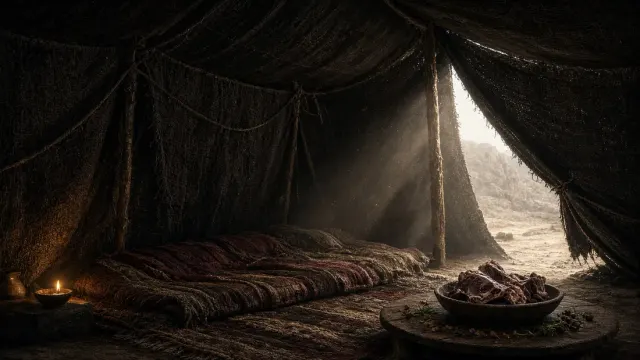
    Isaac cannot see his son, so the deception works on the senses he still has. Rebekah prepares the food, supplies Esau's clothes, and covers Jacob's smooth hands and neck with goatskins. Taste, touch, and smell all support the disguise. The voice does not. Isaac's ears are the one witness still raising an objection.

    This blessing is more than a father's warm farewell. Isaac calls for rich harvests, authority over peoples, and leadership within the family. He also uses the language of blessing and cursing that belongs to God's promise to Abraham. Rebekah wants Jacob to receive it before Esau returns. Jacob's first stated concern is that his father might discover the trick and curse him instead. The passage does not soften what follows: he claims to be Esau, and he brings God's name into the lie by saying the LORD made his hunt successful.

    The blessing lands on Jacob, but it does not turn his false words into true ones. God's earlier choice of the younger son and this family's deceit are both present in the account. The Book of Genesis does not require one to erase the other.

    Verse by verse

    1. 27:9

      The 'kids' are young goats. Rebekah uses their meat for the meal and their skins for the disguise.

    2. 27:20

      Jacob says the LORD brought the hunt to him, but the passage has shown Rebekah preparing goats. His claim is part of the deception, not an explanation supplied by the Book of Genesis.

    3. 27:28

      'Corn' means grain, not specifically maize. Dew, fertile ground, grain, and wine describe the food supply and prosperity of a farming society.

    4. 27:29

      The blessing-and-cursing language recalls Genesis 12:3. The promise is larger than a private transfer of household wealth.

    Genesis 27:1-29: The stolen blessing

    Genesis 27:1-29

    King James Version · 29 verses

    27:1And it came to pass, that when Isaac was old, and his eyes were dim, so that he could not see, he called Esau his eldest son, and said unto him, My son: and he said unto him, Behold, here am I.

    27:2And he said, Behold now, I am old, I know not the day of my death:

    27:3Now therefore take, I pray thee, thy weapons, thy quiver and thy bow, and go out to the field, and take me some venison;

    27:4And make me savoury meat, such as I love, and bring it to me, that I may eat; that my soul may bless thee before I die.

    27:5And Rebekah heard when Isaac spake to Esau his son. And Esau went to the field to hunt for venison, and to bring it.

    27:6And Rebekah spake unto Jacob her son, saying, Behold, I heard thy father speak unto Esau thy brother, saying,

    27:7Bring me venison, and make me savoury meat, that I may eat, and bless thee before the LORD before my death.

    27:8Now therefore, my son, obey my voice according to that which I command thee.

    27:9Go now to the flock, and fetch me from thence two good kids of the goats; and I will make them savoury meat for thy father, such as he loveth:

    27:10And thou shalt bring it to thy father, that he may eat, and that he may bless thee before his death.

    27:11And Jacob said to Rebekah his mother, Behold, Esau my brother is a hairy man, and I am a smooth man:

    27:12My father peradventure will feel me, and I shall seem to him as a deceiver; and I shall bring a curse upon me, and not a blessing.

    27:13And his mother said unto him, Upon me be thy curse, my son: only obey my voice, and go fetch me them.

    27:14And he went, and fetched, and brought them to his mother: and his mother made savoury meat, such as his father loved.

    27:15And Rebekah took goodly raiment of her eldest son Esau, which were with her in the house, and put them upon Jacob her younger son:

    27:16And she put the skins of the kids of the goats upon his hands, and upon the smooth of his neck:

    27:17And she gave the savoury meat and the bread, which she had prepared, into the hand of her son Jacob.

    27:18And he came unto his father, and said, My father: and he said, Here am I; who art thou, my son?

    27:19And Jacob said unto his father, I am Esau thy firstborn; I have done according as thou badest me: arise, I pray thee, sit and eat of my venison, that thy soul may bless me.

    27:20And Isaac said unto his son, How is it that thou hast found it so quickly, my son? And he said, Because the LORD thy God brought it to me.

    27:21And Isaac said unto Jacob, Come near, I pray thee, that I may feel thee, my son, whether thou be my very son Esau or not.

    27:22And Jacob went near unto Isaac his father; and he felt him, and said, The voice is Jacob’s voice, but the hands are the hands of Esau.

    27:23And he discerned him not, because his hands were hairy, as his brother Esau’s hands: so he blessed him.

    27:24And he said, Art thou my very son Esau? And he said, I am.

    27:25And he said, Bring it near to me, and I will eat of my son’s venison, that my soul may bless thee. And he brought it near to him, and he did eat: and he brought him wine, and he drank.

    27:26And his father Isaac said unto him, Come near now, and kiss me, my son.

    27:27And he came near, and kissed him: and he smelled the smell of his raiment, and blessed him, and said, See, the smell of my son is as the smell of a field which the LORD hath blessed:

    27:28Therefore God give thee of the dew of heaven, and the fatness of the earth, and plenty of corn and wine:

    27:29Let people serve thee, and nations bow down to thee: be lord over thy brethren, and let thy mother’s sons bow down to thee: cursed be every one that curseth thee, and blessed be he that blesseth thee.

  4. 04

    Genesis 27:41-28:5

    Flight from Esau

    Esau resolves to kill Jacob once their father is dead. Rebekah tells Jacob to go to Laban in Haran, and Isaac sends him off with a second blessing given knowingly: God Almighty give thee the blessing of Abraham.

    Jacob has obtained the blessing, but he cannot safely stay home to enjoy it. Esau plans to kill him after Isaac's death. Rebekah sends Jacob to her brother Laban, expecting the anger to cool after a few days. Her plan saves one son from the other, but those few days become twenty years in Laban's household, according to Genesis 31:41. The Book of Genesis records no later meeting between Jacob and Rebekah.

    The journey also has a marriage purpose. Esau's Hittite wives have already grieved his parents in Genesis 26:34-35. Isaac now tells Jacob to seek a wife among Rebekah's relatives instead of the women of Canaan. That concern is present before the escape; it is not something the account invents at the last moment.

    The most important change is in Isaac's blessing. This time he knows exactly who stands before him. He names the blessing of Abraham: descendants and the land God gave their grandfather. No borrowed clothes. No goatskins. Jacob leaves carrying a promise openly given, even while escaping the danger his deception has helped create.

    Verse by verse

    1. 27:41

      Esau expects Isaac's death, but expectation is not a death notice. Isaac's death is recorded in Genesis 35:28-29.

    2. 27:44

      The 'few days' are Rebekah's estimate, not God's promise of a short absence. Genesis 31:41 gives Jacob's actual twenty years with Laban.

    3. 28:2

      Laban is Rebekah's brother, making him Jacob's maternal uncle. The journey sends Jacob to known relatives, not to a randomly chosen household.

    4. 28:4

      The blessing of Abraham concerns both descendants and land. Isaac knowingly passes it to Jacob, unlike the mistaken identification in chapter 27.

    Genesis 27:41-28:5

    King James Version · 11 verses

    27:41And Esau hated Jacob because of the blessing wherewith his father blessed him: and Esau said in his heart, The days of mourning for my father are at hand; then will I slay my brother Jacob.

    27:42And these words of Esau her elder son were told to Rebekah: and she sent and called Jacob her younger son, and said unto him, Behold, thy brother Esau, as touching thee, doth comfort himself, purposing to kill thee.

    27:43Now therefore, my son, obey my voice; and arise, flee thou to Laban my brother to Haran;

    27:44And tarry with him a few days, until thy brother’s fury turn away;

    27:45Until thy brother’s anger turn away from thee, and he forget that which thou hast done to him: then I will send, and fetch thee from thence: why should I be deprived also of you both in one day?

    27:46And Rebekah said to Isaac, I am weary of my life because of the daughters of Heth: if Jacob take a wife of the daughters of Heth, such as these which are of the daughters of the land, what good shall my life do me?

    28:1And Isaac called Jacob, and blessed him, and charged him, and said unto him, Thou shalt not take a wife of the daughters of Canaan.

    28:2Arise, go to Padan-aram, to the house of Bethuel thy mother’s father; and take thee a wife from thence of the daughters of Laban thy mother’s brother.

    28:3And God Almighty bless thee, and make thee fruitful, and multiply thee, that thou mayest be a multitude of people;

    28:4And give thee the blessing of Abraham, to thee, and to thy seed with thee; that thou mayest inherit the land wherein thou art a stranger, which God gave unto Abraham.

    28:5And Isaac sent away Jacob: and he went to Padan-aram unto Laban, son of Bethuel the Syrian, the brother of Rebekah, Jacob’s and Esau’s mother.

  5. 05

    Genesis 28:10-22

    Bethel

    He sleeps in the open with a stone for a pillow and dreams of a ladder set on the earth reaching to heaven, the angels of God ascending and descending, and the LORD above it repeating the promise of land and seed and presence. He wakes afraid, sets up the stone, names the place Bethel, and vows a tenth.

    Jacob does not climb the ladder. That familiar picture can hide the point of the dream. He lies on the ground while angels move between earth and heaven, and God speaks. The man who has left his father's house discovers that he has not left God's reach.

    The promise gathers up land, descendants, blessing for all families of the earth, and a safe return. It also becomes deeply personal: God will remain with Jacob on the journey. Nothing in the passage says Jacob earns this speech by choosing a holy campsite. He arrives because the sun has set. Only afterward does he recognize what the place has become to him.

    In the morning, the stone used at his head becomes a standing marker, and oil is poured on it. Jacob names the place Bethel, 'house of God.' There is no building yet. His vow asks for ordinary necessities: food, clothing, and a return to his father's house in peace. Readers differ over whether its wording sounds like bargaining or a response of trust. The order is clear either way. God makes the promise before Jacob makes the vow.

    Verse by verse

    1. 28:12

      The Hebrew sullam occurs only here in the Hebrew Bible. 'Ladder' is the KJV wording, while 'stairway' is another proposed description of its shape.

    2. 28:17

      'Dreadful' means awe-inspiring or fearsome here. Jacob is responding to God's presence, not declaring the place evil.

    3. 28:19

      Bethel means 'house of God'; the passage also preserves the earlier city name, Luz. The new name records Jacob's recognition of the encounter.

    4. 28:20-22

      The vow's conditional wording has been read as either a bargain or a response to God's promise. The passage does not quote God demanding this vow as payment for protection.

    Genesis 28:10-22

    King James Version · 13 verses

    28:10And Jacob went out from Beer-sheba, and went toward Haran.

    28:11And he lighted upon a certain place, and tarried there all night, because the sun was set; and he took of the stones of that place, and put them for his pillows, and lay down in that place to sleep.

    28:12And he dreamed, and behold a ladder set up on the earth, and the top of it reached to heaven: and behold the angels of God ascending and descending on it.

    28:13And, behold, the LORD stood above it, and said, I am the LORD God of Abraham thy father, and the God of Isaac: the land whereon thou liest, to thee will I give it, and to thy seed;

    28:14And thy seed shall be as the dust of the earth, and thou shalt spread abroad to the west, and to the east, and to the north, and to the south: and in thee and in thy seed shall all the families of the earth be blessed.

    28:15And, behold, I am with thee, and will keep thee in all places whither thou goest, and will bring thee again into this land; for I will not leave thee, until I have done that which I have spoken to thee of.

    28:16And Jacob awaked out of his sleep, and he said, Surely the LORD is in this place; and I knew it not.

    28:17And he was afraid, and said, How dreadful is this place! this is none other but the house of God, and this is the gate of heaven.

    28:18And Jacob rose up early in the morning, and took the stone that he had put for his pillows, and set it up for a pillar, and poured oil upon the top of it.

    28:19And he called the name of that place Beth-el: but the name of that city was called Luz at the first.

    28:20And Jacob vowed a vow, saying, If God will be with me, and will keep me in this way that I go, and will give me bread to eat, and raiment to put on,

    28:21So that I come again to my father’s house in peace; then shall the LORD be my God:

    28:22And this stone, which I have set for a pillar, shall be God’s house: and of all that thou shalt give me I will surely give the tenth unto thee.

  6. 06

    Genesis 29:1-30

    Seven years for Rachel

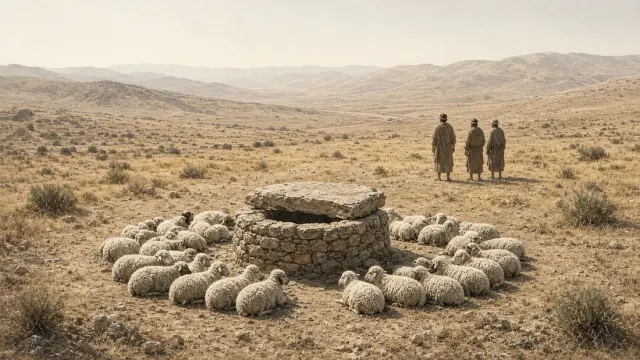
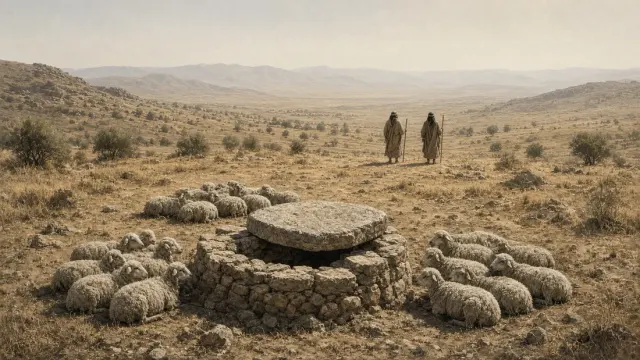
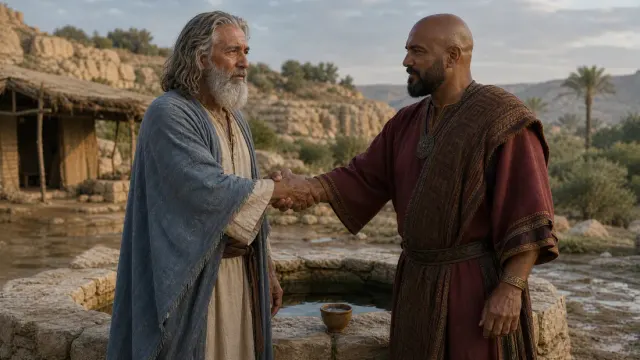
    At a well in Haran he rolls the stone away for Rachel, kisses her and weeps. He serves Laban seven years for her, and they seem to him but a few days. On the wedding night Laban gives him Leah instead. It is not done in our country, Laban says, to give the younger before the firstborn. Jacob serves seven more.

    Seven years can feel short, and one morning can change everything. Jacob meets Rachel while she is tending her father's sheep. She is his mother's niece, and Laban is the uncle he has come to find. Jacob agrees to work seven years to marry her. The Book of Genesis names his love directly: the years seem like a few days because of it.

    Laban then gives him Leah instead. When Jacob objects, Laban explains that the older daughter must marry before the younger. He has an explanation. He does not offer an apology. The family rule appears in the conversation after Jacob has completed the work, not when the agreement was made. The man who passed himself off as an older brother now receives the older sister in place of the younger one.

    The timing matters. Jacob does not wait another seven years before marrying Rachel. He completes Leah's wedding week, receives Rachel as his wife, and then serves the additional seven years. The chapter ends with both sisters married to him, but not equally loved. The extra years settle Laban's labor arrangement. They do not settle the household.

    Verse by verse

    1. 29:12

      'Her father's brother' uses brother in the broader sense of relative. Jacob immediately identifies himself as Rebekah's son, so he is Laban's nephew.

    2. 29:17

      The Hebrew description of Leah's eyes is debated. It does not clearly say she was blind or ugly, and Rachel's beauty should not be used to invent either claim.

    3. 29:23-25

      The passage says Laban brought Leah in the evening and Jacob recognized her in the morning. It does not explain the mistake by stating that Jacob was drunk or that Leah wore a veil.

    4. 29:27-30

      The week is Leah's wedding week, followed by Jacob's marriage to Rachel and seven further years of service. Hosea 12:12 later remembers Jacob's work for a wife.

    Genesis 29:1-30: Seven years for Rachel

    Genesis 29:1-30

    King James Version · 30 verses

    29:1Then Jacob went on his journey, and came into the land of the people of the east.

    29:2And he looked, and behold a well in the field, and, lo, there were three flocks of sheep lying by it; for out of that well they watered the flocks: and a great stone was upon the well’s mouth.

    29:3And thither were all the flocks gathered: and they rolled the stone from the well’s mouth, and watered the sheep, and put the stone again upon the well’s mouth in his place.

    29:4And Jacob said unto them, My brethren, whence be ye? And they said, Of Haran are we.

    29:5And he said unto them, Know ye Laban the son of Nahor? And they said, We know him.

    29:6And he said unto them, Is he well? And they said, He is well: and, behold, Rachel his daughter cometh with the sheep.

    29:7And he said, Lo, it is yet high day, neither is it time that the cattle should be gathered together: water ye the sheep, and go and feed them.

    29:8And they said, We cannot, until all the flocks be gathered together, and till they roll the stone from the well’s mouth; then we water the sheep.

    29:9And while he yet spake with them, Rachel came with her father’s sheep: for she kept them.

    29:10And it came to pass, when Jacob saw Rachel the daughter of Laban his mother’s brother, and the sheep of Laban his mother’s brother, that Jacob went near, and rolled the stone from the well’s mouth, and watered the flock of Laban his mother’s brother.

    29:11And Jacob kissed Rachel, and lifted up his voice, and wept.

    29:12And Jacob told Rachel that he was her father’s brother, and that he was Rebekah’s son: and she ran and told her father.

    29:13And it came to pass, when Laban heard the tidings of Jacob his sister’s son, that he ran to meet him, and embraced him, and kissed him, and brought him to his house. And he told Laban all these things.

    29:14And Laban said to him, Surely thou art my bone and my flesh. And he abode with him the space of a month.

    29:15And Laban said unto Jacob, Because thou art my brother, shouldest thou therefore serve me for nought? tell me, what shall thy wages be?

    29:16And Laban had two daughters: the name of the elder was Leah, and the name of the younger was Rachel.

    29:17Leah was tender eyed; but Rachel was beautiful and well favoured.

    29:18And Jacob loved Rachel; and said, I will serve thee seven years for Rachel thy younger daughter.

    29:19And Laban said, It is better that I give her to thee, than that I should give her to another man: abide with me.

    29:20And Jacob served seven years for Rachel; and they seemed unto him but a few days, for the love he had to her.

    29:21And Jacob said unto Laban, Give me my wife, for my days are fulfilled, that I may go in unto her.

    29:22And Laban gathered together all the men of the place, and made a feast.

    29:23And it came to pass in the evening, that he took Leah his daughter, and brought her to him; and he went in unto her.

    29:24And Laban gave unto his daughter Leah Zilpah his maid for an handmaid.

    29:25And it came to pass, that in the morning, behold, it was Leah: and he said to Laban, What is this thou hast done unto me? did not I serve with thee for Rachel? wherefore then hast thou beguiled me?

    29:26And Laban said, It must not be so done in our country, to give the younger before the firstborn.

    29:27Fulfil her week, and we will give thee this also for the service which thou shalt serve with me yet seven other years.

    29:28And Jacob did so, and fulfilled her week: and he gave him Rachel his daughter to wife also.

    29:29And Laban gave to Rachel his daughter Bilhah his handmaid to be her maid.

    29:30And he went in also unto Rachel, and he loved also Rachel more than Leah, and served with him yet seven other years.

  7. 07

    Genesis 29:31-30:24

    Eleven sons and a daughter

    Leah bears Reuben, Simeon, Levi and Judah. Rachel, barren, gives Bilhah, who bears Dan and Naphtali; Leah gives Zilpah, who bears Gad and Asher; Leah bears Issachar, Zebulun and Dinah. Then God remembers Rachel, and she bears Joseph.

    The children's names are doing more than filling a family list. Leah names sons while speaking about her pain, God's attention, and her hope that Jacob will love her. By Judah's birth, her words turn to praise. That moment is real, but the passage does not claim that all her longing has now disappeared.

    The growing household has four mothers. Leah bears six sons and Dinah. Rachel's servant Bilhah bears two sons, and Leah's servant Zilpah bears two. Rachel finally bears Joseph. That makes eleven sons here; Benjamin is not born until chapter 35. The servants are women placed under their mistresses' authority, not equal partners negotiating a modern family arrangement. Meanwhile, the sisters turn childbirth into an open rivalry. Even a night with Jacob becomes something they trade over mandrakes, plants Rachel wants.

    Yet the Book of Genesis does not credit the plants with producing children. God hears Leah; God remembers Rachel and opens her womb. 'Remembered' does not mean Rachel had slipped out of God's memory. It marks action on her behalf. Joseph's birth ends the section with both relief and another request. Rachel has a son. She names him while asking for one more.

    Verse by verse

    1. 29:31

      The KJV says Leah was 'hated'; verse 30 has just said Jacob loved Rachel more. The contrast concerns being less loved, but the unequal treatment is not made harmless by that explanation.

    2. 29:35

      Judah's name is linked with Leah's act of praising the LORD. Her first three naming speeches also mention her relationship with Jacob; this one centers on praise.

    3. 30:14-17

      The mandrakes are traded for a night with Jacob. The next pregnancy is credited to God hearing Leah, not to a stated medical power of the plants.

    4. 30:21

      Dinah is the daughter whose birth is named here. This does not establish that Jacob had no other daughters; Genesis 37:35 later speaks of his daughters in the plural.

    Genesis 29:31-30:24: Eleven sons and a daughter

    Genesis 29:31-30:24

    King James Version · 29 verses

    29:31And when the LORD saw that Leah was hated, he opened her womb: but Rachel was barren.

    29:32And Leah conceived, and bare a son, and she called his name Reuben: for she said, Surely the LORD hath looked upon my affliction; now therefore my husband will love me.

    29:33And she conceived again, and bare a son; and said, Because the LORD hath heard that I was hated, he hath therefore given me this son also: and she called his name Simeon.

    29:34And she conceived again, and bare a son; and said, Now this time will my husband be joined unto me, because I have born him three sons: therefore was his name called Levi.

    29:35And she conceived again, and bare a son: and she said, Now will I praise the LORD: therefore she called his name Judah; and left bearing.

    30:1And when Rachel saw that she bare Jacob no children, Rachel envied her sister; and said unto Jacob, Give me children, or else I die.

    30:2And Jacob’s anger was kindled against Rachel: and he said, Am I in God’s stead, who hath withheld from thee the fruit of the womb?

    30:3And she said, Behold my maid Bilhah, go in unto her; and she shall bear upon my knees, that I may also have children by her.

    30:4And she gave him Bilhah her handmaid to wife: and Jacob went in unto her.

    30:5And Bilhah conceived, and bare Jacob a son.

    30:6And Rachel said, God hath judged me, and hath also heard my voice, and hath given me a son: therefore called she his name Dan.

    30:7And Bilhah Rachel’s maid conceived again, and bare Jacob a second son.

    30:8And Rachel said, With great wrestlings have I wrestled with my sister, and I have prevailed: and she called his name Naphtali.

    30:9When Leah saw that she had left bearing, she took Zilpah her maid, and gave her Jacob to wife.

    30:10And Zilpah Leah’s maid bare Jacob a son.

    30:11And Leah said, A troop cometh: and she called his name Gad.

    30:12And Zilpah Leah’s maid bare Jacob a second son.

    30:13And Leah said, Happy am I, for the daughters will call me blessed: and she called his name Asher.

    30:14And Reuben went in the days of wheat harvest, and found mandrakes in the field, and brought them unto his mother Leah. Then Rachel said to Leah, Give me, I pray thee, of thy son’s mandrakes.

    30:15And she said unto her, Is it a small matter that thou hast taken my husband? and wouldest thou take away my son’s mandrakes also? And Rachel said, Therefore he shall lie with thee to night for thy son’s mandrakes.

    30:16And Jacob came out of the field in the evening, and Leah went out to meet him, and said, Thou must come in unto me; for surely I have hired thee with my son’s mandrakes. And he lay with her that night.

    30:17And God hearkened unto Leah, and she conceived, and bare Jacob the fifth son.

    30:18And Leah said, God hath given me my hire, because I have given my maiden to my husband: and she called his name Issachar.

    30:19And Leah conceived again, and bare Jacob the sixth son.

    30:20And Leah said, God hath endued me with a good dowry; now will my husband dwell with me, because I have born him six sons: and she called his name Zebulun.

    30:21And afterwards she bare a daughter, and called her name Dinah.

    30:22And God remembered Rachel, and God hearkened to her, and opened her womb.

    30:23And she conceived, and bare a son; and said, God hath taken away my reproach:

    30:24And she called his name Joseph; and said, The LORD shall add to me another son.

  8. 08

    Genesis 30:25-31:55

    Leaving Laban

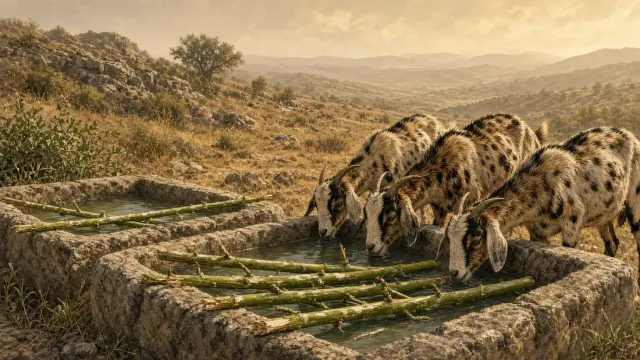
    Jacob asks to go home. He agrees to take only the speckled and spotted of the flocks, and by the rods at the watering troughs his flocks multiply. Laban's sons grumble, God tells Jacob to return, and he leaves secretly with his wives and herds. Laban pursues, searches for his stolen images, and the two make a covenant at a heap of stones called Galeed and Mizpah.

    Jacob's wages keep moving because Laban keeps changing the terms. After Joseph's birth, Jacob asks to leave, then agrees to work for certain marked animals from the flocks. Laban removes animals already bearing those marks. Jacob uses peeled branches at the watering places and separates stronger breeding animals from weaker ones. The account describes these actions, but it does not provide a modern lesson in genetics. Jacob's later dream gives the decisive credit to God, who has seen Laban's treatment of him.

    Leaving is a family decision. Jacob speaks privately with Rachel and Leah; both say their father has treated them like outsiders and consumed what belonged to them. They agree to go. Rachel, however, secretly takes Laban's household gods. Jacob does not know this when he declares that whoever has them should die. Laban searches while Rachel sits on the hidden objects and says she cannot rise because of her monthly period. The search fails. A man looking for his gods cannot get his daughter to stand up.

    The confrontation finally brings twenty years of work into the open: heat by day, frost by night, lost sleep, and losses charged to Jacob. Laban still calls the daughters, children, and flocks his own. God has warned him against harming Jacob, and the dispute ends with a heap of stones and sworn limits. The agreement is not proof of restored trust. It sets boundaries where trust has failed.

    Verse by verse

    1. 30:37-43

      The branches and selective breeding are both described, but the text does not explain a biological mechanism connecting peeled wood with coat markings. Genesis 31:10-12 supplies Jacob's dream account of God's intervention.

    2. 31:19

      The 'images' are household gods, called teraphim in Hebrew. The passage does not state Rachel's motive or say that possessing them legally transferred an inheritance.

    3. 31:32

      Jacob makes his death declaration without knowing Rachel has taken the images. The Book of Genesis explicitly gives that missing knowledge before the search proceeds.

    4. 31:41

      Jacob divides the twenty years into fourteen for the two daughters and six for the livestock. These are not twenty years added after the marriage service.

    5. 31:49-52

      Mizpah is associated with watching. In this setting, God's watch concerns mistreatment of the daughters and hostile crossing of the boundary, not simply affectionate remembrance at a distance.

    Genesis 30:25-31:55: Leaving Laban

    Genesis 30:25-31:55

    King James Version · 74 verses

    30:25And it came to pass, when Rachel had born Joseph, that Jacob said unto Laban, Send me away, that I may go unto mine own place, and to my country.

    30:26Give me my wives and my children, for whom I have served thee, and let me go: for thou knowest my service which I have done thee.

    30:27And Laban said unto him, I pray thee, if I have found favour in thine eyes, tarry: for I have learned by experience that the LORD hath blessed me for thy sake.

    30:28And he said, Appoint me thy wages, and I will give it.

    30:29And he said unto him, Thou knowest how I have served thee, and how thy cattle was with me.

    30:30For it was little which thou hadst before I came, and it is now increased unto a multitude; and the LORD hath blessed thee since my coming: and now when shall I provide for mine own house also?

    30:31And he said, What shall I give thee? And Jacob said, Thou shalt not give me any thing: if thou wilt do this thing for me, I will again feed and keep thy flock:

    30:32I will pass through all thy flock to day, removing from thence all the speckled and spotted cattle, and all the brown cattle among the sheep, and the spotted and speckled among the goats: and of such shall be my hire.

    30:33So shall my righteousness answer for me in time to come, when it shall come for my hire before thy face: every one that is not speckled and spotted among the goats, and brown among the sheep, that shall be counted stolen with me.

    30:34And Laban said, Behold, I would it might be according to thy word.

    30:35And he removed that day the he goats that were ringstraked and spotted, and all the she goats that were speckled and spotted, and every one that had some white in it, and all the brown among the sheep, and gave them into the hand of his sons.

    30:36And he set three days’ journey betwixt himself and Jacob: and Jacob fed the rest of Laban’s flocks.

    30:37And Jacob took him rods of green poplar, and of the hazel and chesnut tree; and pilled white strakes in them, and made the white appear which was in the rods.

    30:38And he set the rods which he had pilled before the flocks in the gutters in the watering troughs when the flocks came to drink, that they should conceive when they came to drink.

    30:39And the flocks conceived before the rods, and brought forth cattle ringstraked, speckled, and spotted.

    30:40And Jacob did separate the lambs, and set the faces of the flocks toward the ringstraked, and all the brown in the flock of Laban; and he put his own flocks by themselves, and put them not unto Laban’s cattle.

    30:41And it came to pass, whensoever the stronger cattle did conceive, that Jacob laid the rods before the eyes of the cattle in the gutters, that they might conceive among the rods.

    30:42But when the cattle were feeble, he put them not in: so the feebler were Laban’s, and the stronger Jacob’s.

    30:43And the man increased exceedingly, and had much cattle, and maidservants, and menservants, and camels, and asses.

    31:1And he heard the words of Laban’s sons, saying, Jacob hath taken away all that was our father’s; and of that which was our father’s hath he gotten all this glory.

    31:2And Jacob beheld the countenance of Laban, and, behold, it was not toward him as before.

    31:3And the LORD said unto Jacob, Return unto the land of thy fathers, and to thy kindred; and I will be with thee.

    31:4And Jacob sent and called Rachel and Leah to the field unto his flock,

    31:5And said unto them, I see your father’s countenance, that it is not toward me as before; but the God of my father hath been with me.

    31:6And ye know that with all my power I have served your father.

    31:7And your father hath deceived me, and changed my wages ten times; but God suffered him not to hurt me.

    31:8If he said thus, The speckled shall be thy wages; then all the cattle bare speckled: and if he said thus, The ringstraked shall be thy hire; then bare all the cattle ringstraked.

    31:9Thus God hath taken away the cattle of your father, and given them to me.

    31:10And it came to pass at the time that the cattle conceived, that I lifted up mine eyes, and saw in a dream, and, behold, the rams which leaped upon the cattle were ringstraked, speckled, and grisled.

    31:11And the angel of God spake unto me in a dream, saying, Jacob: And I said, Here am I.

    31:12And he said, Lift up now thine eyes, and see, all the rams which leap upon the cattle are ringstraked, speckled, and grisled: for I have seen all that Laban doeth unto thee.

    31:13I am the God of Beth-el, where thou anointedst the pillar, and where thou vowedst a vow unto me: now arise, get thee out from this land, and return unto the land of thy kindred.

    31:14And Rachel and Leah answered and said unto him, Is there yet any portion or inheritance for us in our father’s house?

    31:15Are we not counted of him strangers? for he hath sold us, and hath quite devoured also our money.

    31:16For all the riches which God hath taken from our father, that is ours, and our children’s: now then, whatsoever God hath said unto thee, do.

    31:17Then Jacob rose up, and set his sons and his wives upon camels;

    31:18And he carried away all his cattle, and all his goods which he had gotten, the cattle of his getting, which he had gotten in Padan-aram, for to go to Isaac his father in the land of Canaan.

    31:19And Laban went to shear his sheep: and Rachel had stolen the images that were her father’s.

    31:20And Jacob stole away unawares to Laban the Syrian, in that he told him not that he fled.

    31:21So he fled with all that he had; and he rose up, and passed over the river, and set his face toward the mount Gilead.

    31:22And it was told Laban on the third day that Jacob was fled.

    31:23And he took his brethren with him, and pursued after him seven days’ journey; and they overtook him in the mount Gilead.

    31:24And God came to Laban the Syrian in a dream by night, and said unto him, Take heed that thou speak not to Jacob either good or bad.

    31:25Then Laban overtook Jacob. Now Jacob had pitched his tent in the mount: and Laban with his brethren pitched in the mount of Gilead.

    31:26And Laban said to Jacob, What hast thou done, that thou hast stolen away unawares to me, and carried away my daughters, as captives taken with the sword?

    31:27Wherefore didst thou flee away secretly, and steal away from me; and didst not tell me, that I might have sent thee away with mirth, and with songs, with tabret, and with harp?

    31:28And hast not suffered me to kiss my sons and my daughters? thou hast now done foolishly in so doing.

    31:29It is in the power of my hand to do you hurt: but the God of your father spake unto me yesternight, saying, Take thou heed that thou speak not to Jacob either good or bad.

    31:30And now, though thou wouldest needs be gone, because thou sore longedst after thy father’s house, yet wherefore hast thou stolen my gods?

    31:31And Jacob answered and said to Laban, Because I was afraid: for I said, Peradventure thou wouldest take by force thy daughters from me.

    31:32With whomsoever thou findest thy gods, let him not live: before our brethren discern thou what is thine with me, and take it to thee. For Jacob knew not that Rachel had stolen them.

    31:33And Laban went into Jacob’s tent, and into Leah’s tent, and into the two maidservants’ tents; but he found them not. Then went he out of Leah’s tent, and entered into Rachel’s tent.

    31:34Now Rachel had taken the images, and put them in the camel’s furniture, and sat upon them. And Laban searched all the tent, but found them not.

    31:35And she said to her father, Let it not displease my lord that I cannot rise up before thee; for the custom of women is upon me. And he searched, but found not the images.

    31:36And Jacob was wroth, and chode with Laban: and Jacob answered and said to Laban, What is my trespass? what is my sin, that thou hast so hotly pursued after me?

    31:37Whereas thou hast searched all my stuff, what hast thou found of all thy household stuff? set it here before my brethren and thy brethren, that they may judge betwixt us both.

    31:38This twenty years have I been with thee; thy ewes and thy she goats have not cast their young, and the rams of thy flock have I not eaten.

    31:39That which was torn of beasts I brought not unto thee; I bare the loss of it; of my hand didst thou require it, whether stolen by day, or stolen by night.

    31:40Thus I was; in the day the drought consumed me, and the frost by night; and my sleep departed from mine eyes.

    31:41Thus have I been twenty years in thy house; I served thee fourteen years for thy two daughters, and six years for thy cattle: and thou hast changed my wages ten times.

    31:42Except the God of my father, the God of Abraham, and the fear of Isaac, had been with me, surely thou hadst sent me away now empty. God hath seen mine affliction and the labour of my hands, and rebuked thee yesternight.

    31:43And Laban answered and said unto Jacob, These daughters are my daughters, and these children are my children, and these cattle are my cattle, and all that thou seest is mine: and what can I do this day unto these my daughters, or unto their children which they have born?

    31:44Now therefore come thou, let us make a covenant, I and thou; and let it be for a witness between me and thee.

    31:45And Jacob took a stone, and set it up for a pillar.

    31:46And Jacob said unto his brethren, Gather stones; and they took stones, and made an heap: and they did eat there upon the heap.

    31:47And Laban called it Jegar-sahadutha: but Jacob called it Galeed.

    31:48And Laban said, This heap is a witness between me and thee this day. Therefore was the name of it called Galeed;

    31:49And Mizpah; for he said, The LORD watch between me and thee, when we are absent one from another.

    31:50If thou shalt afflict my daughters, or if thou shalt take other wives beside my daughters, no man is with us; see, God is witness betwixt me and thee.

    31:51And Laban said to Jacob, Behold this heap, and behold this pillar, which I have cast betwixt me and thee;

    31:52This heap be witness, and this pillar be witness, that I will not pass over this heap to thee, and that thou shalt not pass over this heap and this pillar unto me, for harm.

    31:53The God of Abraham, and the God of Nahor, the God of their father, judge betwixt us. And Jacob sware by the fear of his father Isaac.

    31:54Then Jacob offered sacrifice upon the mount, and called his brethren to eat bread: and they did eat bread, and tarried all night in the mount.

    31:55And early in the morning Laban rose up, and kissed his sons and his daughters, and blessed them: and Laban departed, and returned unto his place.

  9. 09

    Genesis 32:1-21

    Preparing to meet Esau

    Messengers report that Esau is coming with four hundred men. Jacob divides his camp in two, prays the prayer of a frightened man who remembers the promise, I am not worthy of the least of all the mercies, and sends droves of animals ahead as a present.

    Four hundred men are coming with Esau. The report gives Jacob a number, not an explanation of his brother's intentions, and Jacob is afraid. He divides the household so that one camp might escape if the other is attacked. The man who has just seen God's angels still takes the danger seriously.

    His prayer is unusually direct. He repeats God's command to return, recalls the promise of many descendants, and admits that he does not deserve the kindness already shown to him. He crossed this river with a staff; now he has enough people and animals for two camps. The change is enormous. It does not make him feel safe from Esau.

    Then come the gifts, herd after herd, with space between them. Jacob tells the servants to call Esau his lord and himself Esau's servant. The titles reverse the position sought in Isaac's blessing. He hopes the repeated gifts will soften the meeting. The Book of Genesis explains the purpose rather than leaving it to guesswork: Jacob wants Esau to receive him favorably. He sends the animals ahead. He stays behind for the night.

    Verse by verse

    1. 32:2

      Mahanaim means 'two camps.' The name belongs to the place where Jacob encounters God's angels, before he divides his own household into two groups.

    2. 32:6-7

      The report says Esau has four hundred men, but it does not say he has ordered an attack. Jacob's fear is explicit; Esau's present purpose is not.

    3. 32:10

      The staff and the two camps form Jacob's own comparison between his earlier poverty and his present abundance. He calls God's past kindness greater than he deserves.

    4. 32:20

      Jacob states that the gifts are meant to appease Esau, meaning to calm his anger and gain a favorable reception. The passage does not call them a purchase of forgiveness.

    Genesis 32:1-21: Preparing to meet Esau

    Genesis 32:1-21

    King James Version · 21 verses

    32:1And Jacob went on his way, and the angels of God met him.

    32:2And when Jacob saw them, he said, This is God’s host: and he called the name of that place Mahanaim.

    32:3And Jacob sent messengers before him to Esau his brother unto the land of Seir, the country of Edom.

    32:4And he commanded them, saying, Thus shall ye speak unto my lord Esau; Thy servant Jacob saith thus, I have sojourned with Laban, and stayed there until now:

    32:5And I have oxen, and asses, flocks, and menservants, and womenservants: and I have sent to tell my lord, that I may find grace in thy sight.

    32:6And the messengers returned to Jacob, saying, We came to thy brother Esau, and also he cometh to meet thee, and four hundred men with him.

    32:7Then Jacob was greatly afraid and distressed: and he divided the people that was with him, and the flocks, and herds, and the camels, into two bands;

    32:8And said, If Esau come to the one company, and smite it, then the other company which is left shall escape.

    32:9And Jacob said, O God of my father Abraham, and God of my father Isaac, the LORD which saidst unto me, Return unto thy country, and to thy kindred, and I will deal well with thee:

    32:10I am not worthy of the least of all the mercies, and of all the truth, which thou hast shewed unto thy servant; for with my staff I passed over this Jordan; and now I am become two bands.

    32:11Deliver me, I pray thee, from the hand of my brother, from the hand of Esau: for I fear him, lest he will come and smite me, and the mother with the children.

    32:12And thou saidst, I will surely do thee good, and make thy seed as the sand of the sea, which cannot be numbered for multitude.

    32:13And he lodged there that same night; and took of that which came to his hand a present for Esau his brother;

    32:14Two hundred she goats, and twenty he goats, two hundred ewes, and twenty rams,

    32:15Thirty milch camels with their colts, forty kine, and ten bulls, twenty she asses, and ten foals.

    32:16And he delivered them into the hand of his servants, every drove by themselves; and said unto his servants, Pass over before me, and put a space betwixt drove and drove.

    32:17And he commanded the foremost, saying, When Esau my brother meeteth thee, and asketh thee, saying, Whose art thou? and whither goest thou? and whose are these before thee?

    32:18Then thou shalt say, They be thy servant Jacob’s; it is a present sent unto my lord Esau: and, behold, also he is behind us.

    32:19And so commanded he the second, and the third, and all that followed the droves, saying, On this manner shall ye speak unto Esau, when ye find him.

    32:20And say ye moreover, Behold, thy servant Jacob is behind us. For he said, I will appease him with the present that goeth before me, and afterward I will see his face; peradventure he will accept of me.

    32:21So went the present over before him: and himself lodged that night in the company.

  10. 10

    Genesis 32:22-32

    Peniel

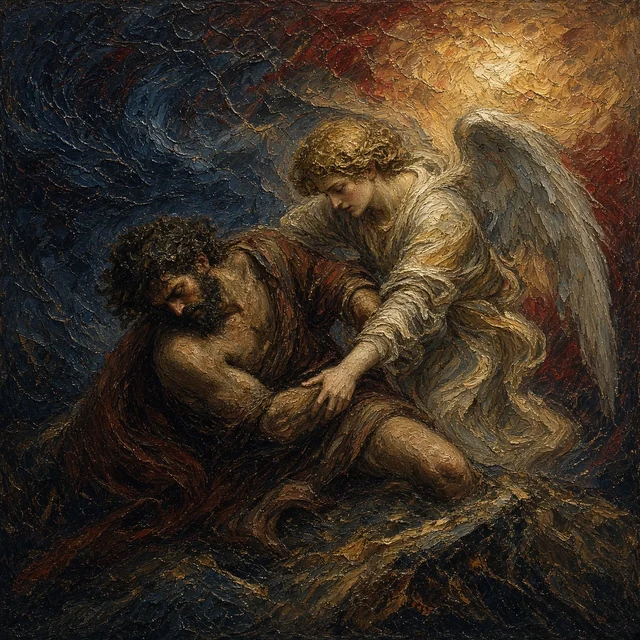
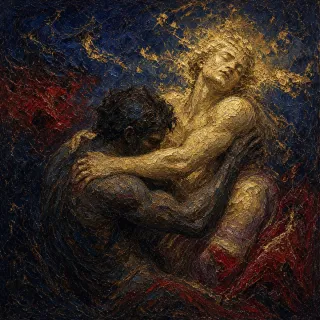
    Alone at the ford of Jabbok, a man wrestles with him until the breaking of the day, touches the hollow of his thigh and puts it out of joint. Jacob will not let go without a blessing. The man asks his name and gives him another: Israel, for as a prince hast thou power with God and with men. Jacob calls the place Peniel: I have seen God face to face.

    Jacob sends his family across the stream, then spends the night fighting for a blessing. The opponent is first called a man. Yet a touch to Jacob's hip is enough to put it out of joint, and Jacob later says he has seen God face to face. This is not an account of a man proving that his muscles are stronger than God's.

    The exchange turns on a name. In front of Isaac, Jacob claimed to be Esau. Here, asked his name, he gives his own. He is then named Israel, with an explanation that connects the name to struggling with God and with men. The blessing he demands is not obtained by wearing someone else's clothes. He receives it while identified as himself.

    The place becomes Peniel, 'face of God,' because Jacob marvels that his life has been preserved. Sunrise does not erase the night's cost. He walks away with a damaged hip, and the chapter connects that wound with a food practice kept among the children of Israel. The blessing remains. So does the limp.

    Verse by verse

    1. 32:24

      The passage begins with 'a man,' while verse 30 speaks of seeing God and Hosea 12:4 speaks of an angel. Identifying the figure specifically as Christ is a Christian interpretation, not a name given in this passage.

    2. 32:28

      The explanation of Israel's name emphasizes Jacob's struggle involving God and men. The Book of Genesis continues to use Jacob as well as Israel afterward, including God's address in 46:2.

    3. 32:30

      Peniel means 'face of God.' Jacob's statement stresses both the encounter and his surprise that he has survived it.

    4. 32:32

      The verse explains an Israelite practice of not eating the sinew associated with the injured hip. It does not say Jacob received a general command to avoid all meat.

    Genesis 32:22-32

    King James Version · 11 verses

    32:22And he rose up that night, and took his two wives, and his two womenservants, and his eleven sons, and passed over the ford Jabbok.

    32:23And he took them, and sent them over the brook, and sent over that he had.

    32:24And Jacob was left alone; and there wrestled a man with him until the breaking of the day.

    32:25And when he saw that he prevailed not against him, he touched the hollow of his thigh; and the hollow of Jacob’s thigh was out of joint, as he wrestled with him.

    32:26And he said, Let me go, for the day breaketh. And he said, I will not let thee go, except thou bless me.

    32:27And he said unto him, What is thy name? And he said, Jacob.

    32:28And he said, Thy name shall be called no more Jacob, but Israel: for as a prince hast thou power with God and with men, and hast prevailed.

    32:29And Jacob asked him, and said, Tell me, I pray thee, thy name. And he said, Wherefore is it that thou dost ask after my name? And he blessed him there.

    32:30And Jacob called the name of the place Peniel: for I have seen God face to face, and my life is preserved.

    32:31And as he passed over Penuel the sun rose upon him, and he halted upon his thigh.

    32:32Therefore the children of Israel eat not of the sinew which shrank, which is upon the hollow of the thigh, unto this day: because he touched the hollow of Jacob’s thigh in the sinew that shrank.

    Genesis 32:22-32: Peniel
  11. 11

    Genesis 33

    Esau runs to meet him

    Jacob bows seven times as he approaches. Esau runs, embraces him, falls on his neck and kisses him, and they weep. Jacob presses his present on him: I have seen thy face, as though I had seen the face of God. They part, Esau to Seir, Jacob to Succoth and then Shechem.

    Esau runs, but not to strike him. He embraces Jacob, kisses him, and weeps with him. That is the actual answer to the four hundred men who filled Jacob with fear. Jacob has bowed seven times and placed himself ahead of the household. The greeting he receives is warmer than his careful preparations could guarantee.

    Their words are not quite alike. Jacob repeatedly calls Esau his lord and himself a servant. Esau calls him his brother. When Esau asks about the livestock, Jacob explains that the gift seeks his favor. Esau initially refuses because he has enough; Jacob insists, calling the present his blessing. After a conflict over a blessing taken, there is now a blessing offered.

    Jacob compares Esau's favorable face with seeing God's face, linking this meeting with Peniel. He is not declaring Esau divine. He is describing the welcome he has received. The brothers then separate, and Jacob moves at the pace of the children and nursing animals. Peace has been made, but the households do not become one. Jacob eventually buys land near Shechem and builds an altar, giving his arrival a place as well as a promise.

    Verse by verse

    1. 33:2-3

      Rachel and Joseph remain at the back of the family arrangement, but Jacob himself goes ahead of everyone. These are two separate details, and both matter.

    2. 33:10

      The comparison with God's face concerns Esau's favorable reception. It also recalls the name and explanation of Peniel in Genesis 32:30.

    3. 33:17

      Succoth means 'booths' or shelters. The verse connects the name with the shelters Jacob makes for his livestock.

    4. 33:19-20

      John 4:5-6 later associates Jacob's land and well with this region. Genesis records the land purchase and altar here, but does not describe Jacob digging the well.

    Genesis 33: Esau runs to meet him

    Genesis 33

    King James Version · 20 verses

    33:1And Jacob lifted up his eyes, and looked, and, behold, Esau came, and with him four hundred men. And he divided the children unto Leah, and unto Rachel, and unto the two handmaids.

    33:2And he put the handmaids and their children foremost, and Leah and her children after, and Rachel and Joseph hindermost.

    33:3And he passed over before them, and bowed himself to the ground seven times, until he came near to his brother.

    33:4And Esau ran to meet him, and embraced him, and fell on his neck, and kissed him: and they wept.

    33:5And he lifted up his eyes, and saw the women and the children; and said, Who are those with thee? And he said, The children which God hath graciously given thy servant.

    33:6Then the handmaidens came near, they and their children, and they bowed themselves.

    33:7And Leah also with her children came near, and bowed themselves: and after came Joseph near and Rachel, and they bowed themselves.

    33:8And he said, What meanest thou by all this drove which I met? And he said, These are to find grace in the sight of my lord.

    33:9And Esau said, I have enough, my brother; keep that thou hast unto thyself.

    33:10And Jacob said, Nay, I pray thee, if now I have found grace in thy sight, then receive my present at my hand: for therefore I have seen thy face, as though I had seen the face of God, and thou wast pleased with me.

    33:11Take, I pray thee, my blessing that is brought to thee; because God hath dealt graciously with me, and because I have enough. And he urged him, and he took it.

    33:12And he said, Let us take our journey, and let us go, and I will go before thee.

    33:13And he said unto him, My lord knoweth that the children are tender, and the flocks and herds with young are with me: and if men should overdrive them one day, all the flock will die.

    33:14Let my lord, I pray thee, pass over before his servant: and I will lead on softly, according as the cattle that goeth before me and the children be able to endure, until I come unto my lord unto Seir.

    33:15And Esau said, Let me now leave with thee some of the folk that are with me. And he said, What needeth it? let me find grace in the sight of my lord.

    33:16So Esau returned that day on his way unto Seir.

    33:17And Jacob journeyed to Succoth, and built him an house, and made booths for his cattle: therefore the name of the place is called Succoth.

    33:18And Jacob came to Shalem, a city of Shechem, which is in the land of Canaan, when he came from Padan-aram; and pitched his tent before the city.

    33:19And he bought a parcel of a field, where he had spread his tent, at the hand of the children of Hamor, Shechem’s father, for an hundred pieces of money.

    33:20And he erected there an altar, and called it El-elohe-Israel.

  12. 12

    Genesis 34

    Dinah at Shechem

    Shechem the son of Hamor takes Dinah and then asks to marry her. Jacob's sons answer deceitfully, requiring the city's men to be circumcised, and on the third day Simeon and Levi kill them all. Jacob says, ye have made me to stink among the inhabitants of the land.

    Shechem's wish to marry Dinah does not undo what he has done to her. The chapter first reports that he took and sexually violated her. Only afterward does it describe his attachment and his request for marriage. Calling the passage a romance would reverse its order and hide its violence.

    The negotiations soon widen into plans for land, trade, and intermarriage. Dinah's brothers answer deceitfully. They require the men of the city to be circumcised, turning the bodily sign of God's covenant into a means of leaving an entire town vulnerable. On the third day, Simeon and Levi kill the males and bring Dinah out of Shechem's house. Other sons plunder the city and take women and children captive. Violence against one member of the family has been answered with violence against a whole community.

    Jacob objects that the attack has endangered his small household among its neighbors. His sons answer with their own charge about how their sister has been treated. The chapter does not supply an easy settlement between those replies. It also gives Dinah no recorded speech during the negotiations or their aftermath. Men argue over her, bargain over her, and kill over her. Her own words are absent.

    Verse by verse

    1. 34:2

      'Defiled' identifies a grave violation, not a harmless breach of dating custom. The later language of love does not remove the earlier assault.

    2. 34:13-17

      Circumcision is the bodily sign of the covenant in Genesis 17:10-14. Here the brothers use the requirement deceitfully to prepare their attack.

    3. 34:25-26

      Simeon and Levi are identified as Dinah's brothers, sons of the same mother, Leah. Verse 26 places Dinah in Shechem's house when they bring her out.

    4. 34:30-31

      Jacob speaks here about the danger of retaliation, while his sons defend their response. Genesis 49:5-7 later makes his condemnation of their violence explicit.

    Genesis 34: Dinah at Shechem

    Genesis 34

    King James Version · 31 verses

    34:1And Dinah the daughter of Leah, which she bare unto Jacob, went out to see the daughters of the land.

    34:2And when Shechem the son of Hamor the Hivite, prince of the country, saw her, he took her, and lay with her, and defiled her.

    34:3And his soul clave unto Dinah the daughter of Jacob, and he loved the damsel, and spake kindly unto the damsel.

    34:4And Shechem spake unto his father Hamor, saying, Get me this damsel to wife.

    34:5And Jacob heard that he had defiled Dinah his daughter: now his sons were with his cattle in the field: and Jacob held his peace until they were come.

    34:6And Hamor the father of Shechem went out unto Jacob to commune with him.

    34:7And the sons of Jacob came out of the field when they heard it: and the men were grieved, and they were very wroth, because he had wrought folly in Israel in lying with Jacob’s daughter; which thing ought not to be done.

    34:8And Hamor communed with them, saying, The soul of my son Shechem longeth for your daughter: I pray you give her him to wife.

    34:9And make ye marriages with us, and give your daughters unto us, and take our daughters unto you.

    34:10And ye shall dwell with us: and the land shall be before you; dwell and trade ye therein, and get you possessions therein.

    34:11And Shechem said unto her father and unto her brethren, Let me find grace in your eyes, and what ye shall say unto me I will give.

    34:12Ask me never so much dowry and gift, and I will give according as ye shall say unto me: but give me the damsel to wife.

    34:13And the sons of Jacob answered Shechem and Hamor his father deceitfully, and said, because he had defiled Dinah their sister:

    34:14And they said unto them, We cannot do this thing, to give our sister to one that is uncircumcised; for that were a reproach unto us:

    34:15But in this will we consent unto you: If ye will be as we be, that every male of you be circumcised;

    34:16Then will we give our daughters unto you, and we will take your daughters to us, and we will dwell with you, and we will become one people.

    34:17But if ye will not hearken unto us, to be circumcised; then will we take our daughter, and we will be gone.

    34:18And their words pleased Hamor, and Shechem Hamor’s son.

    34:19And the young man deferred not to do the thing, because he had delight in Jacob’s daughter: and he was more honourable than all the house of his father.

    34:20And Hamor and Shechem his son came unto the gate of their city, and communed with the men of their city, saying,

    34:21These men are peaceable with us; therefore let them dwell in the land, and trade therein; for the land, behold, it is large enough for them; let us take their daughters to us for wives, and let us give them our daughters.

    34:22Only herein will the men consent unto us for to dwell with us, to be one people, if every male among us be circumcised, as they are circumcised.

    34:23Shall not their cattle and their substance and every beast of theirs be ours? only let us consent unto them, and they will dwell with us.

    34:24And unto Hamor and unto Shechem his son hearkened all that went out of the gate of his city; and every male was circumcised, all that went out of the gate of his city.

    34:25And it came to pass on the third day, when they were sore, that two of the sons of Jacob, Simeon and Levi, Dinah’s brethren, took each man his sword, and came upon the city boldly, and slew all the males.

    34:26And they slew Hamor and Shechem his son with the edge of the sword, and took Dinah out of Shechem’s house, and went out.

    34:27The sons of Jacob came upon the slain, and spoiled the city, because they had defiled their sister.

    34:28They took their sheep, and their oxen, and their asses, and that which was in the city, and that which was in the field,

    34:29And all their wealth, and all their little ones, and their wives took they captive, and spoiled even all that was in the house.

    34:30And Jacob said to Simeon and Levi, Ye have troubled me to make me to stink among the inhabitants of the land, among the Canaanites and the Perizzites: and I being few in number, they shall gather themselves together against me, and slay me; and I shall be destroyed, I and my house.

    34:31And they said, Should he deal with our sister as with an harlot?

  13. 13

    Genesis 35

    Back to Bethel; Rachel dies

    God tells him to go up to Bethel. He buries the household gods under an oak at Shechem and builds an altar. God appears again, confirms the name Israel and the promise. On the road Rachel dies giving birth to Benjamin and is buried near Bethlehem. Jacob reaches Isaac at Hebron and buries him with Esau.

    The return to Bethel begins with things being put away. Jacob tells his household to remove foreign gods, wash, and change clothes before approaching the place where God met him during his flight. He buries the objects and earrings near Shechem. The journey back is not merely a visit to a favorite landmark. It involves a break with worship that does not belong beside this altar.

    God again names him Israel and repeats the promise of descendants, kings, and land. Yet the chapter places that promise among several deaths. Deborah, Rebekah's nurse, is buried beneath an oak. Rachel dies giving birth to Benjamin, the twelfth son. Isaac's death closes the chapter. Blessing does not make this family untouched by burial.

    Rachel calls her newborn Ben-oni, 'son of my sorrow'; Jacob calls him Benjamin, 'son of the right hand.' A pillar marks her grave, just as another pillar marks God's speech at Bethel. Between these events, Reuben sleeps with Bilhah, his father's concubine, a woman in a secondary marital position. Israel hears it, and Genesis 49:4 later names the offense. The chapter preserves promise, grief, and family damage without pretending that any one of them cancels the others.

    Verse by verse

    1. 35:2-4

      The household gives up foreign gods and earrings, but the passage does not identify every object with Rachel's stolen images from chapter 31. The removal is wider than a named inventory of that theft.

    2. 35:18

      Ben-oni means 'son of my sorrow,' while Benjamin means 'son of the right hand.' The text gives both names without stating Jacob's private reason for changing the first.

    3. 35:22

      The brief report that Israel heard of Reuben's act is not a statement that he approved it. Genesis 49:4 and 1 Chronicles 5:1 identify its lasting consequences.

    4. 35:26

      The list ends with a collective reference to Padan-aram, although verses 16-19 have placed Benjamin's birth in Canaan. That closing summary should not be used to move his birth away from the location just given.

    5. 35:29

      Esau and Jacob bury Isaac together. Their shared duty recalls Isaac and Ishmael burying Abraham in Genesis 25:9.

    Genesis 35: Back to Bethel; Rachel dies

    Genesis 35

    King James Version · 29 verses

    35:1And God said unto Jacob, Arise, go up to Beth-el, and dwell there: and make there an altar unto God, that appeared unto thee when thou fleddest from the face of Esau thy brother.

    35:2Then Jacob said unto his household, and to all that were with him, Put away the strange gods that are among you, and be clean, and change your garments:

    35:3And let us arise, and go up to Beth-el; and I will make there an altar unto God, who answered me in the day of my distress, and was with me in the way which I went.

    35:4And they gave unto Jacob all the strange gods which were in their hand, and all their earrings which were in their ears; and Jacob hid them under the oak which was by Shechem.

    35:5And they journeyed: and the terror of God was upon the cities that were round about them, and they did not pursue after the sons of Jacob.

    35:6So Jacob came to Luz, which is in the land of Canaan, that is, Beth-el, he and all the people that were with him.

    35:7And he built there an altar, and called the place El-beth-el: because there God appeared unto him, when he fled from the face of his brother.

    35:8But Deborah Rebekah’s nurse died, and she was buried beneath Beth-el under an oak: and the name of it was called Allon-bachuth.

    35:9And God appeared unto Jacob again, when he came out of Padan-aram, and blessed him.

    35:10And God said unto him, Thy name is Jacob: thy name shall not be called any more Jacob, but Israel shall be thy name: and he called his name Israel.

    35:11And God said unto him, I am God Almighty: be fruitful and multiply; a nation and a company of nations shall be of thee, and kings shall come out of thy loins;

    35:12And the land which I gave Abraham and Isaac, to thee I will give it, and to thy seed after thee will I give the land.

    35:13And God went up from him in the place where he talked with him.

    35:14And Jacob set up a pillar in the place where he talked with him, even a pillar of stone: and he poured a drink offering thereon, and he poured oil thereon.

    35:15And Jacob called the name of the place where God spake with him, Beth-el.

    35:16And they journeyed from Beth-el; and there was but a little way to come to Ephrath: and Rachel travailed, and she had hard labour.

    35:17And it came to pass, when she was in hard labour, that the midwife said unto her, Fear not; thou shalt have this son also.

    35:18And it came to pass, as her soul was in departing, (for she died) that she called his name Ben-oni: but his father called him Benjamin.

    35:19And Rachel died, and was buried in the way to Ephrath, which is Beth-lehem.

    35:20And Jacob set a pillar upon her grave: that is the pillar of Rachel’s grave unto this day.

    35:21And Israel journeyed, and spread his tent beyond the tower of Edar.

    35:22And it came to pass, when Israel dwelt in that land, that Reuben went and lay with Bilhah his father’s concubine: and Israel heard it. Now the sons of Jacob were twelve:

    35:23The sons of Leah; Reuben, Jacob’s firstborn, and Simeon, and Levi, and Judah, and Issachar, and Zebulun:

    35:24The sons of Rachel; Joseph, and Benjamin:

    35:25And the sons of Bilhah, Rachel’s handmaid; Dan, and Naphtali:

    35:26And the sons of Zilpah, Leah’s handmaid; Gad, and Asher: these are the sons of Jacob, which were born to him in Padan-aram.

    35:27And Jacob came unto Isaac his father unto Mamre, unto the city of Arbah, which is Hebron, where Abraham and Isaac sojourned.

    35:28And the days of Isaac were an hundred and fourscore years.

    35:29And Isaac gave up the ghost, and died, and was gathered unto his people, being old and full of days: and his sons Esau and Jacob buried him.

  14. 14

    Genesis 37

    The coat, and the blood on it

    Israel loves Joseph more than all his children and makes him a coat of many colours. The brothers sell Joseph and bring the coat dipped in goat's blood. Jacob tears his clothes: it is my son's coat, an evil beast hath devoured him. He refuses all comfort and says he will go down to the grave mourning.

    The coat is real. The conclusion drawn from it is false. That is what makes the brothers' deception so effective. They dip Joseph's garment in goat's blood and ask Jacob to identify it. He recognizes the coat, then supplies the account of a wild animal killing his son. They do not have to describe a death they never saw.

    The trouble begins before the blood. Jacob openly favors Joseph, just as favoritism divided his own childhood home. Joseph is seventeen, brings his father a bad report about his brothers, and receives dreams in which the family bows to him. Jacob rebukes the second dream, but keeps the saying in mind. He does not simply dismiss it.

    The brothers sell Joseph, and the coat comes home without him. Jacob tears his clothes, puts on sackcloth, and refuses comfort. His sons join the attempt to comfort him while the truth remains hidden. The passage lets the grief last; it does not rush toward Joseph's future success to make this loss feel smaller. Jacob believes he will go down to the grave mourning. His son is alive, but that knowledge has not reached him.

    Verse by verse

    1. 37:2

      Joseph is seventeen at this point. That age belongs to the account before his enslavement, not to his later rise in Egypt.

    2. 37:3

      The exact design described by the Hebrew kethoneth passim is disputed, though the KJV reads 'coat of many colours.' The same garment expression appears with royal daughters in 2 Samuel 13:18-19.

    3. 37:32

      The brothers call Joseph 'thy son' in the message about the coat. Their wording asks Jacob to recognize the garment without directly announcing that they watched Joseph die.

    4. 37:35

      The Hebrew Sheol lies behind 'grave' here. Jacob believes Joseph has been torn apart, so his words cannot require a known shared burial place.

    Genesis 37: The coat, and the blood on it

    Genesis 37

    King James Version · 36 verses

    37:1And Jacob dwelt in the land wherein his father was a stranger, in the land of Canaan.

    37:2These are the generations of Jacob. Joseph, being seventeen years old, was feeding the flock with his brethren; and the lad was with the sons of Bilhah, and with the sons of Zilpah, his father’s wives: and Joseph brought unto his father their evil report.

    37:3Now Israel loved Joseph more than all his children, because he was the son of his old age: and he made him a coat of many colours.

    37:4And when his brethren saw that their father loved him more than all his brethren, they hated him, and could not speak peaceably unto him.

    37:5And Joseph dreamed a dream, and he told it his brethren: and they hated him yet the more.

    37:6And he said unto them, Hear, I pray you, this dream which I have dreamed:

    37:7For, behold, we were binding sheaves in the field, and, lo, my sheaf arose, and also stood upright; and, behold, your sheaves stood round about, and made obeisance to my sheaf.

    37:8And his brethren said to him, Shalt thou indeed reign over us? or shalt thou indeed have dominion over us? And they hated him yet the more for his dreams, and for his words.

    37:9And he dreamed yet another dream, and told it his brethren, and said, Behold, I have dreamed a dream more; and, behold, the sun and the moon and the eleven stars made obeisance to me.

    37:10And he told it to his father, and to his brethren: and his father rebuked him, and said unto him, What is this dream that thou hast dreamed? Shall I and thy mother and thy brethren indeed come to bow down ourselves to thee to the earth?

    37:11And his brethren envied him; but his father observed the saying.

    37:12And his brethren went to feed their father’s flock in Shechem.

    37:13And Israel said unto Joseph, Do not thy brethren feed the flock in Shechem? come, and I will send thee unto them. And he said to him, Here am I.

    37:14And he said to him, Go, I pray thee, see whether it be well with thy brethren, and well with the flocks; and bring me word again. So he sent him out of the vale of Hebron, and he came to Shechem.

    37:15And a certain man found him, and, behold, he was wandering in the field: and the man asked him, saying, What seekest thou?

    37:16And he said, I seek my brethren: tell me, I pray thee, where they feed their flocks.

    37:17And the man said, They are departed hence; for I heard them say, Let us go to Dothan. And Joseph went after his brethren, and found them in Dothan.

    37:18And when they saw him afar off, even before he came near unto them, they conspired against him to slay him.

    37:19And they said one to another, Behold, this dreamer cometh.

    37:20Come now therefore, and let us slay him, and cast him into some pit, and we will say, Some evil beast hath devoured him: and we shall see what will become of his dreams.

    37:21And Reuben heard it, and he delivered him out of their hands; and said, Let us not kill him.

    37:22And Reuben said unto them, Shed no blood, but cast him into this pit that is in the wilderness, and lay no hand upon him; that he might rid him out of their hands, to deliver him to his father again.

    37:23And it came to pass, when Joseph was come unto his brethren, that they stript Joseph out of his coat, his coat of many colours that was on him;

    37:24And they took him, and cast him into a pit: and the pit was empty, there was no water in it.

    37:25And they sat down to eat bread: and they lifted up their eyes and looked, and, behold, a company of Ishmeelites came from Gilead with their camels bearing spicery and balm and myrrh, going to carry it down to Egypt.

    37:26And Judah said unto his brethren, What profit is it if we slay our brother, and conceal his blood?

    37:27Come, and let us sell him to the Ishmeelites, and let not our hand be upon him; for he is our brother and our flesh. And his brethren were content.

    37:28Then there passed by Midianites merchantmen; and they drew and lifted up Joseph out of the pit, and sold Joseph to the Ishmeelites for twenty pieces of silver: and they brought Joseph into Egypt.

    37:29And Reuben returned unto the pit; and, behold, Joseph was not in the pit; and he rent his clothes.

    37:30And he returned unto his brethren, and said, The child is not; and I, whither shall I go?

    37:31And they took Joseph’s coat, and killed a kid of the goats, and dipped the coat in the blood;

    37:32And they sent the coat of many colours, and they brought it to their father; and said, This have we found: know now whether it be thy son’s coat or no.

    37:33And he knew it, and said, It is my son’s coat; an evil beast hath devoured him; Joseph is without doubt rent in pieces.

    37:34And Jacob rent his clothes, and put sackcloth upon his loins, and mourned for his son many days.

    37:35And all his sons and all his daughters rose up to comfort him; but he refused to be comforted; and he said, For I will go down into the grave unto my son mourning. Thus his father wept for him.

    37:36And the Midianites sold him into Egypt unto Potiphar, an officer of Pharaoh’s, and captain of the guard.

  15. 15

    Genesis 42-43

    Famine and Benjamin

    In the famine he sends ten sons to Egypt for grain but keeps Benjamin. They return without Simeon and with a demand for Benjamin. Me have ye bereaved of my children, he says. When the grain runs out he lets Benjamin go: if I be bereaved of my children, I am bereaved.

    Jacob can buy grain in Egypt, but the price of the next journey seems to be Benjamin. The famine has left the household short of food. When the older sons go to Egypt, they meet Joseph without recognizing him. He recognizes them, accuses them of spying, and demands that they bring their youngest brother to confirm their account. Simeon remains behind as a prisoner.

    Back home, the money returned in their sacks makes the danger seem worse. Jacob counts Joseph as dead, Simeon as lost, and Benjamin as threatened. His words, 'all these things are against me,' describe what he can see, not everything that is happening. Benjamin is not his only living son. He is the only son of Rachel whom Jacob believes remains. Reuben offers the deaths of his own two sons if he fails to return Benjamin, a proposal that gives a grieving father more possible funerals, not reassurance. Judah instead pledges his own responsibility. To be surety is to stand answerable for another person's safe return.

    As the food runs out, Jacob sends Benjamin with gifts, extra money, and a prayer for mercy from God Almighty. In Egypt, Simeon is released, the brothers are seated in birth order, and Benjamin receives five times as much food. Another favored son sits before them, but the passage records no outbreak of jealousy at this meal. Jacob does not see that table. His part is to let Benjamin go without knowing how the visit will end.

    Verse by verse

    1. 42:23

      An interpreter stands between Joseph and his brothers, so they do not know he understands their speech. Their admission of guilt is made without realizing he can hear its meaning.

    2. 42:36

      Jacob's statement that everything is against him is his conclusion from incomplete information. The chapter has already shown that Joseph is alive and directing the encounter.

    3. 43:9

      Judah's promise makes him personally responsible for Benjamin. Genesis 44:32-34 later shows him acting on that pledge by offering himself in Benjamin's place.

    4. 43:34

      'Mess' means a serving or portion of food. Benjamin receives five times as much, not a confused or untidy meal.

    Genesis 42-43: Famine and Benjamin

    Genesis 42-43

    King James Version · 72 verses

    42:1Now when Jacob saw that there was corn in Egypt, Jacob said unto his sons, Why do ye look one upon another?

    42:2And he said, Behold, I have heard that there is corn in Egypt: get you down thither, and buy for us from thence; that we may live, and not die.

    42:3And Joseph’s ten brethren went down to buy corn in Egypt.

    42:4But Benjamin, Joseph’s brother, Jacob sent not with his brethren; for he said, Lest peradventure mischief befall him.

    42:5And the sons of Israel came to buy corn among those that came: for the famine was in the land of Canaan.

    42:6And Joseph was the governor over the land, and he it was that sold to all the people of the land: and Joseph’s brethren came, and bowed down themselves before him with their faces to the earth.

    42:7And Joseph saw his brethren, and he knew them, but made himself strange unto them, and spake roughly unto them; and he said unto them, Whence come ye? And they said, From the land of Canaan to buy food.

    42:8And Joseph knew his brethren, but they knew not him.

    42:9And Joseph remembered the dreams which he dreamed of them, and said unto them, Ye are spies; to see the nakedness of the land ye are come.

    42:10And they said unto him, Nay, my lord, but to buy food are thy servants come.

    42:11We are all one man’s sons; we are true men, thy servants are no spies.

    42:12And he said unto them, Nay, but to see the nakedness of the land ye are come.

    42:13And they said, Thy servants are twelve brethren, the sons of one man in the land of Canaan; and, behold, the youngest is this day with our father, and one is not.

    42:14And Joseph said unto them, That is it that I spake unto you, saying, Ye are spies:

    42:15Hereby ye shall be proved: By the life of Pharaoh ye shall not go forth hence, except your youngest brother come hither.

    42:16Send one of you, and let him fetch your brother, and ye shall be kept in prison, that your words may be proved, whether there be any truth in you: or else by the life of Pharaoh surely ye are spies.

    42:17And he put them all together into ward three days.

    42:18And Joseph said unto them the third day, This do, and live; for I fear God:

    42:19If ye be true men, let one of your brethren be bound in the house of your prison: go ye, carry corn for the famine of your houses:

    42:20But bring your youngest brother unto me; so shall your words be verified, and ye shall not die. And they did so.

    42:21And they said one to another, We are verily guilty concerning our brother, in that we saw the anguish of his soul, when he besought us, and we would not hear; therefore is this distress come upon us.

    42:22And Reuben answered them, saying, Spake I not unto you, saying, Do not sin against the child; and ye would not hear? therefore, behold, also his blood is required.

    42:23And they knew not that Joseph understood them; for he spake unto them by an interpreter.

    42:24And he turned himself about from them, and wept; and returned to them again, and communed with them, and took from them Simeon, and bound him before their eyes.

    42:25Then Joseph commanded to fill their sacks with corn, and to restore every man’s money into his sack, and to give them provision for the way: and thus did he unto them.

    42:26And they laded their asses with the corn, and departed thence.

    42:27And as one of them opened his sack to give his ass provender in the inn, he espied his money; for, behold, it was in his sack’s mouth.

    42:28And he said unto his brethren, My money is restored; and, lo, it is even in my sack: and their heart failed them, and they were afraid, saying one to another, What is this that God hath done unto us?

    42:29And they came unto Jacob their father unto the land of Canaan, and told him all that befell unto them; saying,

    42:30The man, who is the lord of the land, spake roughly to us, and took us for spies of the country.

    42:31And we said unto him, We are true men; we are no spies:

    42:32We be twelve brethren, sons of our father; one is not, and the youngest is this day with our father in the land of Canaan.

    42:33And the man, the lord of the country, said unto us, Hereby shall I know that ye are true men; leave one of your brethren here with me, and take food for the famine of your households, and be gone:

    42:34And bring your youngest brother unto me: then shall I know that ye are no spies, but that ye are true men: so will I deliver you your brother, and ye shall traffick in the land.

    42:35And it came to pass as they emptied their sacks, that, behold, every man’s bundle of money was in his sack: and when both they and their father saw the bundles of money, they were afraid.

    42:36And Jacob their father said unto them, Me have ye bereaved of my children: Joseph is not, and Simeon is not, and ye will take Benjamin away: all these things are against me.

    42:37And Reuben spake unto his father, saying, Slay my two sons, if I bring him not to thee: deliver him into my hand, and I will bring him to thee again.

    42:38And he said, My son shall not go down with you; for his brother is dead, and he is left alone: if mischief befall him by the way in the which ye go, then shall ye bring down my gray hairs with sorrow to the grave.

    43:1And the famine was sore in the land.

    43:2And it came to pass, when they had eaten up the corn which they had brought out of Egypt, their father said unto them, Go again, buy us a little food.

    43:3And Judah spake unto him, saying, The man did solemnly protest unto us, saying, Ye shall not see my face, except your brother be with you.

    43:4If thou wilt send our brother with us, we will go down and buy thee food:

    43:5But if thou wilt not send him, we will not go down: for the man said unto us, Ye shall not see my face, except your brother be with you.

    43:6And Israel said, Wherefore dealt ye so ill with me, as to tell the man whether ye had yet a brother?

    43:7And they said, The man asked us straitly of our state, and of our kindred, saying, Is your father yet alive? have ye another brother? and we told him according to the tenor of these words: could we certainly know that he would say, Bring your brother down?

    43:8And Judah said unto Israel his father, Send the lad with me, and we will arise and go; that we may live, and not die, both we, and thou, and also our little ones.

    43:9I will be surety for him; of my hand shalt thou require him: if I bring him not unto thee, and set him before thee, then let me bear the blame for ever:

    43:10For except we had lingered, surely now we had returned this second time.

    43:11And their father Israel said unto them, If it must be so now, do this; take of the best fruits in the land in your vessels, and carry down the man a present, a little balm, and a little honey, spices, and myrrh, nuts, and almonds:

    43:12And take double money in your hand; and the money that was brought again in the mouth of your sacks, carry it again in your hand; peradventure it was an oversight:

    43:13Take also your brother, and arise, go again unto the man:

    43:14And God Almighty give you mercy before the man, that he may send away your other brother, and Benjamin. If I be bereaved of my children, I am bereaved.

    43:15And the men took that present, and they took double money in their hand, and Benjamin; and rose up, and went down to Egypt, and stood before Joseph.

    43:16And when Joseph saw Benjamin with them, he said to the ruler of his house, Bring these men home, and slay, and make ready; for these men shall dine with me at noon.

    43:17And the man did as Joseph bade; and the man brought the men into Joseph’s house.

    43:18And the men were afraid, because they were brought into Joseph’s house; and they said, Because of the money that was returned in our sacks at the first time are we brought in; that he may seek occasion against us, and fall upon us, and take us for bondmen, and our asses.

    43:19And they came near to the steward of Joseph’s house, and they communed with him at the door of the house,

    43:20And said, O sir, we came indeed down at the first time to buy food:

    43:21And it came to pass, when we came to the inn, that we opened our sacks, and, behold, every man’s money was in the mouth of his sack, our money in full weight: and we have brought it again in our hand.

    43:22And other money have we brought down in our hands to buy food: we cannot tell who put our money in our sacks.

    43:23And he said, Peace be to you, fear not: your God, and the God of your father, hath given you treasure in your sacks: I had your money. And he brought Simeon out unto them.

    43:24And the man brought the men into Joseph’s house, and gave them water, and they washed their feet; and he gave their asses provender.

    43:25And they made ready the present against Joseph came at noon: for they heard that they should eat bread there.

    43:26And when Joseph came home, they brought him the present which was in their hand into the house, and bowed themselves to him to the earth.

    43:27And he asked them of their welfare, and said, Is your father well, the old man of whom ye spake? Is he yet alive?

    43:28And they answered, Thy servant our father is in good health, he is yet alive. And they bowed down their heads, and made obeisance.

    43:29And he lifted up his eyes, and saw his brother Benjamin, his mother’s son, and said, Is this your younger brother, of whom ye spake unto me? And he said, God be gracious unto thee, my son.

    43:30And Joseph made haste; for his bowels did yearn upon his brother: and he sought where to weep; and he entered into his chamber, and wept there.

    43:31And he washed his face, and went out, and refrained himself, and said, Set on bread.

    43:32And they set on for him by himself, and for them by themselves, and for the Egyptians, which did eat with him, by themselves: because the Egyptians might not eat bread with the Hebrews; for that is an abomination unto the Egyptians.

    43:33And they sat before him, the firstborn according to his birthright, and the youngest according to his youth: and the men marvelled one at another.

    43:34And he took and sent messes unto them from before him: but Benjamin’s mess was five times so much as any of theirs. And they drank, and were merry with him.

  16. 16

    Genesis 45:25-46:7

    Joseph is yet alive

    The brothers come back with the news that Joseph is alive and governor over Egypt. Jacob's heart faints, then revives when he sees the wagons. At Beersheba God speaks in the night: fear not to go down into Egypt, I will make of thee a great nation. He goes with all his house.

    Words are not enough at first. The sons announce that Joseph is alive and rules in Egypt, but Jacob cannot believe them. Then he sees the wagons Joseph has sent. A garment once persuaded him that his son was dead; now a convoy helps persuade him that his son lives.

    Jacob's reply gives the reunion its proper scale. He does not celebrate a family promotion at Pharaoh's court. He wants to see Joseph before he dies. The move will take the whole household out of Canaan, the land repeatedly promised to him, so the stop at Beersheba matters. There he offers sacrifices to the God of Isaac and receives a direct answer about the journey.

    God tells him not to fear going down to Egypt, promises to make a great nation of him there, and promises to go with him. Egypt is not beyond the reach of the God who met him at Bethel. The promise that Joseph will put his hand on Jacob's eyes brings the future down to one intimate act at death. This journey will restore more than news of a living son. It will bring the son himself within reach.
    Verse by verse

    1. 45:26-27

      Jacob's heart failing him describes his overwhelmed response, not his death. The next verse says his spirit revives when he hears Joseph's words and sees the wagons.

    2. 46:1

      Beersheba already belongs to Isaac's history of worship and divine reassurance in Genesis 26:23-25. Jacob's sacrifice deliberately names the God of his father.

    3. 46:4

      Joseph putting his hand upon Jacob's eyes points to his presence at his father's death. It is a promise of personal care, not simply of political protection.

    4. 46:7

      The journey includes children and grandchildren, not Jacob alone. The household's move explains how the family that bears Israel's name comes to live in Egypt.

    Genesis 45:25-46:7

    King James Version · 11 verses

    45:25And they went up out of Egypt, and came into the land of Canaan unto Jacob their father,

    45:26And told him, saying, Joseph is yet alive, and he is governor over all the land of Egypt. And Jacob’s heart fainted, for he believed them not.

    45:27And they told him all the words of Joseph, which he had said unto them: and when he saw the wagons which Joseph had sent to carry him, the spirit of Jacob their father revived:

    45:28And Israel said, It is enough; Joseph my son is yet alive: I will go and see him before I die.

    46:1And Israel took his journey with all that he had, and came to Beer-sheba, and offered sacrifices unto the God of his father Isaac.

    46:2And God spake unto Israel in the visions of the night, and said, Jacob, Jacob. And he said, Here am I.

    46:3And he said, I am God, the God of thy father: fear not to go down into Egypt; for I will there make of thee a great nation:

    46:4I will go down with thee into Egypt; and I will also surely bring thee up again: and Joseph shall put his hand upon thine eyes.

    46:5And Jacob rose up from Beer-sheba: and the sons of Israel carried Jacob their father, and their little ones, and their wives, in the wagons which Pharaoh had sent to carry him.
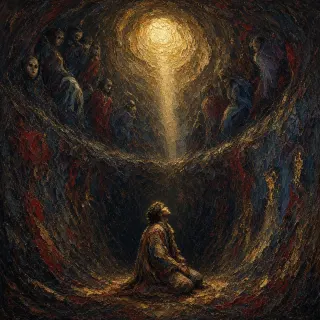
    46:6And they took their cattle, and their goods, which they had gotten in the land of Canaan, and came into Egypt, Jacob, and all his seed with him:

    46:7His sons, and his sons’ sons with him, his daughters, and his sons’ daughters, and all his seed brought he with him into Egypt.

  17. 17

    Genesis 46:28-47:12

    Meeting Joseph; blessing Pharaoh

    Joseph rides to Goshen, falls on his father's neck and weeps a good while. Jacob says, now let me die, since I have seen thy face. Before Pharaoh he calls his years few and evil, a hundred and thirty, and blesses the king twice.

    Before Jacob stands before Pharaoh, he is simply a father holding his son. Joseph goes to meet him in Goshen and weeps on his neck for a long time. Jacob says he can now die, having seen Joseph alive. The words express a reunion completed, not a wish that ends the family journey at once.

    The household still needs somewhere to live and feed its animals. Joseph prepares his brothers to explain their work honestly: they are shepherds, as their fathers were. Goshen offers a place for that way of life. The passage says Egyptians regard shepherds with disgust, yet Pharaoh also owns livestock and wants capable men to oversee it. The issue cannot be reduced to a claim that Egyptians never kept animals.

    Then the old man blesses the king, both on arrival and departure. Pharaoh asks his age; Jacob answers with a description of his years as a pilgrimage, a life spent living as a stranger. His 130 years are few compared with Abraham's 175 and Isaac's 180. Calling them evil means they have been hard and troubled, not that every year was a crime. He comes needing food and pasture, but the passage does not present him as having nothing to give. Egypt can provide land for his flocks. Jacob has a blessing for Egypt's king.

    Verse by verse

    1. 46:28

      Judah is sent ahead to guide the approach to Goshen. The role follows his taking responsibility for Benjamin in chapters 43-44.

    2. 46:34

      The statement about Egyptian dislike of shepherds stands beside Pharaoh's ownership of cattle in 47:6. The passage itself prevents turning that dislike into a claim that Egypt had no livestock economy.

    3. 47:6

      'Men of activity' means capable or competent men for the work. Pharaoh offers responsibility over his own livestock to suitable members of the family.

    4. 47:9

      'Evil' can describe distressing or difficult days. Jacob compares the length and hardship of his life with those of his fathers, not merely the count of his birthdays.

    Genesis 46:28-47:12: Meeting Joseph; blessing Pharaoh

    Genesis 46:28-47:12

    King James Version · 19 verses

    46:28And he sent Judah before him unto Joseph, to direct his face unto Goshen; and they came into the land of Goshen.

    46:29And Joseph made ready his chariot, and went up to meet Israel his father, to Goshen, and presented himself unto him; and he fell on his neck, and wept on his neck a good while.

    46:30And Israel said unto Joseph, Now let me die, since I have seen thy face, because thou art yet alive.

    46:31And Joseph said unto his brethren, and unto his father’s house, I will go up, and shew Pharaoh, and say unto him, My brethren, and my father’s house, which were in the land of Canaan, are come unto me;

    46:32And the men are shepherds, for their trade hath been to feed cattle; and they have brought their flocks, and their herds, and all that they have.

    46:33And it shall come to pass, when Pharaoh shall call you, and shall say, What is your occupation?

    46:34That ye shall say, Thy servants’ trade hath been about cattle from our youth even until now, both we, and also our fathers: that ye may dwell in the land of Goshen; for every shepherd is an abomination unto the Egyptians.

    47:1Then Joseph came and told Pharaoh, and said, My father and my brethren, and their flocks, and their herds, and all that they have, are come out of the land of Canaan; and, behold, they are in the land of Goshen.

    47:2And he took some of his brethren, even five men, and presented them unto Pharaoh.

    47:3And Pharaoh said unto his brethren, What is your occupation? And they said unto Pharaoh, Thy servants are shepherds, both we, and also our fathers.

    47:4They said moreover unto Pharaoh, For to sojourn in the land are we come; for thy servants have no pasture for their flocks; for the famine is sore in the land of Canaan: now therefore, we pray thee, let thy servants dwell in the land of Goshen.

    47:5And Pharaoh spake unto Joseph, saying, Thy father and thy brethren are come unto thee:

    47:6The land of Egypt is before thee; in the best of the land make thy father and brethren to dwell; in the land of Goshen let them dwell: and if thou knowest any men of activity among them, then make them rulers over my cattle.

    47:7And Joseph brought in Jacob his father, and set him before Pharaoh: and Jacob blessed Pharaoh.

    47:8And Pharaoh said unto Jacob, How old art thou?

    47:9And Jacob said unto Pharaoh, The days of the years of my pilgrimage are an hundred and thirty years: few and evil have the days of the years of my life been, and have not attained unto the days of the years of the life of my fathers in the days of their pilgrimage.

    47:10And Jacob blessed Pharaoh, and went out from before Pharaoh.

    47:11And Joseph placed his father and his brethren, and gave them a possession in the land of Egypt, in the best of the land, in the land of Rameses, as Pharaoh had commanded.

    47:12And Joseph nourished his father, and his brethren, and all his father’s household, with bread, according to their families.

  18. 18

    Genesis 48

    Crossed hands over Joseph's sons

    Dying, he adopts Ephraim and Manasseh as his own and blesses them with his hands crossed, the right on the younger, though Joseph tries to correct him. He knows what he is doing: the younger shall be greater. He gives Joseph one portion above his brothers.
    Joseph arranges the sons correctly. Jacob crosses his hands anyway. The father has placed Manasseh, the older son, where Jacob's right hand would naturally rest, and Ephraim at the left. Jacob deliberately gives the younger the favored position. When Joseph tries to correct him, the old man insists that he knows what he is doing.

    Before the hands cross, something even larger happens. Jacob receives these two grandsons as his own sons, with the same standing as Reuben and Simeon. They will carry family shares in their own names, giving Joseph a double place through them. Reuben and Simeon are not erased from the family. The number of inheritance lines changes because two grandsons are raised to the rank of sons.

    Jacob's dim eyes recall Isaac's failing sight in chapter 27, but this blessing is not stolen through mistaken identity. He knows the younger is younger and still places him first. He also describes God as the one who fed him all his life. The Hebrew word pictures a shepherd's care. The man who called his years hard can also say he has been tended through them. He remembers Rachel, blesses both grandsons, and speaks of a return to the land after his death. His eyesight is failing. His account of the promise is not.

    Verse by verse

    1. 48:5

      Receiving Ephraim and Manasseh as sons gives them their own standing in the family inheritance. First Chronicles 5:1 explicitly connects Joseph's sons with the birthright.

    2. 48:15

      The Hebrew verb behind 'fed' is used of shepherding. Jacob describes God's care through the language of the work he himself has done for decades.

    3. 48:19

      Manasseh is also promised greatness. Giving Ephraim the greater place is not the same as denying the older grandson any blessing.

    4. 48:22

      The portion taken with sword and bow is difficult to identify with a separately recorded event. The passage should not be made to endorse Simeon and Levi's attack, which Jacob condemns in Genesis 49:5-7.

    Genesis 48: Crossed hands over Joseph's sons

    Genesis 48

    King James Version · 22 verses

    48:1And it came to pass after these things, that one told Joseph, Behold, thy father is sick: and he took with him his two sons, Manasseh and Ephraim.
    48:2And one told Jacob, and said, Behold, thy son Joseph cometh unto thee: and Israel strengthened himself, and sat upon the bed.

    48:3And Jacob said unto Joseph, God Almighty appeared unto me at Luz in the land of Canaan, and blessed me,

    48:4And said unto me, Behold, I will make thee fruitful, and multiply thee, and I will make of thee a multitude of people; and will give this land to thy seed after thee for an everlasting possession.

    48:5And now thy two sons, Ephraim and Manasseh, which were born unto thee in the land of Egypt before I came unto thee into Egypt, are mine; as Reuben and Simeon, they shall be mine.

    48:6And thy issue, which thou begettest after them, shall be thine, and shall be called after the name of their brethren in their inheritance.

    48:7And as for me, when I came from Padan, Rachel died by me in the land of Canaan in the way, when yet there was but a little way to come unto Ephrath: and I buried her there in the way of Ephrath; the same is Beth-lehem.
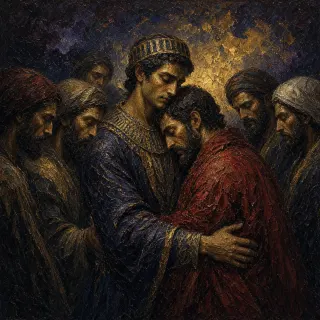
    48:8And Israel beheld Joseph’s sons, and said, Who are these?

    48:9And Joseph said unto his father, They are my sons, whom God hath given me in this place. And he said, Bring them, I pray thee, unto me, and I will bless them.
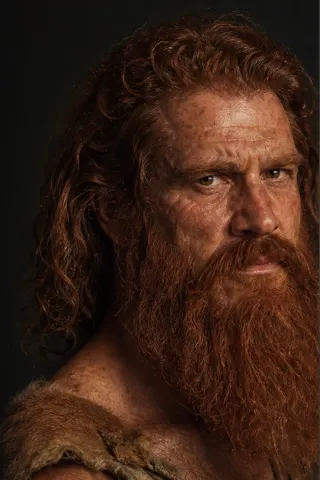
    48:10Now the eyes of Israel were dim for age, so that he could not see. And he brought them near unto him; and he kissed them, and embraced them.

    48:11And Israel said unto Joseph, I had not thought to see thy face: and, lo, God hath shewed me also thy seed.

    48:12And Joseph brought them out from between his knees, and he bowed himself with his face to the earth.

    48:13And Joseph took them both, Ephraim in his right hand toward Israel’s left hand, and Manasseh in his left hand toward Israel’s right hand, and brought them near unto him.

    48:14And Israel stretched out his right hand, and laid it upon Ephraim’s head, who was the younger, and his left hand upon Manasseh’s head, guiding his hands wittingly; for Manasseh was the firstborn.

    48:15And he blessed Joseph, and said, God, before whom my fathers Abraham and Isaac did walk, the God which fed me all my life long unto this day,

    48:16The Angel which redeemed me from all evil, bless the lads; and let my name be named on them, and the name of my fathers Abraham and Isaac; and let them grow into a multitude in the midst of the earth.

    48:17And when Joseph saw that his father laid his right hand upon the head of Ephraim, it displeased him: and he held up his father’s hand, to remove it from Ephraim’s head unto Manasseh’s head.

    48:18And Joseph said unto his father, Not so, my father: for this is the firstborn; put thy right hand upon his head.

    48:19And his father refused, and said, I know it, my son, I know it: he also shall become a people, and he also shall be great: but truly his younger brother shall be greater than he, and his seed shall become a multitude of nations.

    48:20And he blessed them that day, saying, In thee shall Israel bless, saying, God make thee as Ephraim and as Manasseh: and he set Ephraim before Manasseh.

    48:21And Israel said unto Joseph, Behold, I die: but God shall be with you, and bring you again unto the land of your fathers.

    48:22Moreover I have given to thee one portion above thy brethren, which I took out of the hand of the Amorite with my sword and with my bow.

  19. 19

    Genesis 49

    The blessing of the twelve

    He gathers his sons and tells them what will befall them in the last days: Reuben unstable, Simeon and Levi scattered, Judah the lion with the sceptre until Shiloh come, Joseph the fruitful bough, Benjamin the wolf. He charges them to bury him at Machpelah, gathers his feet into the bed, and dies.

    A blessing is not always a compliment. Jacob gathers his sons to speak about their future, and the first words strip away any expectation of easy praise. Reuben's position as firstborn does not protect him from the consequences of entering his father's bed. Simeon and Levi hear their violence named, not dressed up as family loyalty. Jacob curses their anger and speaks of their scattering in Israel.

    The speech looks beyond these men to the tribes descended from them. Judah receives the lion and the sceptre, a ruler's staff. Zebulun's words look toward ships and the coast. Issachar's strong donkey carries the weight of labor. Dan's small serpent can bring down a mounted rider; Gad is attacked and strikes back. Asher has rich food, Naphtali the image of a released deer and good words, and Benjamin a wolf dividing spoil. Joseph's fruitful branch is attacked by archers, yet his strength is tied to the Mighty God of Jacob. These are different futures, not twelve copies of the same promise. In their midst, Jacob pauses to speak of waiting for the LORD's salvation.

    Then the father gives a very specific burial request. Not merely Canaan, but the cave Abraham purchased, where the earlier generations lie. He names Leah's burial there too. The speech has ranged across nations and generations; it ends with a family grave. Jacob draws his feet into the bed and dies, after giving his sons words that reach beyond his own life.

    Verse by verse

    1. 49:4

      The offense recalls Reuben's act with Bilhah in Genesis 35:22. First Chronicles 5:1 also identifies it as the reason he loses the birthright.

    2. 49:5-7

      Jacob condemns Simeon and Levi's fierce anger, recalling Shechem in chapter 34. The curse falls on their anger and wrath, not on the fact that Dinah was their sister.

    3. 49:10

      The meaning of 'Shiloh' is disputed, including whether it is a title or wording about the one to whom rule belongs. The verse's royal language is clear, but a single derivation should not be presented as settled.

    4. 49:9-10

      Revelation 5:5 identifies Jesus with the Lion of the tribe of Judah. That later title draws on the lion and ruling imagery here.

    5. 49:18

      Jacob's statement about waiting for salvation interrupts the addresses to his sons. It is a prayerful turn within the blessing, not another son's name.

    6. 49:31

      This is where Genesis explicitly states that Jacob buried Leah in the ancestral cave. Rachel's roadside burial in chapter 35 remains a different location.

    Genesis 49: The blessing of the twelve

    Genesis 49

    King James Version · 33 verses

    49:1And Jacob called unto his sons, and said, Gather yourselves together, that I may tell you that which shall befall you in the last days.

    49:2Gather yourselves together, and hear, ye sons of Jacob; and hearken unto Israel your father.

    49:3Reuben, thou art my firstborn, my might, and the beginning of my strength, the excellency of dignity, and the excellency of power:

    49:4Unstable as water, thou shalt not excel; because thou wentest up to thy father’s bed; then defiledst thou it: he went up to my couch.

    49:5Simeon and Levi are brethren; instruments of cruelty are in their habitations.

    49:6O my soul, come not thou into their secret; unto their assembly, mine honour, be not thou united: for in their anger they slew a man, and in their selfwill they digged down a wall.

    49:7Cursed be their anger, for it was fierce; and their wrath, for it was cruel: I will divide them in Jacob, and scatter them in Israel.

    49:8Judah, thou art he whom thy brethren shall praise: thy hand shall be in the neck of thine enemies; thy father’s children shall bow down before thee.

    49:9Judah is a lion’s whelp: from the prey, my son, thou art gone up: he stooped down, he couched as a lion, and as an old lion; who shall rouse him up?

    49:10The sceptre shall not depart from Judah, nor a lawgiver from between his feet, until Shiloh come; and unto him shall the gathering of the people be.

    49:11Binding his foal unto the vine, and his ass’s colt unto the choice vine; he washed his garments in wine, and his clothes in the blood of grapes:

    49:12His eyes shall be red with wine, and his teeth white with milk.

    49:13Zebulun shall dwell at the haven of the sea; and he shall be for an haven of ships; and his border shall be unto Zidon.

    49:14Issachar is a strong ass couching down between two burdens:

    49:15And he saw that rest was good, and the land that it was pleasant; and bowed his shoulder to bear, and became a servant unto tribute.

    49:16Dan shall judge his people, as one of the tribes of Israel.

    49:17Dan shall be a serpent by the way, an adder in the path, that biteth the horse heels, so that his rider shall fall backward.

    49:18I have waited for thy salvation, O LORD.

    49:19Gad, a troop shall overcome him: but he shall overcome at the last.

    49:20Out of Asher his bread shall be fat, and he shall yield royal dainties.

    49:21Naphtali is a hind let loose: he giveth goodly words.

    49:22Joseph is a fruitful bough, even a fruitful bough by a well; whose branches run over the wall:

    49:23The archers have sorely grieved him, and shot at him, and hated him:

    49:24But his bow abode in strength, and the arms of his hands were made strong by the hands of the mighty God of Jacob; (from thence is the shepherd, the stone of Israel:)

    49:25Even by the God of thy father, who shall help thee; and by the Almighty, who shall bless thee with blessings of heaven above, blessings of the deep that lieth under, blessings of the breasts, and of the womb:

    49:26The blessings of thy father have prevailed above the blessings of my progenitors unto the utmost bound of the everlasting hills: they shall be on the head of Joseph, and on the crown of the head of him that was separate from his brethren.

    49:27Benjamin shall ravin as a wolf: in the morning he shall devour the prey, and at night he shall divide the spoil.

    49:28All these are the twelve tribes of Israel: and this is it that their father spake unto them, and blessed them; every one according to his blessing he blessed them.

    49:29And he charged them, and said unto them, I am to be gathered unto my people: bury me with my fathers in the cave that is in the field of Ephron the Hittite,

    49:30In the cave that is in the field of Machpelah, which is before Mamre, in the land of Canaan, which Abraham bought with the field of Ephron the Hittite for a possession of a buryingplace.

    49:31There they buried Abraham and Sarah his wife; there they buried Isaac and Rebekah his wife; and there I buried Leah.

    49:32The purchase of the field and of the cave that is therein was from the children of Heth.

    49:33And when Jacob had made an end of commanding his sons, he gathered up his feet into the bed, and yielded up the ghost, and was gathered unto his people.

  20. 20

    Genesis 50:1-14

    Carried home

    Joseph weeps over him and has him embalmed; Egypt mourns seventy days. A great company of Egyptian officials and all Jacob's household go up to Canaan, mourn seven days at the threshing floor of Atad, and bury him in the cave of Machpelah with Abraham and Isaac.

    Jacob leaves Egypt with an escort fit for a man the country has learned to honor, but he does not leave alive. Joseph falls upon his father's face, weeps, and kisses him. Then he directs physicians to preserve the body. The public mourning and the long procession do not replace that first private moment between father and son.

    Joseph asks permission to fulfill the burial oath. Pharaoh allows it, and Egyptian officials travel with Jacob's family. The company is large enough to draw attention from the people of Canaan, who name the place of mourning for the Egyptians they see there. Yet the destination is not an Egyptian royal tomb. The sons carry Jacob to Machpelah, the cave purchased by Abraham and named in their father's instructions.

    The return is carefully limited. Children, flocks, and herds remain in Goshen, and the mourners go back to Egypt after the burial. This is not yet the departure of Israel's descendants from Egypt. It is one father's return to the land promised to his family. The promise of return in Genesis 46:4 receives this immediate, bodily expression, while the larger family remains abroad. Egypt honors him. Canaan receives him.

    Verse by verse

    1. 50:2-3

      Embalming preserves a body, making the journey to Canaan possible. The forty days of treatment and seventy days of mourning should not automatically be added into 110 days; the passage does not state that they are separate, successive periods.

    2. 50:5

      Joseph appeals to the oath his father required in Genesis 47:29-31. His request is to complete that obligation and then return to Egypt.

    3. 50:13

      Jacob is buried at Machpelah; Joshua 24:32 places Joseph's later burial at Shechem. Acts 7:15-16 compresses the ancestral burial account with different purchase and place details, whose relationship to these passages is disputed.

    4. 50:14

      The mourners return to Egypt, where the children and livestock have remained. Genesis 47:28 gives Jacob's age at death as 147, after seventeen years in Egypt.

    Genesis 50:1-14

    King James Version · 14 verses

    50:1And Joseph fell upon his father’s face, and wept upon him, and kissed him.

    50:2And Joseph commanded his servants the physicians to embalm his father: and the physicians embalmed Israel.

    50:3And forty days were fulfilled for him; for so are fulfilled the days of those which are embalmed: and the Egyptians mourned for him threescore and ten days.

    50:4And when the days of his mourning were past, Joseph spake unto the house of Pharaoh, saying, If now I have found grace in your eyes, speak, I pray you, in the ears of Pharaoh, saying,

    50:5My father made me swear, saying, Lo, I die: in my grave which I have digged for me in the land of Canaan, there shalt thou bury me. Now therefore let me go up, I pray thee, and bury my father, and I will come again.

    50:6And Pharaoh said, Go up, and bury thy father, according as he made thee swear.

    50:7And Joseph went up to bury his father: and with him went up all the servants of Pharaoh, the elders of his house, and all the elders of the land of Egypt,

    50:8And all the house of Joseph, and his brethren, and his father’s house: only their little ones, and their flocks, and their herds, they left in the land of Goshen.

    50:9And there went up with him both chariots and horsemen: and it was a very great company.

    50:10And they came to the threshingfloor of Atad, which is beyond Jordan, and there they mourned with a great and very sore lamentation: and he made a mourning for his father seven days.

    50:11And when the inhabitants of the land, the Canaanites, saw the mourning in the floor of Atad, they said, This is a grievous mourning to the Egyptians: wherefore the name of it was called Abel-mizraim, which is beyond Jordan.

    50:12And his sons did unto him according as he commanded them:

    50:13For his sons carried him into the land of Canaan, and buried him in the cave of the field of Machpelah, which Abraham bought with the field for a possession of a buryingplace of Ephron the Hittite, before Mamre.

    50:14And Joseph returned into Egypt, he, and his brethren, and all that went up with him to bury his father, after he had buried his father.

The people, the places and the rest of Scripture.

Reading Jacob closely

The people he dealt with

Esau is the brother he wronged twice and feared for twenty years. The stew and the stolen blessing are Jacob's doing, and the account does not excuse them, but it also records that God had chosen the younger before either was born. When they meet again Esau is generous and Jacob is wary, bowing seven times and calling him lord, and they part as neighbours rather than as brothers. They meet once more to bury Isaac.

His parents split over him. Rebekah loves him and plans the deception; Isaac loves Esau but ends by blessing Jacob knowingly and sending him off with the blessing of Abraham. Jacob never sees his mother again. Laban is the mirror held up to him: a smooth talker who substitutes one sibling for another in the dark, changes his wages ten times, and chases him down to accuse him of theft. Jacob answers him with the only long speech he makes about himself, twenty years of heat by day and frost by night.

Leah and Rachel are the wives he did not choose in the order he chose. He loves Rachel, and the text says Leah was hated, and God opens Leah's womb because of it. The rivalry between the sisters produces his twelve sons and much of his household's misery. Of the sons, Joseph is the one he loves openly, Benjamin the one he cannot let go, Reuben the one who loses the firstborn's place, Simeon and Levi the ones whose anger he curses, and Judah the one who pledges himself for Benjamin and receives the sceptre.

Genesis 25
Genesis 25

The two nights

Jacob's life turns on two nights alone with God. At Bethel he is a fugitive with a stone for a pillow, and God comes down the ladder to him unasked, with promises he has done nothing to earn. His response is a vow with conditions in it: if God will be with me, then shall the LORD be my God. He is bargaining even here.

At Peniel, twenty years later, he is a rich man terrified of his brother, and this time the stranger attacks him. He fights all night, is crippled, and stops fighting and starts clinging. The name he is given is not a reward for winning. It marks the man who has finally learned to hold on rather than to grasp. He limps away into the sunrise, and Israel has not stopped remembering that the sinew shrank. Hosea puts both nights together: he took his brother by the heel in the womb, and by his strength he had power with God, and he found him in Bethel.

Genesis 26

What came before and what followed

The promise came to Abraham as a single man, passed to Isaac as a single son, and with Jacob became a nation. Behind him are the oracle to Rebekah, Ishmael's exclusion, and the pattern of the younger chosen over the elder, which he repeats with his own grandsons when he crosses his hands. Ahead of him the whole book of Exodus begins with his name, these are the names of the children of Israel who came into Egypt, and his descent to Goshen with seventy souls is the reason there is a people to bring out four hundred years later.

His blessings in Genesis 49 are the first prophecy of tribal history, and Moses' blessing in Deuteronomy 33 answers them. Judah's sceptre, Joseph's double portion through Ephraim and Manasseh, Levi's scattering that becomes the priesthood, and Benjamin's ferocity all unfold across Judges, Samuel and Kings. His bones go home before his people do, and Joseph, following his example, asks for the same.

Genesis 26
Genesis 26

Where the rest of Scripture reaches back

Jacob is named more than three hundred times outside Genesis, most often as the people rather than the man. The Psalms call God the God of Jacob and his people the seed of Jacob. Isaiah addresses Jacob my servant, Israel whom I have chosen. Hosea 12 retells his life in five verses as a sermon to his descendants. Malachi opens with Jacob have I loved, and Esau have I hated, and Paul builds Romans 9 on that verse and the oracle to Rebekah: the purpose of God according to election stands, not of works, but of him that calleth.

Jesus tells Nathanael he will see heaven open and the angels of God ascending and descending upon the Son of man, making himself the ladder of Bethel. The Samaritan woman speaks with him beside Jacob's well. Hebrews 11 lists Jacob among those who dwelt in tents as heirs of the promise, and remembers him dying, blessing both the sons of Joseph, worshipping, leaning upon the top of his staff. Stephen's speech and the genealogies of Matthew and Luke carry him into the New Testament as the father of the patriarchs and the ancestor of Christ.

Genesis 26
Genesis 27

Why it matters

Jacob is the man the nation is named after. Every time Scripture says Israel it is saying his new name, and the twelve tribes are his twelve sons. God calls himself the God of Jacob more than forty times, and the phrase the God of Abraham, Isaac and Jacob is how he introduced himself to Moses. The promise that ran through one son in each generation, Isaac and not Ishmael, Jacob and not Esau, widens with him to a whole family, and his deathbed blessings in Genesis 49 are the first map of what each tribe will become, including the sceptre that will not depart from Judah until Shiloh come.

He is also the Bible's clearest picture of grace working on an unpromising man. He deceives, is deceived, bargains with God at Bethel, and only at Peniel, lamed and clinging, says: I will not let thee go except thou bless me. Hosea reads that night as the turning point: he had power over the angel, and prevailed; he wept, and made supplication. Paul uses Jacob and Esau to teach election, Jacob have I loved, and Hebrews remembers him worshipping on the top of his staff, blessing Joseph's sons with crossed hands. Jesus told Nathanael he would see heaven open and angels ascending and descending on the Son of man, which is Jacob's ladder with Christ as the stair.

15 songs

The music

Every song in the catalogue whose passage falls inside these chapters.

  1. Genesis 23:1-25:18

    Led to the Well

  2. Genesis 25:19-28:22

    The Blessing and the Ladder

  3. Genesis 25:19-34; 27

    The Blessing Taken

  4. Genesis 28:10-22

    A Ladder in the Night

  5. Genesis 28:10-22

    Jacob's Ladder

  6. Genesis 28:10-22

    The Gate of Heaven

  7. Genesis 29:1-31:55

    Twenty Years in Haran

  8. Genesis 32:1-36:40

    No Longer Jacob

  9. Genesis 32:22-32

    Until the Breaking of Day

  10. Genesis 37

    Into the Pit

  11. Genesis 37:1-38:30

    The Dreamer in the Pit

  12. Genesis 39:1-41:57

    From Prison to the Throne

  13. Genesis 39-40

    The Prisoner Still Dreamed

  14. Genesis 41-50

    What You Meant for Evil

  15. Genesis 42:1-50:26

    You Meant It for Evil

Nearby

All the people

Report an error on this page