New · FreePlay The Witnesses The in-depth puzzle battle quest through Bible history

People of the Bible

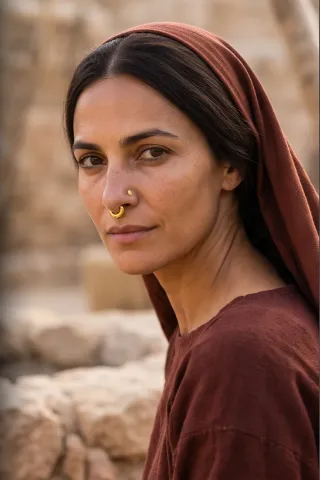
Isaac

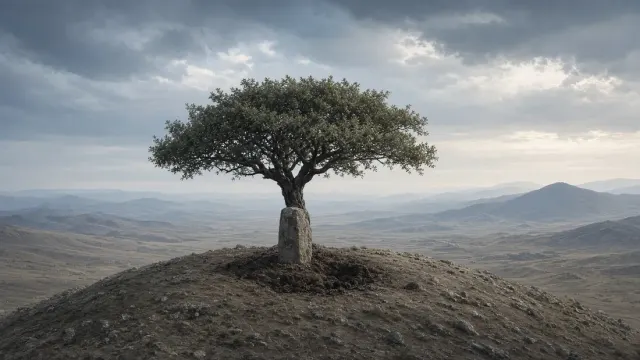
The son of laughter, bound on a mountain and spared, who dug his father's wells again.

Also called The child of promise; the only patriarch who never left the land

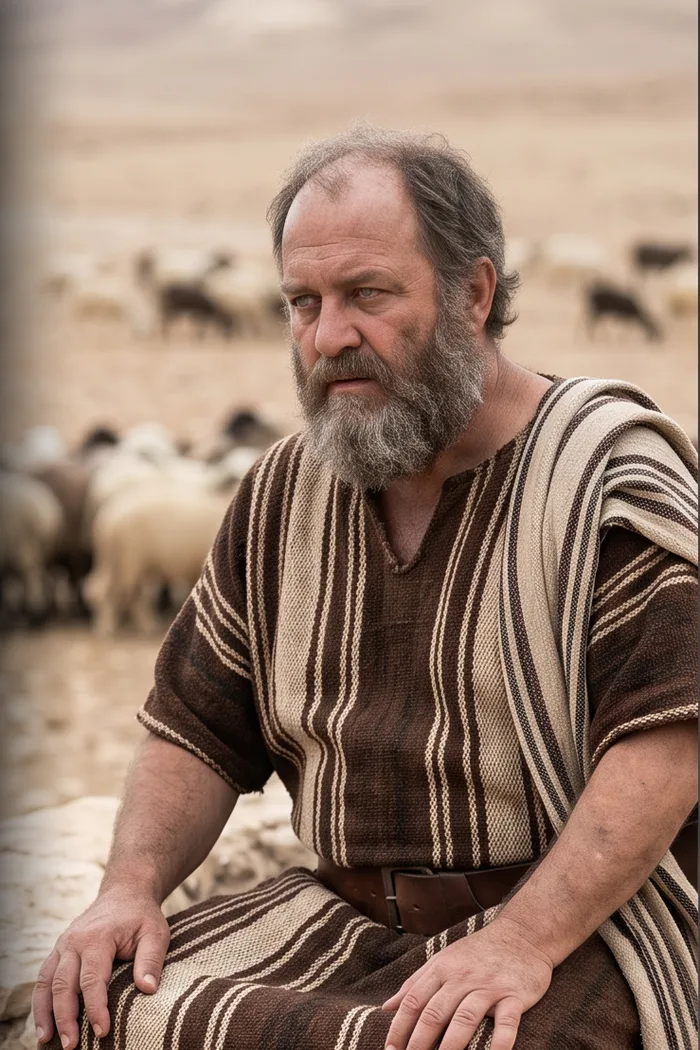
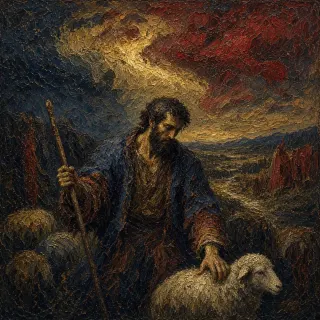
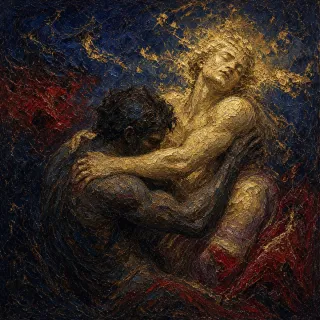
Isaac is the son God promised to Abraham and Sarah, born when his father was a hundred and his mother ninety, and named for the laughter his announcement caused. He is circumcised on the eighth day, weaned with a feast, and as a young man walks up Mount Moriah beside his father carrying the wood for his own sacrifice. He asks one question, where is the lamb, and is bound on the altar before the angel calls and the ram is found. At forty he marries Rebekah, brought from Haran by his father's servant, and he loves her. She is barren for twenty years until he prays, and then she bears twins who fight in the womb.

He is the quietest of the patriarchs. He repeats his father's lie about his wife at Gerar, reopens his father's wells and names them again, and makes peace with the Philistine king at Beersheba, where God renews the promise to him for his father's sake. He loves Esau, the hunter, and Rebekah loves Jacob, and when he is old and blind he is deceived into giving Jacob the blessing meant for Esau. He trembles, and does not take it back. He sends Jacob to Haran with the blessing of Abraham, lives to see him return, and dies at a hundred and eighty, buried at Machpelah by both his sons.

Where he appearsGenesis 17 to 35

Scroll down to the account
Isaac

The movements, in the order the text gives them.

The Account of Isaac

  1. 01

    Genesis 17:19; 18:10-15

    Named before he was conceived

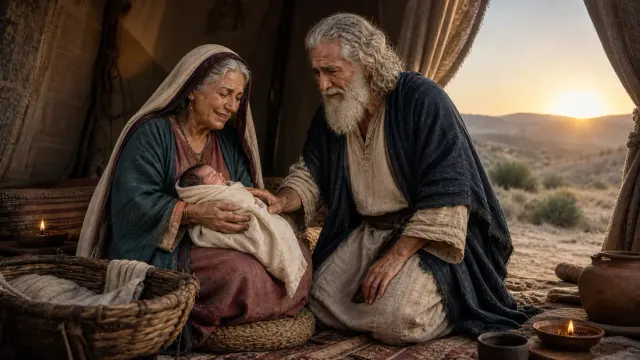
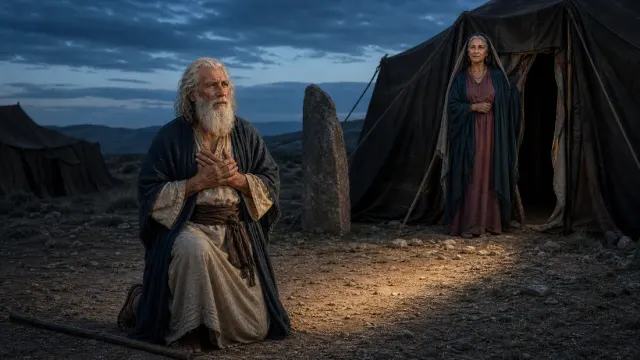
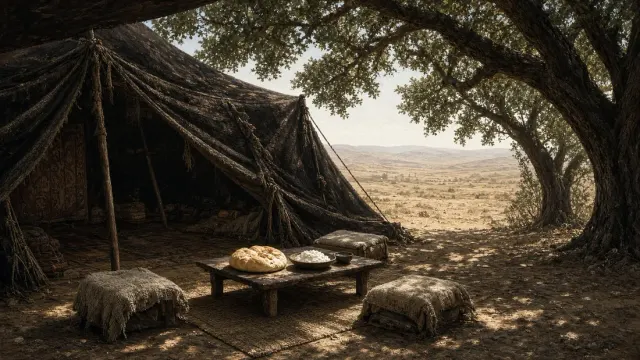
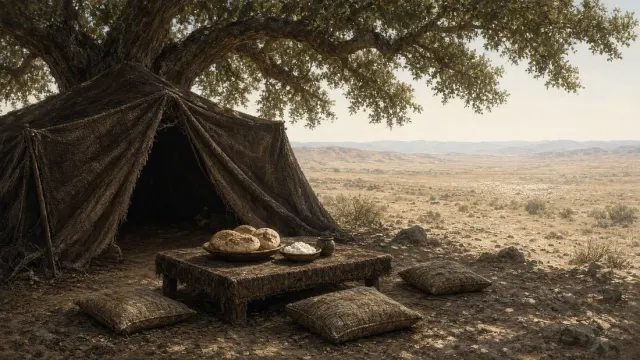
    God tells Abraham that Sarah will bear a son and that his name will be Isaac, and that the covenant will be with him. A year later, at the tent door, Sarah laughs at the same promise, and the name is fixed by both parents' laughter.

    He is named before he is conceived, and the name is a joke that God insists on keeping. Thou shalt call his name Isaac, he laughs. Abraham had already laughed at the idea in 17:17, and when the visitors repeat the promise at the tent door Sarah laughs too, within herself, at a body that has stopped being able. The LORD hears what was never said aloud and asks the question the whole chapter turns on: is any thing too hard for the LORD? Sarah denies it, for she was afraid, and the reply is four flat words, Nay, but thou didst laugh. God neither scolds her nor withdraws the promise. He fixes the laughter into the child's name, so that every time anyone says it for the rest of the Bible, the doubt and the answer are said together.

    Verse by verse

    1. 17:19

      Isaac: he laughs. Abraham laughs in 17:17, Sarah in 18:12, and she laughs again for joy in 21:6.

    2. 18:12

      Within herself: unspoken. The point of the exchange is that God answers a thought.

    3. 18:14

      Is any thing too hard for the LORD: the question is repeated to Jeremiah in 32:27 and echoed by the angel to Mary in Luke 1:37.

    4. 18:15

      For she was afraid: the text gives her reason for lying, which is not the same as excusing it.

    Genesis 17:19; 18:10-15

    King James Version · 7 verses

    17:19And God said, Sarah thy wife shall bear thee a son indeed; and thou shalt call his name Isaac: and I will establish my covenant with him for an everlasting covenant, and with his seed after him.

    18:10And he said, I will certainly return unto thee according to the time of life; and, lo, Sarah thy wife shall have a son. And Sarah heard it in the tent door, which was behind him.

    18:11Now Abraham and Sarah were old and well stricken in age; and it ceased to be with Sarah after the manner of women.

    18:12Therefore Sarah laughed within herself, saying, After I am waxed old shall I have pleasure, my lord being old also?

    18:13And the LORD said unto Abraham, Wherefore did Sarah laugh, saying, Shall I of a surety bear a child, which am old?

    18:14Is any thing too hard for the LORD? At the time appointed I will return unto thee, according to the time of life, and Sarah shall have a son.

    18:15Then Sarah denied, saying, I laughed not; for she was afraid. And he said, Nay; but thou didst laugh.

  2. 02

    Genesis 21:1-8

    Born, circumcised, weaned

    The LORD visits Sarah as he had said, and Isaac is born at the appointed time. Abraham circumcises him at eight days as God commanded, and makes a great feast on the day he is weaned. Sarah says God has made her laugh.

    Three times in two verses the text insists this was promised: as he had said, as he had spoken, at the set time of which God had spoken. Nothing here is accident or reward, it is a date being kept. Abraham is a hundred years old. He circumcises the boy on the eighth day, exactly as commanded, which is the first time anyone keeps that law with a newborn. Then Sarah speaks, and her words turn the old joke inside out: God hath made me to laugh, so that all that hear will laugh with me. The laugh of disbelief in chapter 18 has become a laugh she wants the neighbours to share. The chapter ends at the weaning feast, a normal family celebration, which is also where the trouble with Ishmael begins.

    Verse by verse

    1. 21:1

      The LORD visited Sarah: the verb used when God acts on a promise, as in 50:24 and Exodus 4:31.

    2. 21:4

      Eight days old: the command of 17:12, kept here for the first time on a child of the covenant.

    3. 21:6

      God hath made me to laugh: the same root as Isaac's name, now meaning delight instead of disbelief.

    4. 21:8

      Weaned: probably around three years old. The feast marks a child who has survived infancy.

    Genesis 21:1-8

    King James Version · 8 verses

    21:1And the LORD visited Sarah as he had said, and the LORD did unto Sarah as he had spoken.

    21:2For Sarah conceived, and bare Abraham a son in his old age, at the set time of which God had spoken to him.

    21:3And Abraham called the name of his son that was born unto him, whom Sarah bare to him, Isaac.

    21:4And Abraham circumcised his son Isaac being eight days old, as God had commanded him.

    21:5And Abraham was an hundred years old, when his son Isaac was born unto him.

    21:6And Sarah said, God hath made me to laugh, so that all that hear will laugh with me.

    21:7And she said, Who would have said unto Abraham, that Sarah should have given children suck? for I have born him a son in his old age.

    21:8And the child grew, and was weaned: and Abraham made a great feast the same day that Isaac was weaned.

    Genesis 21:1-8: Born, circumcised, weaned
  3. 03

    Genesis 22:1-14

    Moriah

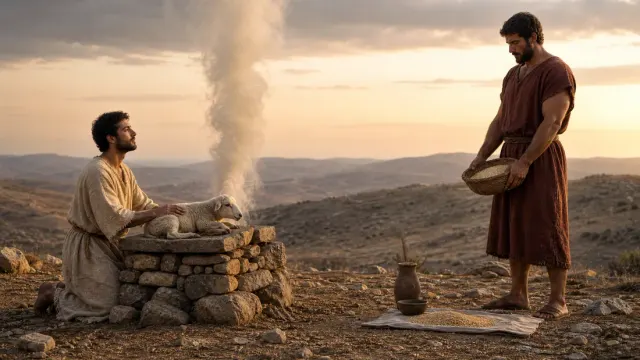
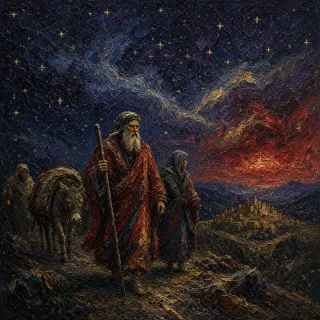
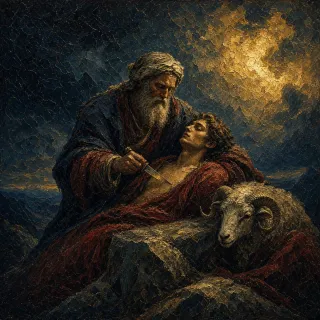
    God tells Abraham to take Isaac, his only son, whom he loves, and offer him. Isaac carries the wood and asks where the lamb is. Abraham binds him on the altar and takes the knife, and the angel of the LORD stops him. A ram is caught in a thicket, and the place is called the LORD will provide.

    The chapter is told from the father's side, and Isaac's part is a handful of details that are easy to pass over. He carries the wood, which means he is old enough to carry it, not an infant. He walks three days with a father who has told him nothing. He asks one question, and it is the right one: behold the fire and the wood, but where is the lamb. The answer he gets is not an answer, God will provide himself a lamb, and the text says twice that they went both of them together. Then he is bound and laid on the altar by a man of well over a hundred, which no strong young man permits unless he consents to it. He says nothing more in the chapter. Whatever else this is, it is not something done to a child who did not understand.

    Verse by verse

    1. 22:2

      Thine only son: Ishmael has been sent away in the previous chapter. Isaac is the only son of the promise, which is what is being asked for.

    2. 22:6

      Laid it upon Isaac his son: he carries the wood for his own offering, a detail the early church read alongside John 19:17.

    3. 22:8

      God will provide himself a lamb: it can be read as a deflection or as faith. Verse 13 supplies a ram, and the name in verse 14 keeps the promise open.

    4. 22:9

      Bound Isaac his son: Jewish tradition calls the whole episode the Akedah, the binding, naming it for this verse rather than for the knife.

    5. 22:12

      Now I know: the testing was to make something evident, not to inform God. Verse 1 already told the reader it was a test.

    6. 22:14

      Jehovah-jireh: the LORD will see, or provide. Moriah is named again in 2 Chronicles 3:1 as the site of the temple.

    Genesis 22:1-14: Moriah

    Genesis 22:1-14

    King James Version · 14 verses

    22:1And it came to pass after these things, that God did tempt Abraham, and said unto him, Abraham: and he said, Behold, here I am.

    22:2And he said, Take now thy son, thine only son Isaac, whom thou lovest, and get thee into the land of Moriah; and offer him there for a burnt offering upon one of the mountains which I will tell thee of.

    22:3And Abraham rose up early in the morning, and saddled his ass, and took two of his young men with him, and Isaac his son, and clave the wood for the burnt offering, and rose up, and went unto the place of which God had told him.

    22:4Then on the third day Abraham lifted up his eyes, and saw the place afar off.

    22:5And Abraham said unto his young men, Abide ye here with the ass; and I and the lad will go yonder and worship, and come again to you.

    22:6And Abraham took the wood of the burnt offering, and laid it upon Isaac his son; and he took the fire in his hand, and a knife; and they went both of them together.

    22:7And Isaac spake unto Abraham his father, and said, My father: and he said, Here am I, my son. And he said, Behold the fire and the wood: but where is the lamb for a burnt offering?

    22:8And Abraham said, My son, God will provide himself a lamb for a burnt offering: so they went both of them together.

    22:9And they came to the place which God had told him of; and Abraham built an altar there, and laid the wood in order, and bound Isaac his son, and laid him on the altar upon the wood.

    22:10And Abraham stretched forth his hand, and took the knife to slay his son.

    22:11And the angel of the LORD called unto him out of heaven, and said, Abraham, Abraham: and he said, Here am I.

    22:12And he said, Lay not thine hand upon the lad, neither do thou any thing unto him: for now I know that thou fearest God, seeing thou hast not withheld thy son, thine only son from me.

    22:13And Abraham lifted up his eyes, and looked, and behold behind him a ram caught in a thicket by his horns: and Abraham went and took the ram, and offered him up for a burnt offering in the stead of his son.

    22:14And Abraham called the name of that place Jehovah-jireh: as it is said to this day, In the mount of the LORD it shall be seen.

  4. 04

    Genesis 24

    Rebekah comes

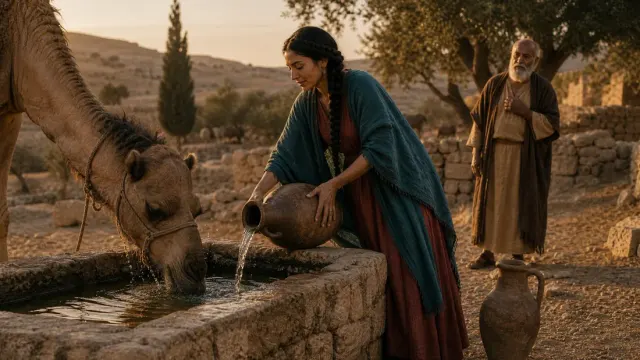
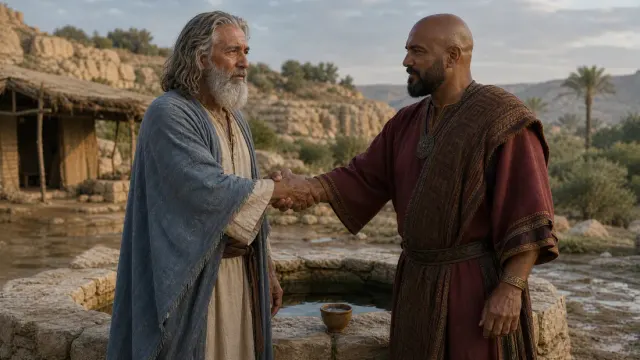
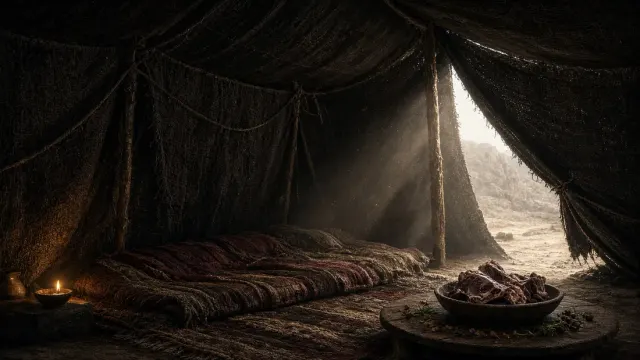
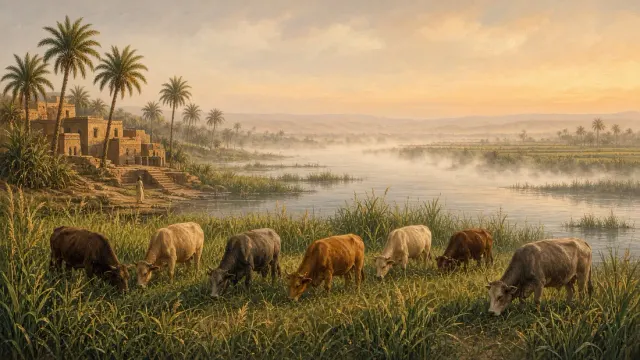
    Abraham sends his servant to Haran for a wife from his own kindred. The servant prays at the well, and Rebekah waters his camels. Isaac, meditating in the field at evening, sees the camels coming. He takes her into his mother's tent, and he loves her, and is comforted after Sarah's death.

    The longest chapter in Genesis is about finding Isaac a wife, and Isaac is absent from nearly all of it. His father swears the servant to two conditions, not a Canaanite and not taking Isaac back to Mesopotamia, and then the account belongs to the servant, who prays for a specific sign at a well and gets it while he is still speaking. Rebekah waters ten camels, which is a great deal of water and the chapter's way of showing character without describing it. Her family agrees, then tries to delay, and she is asked directly: wilt thou go with this man? And she said, I will go. Isaac appears only at the end, walking in the field at eventide to meditate, and lifts up his eyes to see the camels coming. He takes her into his mother's tent, and the chapter closes with the first sentence in the Bible about a husband loving his wife, joined to the first about grief easing: and Isaac was comforted after his mother's death.

    Verse by verse

    1. 24:2

      Thy hand under my thigh: the most solemn oath in the patriarchal narratives, used again by Jacob in 47:29.

    2. 24:14

      The servant asks for a sign of character, not of beauty or wealth. Watering ten camels is hours of work for a stranger.

    3. 24:27

      I being in the way, the LORD led me: the servant's summary of the whole chapter, said before anything is settled.

    4. 24:58

      I will go: Rebekah is asked and answers for herself, which is not assumed in an arranged match of this period.

    5. 24:63

      To meditate in the field at the eventide: the only glimpse of Isaac's inner life the book gives.

    6. 24:67

      He loved her: the first time the Bible says a husband loved his wife. Sarah has been dead three years.

    Genesis 24: Rebekah comes

    Genesis 24

    King James Version · 67 verses

    24:1And Abraham was old, and well stricken in age: and the LORD had blessed Abraham in all things.

    24:2And Abraham said unto his eldest servant of his house, that ruled over all that he had, Put, I pray thee, thy hand under my thigh:

    24:3And I will make thee swear by the LORD, the God of heaven, and the God of the earth, that thou shalt not take a wife unto my son of the daughters of the Canaanites, among whom I dwell:

    24:4But thou shalt go unto my country, and to my kindred, and take a wife unto my son Isaac.

    24:5And the servant said unto him, Peradventure the woman will not be willing to follow me unto this land: must I needs bring thy son again unto the land from whence thou camest?

    24:6And Abraham said unto him, Beware thou that thou bring not my son thither again.

    24:7The LORD God of heaven, which took me from my father’s house, and from the land of my kindred, and which spake unto me, and that sware unto me, saying, Unto thy seed will I give this land; he shall send his angel before thee, and thou shalt take a wife unto my son from thence.

    24:8And if the woman will not be willing to follow thee, then thou shalt be clear from this my oath: only bring not my son thither again.

    24:9And the servant put his hand under the thigh of Abraham his master, and sware to him concerning that matter.

    24:10And the servant took ten camels of the camels of his master, and departed; for all the goods of his master were in his hand: and he arose, and went to Mesopotamia, unto the city of Nahor.

    24:11And he made his camels to kneel down without the city by a well of water at the time of the evening, even the time that women go out to draw water.

    24:12And he said, O LORD God of my master Abraham, I pray thee, send me good speed this day, and shew kindness unto my master Abraham.

    24:13Behold, I stand here by the well of water; and the daughters of the men of the city come out to draw water:

    24:14And let it come to pass, that the damsel to whom I shall say, Let down thy pitcher, I pray thee, that I may drink; and she shall say, Drink, and I will give thy camels drink also: let the same be she that thou hast appointed for thy servant Isaac; and thereby shall I know that thou hast shewed kindness unto my master.

    24:15And it came to pass, before he had done speaking, that, behold, Rebekah came out, who was born to Bethuel, son of Milcah, the wife of Nahor, Abraham’s brother, with her pitcher upon her shoulder.

    24:16And the damsel was very fair to look upon, a virgin, neither had any man known her: and she went down to the well, and filled her pitcher, and came up.

    24:17And the servant ran to meet her, and said, Let me, I pray thee, drink a little water of thy pitcher.

    24:18And she said, Drink, my lord: and she hasted, and let down her pitcher upon her hand, and gave him drink.

    24:19And when she had done giving him drink, she said, I will draw water for thy camels also, until they have done drinking.

    24:20And she hasted, and emptied her pitcher into the trough, and ran again unto the well to draw water, and drew for all his camels.

    24:21And the man wondering at her held his peace, to wit whether the LORD had made his journey prosperous or not.

    24:22And it came to pass, as the camels had done drinking, that the man took a golden earring of half a shekel weight, and two bracelets for her hands of ten shekels weight of gold;

    24:23And said, Whose daughter art thou? tell me, I pray thee: is there room in thy father’s house for us to lodge in?

    24:24And she said unto him, I am the daughter of Bethuel the son of Milcah, which she bare unto Nahor.

    24:25She said moreover unto him, We have both straw and provender enough, and room to lodge in.

    24:26And the man bowed down his head, and worshipped the LORD.

    24:27And he said, Blessed be the LORD God of my master Abraham, who hath not left destitute my master of his mercy and his truth: I being in the way, the LORD led me to the house of my master’s brethren.

    24:28And the damsel ran, and told them of her mother’s house these things.

    24:29And Rebekah had a brother, and his name was Laban: and Laban ran out unto the man, unto the well.

    24:30And it came to pass, when he saw the earring and bracelets upon his sister’s hands, and when he heard the words of Rebekah his sister, saying, Thus spake the man unto me; that he came unto the man; and, behold, he stood by the camels at the well.

    24:31And he said, Come in, thou blessed of the LORD; wherefore standest thou without? for I have prepared the house, and room for the camels.

    24:32And the man came into the house: and he ungirded his camels, and gave straw and provender for the camels, and water to wash his feet, and the men’s feet that were with him.

    24:33And there was set meat before him to eat: but he said, I will not eat, until I have told mine errand. And he said, Speak on.

    24:34And he said, I am Abraham’s servant.

    24:35And the LORD hath blessed my master greatly; and he is become great: and he hath given him flocks, and herds, and silver, and gold, and menservants, and maidservants, and camels, and asses.

    24:36And Sarah my master’s wife bare a son to my master when she was old: and unto him hath he given all that he hath.

    24:37And my master made me swear, saying, Thou shalt not take a wife to my son of the daughters of the Canaanites, in whose land I dwell:

    24:38But thou shalt go unto my father’s house, and to my kindred, and take a wife unto my son.

    24:39And I said unto my master, Peradventure the woman will not follow me.

    24:40And he said unto me, The LORD, before whom I walk, will send his angel with thee, and prosper thy way; and thou shalt take a wife for my son of my kindred, and of my father’s house:

    24:41Then shalt thou be clear from this my oath, when thou comest to my kindred; and if they give not thee one, thou shalt be clear from my oath.

    24:42And I came this day unto the well, and said, O LORD God of my master Abraham, if now thou do prosper my way which I go:

    24:43Behold, I stand by the well of water; and it shall come to pass, that when the virgin cometh forth to draw water, and I say to her, Give me, I pray thee, a little water of thy pitcher to drink;

    24:44And she say to me, Both drink thou, and I will also draw for thy camels: let the same be the woman whom the LORD hath appointed out for my master’s son.

    24:45And before I had done speaking in mine heart, behold, Rebekah came forth with her pitcher on her shoulder; and she went down unto the well, and drew water: and I said unto her, Let me drink, I pray thee.

    24:46And she made haste, and let down her pitcher from her shoulder, and said, Drink, and I will give thy camels drink also: so I drank, and she made the camels drink also.

    24:47And I asked her, and said, Whose daughter art thou? And she said, The daughter of Bethuel, Nahor’s son, whom Milcah bare unto him: and I put the earring upon her face, and the bracelets upon her hands.

    24:48And I bowed down my head, and worshipped the LORD, and blessed the LORD God of my master Abraham, which had led me in the right way to take my master’s brother’s daughter unto his son.

    24:49And now if ye will deal kindly and truly with my master, tell me: and if not, tell me; that I may turn to the right hand, or to the left.

    24:50Then Laban and Bethuel answered and said, The thing proceedeth from the LORD: we cannot speak unto thee bad or good.

    24:51Behold, Rebekah is before thee, take her, and go, and let her be thy master’s son’s wife, as the LORD hath spoken.

    24:52And it came to pass, that, when Abraham’s servant heard their words, he worshipped the LORD, bowing himself to the earth.

    24:53And the servant brought forth jewels of silver, and jewels of gold, and raiment, and gave them to Rebekah: he gave also to her brother and to her mother precious things.

    24:54And they did eat and drink, he and the men that were with him, and tarried all night; and they rose up in the morning, and he said, Send me away unto my master.

    24:55And her brother and her mother said, Let the damsel abide with us a few days, at the least ten; after that she shall go.

    24:56And he said unto them, Hinder me not, seeing the LORD hath prospered my way; send me away that I may go to my master.

    24:57And they said, We will call the damsel, and enquire at her mouth.

    24:58And they called Rebekah, and said unto her, Wilt thou go with this man? And she said, I will go.

    24:59And they sent away Rebekah their sister, and her nurse, and Abraham’s servant, and his men.

    24:60And they blessed Rebekah, and said unto her, Thou art our sister, be thou the mother of thousands of millions, and let thy seed possess the gate of those which hate them.

    24:61And Rebekah arose, and her damsels, and they rode upon the camels, and followed the man: and the servant took Rebekah, and went his way.

    24:62And Isaac came from the way of the well Lahai-roi; for he dwelt in the south country.

    24:63And Isaac went out to meditate in the field at the eventide: and he lifted up his eyes, and saw, and, behold, the camels were coming.

    24:64And Rebekah lifted up her eyes, and when she saw Isaac, she lighted off the camel.

    24:65For she had said unto the servant, What man is this that walketh in the field to meet us? And the servant had said, It is my master: therefore she took a vail, and covered herself.

    24:66And the servant told Isaac all things that he had done.

    24:67And Isaac brought her into his mother Sarah’s tent, and took Rebekah, and she became his wife; and he loved her: and Isaac was comforted after his mother’s death.

  5. 05

    Genesis 25:19-26

    Twenty years, then twins

    Rebekah is barren, and Isaac entreats the LORD for her, and she conceives. The children struggle within her, and she is told two nations are in her womb and the elder will serve the younger. Esau comes out red and hairy, Jacob holding his heel. Isaac is sixty.

    The pattern of his parents repeats on him. Rebekah was barren, and Isaac intreated the LORD for his wife, and the answer comes after twenty years of waiting, which the text mentions almost in passing by giving his age at both ends. When she conceives, the pregnancy is violent, and her question is the honest one: if it be so, why am I thus? She goes to enquire of the LORD herself, and receives an oracle that reverses the ordinary order before either child is born: the elder shall serve the younger. Then the birth, with the details that will decide the family's next fifty years. Esau comes out red and hairy. Jacob comes out holding his brother's heel, and is named for it. Isaac is sixty, and everything that goes wrong later is already present in this paragraph.

    Verse by verse

    1. 25:21

      Isaac intreated the LORD for his wife: he prays for her rather than taking a second wife, which is what his father did.

    2. 25:22

      She went to enquire of the LORD: Rebekah seeks the answer directly, and the oracle is given to her, not to Isaac.

    3. 25:23

      The elder shall serve the younger: the reversal is announced before birth, before either has done anything. Paul quotes it in Romans 9:12.

    4. 25:26

      Jacob: he takes by the heel, or he supplants. The name is a description that becomes a character.

    Genesis 25:19-26

    King James Version · 8 verses

    25:19And these are the generations of Isaac, Abraham’s son: Abraham begat Isaac:

    25:20And Isaac was forty years old when he took Rebekah to wife, the daughter of Bethuel the Syrian of Padan-aram, the sister to Laban the Syrian.

    25:21And Isaac intreated the LORD for his wife, because she was barren: and the LORD was intreated of him, and Rebekah his wife conceived.

    25:22And the children struggled together within her; and she said, If it be so, why am I thus? And she went to enquire of the LORD.

    25:23And the LORD said unto her, Two nations are in thy womb, and two manner of people shall be separated from thy bowels; and the one people shall be stronger than the other people; and the elder shall serve the younger.

    25:24And when her days to be delivered were fulfilled, behold, there were twins in her womb.

    25:25And the first came out red, all over like an hairy garment; and they called his name Esau.

    25:26And after that came his brother out, and his hand took hold on Esau’s heel; and his name was called Jacob: and Isaac was threescore years old when she bare them.

  6. 06

    Genesis 26:1-11

    Gerar

    In a famine God tells him not to go down to Egypt but to stay in Gerar, and renews every promise made to Abraham. There he says Rebekah is his sister, as his father had said of Sarah, and Abimelech sees him caressing her through a window and rebukes him.

    Famine sends him toward Egypt and God stops him: sojourn in this land, and I will be with thee. It is the only time God speaks to Isaac at length, and the promise given to Abraham is repeated to him word for word, with the reason attached: because that Abraham obeyed my voice. Then Isaac does the one thing his father did twice. He tells the men of Gerar that Rebekah is his sister, because he feared to say, she is my wife, lest the men of the place should kill me for her. The lie lasts a long time and ends absurdly, with Abimelech looking out of a window and seeing Isaac sporting with Rebekah, which no brother does. The king's rebuke is sharper than anything Isaac says in the chapter: what is this thou hast done unto us?

    Verse by verse

    1. 26:2

      Go not down into Egypt: the road Abraham took in 12:10 and the one Jacob's family will take in 46:3, where God permits it.

    2. 26:5

      Because that Abraham obeyed: Isaac inherits the promise on the strength of his father's obedience, which is stated plainly rather than softened.

    3. 26:7

      She is my sister: the same failure as 12:13 and 20:2. Unlike Abraham's version, this one is not even half true.

    4. 26:10

      Thou shouldest have brought guiltiness upon us: a pagan king explains the moral stakes to the heir of the covenant.

    Genesis 26:1-11: Gerar

    Genesis 26:1-11

    King James Version · 11 verses

    26:1And there was a famine in the land, beside the first famine that was in the days of Abraham. And Isaac went unto Abimelech king of the Philistines unto Gerar.

    26:2And the LORD appeared unto him, and said, Go not down into Egypt; dwell in the land which I shall tell thee of:

    26:3Sojourn in this land, and I will be with thee, and will bless thee; for unto thee, and unto thy seed, I will give all these countries, and I will perform the oath which I sware unto Abraham thy father;

    26:4And I will make thy seed to multiply as the stars of heaven, and will give unto thy seed all these countries; and in thy seed shall all the nations of the earth be blessed;

    26:5Because that Abraham obeyed my voice, and kept my charge, my commandments, my statutes, and my laws.

    26:6And Isaac dwelt in Gerar:

    26:7And the men of the place asked him of his wife; and he said, She is my sister: for he feared to say, She is my wife; lest, said he, the men of the place should kill me for Rebekah; because she was fair to look upon.

    26:8And it came to pass, when he had been there a long time, that Abimelech king of the Philistines looked out at a window, and saw, and, behold, Isaac was sporting with Rebekah his wife.

    26:9And Abimelech called Isaac, and said, Behold, of a surety she is thy wife: and how saidst thou, She is my sister? And Isaac said unto him, Because I said, Lest I die for her.

    26:10And Abimelech said, What is this thou hast done unto us? one of the people might lightly have lien with thy wife, and thou shouldest have brought guiltiness upon us.

    26:11And Abimelech charged all his people, saying, He that toucheth this man or his wife shall surely be put to death.

  7. 07

    Genesis 26:12-33

    The wells

    He sows and reaps a hundredfold and grows so great that the Philistines envy him and stop his father's wells. He digs them again and calls them by their old names, and digs new ones, Esek, Sitnah and Rehoboth, until there is room. At Beersheba the LORD appears to him, and Abimelech comes to make a covenant.

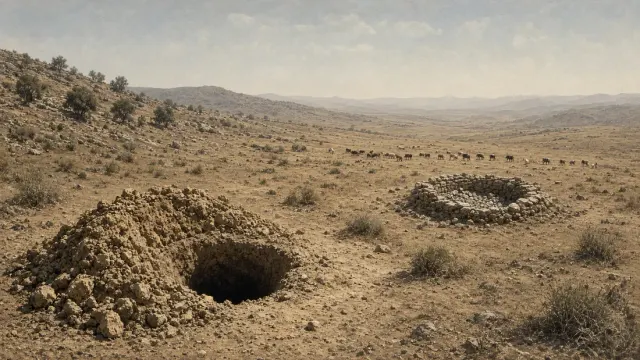
    This is the part of his life that is his own, and it is an account about wells. He sows and reaps a hundredfold, grows great, and the Philistines envy him and stop up the wells his father dug, which is how you drive a herdsman out without a fight. Isaac moves and digs again. They quarrel over the first, so he names it Esek, contention. They quarrel over the second, so he names it Sitnah, hatred. He moves once more, digs a third, and no one fights him, and he names it Rehoboth: for now the LORD hath made room for us. Nothing in his life shows better what kind of man he was. He does not fight for what is his; he keeps moving until there is room. Then God appears at Beersheba, and the same king who sent him away comes to make a treaty, saying, we saw certainly that the LORD was with thee.

    Verse by verse

    1. 26:15

      The Philistines had stopped them: filling a well is an act of economic war that leaves no one to blame.

    2. 26:18

      He called their names after the names by which his father had called them: he restores what was buried rather than claiming it as new.

    3. 26:22

      Rehoboth: room, or broad places. The third well is the only one nobody disputes, and he moved twice to get it.

    4. 26:28

      We saw certainly that the LORD was with thee: the treaty is offered because of what his neighbours observed, not what he argued.

    Genesis 26:12-33: The wells

    Genesis 26:12-33

    King James Version · 22 verses

    26:12Then Isaac sowed in that land, and received in the same year an hundredfold: and the LORD blessed him.

    26:13And the man waxed great, and went forward, and grew until he became very great:

    26:14For he had possession of flocks, and possession of herds, and great store of servants: and the Philistines envied him.

    26:15For all the wells which his father’s servants had digged in the days of Abraham his father, the Philistines had stopped them, and filled them with earth.

    26:16And Abimelech said unto Isaac, Go from us; for thou art much mightier than we.

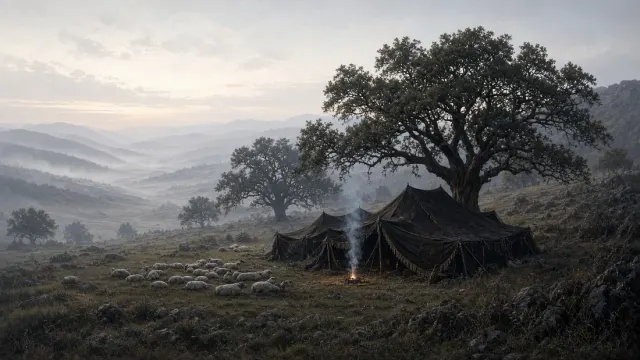
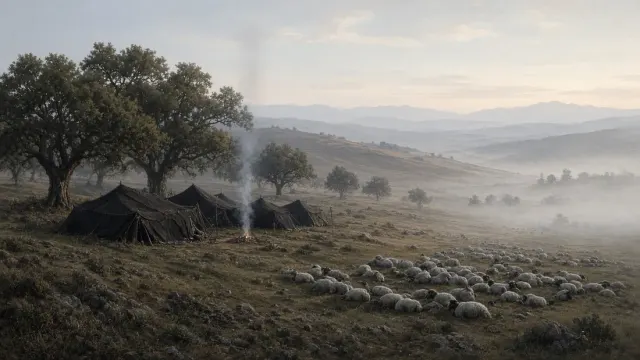
    26:17And Isaac departed thence, and pitched his tent in the valley of Gerar, and dwelt there.

    26:18And Isaac digged again the wells of water, which they had digged in the days of Abraham his father; for the Philistines had stopped them after the death of Abraham: and he called their names after the names by which his father had called them.

    26:19And Isaac’s servants digged in the valley, and found there a well of springing water.

    26:20And the herdmen of Gerar did strive with Isaac’s herdmen, saying, The water is ours: and he called the name of the well Esek; because they strove with him.

    26:21And they digged another well, and strove for that also: and he called the name of it Sitnah.

    26:22And he removed from thence, and digged another well; and for that they strove not: and he called the name of it Rehoboth; and he said, For now the LORD hath made room for us, and we shall be fruitful in the land.

    26:23And he went up from thence to Beer-sheba.

    26:24And the LORD appeared unto him the same night, and said, I am the God of Abraham thy father: fear not, for I am with thee, and will bless thee, and multiply thy seed for my servant Abraham’s sake.

    26:25And he builded an altar there, and called upon the name of the LORD, and pitched his tent there: and there Isaac’s servants digged a well.

    26:26Then Abimelech went to him from Gerar, and Ahuzzath one of his friends, and Phichol the chief captain of his army.

    26:27And Isaac said unto them, Wherefore come ye to me, seeing ye hate me, and have sent me away from you?

    26:28And they said, We saw certainly that the LORD was with thee: and we said, Let there be now an oath betwixt us, even betwixt us and thee, and let us make a covenant with thee;

    26:29That thou wilt do us no hurt, as we have not touched thee, and as we have done unto thee nothing but good, and have sent thee away in peace: thou art now the blessed of the LORD.

    26:30And he made them a feast, and they did eat and drink.

    26:31And they rose up betimes in the morning, and sware one to another: and Isaac sent them away, and they departed from him in peace.

    26:32And it came to pass the same day, that Isaac’s servants came, and told him concerning the well which they had digged, and said unto him, We have found water.

    26:33And he called it Shebah: therefore the name of the city is Beer-sheba unto this day.

  8. 08

    Genesis 27

    The stolen blessing

    Old and blind, he sends Esau to hunt game for a meal before he blesses him. Rebekah dresses Jacob in Esau's clothes and goat skins, and Isaac, doubting, blesses him. When Esau comes in, Isaac trembles very exceedingly, and says: I have blessed him, and he shall be blessed.

    Isaac is old and blind and wants to bless Esau over a meal of venison, though the oracle before the twins were born said the elder shall serve the younger, and though Esau has already sold his birthright and married two Hittite women who were a grief of mind unto Isaac and to Rebekah. Rebekah overhears and organises the deception; Jacob does it, wearing his brother's clothes and goatskins on his hands. The old man is suspicious all the way through, the voice is Jacob's voice, but the hands are the hands of Esau, and he blesses him anyway. When Esau comes in, Isaac trembled very exceedingly, and says the thing that ends the scene: yea, and he shall be blessed. He does not take it back. Everyone in this chapter acts badly, and the blessing lands exactly where God said it would before any of them could scheme.

    Verse by verse

    1. 27:1

      His eyes were dim: Isaac lives another forty-three years after this scene, so the deathbed urgency is his own idea.

    2. 27:4

      That my soul may bless thee: he intends the blessing for Esau despite 25:23 and despite the birthright sold in 25:33.

    3. 27:22

      The voice is Jacob's voice, but the hands are the hands of Esau: he notices, says so aloud, and proceeds anyway.

    4. 27:33

      Yea, and he shall be blessed: Isaac recognises the hand of God in the theft and refuses to undo it.

    5. 27:41

      Esau hated Jacob: the blessing costs twenty years of exile and a family that does not speak.

    Genesis 27: The stolen blessing

    Genesis 27

    King James Version · 46 verses

    27:1And it came to pass, that when Isaac was old, and his eyes were dim, so that he could not see, he called Esau his eldest son, and said unto him, My son: and he said unto him, Behold, here am I.

    27:2And he said, Behold now, I am old, I know not the day of my death:

    27:3Now therefore take, I pray thee, thy weapons, thy quiver and thy bow, and go out to the field, and take me some venison;

    27:4And make me savoury meat, such as I love, and bring it to me, that I may eat; that my soul may bless thee before I die.

    27:5And Rebekah heard when Isaac spake to Esau his son. And Esau went to the field to hunt for venison, and to bring it.

    27:6And Rebekah spake unto Jacob her son, saying, Behold, I heard thy father speak unto Esau thy brother, saying,

    27:7Bring me venison, and make me savoury meat, that I may eat, and bless thee before the LORD before my death.

    27:8Now therefore, my son, obey my voice according to that which I command thee.

    27:9Go now to the flock, and fetch me from thence two good kids of the goats; and I will make them savoury meat for thy father, such as he loveth:

    27:10And thou shalt bring it to thy father, that he may eat, and that he may bless thee before his death.
    27:11And Jacob said to Rebekah his mother, Behold, Esau my brother is a hairy man, and I am a smooth man:

    27:12My father peradventure will feel me, and I shall seem to him as a deceiver; and I shall bring a curse upon me, and not a blessing.

    27:13And his mother said unto him, Upon me be thy curse, my son: only obey my voice, and go fetch me them.

    27:14And he went, and fetched, and brought them to his mother: and his mother made savoury meat, such as his father loved.

    27:15And Rebekah took goodly raiment of her eldest son Esau, which were with her in the house, and put them upon Jacob her younger son:

    27:16And she put the skins of the kids of the goats upon his hands, and upon the smooth of his neck:

    27:17And she gave the savoury meat and the bread, which she had prepared, into the hand of her son Jacob.

    27:18And he came unto his father, and said, My father: and he said, Here am I; who art thou, my son?

    27:19And Jacob said unto his father, I am Esau thy firstborn; I have done according as thou badest me: arise, I pray thee, sit and eat of my venison, that thy soul may bless me.

    27:20And Isaac said unto his son, How is it that thou hast found it so quickly, my son? And he said, Because the LORD thy God brought it to me.

    27:21And Isaac said unto Jacob, Come near, I pray thee, that I may feel thee, my son, whether thou be my very son Esau or not.

    27:22And Jacob went near unto Isaac his father; and he felt him, and said, The voice is Jacob’s voice, but the hands are the hands of Esau.

    27:23And he discerned him not, because his hands were hairy, as his brother Esau’s hands: so he blessed him.

    27:24And he said, Art thou my very son Esau? And he said, I am.

    27:25And he said, Bring it near to me, and I will eat of my son’s venison, that my soul may bless thee. And he brought it near to him, and he did eat: and he brought him wine, and he drank.

    27:26And his father Isaac said unto him, Come near now, and kiss me, my son.

    27:27And he came near, and kissed him: and he smelled the smell of his raiment, and blessed him, and said, See, the smell of my son is as the smell of a field which the LORD hath blessed:

    27:28Therefore God give thee of the dew of heaven, and the fatness of the earth, and plenty of corn and wine:

    27:29Let people serve thee, and nations bow down to thee: be lord over thy brethren, and let thy mother’s sons bow down to thee: cursed be every one that curseth thee, and blessed be he that blesseth thee.

    27:30And it came to pass, as soon as Isaac had made an end of blessing Jacob, and Jacob was yet scarce gone out from the presence of Isaac his father, that Esau his brother came in from his hunting.

    27:31And he also had made savoury meat, and brought it unto his father, and said unto his father, Let my father arise, and eat of his son’s venison, that thy soul may bless me.

    27:32And Isaac his father said unto him, Who art thou? And he said, I am thy son, thy firstborn Esau.

    27:33And Isaac trembled very exceedingly, and said, Who? where is he that hath taken venison, and brought it me, and I have eaten of all before thou camest, and have blessed him? yea, and he shall be blessed.

    27:34And when Esau heard the words of his father, he cried with a great and exceeding bitter cry, and said unto his father, Bless me, even me also, O my father.

    27:35And he said, Thy brother came with subtilty, and hath taken away thy blessing.

    27:36And he said, Is not he rightly named Jacob? for he hath supplanted me these two times: he took away my birthright; and, behold, now he hath taken away my blessing. And he said, Hast thou not reserved a blessing for me?

    27:37And Isaac answered and said unto Esau, Behold, I have made him thy lord, and all his brethren have I given to him for servants; and with corn and wine have I sustained him: and what shall I do now unto thee, my son?

    27:38And Esau said unto his father, Hast thou but one blessing, my father? bless me, even me also, O my father. And Esau lifted up his voice, and wept.

    27:39And Isaac his father answered and said unto him, Behold, thy dwelling shall be the fatness of the earth, and of the dew of heaven from above;

    27:40And by thy sword shalt thou live, and shalt serve thy brother; and it shall come to pass when thou shalt have the dominion, that thou shalt break his yoke from off thy neck.

    27:41And Esau hated Jacob because of the blessing wherewith his father blessed him: and Esau said in his heart, The days of mourning for my father are at hand; then will I slay my brother Jacob.

    27:42And these words of Esau her elder son were told to Rebekah: and she sent and called Jacob her younger son, and said unto him, Behold, thy brother Esau, as touching thee, doth comfort himself, purposing to kill thee.

    27:43Now therefore, my son, obey my voice; and arise, flee thou to Laban my brother to Haran;

    27:44And tarry with him a few days, until thy brother’s fury turn away;

    27:45Until thy brother’s anger turn away from thee, and he forget that which thou hast done to him: then I will send, and fetch thee from thence: why should I be deprived also of you both in one day?

    27:46And Rebekah said to Isaac, I am weary of my life because of the daughters of Heth: if Jacob take a wife of the daughters of Heth, such as these which are of the daughters of the land, what good shall my life do me?

  9. 09

    Genesis 28:1-5

    The blessing of Abraham

    He sends Jacob to Padan-aram for a wife, and this time blesses him knowingly: God Almighty bless thee, and give thee the blessing of Abraham, to thee and to thy seed. The promise passes on with Isaac's full consent.

    The short scene after the theft is easy to miss and matters a great deal. Isaac calls Jacob, and this time there is no venison, no disguise and no doubt about who is standing there. He forbids a Canaanite wife, sends him to Padan-aram, and blesses him deliberately and by name: God Almighty bless thee, and give thee the blessing of Abraham, to thee, and to thy seed with thee. The first blessing was stolen. This one is given, with his eyes open, naming the covenant and handing it on. Whatever Isaac thought he was doing in chapter 27, by chapter 28 he has accepted which son carries the promise, and he says so in a form nobody can dispute afterwards.

    Verse by verse

    1. 28:1

      Isaac called Jacob, and blessed him: the second blessing is deliberate, and it is this one that names the covenant of Abraham.

    2. 28:3

      God Almighty: El Shaddai, the name used when God made the covenant with Abraham in 17:1.

    3. 28:4

      The blessing of Abraham: the land and the seed, handed on explicitly. Chapter 27 gave grain and dominion; this gives the promise.

    Genesis 28:1-5

    King James Version · 5 verses

    28:1And Isaac called Jacob, and blessed him, and charged him, and said unto him, Thou shalt not take a wife of the daughters of Canaan.

    28:2Arise, go to Padan-aram, to the house of Bethuel thy mother’s father; and take thee a wife from thence of the daughters of Laban thy mother’s brother.

    28:3And God Almighty bless thee, and make thee fruitful, and multiply thee, that thou mayest be a multitude of people;

    28:4And give thee the blessing of Abraham, to thee, and to thy seed with thee; that thou mayest inherit the land wherein thou art a stranger, which God gave unto Abraham.

    28:5And Isaac sent away Jacob: and he went to Padan-aram unto Laban, son of Bethuel the Syrian, the brother of Rebekah, Jacob’s and Esau’s mother.

    Genesis 28:1-5: The blessing of Abraham
  10. 10

    Genesis 35:27-29

    A hundred and eighty years

    Jacob returns to his father at Mamre, at Hebron. Isaac gives up the ghost, old and full of days, and his sons Esau and Jacob bury him. As with Abraham, the two brothers stand together at the grave.

    He dies at a hundred and eighty, the longest life of the three patriarchs, and the last verses are quiet. Jacob comes home to Mamre, where Abraham and Isaac had both lived, and is there when his father dies. Isaac gave up the ghost, and died, and was gathered unto his people, being old and full of days. Then the sentence that closes the family's long quarrel without commenting on it: and his sons Esau and Jacob buried him. The same two words that ended Abraham's burial notice, when Isaac and Ishmael stood together at Machpelah. Genesis has a habit of settling its feuds at gravesides and saying nothing about it, leaving the reader to notice that the brothers are in the same place again.

    Verse by verse

    1. 35:27

      Mamre, the city of Arbah, which is Hebron: the ground Abraham bought in chapter 23, where Sarah and Abraham are already buried.

    2. 35:28

      An hundred and eighty years: Abraham lived 175, Jacob 147. Isaac outlives them both and is the least written about.

    3. 35:29

      His sons Esau and Jacob buried him: the same closing as 25:9, where Isaac and Ishmael buried Abraham.

    Genesis 35:27-29

    King James Version · 3 verses

    35:27And Jacob came unto Isaac his father unto Mamre, unto the city of Arbah, which is Hebron, where Abraham and Isaac sojourned.

    35:28And the days of Isaac were an hundred and fourscore years.

    35:29And Isaac gave up the ghost, and died, and was gathered unto his people, being old and full of days: and his sons Esau and Jacob buried him.

    Genesis 35:27-29: A hundred and eighty years

The people, the places and the rest of Scripture.

Reading Isaac closely

The people he dealt with

His father shapes his whole life without either of them saying much. Abraham carries him up Moriah, chooses his wife, and gives him everything he has. The one conversation recorded between them is on the mountain: my father, here am I, behold the fire and the wood, but where is the lamb, God will provide himself a lamb, my son. Isaac is old enough to carry the wood and so old enough to resist, and the text shows him doing neither.

Rebekah is the wife he loves, the first time the Bible says a man loved his wife, and the one he prays for through twenty barren years. She is also the one who deceives him for Jacob, and the account places his love for Esau's venison beside her love for Jacob as the fault line in the family. He is not shown speaking to her after the twins are born until the day she complains about Esau's Hittite wives.

His sons divide him. He loves Esau, and the text gives a reason that is almost an accusation: because he ate of his venison. Jacob he blesses twice, once by deception and once on purpose, and when he learns he has been tricked he trembles and confirms the blessing anyway, which Hebrews reads as faith concerning things to come. Abimelech and the Philistines are the outsiders, envious, quarrelsome over wells, and finally at peace with him because they can see the LORD is with him.

Genesis 17
Genesis 17

The binding

Genesis 22 is told from Abraham's side, and Isaac's part in it is a question and a silence. Jewish readers have always noticed that he was a young man and his father was over a hundred, so the binding cannot have been forced. He lay down on the wood. The chapter never says what he thought, and never says what passed between father and son on the way home, and Sarah dies in the next chapter.

The New Testament reads it as a rehearsal. Hebrews says Abraham received him from the dead in a figure. The ram caught in the thicket and offered in the stead of his son is the first substitute in Scripture, and Abraham's answer, God will provide himself a lamb, was heard by the church as a word about another only son carried up another hill. Moriah, according to Chronicles, is where the temple was later built.

Genesis 17

What came before and what followed

Before Isaac there is twenty-five years of waiting, the laughter of both parents, and Ishmael, the son who was not the promise. Isaac's birth settles the question the whole account of Abraham has been asking, and his weaning feast is where that settlement costs Ishmael his place.

After him the promise splits again, Esau and Jacob, and passes to the younger by an oracle given before they were born. Isaac's own life is lived entirely inside the land, the only patriarch never to leave it, told by God not to go to Egypt in the famine. He reopens Abraham's wells and gives them Abraham's names, and the text says the LORD blessed him for Abraham's sake. He is the link, and the Bible is content to call him that: the God of Abraham, Isaac and Jacob.

Genesis 17

Where the rest of Scripture reaches back

God names himself by Isaac at the burning bush, and Jesus quotes that name to the Sadducees to prove the resurrection. Amos calls Israel's shrines the high places of Isaac. The Psalms and Chronicles remember the covenant confirmed to Isaac by oath.

Paul takes the words in Isaac shall thy seed be called and builds on them in Romans 9: the children of the flesh are not the children of God, but the children of the promise are counted for the seed. Galatians 4 tells the church, now we, brethren, as Isaac was, are the children of promise. Hebrews 11 says he lived in tents with Abraham as an heir of the same promise, that Abraham offered him up, and that by faith Isaac blessed Jacob and Esau concerning things to come. James points to the altar as the place Abraham's faith was made perfect by works. Luke's and Matthew's genealogies both pass through him. The quiet son carries more doctrine than his few words suggest.

Genesis 18
Genesis 18

Why it matters

Isaac is the proof that the promise passes by God's choosing and not by human strength. He does almost nothing to earn his place. He is born to a barren woman, spared on an altar he did not climb by choice, given a wife he did not seek, and blessed at Beersheba for the sake of Abraham my servant. Paul makes him the pattern of the children of promise: in Isaac shall thy seed be called, not because of the flesh but because of the word. Galatians says the church is, as Isaac was, the child of promise.

His binding on Moriah became the Bible's deepest picture of a father giving up a son. Hebrews says Abraham reckoned that God could raise him from the dead, and received him back in a figure. James says the offering of Isaac was the work that made Abraham's faith perfect. God names himself the God of Abraham, Isaac and Jacob, and Jesus uses that name to prove that the dead are raised, since God is not the God of the dead but of the living. The middle patriarch, who did the least, carries the promise across a whole generation.

17 songs

The music

Every song in the catalogue whose passage falls inside these chapters.

  1. Genesis 15:1-17:27

    Count the Stars

    Play hereOpen song pageRead lyrics
  2. Genesis 18:1-15; 21:1-7

    Laughter in the Tent

  3. Genesis 18:1-19:38

    Smoke over the Plain

  4. Genesis 18:16-19:29

    Smoke Rose Like a Furnace

  5. Genesis 18-19

    Sodom and Gomorrah

  6. Genesis 20:1-22:24

    The LORD Will Provide

  7. Genesis 22:1-19

    God Will Provide

  8. Genesis 23:1-25:18

    Led to the Well

  9. Genesis 24

    At the Well

  10. Genesis 25:19-28:22

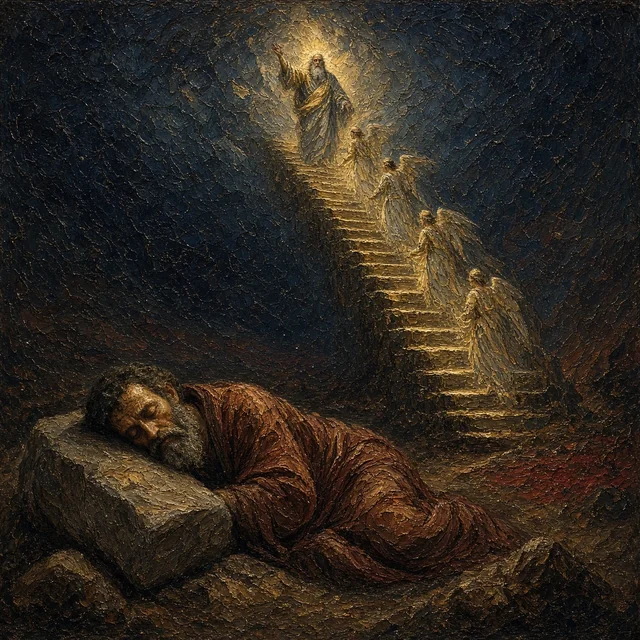
    The Blessing and the Ladder

  11. Genesis 25:19-34; 27

    The Blessing Taken

  12. Genesis 28:10-22

    A Ladder in the Night

  13. Genesis 28:10-22

    Jacob's Ladder

  14. Genesis 28:10-22

    The Gate of Heaven

  15. Genesis 29:1-31:55

    Twenty Years in Haran

  16. Genesis 32:1-36:40

    No Longer Jacob

  17. Genesis 32:22-32

    Until the Breaking of Day

Nearby

All the people

Report an error on this page