
Guided first edition · Exodus 15:22–27
Central truth
Follow the commands and community responsibilities that shape mercy, justice, purity, work, and neighbor love in Exodus.
Read the complete assigned passage before isolating a phrase or answering a question. Identify the speakers, setting, repeated words, problem, response, and the change that occurs by the end of the unit.
Immediate context
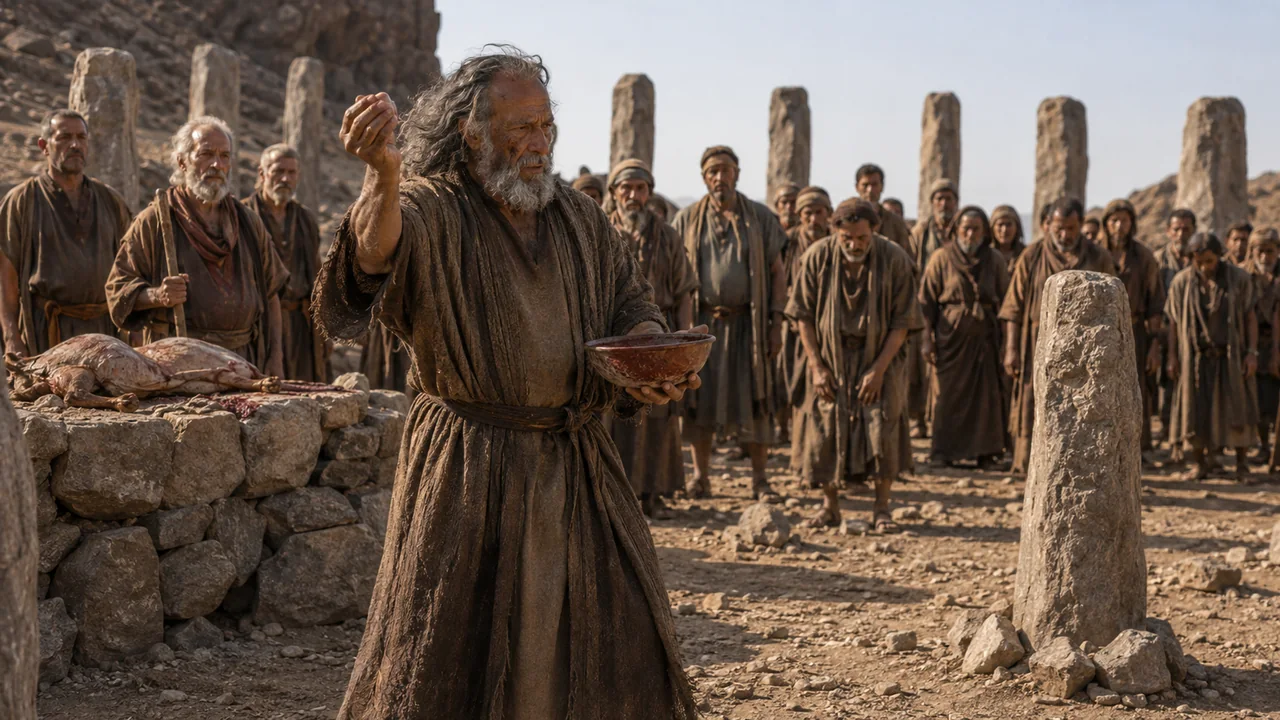
Read Exodus 15:22–27 with the paragraphs before and after it. Identify the opening situation, turning point, and outcome.
Exodus context
Justice and life together: Follow the commands and community responsibilities that shape mercy, justice, purity, work, and neighbor love in Exodus.
Whole-Bible context
Identify the covenant audience, the reason for the command, and its place in rescue, worship, holiness, justice, and communal life.
King James Version · 6 verses
Scripture text
Read the complete assigned text. The KJV text is presented here so that every observation can be checked against the passage.
Exodus 15
King James Version22So Moses brought Israel from the Red sea, and they went out into the wilderness of Shur; and they went three days in the wilderness, and found no water.
23And when they came to Marah, they could not drink of the waters of Marah, for they were bitter: therefore the name of it was called Marah.
24And the people murmured against Moses, saying, What shall we drink?
25And he cried unto the LORD ; and the LORD shewed him a tree, which when he had cast into the waters, the waters were made sweet: there he made for them a statute and an ordinance, and there he proved them,
26And said, If thou wilt diligently hearken to the voice of the LORD thy God, and wilt do that which is right in his sight, and wilt give ear to his commandments, and keep all his statutes, I will put none of these diseases upon thee, which I have brought upon the Egyptians: for I am the LORD that healeth thee.
27And they came to Elim, where were twelve wells of water, and threescore and ten palm trees: and they encamped there by the waters.
Central truth
Follow the commands and community responsibilities that shape mercy, justice, purity, work, and neighbor love in Exodus.
Guided close reading
Work through every reading block in order. The prompts identify what to examine without replacing the words of Scripture.
Chapter summary · 15
Exodus 15
Exodus 15 opens in verse 22 with “So Moses brought Israel from the Red sea, and they went out into the wilderness of Shur;...”, reaches its middle movement near verse 24 with “And the people murmured against Moses, saying, What shall we drink?”, and closes in verse 27 with “And they came to Elim, where were twelve wells of water, and threescore and ten palm...”. Repeated or prominent terms include lord, waters, marah, wilt, brought. Read these details within the lesson focus: Exodus 15:22–27 moves from “So Moses brought Israel from the Red sea, and they went out into the wilderness of...” to “And they came to Elim, where were twelve wells of water, and threescore and ten palm....”.
Exodus 15:22–27
22–27: So Moses brought Israel from the Red sea, and they went out into the...
Section summary
Exodus 15:22–27 opens with “So Moses brought Israel from the Red sea, and they went out into the wilderness of Shur; and...” and reaches “And they came to Elim, where were twelve wells of water, and threescore and ten palm trees: and...” by its final verse. That textual movement develops the lesson focus: Exodus 15:22–27 moves from “So Moses brought Israel from the Red sea, and they went out into the wilderness of...” to “And they came to Elim, where were twelve wells of water, and threescore and ten palm....”, with special attention to the recurring or prominent terms lord, waters, marah.
Deep dive
Verse 22 establishes the section with “So Moses brought Israel from the Red sea, and they went out into the wilderness of Shur; and...”. Near verse 24, the wording reads “And the people murmured against Moses, saying, What shall we drink?”. The final verse closes this reading block with “And they came to Elim, where were twelve wells of water, and threescore and ten palm trees:...”. The wording also contains 3 verses with a speech marker, 1 question, 2 verses naming the LORD or God, giving the reader concrete features to test in context.
Identify the covenant audience, the stated reason for each command, and how worship, holiness, justice, mercy, and communal responsibility relate to one another. Trace the words lord, waters, marah, wilt, brought, drink across the complete block. Connect every claim to the lesson focus, Exodus 15:22–27 moves from “So Moses brought Israel from the Red sea, and they went out into the wilderness of...” to “And they came to Elim, where were twelve wells of water, and threescore and ten palm....”, and label conclusions honestly as explicit statement, Scripture-supported conclusion, strong inference, or interpretation.
Words to trace: lord, waters, marah, wilt, brought, drink
Verse-by-verse path
Use these notes to slow down and examine how each verse contributes to the section. Return to the exact wording before drawing a conclusion.
- Exodus 15:22
Reason or consequence: connect this verse to the claim or action immediately before it.
- Exodus 15:23
Human speech: identify the speaker and audience, then test the claim against what the narrator shows before and after it.
- Exodus 15:24
Command and responsibility: identify who receives the instruction, what it requires, and the purpose supplied by the context.
- Exodus 15:25
Human speech: identify the speaker and audience, then test the claim against what the narrator shows before and after it.
- Exodus 15:26
Human speech: identify the speaker and audience, then test the claim against what the narrator shows before and after it.
- Exodus 15:27
Textual detail: identify the action, the people affected, and the change this verse introduces.
Observation and teaching prompt
- Identify the people addressed and the covenant setting.
- Distinguish rescue, worship, holiness, justice, and community responsibility.
- Read commands in their literary and covenant context before making a modern application.
Learning objectives
- Place Exodus 15:22–27 within Justice and life together and explain its role in Exodus.
- Describe from the text how the passage develops this focus: Exodus 15:22–27 moves from “So Moses brought Israel from the Red sea, and they went out into the wilderness of...” to “And they came to Elim, where were twelve wells of water, and threescore and ten palm....”.
- Distinguish an explicit statement, a Scripture-supported conclusion, and an interpretation.
- Explain how law and covenant shapes a responsible reading of this unit.
- Compare a related song or video with the passage, then return to the text to test it.
- Form a personal and communal response that does not exceed the evidence of Scripture.
Teacher preparation
- Read Exodus 15:22–27 twice, then read the material immediately before and after it.
- Review the book movement: Justice and life together (Exodus · 03).
- Mark speakers, actions, repeated words, commands, contrasts, promises, and consequences.
- Preview each related song or video and note where it condenses, interprets, or dramatizes the text.
- Prepare a participation option that lets learners respond without forced personal disclosure.
Evidence and interpretation checks
Explicit
Record two claims that Exodus 15:22–27 states directly and cite the verses.
Scripture-supported
Form one conclusion that joins several parts of Exodus 15:22–27. Show each step.
Strong inference
Identify a conclusion that follows the text closely even though it is not stated in one sentence.
Possible or traditional reading
Where responsible readings differ, present the difference without turning it into certainty.
Limit
Do not use speculation as a teaching conclusion.
Discussion with answer guidance
1. What does Exodus 15:22–27 state directly about God, people, or the situation?
Show teacher guidance
Begin with the passage’s words and actions. Require an exact verse before accepting a conclusion.
2. How does this focus develop across the passage: Exodus 15:22–27 moves from “So Moses brought Israel from the Red sea, and they went out into the wilderness of...” to “And they came to Elim, where were twelve wells of water, and threescore and ten palm....”?
Show teacher guidance
Trace the opening, change, and outcome. Do not rely on one sentence when the unit presents a sequence.
3. Which word, action, contrast, or response repeats, and what work does it do?
Show teacher guidance
Repetition may signal structure or emphasis, but explain its meaning inside the immediate context.
4. How does this unit contribute to the Justice and life together movement?
Show teacher guidance
Compare the unit with what comes before and after it in the same book.
5. What interpretive caution does law and covenant require here?
Show teacher guidance
Identify the covenant audience, the reason for the command, and its place in rescue, worship, holiness, justice, and communal life.
6. What faithful response follows for an individual and for a community?
Show teacher guidance
Form a concrete, proportionate response. Do not turn a description into a command without evidence.
Responsible application
Heart and habits
Name one belief, desire, or practice that Exodus 15:22–27 corrects, strengthens, or redirects.
Relationships and community
Form one action that protects dignity, truth, justice, mercy, or faithfulness in a real relationship.
Worship and prayer
Write a prayer using the vocabulary and concerns of the passage.
Service and witness
Choose one observable response for this week and one person who can support accountability.
Audience adaptations
Children
Use a short reading block, a people-and-actions map, and one concrete response. Explain difficult vocabulary before reading.
Youth
Ask learners to identify pressure, loyalty, power, and consequences. Permit written responses without public disclosure.
Adults
Add literary and historical context, compare responsible readings, and require evidence for each claim.
Intergenerational group
Pair different ages, assign observation before interpretation, and close with a shared prayer.
Online or at home
Send the reference in advance, use media as an observation pause, and gather responses in a shared document.
Complete 75-minute teaching path
A shorter group can omit the extended discussion while preserving the Scripture reading, evidence check, and closing response.
Orient the group
Name the book, Exodus 15:22–27, genre, and central question. Explain that every conclusion will be checked against the text.
Read the complete unit
Read aloud or silently. Learners mark speakers, repetitions, commands, contrasts, and changes.
Work through the reading blocks
Summarize each block in one sentence and record the verse that supports the summary.
Use a song or video
Play one related resource. Compare its emphasis and omissions with the passage.
Discuss from evidence
Use the questions and require a Scripture reference for every major answer.
Form responsible application
Develop one personal and one communal response. Avoid promises or commands that the text does not establish.
Summarize and pray
Let each learner complete one sentence about the passage. Pray with its vocabulary and concerns.
Song and video learning lab
Use the media after the passage has been read. A song or video may interpret, compress, or dramatize the text, so learners should compare it with Scripture rather than treat it as Scripture.
- Before: read the exact passage and name its central movement.
- During: note which words, people, events, or emotions the artist emphasizes.
- After: identify what the media clarifies, what it leaves out, and what must be checked in the text.
Listen and watch alongside the passage
Related media appears only when its Scripture reference overlaps this study unit. Use music and video as companions, then return to the biblical text.


