
1 Samuel 16:1–13
Samuel anoints the shepherd boy David

Ages 8 to 11
The account
Samuel was mourning because Saul had been rejected as king. The LORD told Samuel to fill his horn with oil and go to Jesse of Bethlehem. God had chosen a king from among Jesse's sons.
Samuel was afraid that Saul might hear about the trip and kill him. The LORD told Samuel to take a young cow and say he had come to sacrifice. Samuel obeyed and went to Bethlehem. The elders of the town were nervous when they saw him, but Samuel told them he had come peacefully.
Samuel invited Jesse and his sons to the sacrifice. When Samuel saw Jesse's son Eliab, he thought the LORD's chosen king must be standing before him. But God told Samuel not to judge by Eliab's appearance or height. People look at outward appearance, but the LORD looks at the heart.
Jesse then brought Abinadab and Shammah before Samuel, followed by the rest of his sons who were there. None of them was the one God had chosen. Samuel asked whether Jesse had any other children. Jesse said the youngest was out keeping the sheep.
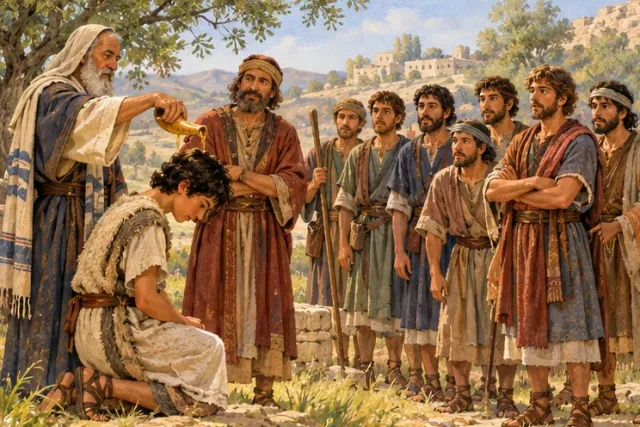
They sent for him. His name was David. When David arrived, the LORD told Samuel that he was the one. Samuel took the horn of oil and anointed David in front of his brothers. From that day forward, the Spirit of the LORD came upon David. Samuel then returned to Ramah.
Memory verse
But the LORD said unto Samuel, Look not on his countenance, or on the height of his stature; because I have refused him: for the LORD seeth not as man seeth; for man looketh on the outward appearance, but the LORD looketh on the heart.
1 Samuel 16:7
Talk about it
- What did Samuel first notice about Eliab?
- Where was David while his older brothers were being shown to Samuel?
- What happened after Samuel anointed David?
Try this
Draw two simple people on a page. Around the outside of each figure, write things people can notice quickly, such as height, clothes or hair; inside the figures, write qualities that are harder to see, such as honesty, courage or kindness.
What can we learn?
A lesson from this account is that first impressions do not tell us everything about a person. The passage reminds us that God sees what people cannot see just by looking.
Ages 12 to 15
The account
Samuel was still grieving over Saul when the LORD told him it was time to go to Bethlehem. Saul had been rejected from continuing as king, and God told Samuel that he had provided a king among the sons of Jesse. Samuel was to fill his horn with oil and go.
Samuel knew the mission could be dangerous. He said that if Saul heard about it, Saul might kill him. The LORD instructed Samuel to take a heifer and say that he had come to sacrifice to the LORD. He was also to invite Jesse to the sacrifice, and God would show him what to do.
Samuel obeyed and came to Bethlehem. The elders of the town trembled when they met him and asked whether he came peacefully. Samuel answered that he had come in peace to sacrifice to the LORD. He told them to prepare themselves, and he called Jesse and his sons to the sacrifice.
When Jesse's sons came before Samuel, Samuel saw Eliab and thought surely the LORD's anointed was before him. But the LORD corrected Samuel's first impression. Eliab's appearance and height were not the deciding things. God had not chosen him. The passage makes the contrast clear: people see what is outward, but the LORD looks at the heart.
Jesse next brought Abinadab before Samuel, but he was not chosen. Shammah came next, and he was not chosen either. In all, seven of Jesse's sons passed before Samuel. Samuel told Jesse that the LORD had not chosen any of them.
Samuel then asked whether these were all Jesse's children. Jesse explained that the youngest remained and was keeping the sheep. Samuel told him to send for the young shepherd before they sat down. Jesse sent for him. The passage describes David as ruddy, with a beautiful countenance and goodly to look to. Then the LORD told Samuel to arise and anoint him.
Samuel took the horn of oil and anointed David in the midst of his brothers. From that day forward, the Spirit of the LORD came upon David. Samuel then rose and went back to Ramah. The account does not show David taking the throne that day. It shows the beginning of the calling that would shape much of the history that follows.
Memory verse
But the LORD said unto Samuel, Look not on his countenance, or on the height of his stature; because I have refused him: for the LORD seeth not as man seeth; for man looketh on the outward appearance, but the LORD looketh on the heart.
1 Samuel 16:7
Think about it
- Why was Samuel's trip to Bethlehem dangerous enough for him to mention Saul's possible reaction?
- What does Samuel's first response to Eliab show about how easily people can judge by appearance?
- Why do you think the account makes a point of saying that David was away keeping the sheep?
- What does the LORD's choice of David show about the difference between human expectations and God's knowledge?
Going deeper
David's anointing begins a line of Bible history that continues far beyond this day in Bethlehem. David later becomes king, and in 2 Samuel 7 God makes a covenant concerning David's house and kingdom. The New Testament then identifies Jesus as the son of David, connecting Jesus to that royal line.
What can we learn?
This account gives a clear warning against treating appearance as the best measure of a person. A lesson we can draw is to be slower about first impressions and more interested in character, while remembering that the passage says God's knowledge of the heart is deeper than ours.