
Joshua 6
The walls of Jericho
Ages 8 to 11
The account
Jericho was tightly closed because of the children of Israel. No one went out, and no one came in. The Lord told Joshua that he had given Jericho into his hand.
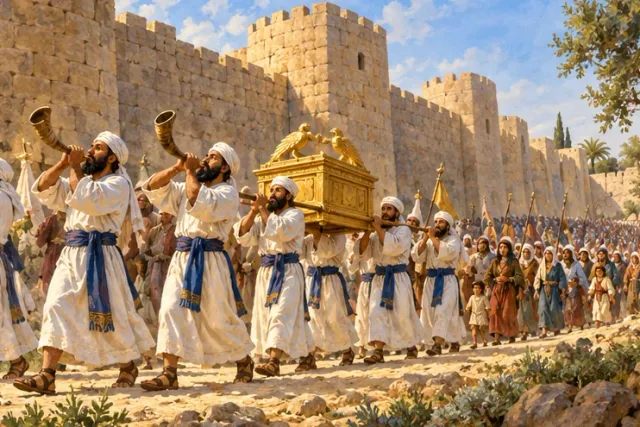
For six days, Israel's men of war were to march around the city once each day. Seven priests carried seven trumpets of rams' horns before the ark of the covenant. Joshua told the people not to shout or speak until he gave the command.
On the seventh day they rose early and marched around Jericho seven times. On the seventh trip, the priests blew the trumpets. Joshua told the people to shout because the Lord had given them the city. He also reminded them that Rahab and everyone with her in her house were to live because she had hidden the messengers sent to Jericho.
The people shouted, and the wall fell down flat. Israel entered the city and took it. The account says the city and its inhabitants were destroyed, while Rahab and her family were brought out safely. The city was burned. Silver, gold, brass and iron vessels were placed in the Lord's treasury.
Joshua warned against rebuilding Jericho. The chapter ends by saying that the Lord was with Joshua, and Joshua's fame spread through the country.
Memory verse
So the LORD was with Joshua; and his fame was noised throughout all the country.
Joshua 6:27
Talk about it
- What did Israel do around Jericho for the first six days?
- What changed on the seventh day?
- Why were Rahab and the people with her in her house spared?
Try this
Build a small wall with blocks, cups or folded paper. Count one pretend trip around it for each of the first six days, then count seven trips for the seventh day before gently taking the wall down.
What can we learn?
A lesson we can draw is that following instructions mattered even when the plan did not look like an ordinary attack. The account also shows that Rahab's household was not forgotten when the city fell.
Ages 12 to 15
The account
Jericho was shut tightly because of the children of Israel. No one went out, and no one came in. The Lord told Joshua that he had given Jericho, its king and its mighty men into Joshua's hand. The Lord then gave Joshua exact instructions for the march around the city.
For six days, the men of war were to go around the city once each day. Seven priests carrying seven trumpets of rams' horns went before the ark of the covenant, with armed men ahead and a rear guard behind. The priests blew the trumpets as they moved, but Joshua commanded the people themselves to remain silent until he told them to shout.
Each day Israel completed the circuit and returned to camp. On the seventh day they rose around dawn and circled Jericho seven times. At the seventh circuit, the priests sounded the trumpets. Joshua commanded the people to shout because the Lord had given them the city.
Joshua also gave instructions about what would happen when the city fell. Jericho was devoted to destruction. Rahab and all who were with her in her house were to be spared because she had hidden the messengers Joshua had sent. Israel was warned not to take the things devoted to destruction for themselves. Silver, gold, and vessels of brass and iron were to go into the Lord's treasury.
When the people heard the trumpet sound, they shouted with a great shout. The wall fell down flat, and the Israelites entered the city. Joshua 6 says that the inhabitants and animals in the city were destroyed. The two men who had spied out the land went to Rahab's house and brought out Rahab, her father, mother, brothers, and her kindred. They were placed outside Israel's camp at first, and Rahab later lived among Israel.
The city itself was burned, while the silver, gold, brass and iron vessels were kept for the Lord's treasury. Joshua then pronounced a curse on anyone who would rise up to rebuild Jericho. The chapter closes by saying that the Lord was with Joshua and that his fame spread throughout the country.
Israel followed the instructions given through Joshua: the repeated circuits, the trumpet blasts, the silence of the people until the command to shout, the protection of Rahab's household, and the restriction on taking devoted things for themselves.
Memory verse
So the LORD was with Joshua; and his fame was noised throughout all the country.
Joshua 6:27
Think about it
- Why was Rahab spared according to Joshua 6?
- What does the account show about how closely Israel followed the instructions given through Joshua?
- Why were the Israelites forbidden to keep the devoted things for themselves?
- How does the chapter place Rahab's rescue beside the destruction of Jericho?
Going deeper
Hebrews 11:30 remembers the fall of Jericho's walls, and the next verse names Rahab when recalling faith. Matthew 1:5 later includes Rahab in the family line that leads to Jesus. The wider Bible therefore remembers both the fall of the city and the woman whose household was spared.
What can we learn?
A lesson we can draw is that victory did not give Israel permission to ignore the limits God had set. The account emphasizes exact obedience about marching, shouting, Rahab's household and the devoted possessions. It also places rescue and judgment in the same chapter without pretending that either part is absent.