
Matthew 3:13–17
Jesus is baptized

Ages 8 to 11
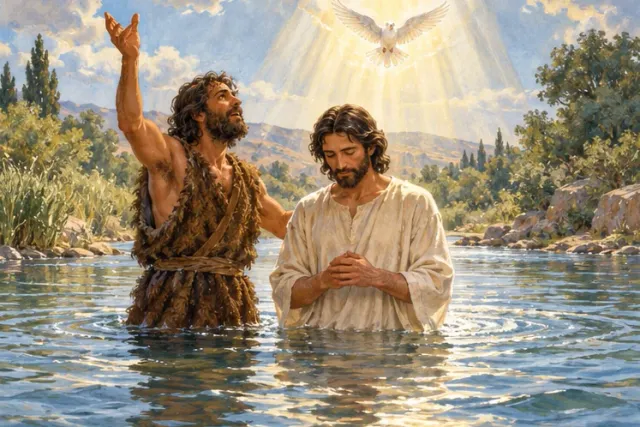
The account
Jesus came from Galilee to the Jordan River, where John was, because Jesus wanted John to baptize him. John objected. He said that he needed to be baptized by Jesus, not the other way around.
Jesus answered that John should allow it then, because it was fitting for them to fulfil all righteousness. John agreed and baptized him.
When Jesus came up out of the water, the heavens were opened. He saw the Spirit of God descending like a dove and coming upon him. Matthew says the Spirit descended like a dove. The passage does not say that the Spirit was simply an ordinary bird.
Then a voice came from heaven. The voice identified Jesus as God's beloved Son and said that God was well pleased with him.
The whole account is only a few verses, but every part matters. Jesus comes to John. John knows that Jesus is not like the others who came to him. Jesus says the baptism should happen to fulfil all righteousness. Then, after the baptism, Matthew records the opened heavens, the Spirit of God, and the voice from heaven.
Memory verse
And lo a voice from heaven, saying, This is my beloved Son, in whom I am well pleased.
Matthew 3:17
Talk about it
- Why did Jesus come to John at the Jordan?
- What did John first say about baptizing Jesus?
- What happened after Jesus came up out of the water?
Try this
Fold a paper into four sections and label them Jesus Comes, John Responds, Jesus Is Baptized, and What Happened Next. Draw one picture or write one sentence in each section using only details from Matthew 3:13–17.
What can we learn?
A lesson we can draw is that doing what is right can matter even when someone else does not yet understand why it should happen. This account also teaches us to pay close attention to the exact words the Bible uses, including that the Spirit descended like a dove.
Ages 12 to 15
The account
Matthew's account begins with Jesus traveling from Galilee to the Jordan to John for baptism. Earlier in Matthew 3, John had been baptizing people in the Jordan while they confessed their sins and had been calling people to repentance. That setting makes his response to Jesus especially noticeable. John does not treat Jesus as simply one more person coming to him. He objects and says that he needs to be baptized by Jesus instead.
Jesus answers that John should allow it at that time because it is fitting for them to fulfil all righteousness. Matthew does not expand that phrase into a long explanation here. He gives Jesus' reason and then says John allowed the baptism to take place.
After Jesus was baptized, he came up straightway out of the water. The heavens were opened to him. He saw the Spirit of God descending like a dove and lighting upon him. The wording matters. Matthew compares the Spirit's descent to a dove; he does not say merely that an ordinary dove happened to appear.
Then a voice from heaven spoke. It identified Jesus as God's beloved Son and said that God was well pleased with him. In a very short space, the passage brings together Jesus, the Spirit of God, and the voice from heaven.
The setting matters because John's baptism was already drawing people to the Jordan, yet John's own words show that he understood Jesus' arrival differently. John says he needs baptism from Jesus. Jesus nevertheless directs him to proceed, not because Matthew presents Jesus as confessing sin, but because Jesus says the act should fulfil all righteousness. The account then shifts immediately from the baptism itself to the signs that follow. Matthew does not record a speech from the crowd or explain what anyone else thought. He keeps the attention on what Jesus says, what John does, and what comes from heaven afterward.
For readers, this scene marks a public moment at the beginning of Jesus' ministry in Matthew. It does not depend on extra ceremony or later tradition. The text gives the river, John, Jesus' reason for being baptized, the opened heavens, the Spirit descending like a dove, and the heavenly declaration about the Son.
Memory verse
And lo a voice from heaven, saying, This is my beloved Son, in whom I am well pleased.
Matthew 3:17
Think about it
- Why does John's objection show that he understood Jesus differently from the other people who came for baptism?
- Why is it important not to make Jesus' phrase about fulfilling all righteousness say more than Matthew explains here?
- What does the scene show by placing Jesus, the Spirit of God, and the voice from heaven together?
- Why might the voice identifying Jesus as the beloved Son matter at the beginning of his public ministry?
Going deeper
Matthew later records another scene in which a voice from above identifies Jesus as the beloved Son, at the transfiguration in Matthew 17:5. The baptism therefore connects with a wider pattern in Matthew: key moments in Jesus' ministry are accompanied by a heavenly declaration about who he is.
What can we learn?
A lesson we can draw is that careful reading matters, especially in passages Christians may discuss in different ways. Staying close to Matthew's actual wording lets the main features of the account remain clear without adding details the passage does not give.