
Mark 12:41–44
The widow's two coins

Ages 8 to 11
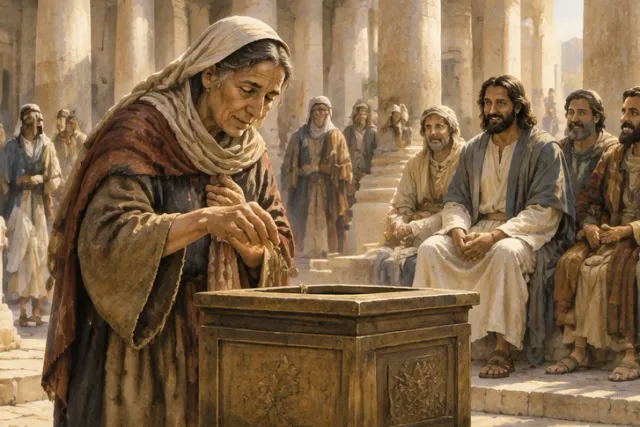
The account
Jesus sat across from the treasury and watched people put money into it. Many rich people put in large amounts.
Then a poor widow came. She put in two mites, which together made a farthing. Her gift was small in size compared with the large amounts other people were giving.
Jesus called his disciples to him because he wanted them to notice what had happened. He told them that the poor widow had put in more than all the others who had given to the treasury.
That might sound surprising at first. Jesus explained the difference. The others had given from their abundance. They still had plenty. The widow, however, gave from her want. Jesus said that she put in all that she had, even all her living.
The passage does not tell us the widow's name. It does not tell us what happened to her after she gave. It also does not record any words from her. Jesus is the one who points her out.
He did not measure her gift only by the number of coins. He compared what the gift meant for the giver. Two small coins could look tiny beside larger gifts, but Jesus told his disciples to see the difference between abundance and want.
Memory verse
And there came a certain poor widow, and she threw in two mites, which make a farthing.
Mark 12:42
Talk about it:
- What was Jesus watching people do?
- How many mites did the widow put in?
- Why did Jesus say her gift was more than the others?
Try this:
Draw two circles to stand for the widow's two coins. Around them, write words from the account that explain why Jesus noticed her gift, such as poor, want, all, and living.
What can we learn?
A lesson we can draw from this account is that the size of a gift does not tell us everything about what it costs the giver. We should be careful not to judge generosity only by big numbers.
Ages 12 to 15
The account
Jesus sat over against the treasury and watched how people put money into it. Mark says that many rich people cast in much. The scene could easily have been judged by visible totals: some people were giving large amounts, and those amounts were easy to notice.
Then a poor widow came and put in two mites, which made a farthing. Mark does not give her name or record anything she said. He gives only the facts needed for what Jesus was about to teach his disciples.
Jesus called the disciples to him and told them that the poor widow had put in more than all the others who had given to the treasury. His statement was not based on the number of coins. In ordinary arithmetic, the larger gifts were still larger.
Jesus explained the comparison himself. The others had given from their abundance. The widow had given from her want. She had put in all that she had, even all her living.
That explanation changes the way the gift is measured. Jesus directs the disciples away from the amount alone and toward what remained with the giver afterward. The rich people could give much out of abundance. The widow gave two small coins out of poverty, and Jesus said those coins represented all she had to live on.
The account is brief, and some questions are left unanswered. Mark does not say what happened to the widow next. He does not tell us why she chose to give everything. He does not record Jesus telling other people to copy the exact amount or percentage she gave. Those details should not be added.
What the passage clearly does show is that Jesus noticed a person whose contribution could easily have looked unimportant beside the larger gifts. He also taught his disciples that the true weight of what they had just seen could not be read from the coin total alone.
Mark says Jesus watched how people were putting money into the treasury. His explanation then gives the disciples two different situations to compare: abundance and want. That comparison keeps the focus on the giver's circumstances, not merely on which pile of coins would have looked largest.
Memory verse
And there came a certain poor widow, and she threw in two mites, which make a farthing.
Mark 12:42
Think about it:
- Why do you think Jesus called the disciples to him after watching the widow give?
- What does Jesus' comparison show about the limits of judging a gift only by its size?
- Why is it important not to invent the widow's motives when Mark does not state them?
- What changes when you compare what a person gives with what that person has left?
Going deeper:
A wider biblical pattern appears in 1 Samuel 16:7, where outward appearance is not treated as the whole measure and God looks on the heart. Mark 12 makes a similar move away from what is easiest to see. The visible amount was small, but Jesus directed the disciples to consider the widow's poverty and the cost of what she gave.
What can we learn?
A lesson drawn from this account is that generosity cannot always be measured fairly by comparing totals. It also teaches us to notice people and sacrifices that may be easy to overlook.