
1 Thessalonians

5 Chapters
1 Thessalonians: The Whole Book, Chapter by Chapter
A Received Word Becomes a Sounding Voice
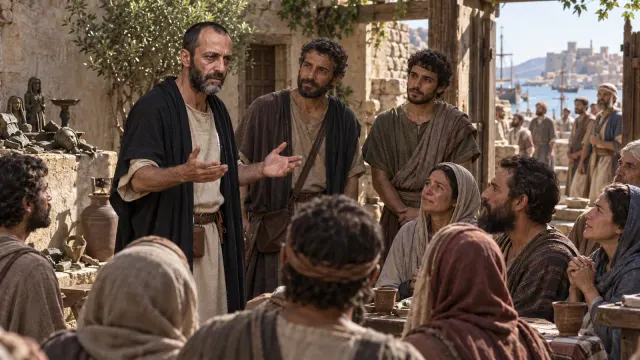
A church can be young and still make noise far beyond its own room. The Book of 1 Thessalonians opens by locating this congregation both in Thessalonica and “in God the Father and in the Lord Jesus Christ,” then immediately points to faith, love, and hope wearing working clothes. The gospel arrived as spoken word, spiritual power, visible conduct, and assurance, while affliction somehow shared the same space with joy. The direction of influence then reverses. Those who imitated the missionaries become examples themselves, and the word “sounded out” from them so widely that Paul describes arriving elsewhere to find the report already there. Their conversion has two continuing motions: serving the living God and waiting for the risen Son. Expectation of the future does not replace present allegiance. It gives that allegiance a horizon.
One complete chapter pageOpen chapter →
The Messengers’ Lives Stand Beside Their Message
Chapter 2 puts the missionaries’ conduct on the witness stand and keeps calling the Thessalonians to testify from memory. Paul recalls courage after mistreatment, rejects deceit, impurity, flattery, concealed greed, and the pursuit of human glory, then replaces the image of a religious performer with family language. The messengers were gentle like a nursing mother, laborious enough to work night and day, and personal like a father addressing “every one” of his children. Their defense is therefore not built on rank alone but on a life the congregation actually observed. The chapter then turns from the messengers’ integrity to the hearers’ suffering and to a fierce indictment of those obstructing the Gentile mission. Finally, distance becomes the problem. Paul has been absent in person, not in heart, and the people he cannot presently visit are the very people he calls his hope, joy, and crown at Christ’s coming.
One complete chapter pageOpen chapter →
Good News Travels Back to the Messengers
Uncertainty finally becomes harder to bear than separation. Chapter 3 begins with Paul willing to remain at Athens without Timothy so that Timothy can strengthen the Thessalonians and discover how their faith has endured. Affliction had been expected, but its arrival never guaranteed the congregation’s response, and Paul refuses to pretend that concern can be settled by optimistic guessing. The report that returns is genuinely good news: faith and love remain, affection is mutual, and the people sent help now become a source of comfort to the helpers. Paul’s language of relief is intense, “now we live, if ye stand fast in the Lord,” yet gratitude does not make growth unnecessary. He still wants to supply what is lacking. The chapter closes by widening prayer from a hoped-for journey to increasing love “toward all men” and to holiness before God at the coming of Jesus.
One complete chapter pageOpen chapter →
Honour in Ordinary Life, Hope in Bereavement
Chapter 4 moves holiness out of abstraction and into bodies, relationships, work, grief, and expectation. Paul begins from conduct the Thessalonians have already received and asks them to “abound more and more,” then names sanctification in terms that include sexual integrity and the possibility of wronging another person. Brotherly love is likewise praised before it is asked to grow. Even ambition gets redirected toward a quiet life, one’s own affairs, and work with one’s hands, showing that expectation of Christ does not make ordinary responsibility beneath notice. The chapter then turns to the dead. Sorrow is not forbidden, but it is given a different ground through Jesus’ death and resurrection. Those alive at the Lord’s coming will not precede the dead. The dead in Christ rise first, then living and raised believers are gathered “together with them.” The passage reaches its goal in reunion and permanent presence with the Lord, not in supplying every later end-time timetable.
One complete chapter pageOpen chapter →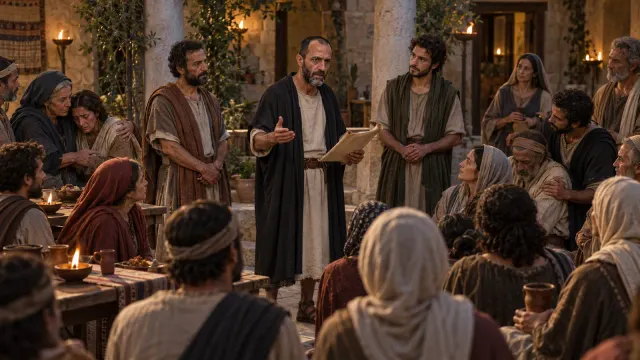
Children of the Day in a Community of Care
The final chapter shifts from what happens to the dead at Christ’s coming to how the community stands in relation to the day itself. The day remains sudden, like a thief in the night, but the Thessalonians are called children of light rather than owners of a secret date. Faith, love, and hope return as armour, linking the ending to the thanksgiving that opened the book. From there, Paul’s instructions become intensely communal. Labouring leaders are to be recognized, yet care does not belong to leaders alone: different needs receive different responses, patience extends to all, and retaliation is refused. Three tiny commands about joy, prayer, and thanksgiving carry the weight of a book that has already named affliction and bereavement. Spiritual speech receives the same balance: do not quench, do not despise, but test. The closing prayer then shifts confidence from the community’s performance to the faithfulness of the God who calls, before drawing everyone into prayer, greeting, hearing, and grace.
One complete chapter pageOpen chapter →Source: eBible.org · eng-kjv2006