
The big picture
After comforting believers about those who have died, Paul turns to how the living wait. Paul is the teacher speaking in this letter. Jesus Christ, the Lord who died for them, will return, but Paul gives no date. He calls for clear minds, mutual care, and trust in God. The final instructions reach into worship and daily relationships. Leaders, frightened members, and people who resist good order all need care. The letter ends with a prayer for the whole group.
In this chapter
- The Day Comes Without Warning 1 Thessalonians 5:1-5
The group does not need a date or a calendar from Paul.
- Hope Keeps Believers Alert 1 Thessalonians 5:6-11
Sleeping and drunkenness now serve as pictures of careless living.
- Different Needs Require Patient Care 1 Thessalonians 5:12-15
Care for the group includes respect for those who work hard and guide it in the Lord.
- Joy Prayer and Thanks Continue 1 Thessalonians 5:16-18
Three short commands call for a lasting pattern in the group's life.
- Test Claims and Keep the Good 1 Thessalonians 5:19-22
God's Spirit is not to be stifled, and claimed messages from God are not to be dismissed with contempt.
- God Keeps the Whole Person 1 Thessalonians 5:23-28
The closing prayer asks the God of peace to make the believers wholly his.
Central truth
Hope in Jesus' return leads Paul to urge alert living, patient care, careful judgement, and trust in God's faithfulness.
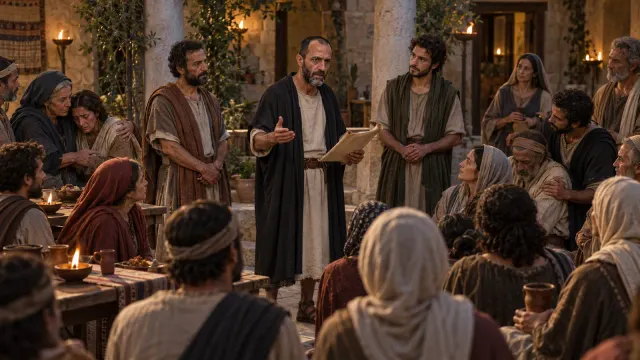

Scripture beside the summary
1 Thessalonians · King James Version · 281 Thessalonians 5:1-5
The Day Comes Without Warning
The group does not need a date or a calendar from Paul. They already know that the Lord's day will arrive without warning, like a thief at night. Claims that everything is safe will not prevent sudden destruction. Paul also uses labour pains to express its sudden, inescapable arrival. He then distinguishes the believers from people living in darkness. They belong to light and day. His point is not that they know the hour, but that their way of life fits readiness rather than surprise.

In everyday life
A coastguard watches a dark line gather over the sea while holidaymakers pack away their radios. She checks the warning flags and keeps her boots beside the door. Calm talk on the beach does not change what she sees approaching. No weather forecast gives advance notice of the day Paul describes.
Notice
1 Thessalonians 5:4 Light does not give the group a secret date. Paul contrasts their position with darkness, so readiness comes through who they are and how they live.
1 Thessalonians 5:1-5
King James Version1But of the times and the seasons, brethren, ye have no need that I write unto you.
2For yourselves know perfectly that the day of the Lord so cometh as a thief in the night.
3For when they shall say, Peace and safety; then sudden destruction cometh upon them, as travail upon a woman with child; and they shall not escape.
4But ye, brethren, are not in darkness, that that day should overtake you as a thief.
5Ye are all the children of light, and the children of the day: we are not of the night, nor of darkness.
1 Thessalonians 5:6-11
Hope Keeps Believers Alert
Sleeping and drunkenness now serve as pictures of careless living. Paul calls the group to stay awake and clearheaded. He describes faith and love as armour over the chest, with hope of rescue as a helmet. God's purpose for them is rescue through Jesus, not wrath. Jesus died so they can live with him whether awake or asleep, here pointing to life or death. Paul turns this shared hope into a reason for mutual comfort. They are already helping each other, and he urges them to continue.

In everyday life
An ambulance worker checks the oxygen supply and secures the stretcher before the next call. Her partner reads the checklist aloud while she checks each latch. Neither knows when the radio will sound, but both keep ready to help. The armour Paul names protects through faith, love, and hope.
Notice
1 Thessalonians 5:9 Alert living rests on a promise of rescue. Paul does not tell the group to earn safety through a state of constant fear.
1 Thessalonians 5:6-11
King James Version6Therefore let us not sleep, as do others; but let us watch and be sober.
7For they that sleep sleep in the night; and they that be drunken are drunken in the night.
8But let us, who are of the day, be sober, putting on the breastplate of faith and love; and for an helmet, the hope of salvation.
9For God hath not appointed us to wrath, but to obtain salvation by our Lord Jesus Christ,
10Who died for us, that, whether we wake or sleep, we should live together with him.
11Wherefore comfort yourselves together, and edify one another, even as also ye do.
1 Thessalonians 5:12-15
Different Needs Require Patient Care
Care for the group includes respect for those who work hard and guide it in the Lord. Paul asks the believers to value that work in love and live at peace. He then distinguishes several needs. People who disrupt good order need warning. The fainthearted need comfort, while the weak need support. Patience must extend to everyone. No one should return harm for harm. The pursuit of good reaches both members of the group and people outside it, rather than stopping at the group's edge.

In everyday life
The rowing captain stops practice after one crew member snaps at another. She warns the angry rower, steadies the frightened novice, and helps an exhausted teammate lift his oar. Treating them alike would leave their different needs unmet. Paul directs a whole believing community toward patient care, not one crew toward a better race.
Notice
1 Thessalonians 5:14 Three needs receive three responses before patience is urged toward all. The weak are to be supported, not treated as though they are merely refusing discipline.
1 Thessalonians 5:12-15
King James Version12And we beseech you, brethren, to know them which labour among you, and are over you in the Lord, and admonish you;
13And to esteem them very highly in love for their work’s sake. And be at peace among yourselves.
14Now we exhort you, brethren, warn them that are unruly, comfort the feebleminded, support the weak, be patient toward all men.
15See that none render evil for evil unto any man; but ever follow that which is good, both among yourselves, and to all men.
1 Thessalonians 5:16-18
Joy Prayer and Thanks Continue
Three short commands call for a lasting pattern in the group's life. Paul tells the believers to keep rejoicing, keep praying, and give thanks in every circumstance. He identifies this as God's will for them in Christ. The commands sit within a letter that openly names pain and loss. They do not claim that nothing hurts. Giving thanks amid all circumstances is also not the same as calling every event good. Paul asks for an enduring relationship with God through changing conditions.


In everyday life
An adult son sits beside his mother's dialysis chair and thanks the nurse for a warm blanket. He speaks with his mother about a kind visit while the pump continues its work. Gratitude shares the room with fatigue and fear. The prayer Paul urges continues even when no medical help brings relief.
Notice
1 Thessalonians 5:18 The thanks is offered in every circumstance. That wording leaves room for grief over harm while gratitude continues, rather than requiring people to praise the harm itself.
1 Thessalonians 5:16-18
King James Version16Rejoice evermore.
17Pray without ceasing.
18In every thing give thanks: for this is the will of God in Christ Jesus concerning you.
1 Thessalonians 5:19-22
Test Claims and Keep the Good
God's Spirit is not to be stifled, and claimed messages from God are not to be dismissed with contempt. At the same time, Paul tells the group to test everything. Respect for such speech does not require accepting every claim. What proves good is to be retained, while every form of evil is to be avoided. These instructions hold openness and care together. Christians differ over how prophecy operates now, but Paul plainly calls this group both to listen and to judge what it hears.

In everyday life
A gem appraiser lifts a stone from its pouch and studies it under a lamp. She does not reject it because the seller is new, or accept it because he speaks well. She tests the stone before naming its worth. Spiritual claims cannot be tested with a lamp and a jeweller's instruments.
Notice
1 Thessalonians 5:21 Testing leads to keeping what is good. Paul does not end with suspicion of everything, since the purpose is to recognise and retain what deserves trust.
1 Thessalonians 5:19-22
King James Version19Quench not the Spirit.
20Despise not prophesyings.
21Prove all things; hold fast that which is good.
22Abstain from all appearance of evil.
1 Thessalonians 5:23-28
God Keeps the Whole Person
The closing prayer asks the God of peace to make the believers wholly his. Paul names spirit, soul, and body to include their entire lives before Jesus returns. His confidence rests on God's faithfulness to finish what he began. He then asks for prayer for the workers. The group is to greet one another with a holy kiss, a sign of shared affection. Everyone must hear the letter read. A final wish for Jesus' freely given help brings the message to its close.

In everyday life
A prisoner holds a letter against the visiting room glass so his sister can read the last line. He asks her to read it aloud to everyone at home. He wants no family member left out of his care. Paul's closing blessing depends on God's faithfulness, not on a relative carrying a message home.
Notice
1 Thessalonians 5:27 The letter must reach the whole group by being read aloud. Its instructions and comfort are not private material reserved for those who lead.
1 Thessalonians 5:23-28
King James Version23And the very God of peace sanctify you wholly; and I pray God your whole spirit and soul and body be preserved blameless unto the coming of our Lord Jesus Christ.
24Faithful is he that calleth you, who also will do it.
25Brethren, pray for us.
26Greet all the brethren with an holy kiss.
27I charge you by the Lord that this epistle be read unto all the holy brethren.
28The grace of our Lord Jesus Christ be with you. Amen.
Details worth noticing
The opening image
1 Thessalonians 5:1 begins with “But of the times and the seasons, brethren, ye have no need that I write unto you.”
Where the chapter turns
1 Thessalonians 5:14 forms a natural hinge: “Now we exhort you, brethren, warn them that are unruly, comfort the feebleminded, support the weak, be patient toward all men.”
The final note
1 Thessalonians 5:28 leaves the reader with “The grace of our Lord Jesus Christ be with you. Amen.”
A word trail through the chapter
The words brethren, Lord, Christ, Jesus, night, sleep help reveal the chapter’s repeated concerns.
KJV words made clear
- edify
- Build others up by helping them grow stronger in faith.
- feebleminded
- Fainthearted or discouraged people, rather than people lacking intelligence.
- prophesyings
- Messages spoken with the claim that they come from God.
- epistle
- A letter sent to people, often to be read aloud.
Music and video connected to the passage
Related media appears when its Scripture reference overlaps this study. Music and video can illuminate a theme while the biblical text remains the foundation.