
Galatians

6 Chapters
Galatians: The Whole Book, Chapter by Chapter

Paul Refuses to Make the Gospel a Matter of Approval
Paul opens the Book of Galatians by putting the dispute inside his greeting. His apostleship is not traced to a human appointment, and Christ’s self-giving is named as deliverance before any accusation appears. Then the letter turns abruptly: the Galatians are moving toward a distorted gospel, and Paul places even himself or an angel from heaven under the authority of the message already received. His own past becomes evidence. A man who once advanced through zeal while persecuting the church now preaches the faith he tried to destroy. He credits that reversal to God’s calling and revelation, not to instruction from Jerusalem. The precise chronology of his later visit to Peter and James further limits what those contacts can explain. Judaean churches knew the transformation by report before they knew Paul by face, and their response was to glorify God.
One complete chapter pageOpen chapter →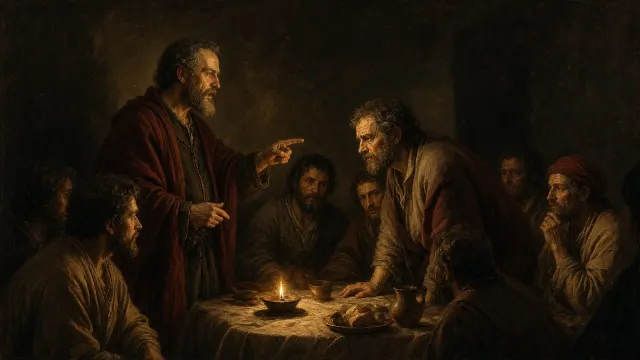
Fellowship Is Tested at the Table
The Book of Galatians makes fellowship visible before testing it in public. Titus, a Greek, is not compelled to be circumcised when Paul lays his Gentile mission before the recognized Jerusalem leaders. James, Cephas, and John perceive the grace given to Paul and Barnabas, extend fellowship, and ask only that the poor be remembered. Yet the agreement is soon strained at an ordinary table. Peter had eaten with Gentiles, then withdraws when certain people arrive, and others follow him until even Barnabas is carried away. Paul treats that separation as more than bad manners because it pressures Gentiles to live as Jews. His response moves directly into justification: Jewish believers themselves have trusted Christ rather than works of the law. To rebuild the old boundary would make the believer, not Christ, the transgressor and would empty Christ’s death of its necessity.
One complete chapter pageOpen chapter →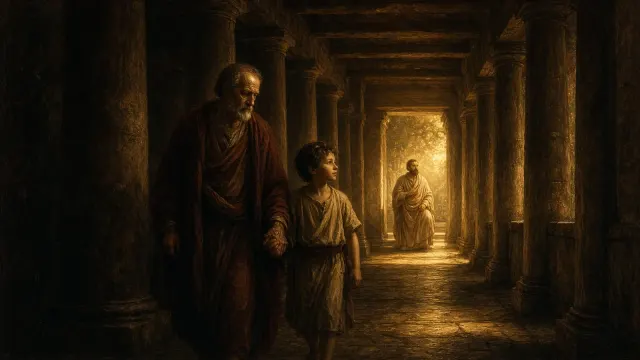
The Promise Arrives Before the Law and Survives It
Paul begins with evidence the Galatians already possess: they received the Spirit through the hearing of faith, not by works of the law. The Book of Galatians then follows that beginning backward to Abraham, whose faith was counted for righteousness and whose promised blessing already reached toward the nations. Paul places the law’s curse beside Christ’s death and then makes chronology carry the argument. A law arriving four hundred thirty years later cannot cancel a promise God had already confirmed. The law therefore has a real but limited role in relation to transgression, confinement, and custody until the promised seed comes. It cannot give life or replace the inheritance. With faith arrived, the supervised child is no longer under the guardian. Baptism into Christ becomes the shared garment, and distinctions of Jew and Greek, bond and free, male and female cannot establish unequal claims to the inheritance. Those who belong to Christ are Abraham’s seed and heirs according to promise.
One complete chapter pageOpen chapter →
Heirs Are Being Invited Back Into the Servants' Quarters
The Book of Galatians extends the image of a supervised child into the status of an heir. At the appointed time God sends his Son to redeem those under the law and sends the Spirit of his Son into believers’ hearts, so the servant’s position gives way to sonship and inheritance. That makes the Galatians’ movement back toward bondage especially jarring. Paul even corrects his own wording from knowing God to being known by God, keeping divine initiative at the center. The argument then becomes personal. He remembers their remarkable welcome during his bodily weakness and contrasts it with teachers who, in his account, seek the Galatians’ dependence. Finally Paul turns to Abraham’s two sons. Hagar and Sarah become an allegorical contrast between bondage and freedom, while Isaiah’s barren woman supplies the surprising image of abundant children. The Galatians are identified with Isaac as children of promise, not with the inheritance of slavery.
One complete chapter pageOpen chapter →
Freedom Takes the Form of Love, Not Self-Indulgence
Freedom in the Book of Galatians is neither a new badge nor permission for self-indulgence. Paul warns that accepting circumcision as the ground of justification brings obligation to the whole law and places the seeker outside the grace on which the letter has insisted. Yet uncircumcision cannot become a rival ground of boasting either. What matters is faith working through love. Paul then exposes the apparently small interference troubling the churches and answers it with severe language because, in his view, the proposed addition changes the gospel’s character. The positive shape of liberty appears in a deliberate paradox: free people serve one another through love. The conflict between flesh and Spirit is therefore measured in relationships as much as appetites. Hatred, rivalry, factions, and envy stand beside sexual wrongdoing and drunkenness. The Spirit’s fruit answers with a different character and ends exactly where the community needs it, with a warning against vain glory, provocation, and envy.
One complete chapter pageOpen chapter →
The Final Marks Are the Ones Paul Bears Himself
The final chapter of the Book of Galatians gives the Spirit-led life ordinary weight. A person overtaken in a fault is to be restored with meekness, burdens are to be carried together, and self-examination prevents another person’s failure from becoming a source of superiority. Paul then joins material sharing, sowing and reaping, perseverance, and doing good into one pattern of generous responsibility. His closing handwriting shifts the dispute back to visible marks. He accuses the rival teachers of pressing circumcision in order to make a good outward showing, avoid persecution for the cross, and boast in the Galatians’ bodies. Paul answers with the cross as his own boast and “a new creature” as the category that matters beyond circumcision or uncircumcision. The final marks are not achievements cut into converts but the marks Paul bears in his own body. He closes the severe letter by calling them brethren and returning once more to the grace of Christ.
One complete chapter pageOpen chapter →Source: eBible.org · eng-kjv2006