The big picture
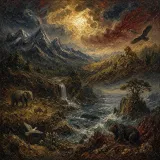
The singer looks across the world and praises its maker. Light, skies, waters, land, plants, animals, and human work all enter the song. Lebanon, a mountain region known for cedars, supplies one named place in this living landscape. The poem traces both shelter and food, night and day, death and renewed life. Its great variety is held together by dependence: every creature receives its place and breath from God.
In this chapter
- Light and Waters Take Their Places Psalms 104:1-9
The singer blesses God as clothed in honour, then pictures light as his garment and the sky as a spread curtain.
- Water and Food Reach Many Homes Psalms 104:10-18
Springs flow through valleys and give wild animals drink.
- Night and Day Give Work Its Rhythm Psalms 104:19-23
Moon and sun mark the appointed times.
- The Sea Holds Uncounted Life Psalms 104:24-26
The singer pauses to marvel at the number and variety of God's works, all made with wisdom.
- Breath and Food Remain Gifts Psalms 104:27-30
All the creatures wait for God to give food at the right time.
- The Singer Offers a Lifelong Response Psalms 104:31-35
God's glory is wished to endure, and he is pictured rejoicing in his works.
Central truth
God wisely gives creatures their places, food, and breath, so the whole living world supplies the singer with reasons for praise.

Scripture beside the summary
Psalms · King James Version · 35Psalms 104:1-9
Light and Waters Take Their Places
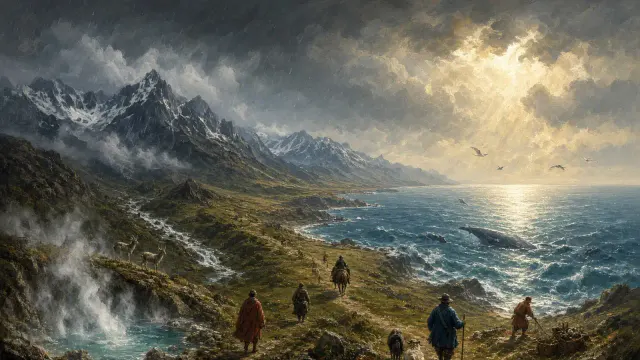
The singer blesses God as clothed in honour, then pictures light as his garment and the sky as a spread curtain. Clouds carry him, winds serve him, and fire belongs to his attending powers. He sets earth firmly while deep water covers even mountains. At his rebuke the waters retreat to their assigned places, with a boundary against returning to cover the earth. These are images of a world ordered by divine command. These great forces are not equal rivals for control. They take their places under the maker's rule.
In everyday life
A theatre rigger checks the great curtains, lights, and moving platforms before a performance. What fills the whole stage has a place and a controlled movement, even where the audience will see only a wide scene. She tests each limit carefully. Order gives the space its usable shape. The psalm describes God's command over creation itself, not a constructed stage.
Notice
Psalms 104:9 A boundary is set for the waters. The created land remains habitable because the threatening deep is given a limit, rather than because water has no strength.
Psalms 104:1-9
King James Version1Bless the LORD, O my soul. O LORD my God, thou art very great; thou art clothed with honour and majesty.
2Who coverest thyself with light as with a garment: who stretchest out the heavens like a curtain:
3Who layeth the beams of his chambers in the waters: who maketh the clouds his chariot: who walketh upon the wings of the wind:
4Who maketh his angels spirits; his ministers a flaming fire:
5Who laid the foundations of the earth, that it should not be removed for ever.
6Thou coveredst it with the deep as with a garment: the waters stood above the mountains.
7At thy rebuke they fled; at the voice of thy thunder they hasted away.
8They go up by the mountains; they go down by the valleys unto the place which thou hast founded for them.
9Thou hast set a bound that they may not pass over; that they turn not again to cover the earth.
Psalms 104:10-18
Water and Food Reach Many Homes
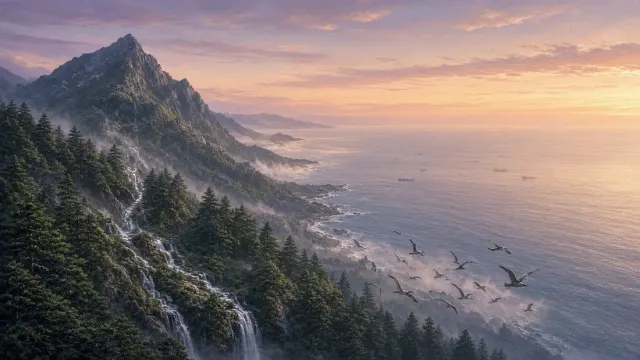
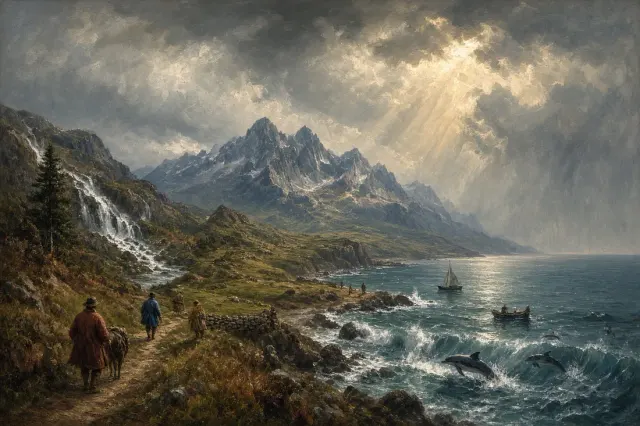
Springs flow through valleys and give wild animals drink. Birds live and sing nearby, while rain waters hills. Grass feeds cattle, and cultivated plants provide human food, wine, oil, and bread. The singer also notices great trees where birds nest, including the stork's home. High hills shelter wild goats, and rocks protect small animals. The account links provision with fitting places to live. Human needs receive attention, but they do not occupy the whole field of care; creatures beyond farms and houses also have food and refuge.
In everyday life
A nature-reserve warden follows a stream from grazing fields into wooded rocks. Cattle drink below, birds nest above, and small animals disappear into cracks near her boots. She records the different uses of the same watercourse before approving a path repair. The landscape serves more lives than the visitors usually notice. The psalm credits God with all their provision.
Notice
Psalms 104:18 The rocks are a refuge for small creatures. Care is seen in a habitat suited to them, not only in supplies brought to human households.
Psalms 104:10-18
King James Version10He sendeth the springs into the valleys, which run among the hills.
11They give drink to every beast of the field: the wild asses quench their thirst.
12By them shall the fowls of the heaven have their habitation, which sing among the branches.
13He watereth the hills from his chambers: the earth is satisfied with the fruit of thy works.
14He causeth the grass to grow for the cattle, and herb for the service of man: that he may bring forth food out of the earth;
15And wine that maketh glad the heart of man, and oil to make his face to shine, and bread which strengtheneth man’s heart.
16The trees of the LORD are full of sap; the cedars of Lebanon, which he hath planted;
17Where the birds make their nests: as for the stork, the fir trees are her house.
18The high hills are a refuge for the wild goats; and the rocks for the conies.
Psalms 104:19-23
Night and Day Give Work Its Rhythm
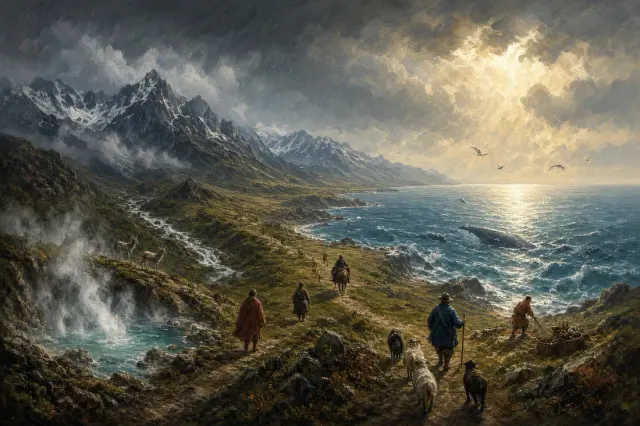
Moon and sun mark the appointed times. Darkness lets forest animals emerge, and young lions seek their prey from God. At sunrise they return to their dens, while people go out to labour until evening. The poem recognises different creatures' needs within the same daily cycle. Night is not treated only as an interruption of human work, nor daylight as the only useful time. Both belong to an ordered world in which wild feeding and human labour have their places under divine provision.
In everyday life
A wildlife photographer packs her camera at dawn as a nocturnal animal slips back into cover. Along the road, a farm worker begins opening gates for the day. The same light closes one period of activity and opens another. She notes both movements before leaving the field. The psalm understands these rhythms as times appointed by God.
Notice
Psalms 104:21 The lions seek food from God even though they hunt. The poem includes their wild activity within dependence on the maker, rather than excluding it from his care.
Psalms 104:19-23
King James Version19He appointed the moon for seasons: the sun knoweth his going down.
20Thou makest darkness, and it is night: wherein all the beasts of the forest do creep forth.
21The young lions roar after their prey, and seek their meat from God.
22The sun ariseth, they gather themselves together, and lay them down in their dens.
23Man goeth forth unto his work and to his labour until the evening.
Psalms 104:24-26
The Sea Holds Uncounted Life
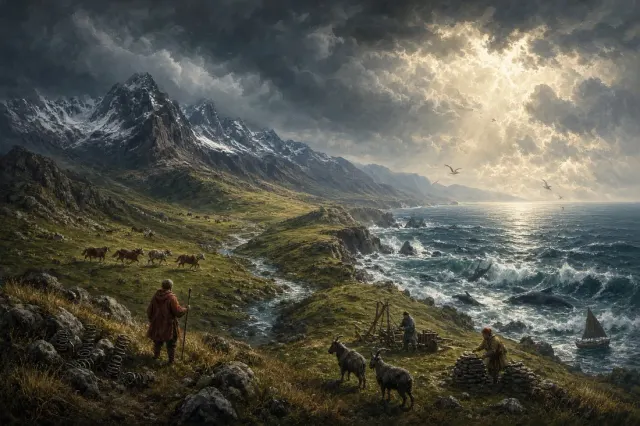
The singer pauses to marvel at the number and variety of God's works, all made with wisdom. The wide sea contains more living things than can be counted, small and great together. Ships travel there, and the great creature named in the poem plays within the same waters. Ships have room to travel. Yet their passage is not the sea's only purpose. What seems vast and unknown is still part of the maker's rich work, filled with life beyond the singer's ability to list.
In everyday life
A marine researcher lowers a viewing lens beside a harbour boat and sees tiny creatures moving through the water. Farther out, a large animal breaks the surface while a cargo ship passes. The sea holds several scales of life and work at once. She records only a small sample of what is there. The psalm praises the wisdom that made them all.
Notice
Psalms 104:26 The great creature is pictured playing in water God made for it. Here its size belongs to creation's variety, rather than making it a rival to the creator.
Psalms 104:24-26
King James Version24O LORD, how manifold are thy works! in wisdom hast thou made them all: the earth is full of thy riches.
25So is this great and wide sea, wherein are things creeping innumerable, both small and great beasts.
26There go the ships: there is that leviathan, whom thou hast made to play therein.
Psalms 104:27-30
Breath and Food Remain Gifts
All the creatures wait for God to give food at the right time. When he opens his hand, they gather and are filled. When he hides his face, they are troubled; when breath is taken away, they die and return to dust. God sends his spirit, and new life renews the earth. The song does not stop at the first making of the world. Continued life, its ending, and its renewal all remain dependent on the giver. The living abundance is real, but it is not self-sustaining.
In everyday life
A hatchery worker checks the water flow through trays of developing fish. Food and oxygen must keep arriving; the original stocking of the trays was not enough. She clears a blocked channel and watches movement return where the supply had weakened. Living systems need continuing support. The psalm makes God the giver of breath, life, and renewal itself.
Notice
Psalms 104:29 The return to dust follows the withdrawal of breath. Dependence reaches the basic fact of being alive, not merely the quality of food or shelter received.
Psalms 104:27-30
King James Version27These wait all upon thee; that thou mayest give them their meat in due season.
28That thou givest them they gather: thou openest thine hand, they are filled with good.
29Thou hidest thy face, they are troubled: thou takest away their breath, they die, and return to their dust.
30Thou sendest forth thy spirit, they are created: and thou renewest the face of the earth.
Psalms 104:31-35
The Singer Offers a Lifelong Response
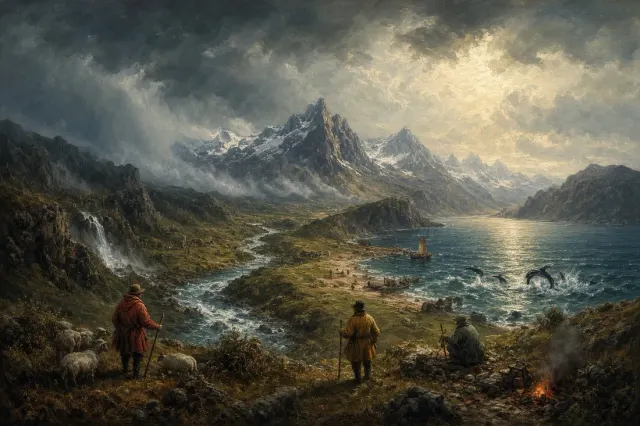
God's glory is wished to endure, and he is pictured rejoicing in his works. A look makes earth tremble, and a touch makes hills smoke. The singer promises praise for the whole span of life and glad thought directed towards God. The final wish asks that sinners and wickedness disappear from earth, a severe conclusion alongside the delight in creation. The soul is again called to bless the Lord. The world's beauty leads into worship, while evil is treated as something that does not belong within its good order.
In everyday life
A landscape painter puts down her brush after spending the day beside a restored wetland. She decides to return through each season rather than treat the first view as enough. Before leaving, she reports fresh dumping at the gate because care for the place includes opposition to harm. The psalm's final request asks God's removal of wicked people.
Notice
Psalms 104:34 Thought is offered alongside the song of praise. Praise includes the inward attention given to God, not only the outward sound made before others.
Psalms 104:31-35
King James Version31The glory of the LORD shall endure for ever: the LORD shall rejoice in his works.
32He looketh on the earth, and it trembleth: he toucheth the hills, and they smoke.
33I will sing unto the LORD as long as I live: I will sing praise to my God while I have my being.
34My meditation of him shall be sweet: I will be glad in the LORD.
35Let the sinners be consumed out of the earth, and let the wicked be no more. Bless thou the LORD, O my soul. Praise ye the LORD.
Details worth noticing
The opening image
Psalms 104:1 begins with “Bless the LORD, O my soul. O LORD my God, thou art very great; thou art clothed with honour and majesty.”
Where the chapter turns
Psalms 104:23 forms a natural hinge: “Man goeth forth unto his work and to his labour until the evening.”
The final note
Psalms 104:35 leaves the reader with “Let the sinners be consumed out of the earth, and let the wicked be no more. Bless thou the LORD, O my soul. Praise ye the LORD.”
A word trail through the chapter
The words LORD, earth, hills, face, maketh, sing help reveal the chapter’s repeated concerns.
KJV words made clear
- conies
- Rock hyraxes, small mammals that shelter among rocks.
- leviathan
- A great sea creature, pictured here at play in the water.
- manifold
- Many in number and varied in kind.
Music and video connected to the passage
Related media appears when its Scripture reference overlaps this study. Music and video can illuminate a theme while the biblical text remains the foundation.