
The big picture
The speaker is overwhelmed by fear, violence in the city, and betrayal by a trusted companion. He longs to escape like a bird, yet keeps bringing his distress to God. The deepest wound comes from someone who once shared counsel and worship with him. The prayer asks severe judgement on harmful people. Its ending contrasts their smooth words and broken loyalty with the Lord's sustaining care, on which the speaker chooses to rely.
In this chapter
- The Wish to Fly Away Psalms 55:1-8
The prayer asks God not to hide from the speaker's noisy grief.
- Violence Fills the Public Streets Psalms 55:9-11
Violence prompts a plea for the Lord to defeat the enemies and divide their speech.
- A Trusted Companion Caused the Wound Psalms 55:12-15
The speaker explains why this insult hurts so deeply.
- Prayer Continues Across the Day Psalms 55:16-19
The speaker turns his own course towards calling on God.
- Smooth Words Conceal a Drawn Sword Psalms 55:20-23
The betrayer has attacked people at peace with him and broken his pledged loyalty.
Central truth
Betrayal and fear drive the speaker towards urgent prayer, while trust in God's support answers the failure of human loyalty.


Scripture beside the summary
Psalms · King James Version · 23Psalms 55:1-8
The Wish to Fly Away
The prayer asks God not to hide from the speaker's noisy grief. Enemy pressure and angry hatred have brought terror into his heart. Trembling and horror overwhelm him, and death feels near. He wishes for a dove's wings so he can fly far away and rest in the wilderness. Escape from the storm would mean more than a change of scenery. He wants distance from a threat that has filled his body and thoughts. The wish is spoken to God rather than acted out in a described departure.

In everyday life
A harassed tenant stands at the window with an unopened bag beside her feet. Another threatening message has made her hands shake. She watches birds lift from the roof and imagines a room far from the noise outside her door. She calls her support worker before moving the bag. The psalm directs its longing for escape to God.
Notice
Psalms 55:6 Wings express a wish for distance and rest. The image gives fear a physical direction without claiming that the speaker has actually escaped the danger.
Psalms 55:1-8
King James Version1Give ear to my prayer, O God; and hide not thyself from my supplication.
2Attend unto me, and hear me: I mourn in my complaint, and make a noise;
3Because of the voice of the enemy, because of the oppression of the wicked: for they cast iniquity upon me, and in wrath they hate me.
4My heart is sore pained within me: and the terrors of death are fallen upon me.
5Fearfulness and trembling are come upon me, and horror hath overwhelmed me.
6And I said, Oh that I had wings like a dove! for then would I fly away, and be at rest.
7Lo, then would I wander far off, and remain in the wilderness. Selah.
8I would hasten my escape from the windy storm and tempest.
Psalms 55:9-11
Violence Fills the Public Streets
Violence prompts a plea for the Lord to defeat the enemies and divide their speech. He has seen violence and conflict throughout the city. Trouble circles the walls day and night, while harm, deceit, and oppression occupy its centre and streets. The danger is not confined to one private quarrel. Places meant for shared life have become filled with schemes and sorrow. The request to disrupt hostile speech answers a setting where coordinated wrongdoing keeps moving through the public spaces without rest.

In everyday life
A market warden walks the same row of stalls at dawn and again after closing. At both times, traders report threats and false demands from the same group. She gathers the accounts separately so the shared intimidation becomes visible. The problem reaches the whole market rather than one argument. The psalm asks God to break a city's violent conspiracy.
Notice
Psalms 55:10 Day and night surround the description of the walls. The repeated circuit makes the city's trouble seem constant, not a brief disturbance already passing away.
Psalms 55:9-11
King James Version9Destroy, O Lord, and divide their tongues: for I have seen violence and strife in the city.
10Day and night they go about it upon the walls thereof: mischief also and sorrow are in the midst of it.
11Wickedness is in the midst thereof: deceit and guile depart not from her streets.
Psalms 55:12-15
A Trusted Companion Caused the Wound
The speaker explains why this insult hurts so deeply. An open enemy's attack would be expected, and escape from a declared hater would be possible. Instead, the betrayer was an equal, guide, and familiar friend. They shared close counsel and walked together to worship. The prayer then asks that death seize such wrongdoers and that they go alive into the realm of the dead. The request is severe. It names betrayal as evil within the shared life that once made trust possible, without softening the speaker's desire for judgement.
In everyday life
A community worker finds her private notes passed around by the colleague who used to walk with her to difficult visits. She sits alone on the stairwell, remembering conversations she thought were safe. An open rival would not have held those details. The loss reaches the trust behind the work. The psalm responds with a deadly appeal to divine judgement.
Notice
Psalms 55:14 Shared worship belongs among the memories of friendship. The betrayal breaks not only private affection but a relationship that had accompanied approach to God.
Psalms 55:12-15
King James Version12For it was not an enemy that reproached me; then I could have borne it: neither was it he that hated me that did magnify himself against me; then I would have hid myself from him:
13But it was thou, a man mine equal, my guide, and mine acquaintance.
14We took sweet counsel together, and walked unto the house of God in company.
15Let death seize upon them, and let them go down quick into hell: for wickedness is in their dwellings, and among them.
Psalms 55:16-19
Prayer Continues Across the Day
The speaker turns his own course towards calling on God. Evening, morning, and noon will all carry his urgent prayer, and he trusts that his voice will be heard. He speaks of peaceful rescue from the battle around him despite the many involved. The enduring God will also hear and humble the enemies. Their unchanging ways and lack of reverence remain part of the charge. Regular prayer does not make the betrayal small. It gives the whole passing day a direction towards the one who can answer it.
In everyday life
A worried mother checks in with the hospital ward before breakfast, during her lunch break, and after the evening dishes. Each call carries the same concern, though her words change with the day. Keeping contact gives shape to hours she cannot control. She listens carefully when help is reported. God's hearing is not limited to scheduled calls or staff availability.
Notice
Psalms 55:17 Three times span ordinary daily life. The speaker intends to keep praying through the day, rather than confining the distress to one brief appeal.
Psalms 55:16-19
King James Version16As for me, I will call upon God; and the LORD shall save me.
17Evening, and morning, and at noon, will I pray, and cry aloud: and he shall hear my voice.
18He hath delivered my soul in peace from the battle that was against me: for there were many with me.
19God shall hear, and afflict them, even he that abideth of old. Selah. Because they have no changes, therefore they fear not God.
Psalms 55:20-23
Smooth Words Conceal a Drawn Sword
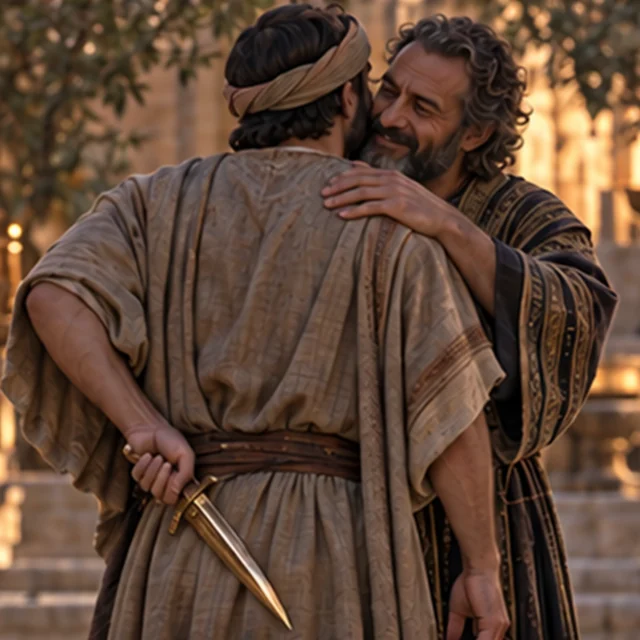
The betrayer has attacked people at peace with him and broken his pledged loyalty. His speech sounds soft and pleasant, yet war lies within it. Words become drawn swords in the poem's picture. Against that false support, the speaker calls for burdens to be placed on the Lord, who sustains the righteous. He asks God to bring violent deceivers down before their expected years are complete. The ending gives his own choice plainly: he will trust God rather than the smooth voice that concealed harm.
In everyday life
A freelance designer rereads a warmly worded contract beside the unpaid invoices it concealed. The client's flattering promises now look different from the work he demanded. She sends the records to a trusted adviser and asks for help carrying the dispute. The pleasant tone no longer decides her trust. The psalm rests its burden on God and asks severe judgement.
Notice
Psalms 55:21 The same mouth sounds gentle while the heart holds war. The contrast warns that a soft manner can carry a purpose as harmful as an exposed weapon.
Psalms 55:20-23
King James Version20He hath put forth his hands against such as be at peace with him: he hath broken his covenant.
21The words of his mouth were smoother than butter, but war was in his heart: his words were softer than oil, yet were they drawn swords.
22Cast thy burden upon the LORD, and he shall sustain thee: he shall never suffer the righteous to be moved.
23But thou, O God, shalt bring them down into the pit of destruction: bloody and deceitful men shall not live out half their days; but I will trust in thee.
Details worth noticing
The opening image
Psalms 55:1 begins with “Give ear to my prayer, O God; and hide not thyself from my supplication.”
Where the chapter turns
Psalms 55:13 forms a natural hinge: “But it was thou, a man mine equal, my guide, and mine acquaintance.”
The final note
Psalms 55:23 leaves the reader with “But thou, O God, shalt bring them down into the pit of destruction: bloody and deceitful men shall not live out half their days; but I will trust in thee.”
A word trail through the chapter
The words hear, LORD, death, enemy, heart, midst help reveal the chapter’s repeated concerns.
KJV words made clear
- quick
- Alive, as used here for going down to the place of the dead.
- covenant
- A binding agreement or relationship that creates duties of loyalty.
Music and video connected to the passage
Related media appears when its Scripture reference overlaps this study. Music and video can illuminate a theme while the biblical text remains the foundation.