The big picture
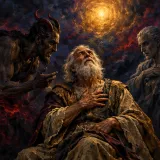
Job's first response to the Lord is brief because the scale of the conversation has changed. He lays his hand on his mouth and declines to continue the argument as before, yet the Lord speaks again rather than ending the encounter there. The second challenge brings justice into direct focus: will Job disannul divine judgment in order to maintain his own righteousness, and can he actually wield the universal power needed to bring every proud and wicked person low? The question does not validate the friends' accusations against Job. It exposes a different excess in Job's indictment of divine government. Behemoth then appears as a fellow creature, "made with thee," possessing enormous bodily strength and a settled place among food, shade, reeds, and water. Its scale exceeds Job's without making it a rival to the Creator who made them both.
In this chapter
- Silence in the Place of Another Defence Job 40:1-5
The Lord explicitly gives Job the turn to answer, so Job's silence is not the result of being denied a hearing.
- Justice Is Not Secured by Condemning the Judge Job 40:6-14
The second address names the central problem more sharply.
- A Fellow Creature Built on Another Scale Job 40:15-19
Behemoth is introduced first as a fellow creature: God made it "with thee." That opening relation keeps the animal's extraordinary strength inside creaturehood rather than turning it into another deity.
- Unhurried Beside the River Job 40:20-24
After the heavy description of behemoth's body, the scene becomes unexpectedly restful.


Scripture beside the summary
Job · King James Version · 24Job 40:1-5
Silence in the Place of Another Defence
The Lord explicitly gives Job the turn to answer, so Job's silence is not the result of being denied a hearing. He answers by saying that he is "vile," asking what he can add, and placing his hand over his mouth. The KJV's word here concerns smallness or slightness and should not be inflated into a confession that the friends' invented accusations were secretly true. Job is acknowledging the disproportion between himself and the scope of the counsel he had been judging. His gesture makes that recognition visible. After chapters of carefully defended speech, the hand that helped carry the argument now covers the mouth that made it. His reference to speaking once and twice is not a literal count of every speech but an acknowledgment that he has already said enough. Yet this is not the final exchange. The Lord continues, showing that mere cessation of argument is only the first stage of Job's response.

Deep dive
The invitation to answer does not disappear beneath the long divine speech. The Lord expressly returns the turn to Job, and Job actually speaks. His response is brief in comparison with the many arguments he had prepared. The hand over the mouth gives visible form to the decision not to continue on the same terms.
The KJV's "vile" represents a form of the Hebrew qalal, whose sense here concerns being slight or of little account. It should not be treated as Job's sudden admission that Eliphaz correctly accused him of robbing orphans. Job recognizes his inadequacy before the one who has questioned him. The speech has exposed the disproportion between his knowledge and the scope of the counsel he was judging.
His reference to having spoken once and twice is a way of acknowledging prior speech, not an arithmetic count of his contributions. He now declines to add more. Yet the book does not end at this first silence. The Lord speaks again, which shows that the response still has further ground to cover beyond withholding another argument.
Words to trace: answer, LORD, Almighty, contendeth, further, hand
Verse-by-verse path
- Job 40:1
A fresh heading breaks into the LORD’s speech after the eagle among the slain in 39:30, as if the voice paused and waited. No whirlwind is named this time, though it framed 38:1 and returns in verse 6. Job has not spoken since 31:40, “The words of Job are ended”.
- Job 40:2
“Contendeth” is the Hebrew rib, the verb for bringing a lawsuit; Job had begged in 10:2, “shew me wherefore thou contendest with me.” “Reproveth” is yakach, the root of the “daysman” Job wished for in 9:33. His own courtroom words are handed back to him, with the floor.
- Job 40:3
After five chapters of silence Job finally speaks, and it is the shortest speech he makes anywhere in the book: two verses, against the thirty and more he gave most of his earlier replies.
- Job 40:4
In 29:9 Job remembered how princes “laid their hand on their mouth” when he came into the gate, and in 21:5 he told his friends to do the same. The gesture he once received as honour, and prescribed for others, he now makes himself.
- Job 40:5
“Once, yea twice” is a Hebrew way of saying enough and more than enough. Elihu used it of God in 33:14, “God speaketh once, yea twice, yet man perceiveth it not.” Job borrows the phrase for his own speaking and closes it off.
Job 40:1-5
King James Version1Moreover the LORD answered Job, and said,
2Shall he that contendeth with the Almighty instruct him? he that reproveth God, let him answer it.
3Then Job answered the LORD, and said,
4Behold, I am vile; what shall I answer thee? I will lay mine hand upon my mouth.
5Once have I spoken; but I will not answer: yea, twice; but I will proceed no further.
Job 40:6-14
Justice Is Not Secured by Condemning the Judge
The second address names the central problem more sharply. Job's refusal to confess crimes he did not commit was not itself wrong, but his defence has at times moved toward condemning divine judgment in order to secure his own righteousness. The Lord therefore asks whether Job will "disannul my judgment" and then couples that question with an impossible assignment. Let Job clothe himself with majesty, survey every proud person, bring each one low, tread down the wicked, and bind them in the dust. The challenge is not power displayed instead of justice. It asks what universal justice would require from an actual governor rather than from an observer naming cases of apparent disorder. Knowledge, reach, authority, and effective action all have to meet in the same hand. Job's hand has just gone to his mouth; now he is asked whether that human right hand can save him and administer the whole moral order.

Deep dive
The central challenge is now explicit. Job's valid refusal to confess crimes he did not commit has at times developed into an indictment of God's governance. The Lord asks whether Job will cancel divine judgment in order to preserve his own righteousness. This is not a demand that he accept the friends' accusations. It identifies a different excess in the way his defence has been conducted.
The invitation to wear majesty and glory follows with a corresponding task: find every proud person, bring each low, and put the wicked in their place. Job has asked why judgment is not visibly executed. The answer tests what it would take to govern that judgment universally rather than describe a few cases from within it.
The right hand becomes decisive. Job's hand has just gone to his mouth; the Lord now asks whether that same human agency can save him and administer the whole moral order. The promised acknowledgment is conditional upon accomplishing the task. Power here is not offered as a substitute for justice. The speech binds adequate knowledge, effective authority, and universal reach to the actual exercise of just government.
Words to trace: proud, thyself, abase, abroad, array, beauty
Verse-by-verse path
- Job 40:6
The heading of 38:1 returns almost word for word, whirlwind and all. The word is se‘arah, a storm wind, the same one Job used in 9:17 when he complained, “he breaketh me with a tempest.” The storm he accused is the place the answer keeps coming from.
- Job 40:7
Repeated exactly from 38:3. “Like a man” is geber, the word for a strong man or warrior, and girding meant tucking the long robe into the belt to run or fight. In 13:22 Job offered, “call thou, and I will answer”; the terms he proposed are the ones he is held to.
- Job 40:8
“Disannul” is the verb for breaking a covenant or voiding a vow. “Judgment” is mishpat, Job’s own word in 27:2, “God, who hath taken away my judgment.” In a two-party lawsuit, one side declared righteous means the other declared guilty; the LORD names that as the logic Job’s case had slid into.
- Job 40:9
In 26:2 Job mocked Bildad for helping “the arm that hath no strength”. Now the arm in question is his own. The thunder recalls Elihu, who had just said “God thundereth marvellously with his voice” (37:5); the LORD asks whether Job has that voice.
- Job 40:10
“Glory and beauty” is the Hebrew pair hod and hadar, the clothing of the divine king in Psalm 104:1, “thou art clothed with honour and majesty.” Job once said of his days in the gate, “my judgment was as a robe and a diadem” (29:14). He is offered the royal wardrobe on one condition, which the next verses spell out.
- Job 40:11
“Rage” is literally overflowings, anger breaking its banks. Job had spoken often of God’s wrath, “He teareth me in his wrath” (16:9); here he is invited to pour out his own. The proud head the list, and “proud” shares its root with the sea’s “proud waves” held back in 38:11.
- Job 40:12
The verse restates verse 11 with a sharper ending. “Tread down” translates a Hebrew verb found nowhere else in the Bible, to trample, and “in their place” means on the spot, where they stand, with no delay and no inquiry. Job’s complaint in 21:7, “Wherefore do the wicked live”, is being taken at its word.
- Job 40:13
The dust is burial, and “in secret” is the hidden place of the dead. Binding the face recalls the cloth wound round a corpse’s head. In 14:13 Job had pleaded, “O that thou wouldest hide me in the grave”; the verb there is hide, and here he is asked to do the hiding.
- Job 40:14
“Confess” is yadah, the verb the psalms use for giving thanks and praise to God. The offer is ironic and exact: accomplish verses 10 to 13 and the LORD will praise Job. In 13:16 Job said of God, “He also shall be my salvation”; the question is whether his own hand could be.
Job 40:6-14
King James Version6Then answered the LORD unto Job out of the whirlwind, and said,
7Gird up thy loins now like a man: I will demand of thee, and declare thou unto me.
8Wilt thou also disannul my judgment? wilt thou condemn me, that thou mayest be righteous?
9Hast thou an arm like God? or canst thou thunder with a voice like him?
10Deck thyself now with majesty and excellency; and array thyself with glory and beauty.
11Cast abroad the rage of thy wrath: and behold every one that is proud, and abase him.
12Look on every one that is proud, and bring him low; and tread down the wicked in their place.
13Hide them in the dust together; and bind their faces in secret.
14Then will I also confess unto thee that thine own right hand can save thee.
Job 40:15-19
A Fellow Creature Built on Another Scale
Behemoth is introduced first as a fellow creature: God made it "with thee." That opening relation keeps the animal's extraordinary strength inside creaturehood rather than turning it into another deity. Its power is then described through the body itself: loins, belly, tail, sinews, and bones, with brass and iron providing comparisons for firmness. The point is massive embodied strength, not literal metal anatomy. The exact modern species is left uncertain by the description. A hippopotamus has long been proposed, while other readings take the language as more heavily heightened. The cedar-like tail is one reason confident identification remains difficult. What the passage makes secure is the relation between Maker and made. Behemoth may be "chief" among God's works in this portrait, but the one who made it remains able to approach it. Job stands beside a creature vastly stronger than himself while both stand within a power neither possesses.

Deep dive
The first relation established is shared creaturehood: God made behemoth "with thee." The animal is not brought forward as a second god. It eats grass, and its formidable strength belongs to a made body. Loins, belly, tail, sinews, and bones make that strength specific. The metal comparisons describe firmness, not a claim that the skeleton is literally composed of bronze and iron.
The precise identification is disputed. The hippopotamus is a longstanding reading, supported by the grazing and waterside setting; other readings understand an extraordinary or poetically heightened beast. The cedar comparison in the description of the tail is one reason debate persists. The passage does not provide enough taxonomic detail to establish a modern species, and it should not be turned into a confident identification of a dinosaur.
Calling the creature chief among God's ways expresses its imposing place in the description. It still does not remove the relation of Maker and made. The one who created it can bring the sword to it. Job is placed beside a creature whose physical scale exceeds his while both remain within a power neither possesses.
Words to trace: bones, approach, bars, behemoth, belly, brass
Verse-by-verse path
- Job 40:15
Behemoth is the plural of the ordinary word for a beast, used as a singular: the beast of beasts, a plural of greatness. Job used the same word in 12:7, “ask now the beasts, and they shall teach thee.” One of them is now brought forward to do exactly that.
- Job 40:16
Two words for power, strength and force, locate it in the loins and the belly. The word the King James renders “navel” is rare and is usually taken as the muscles or sinews of the belly; the hide over a hippopotamus’s belly is thick, which fits the more common identification.
- Job 40:17
“Stones” in 1611 meant testicles, following the Latin Vulgate; most modern versions read “thighs”. Several interpreters take “tail” as a delicate way of naming the same organ, which would explain the cedar comparison. That is an inference, but it suits a passage about raw procreative and bodily vigour.
- Job 40:18
“Strong pieces of brass” is more exactly tubes or channels of bronze, hollow and hard. “Bars” renders a word found nowhere else in the Hebrew Bible. Bronze and iron are the metals of Job’s mining poem, “Iron is taken out of the earth, and brass is molten out of the stone” (28:2); what men dig for, this animal is built of.
- Job 40:19
“Chief of the ways of God” is literally first of the ways of God, the phrase wisdom uses of itself in Proverbs 8:22, “The LORD possessed me in the beginning of his way.” First can mean first in rank or first in time. The second half is hard Hebrew; the King James makes it a reminder that its maker alone can bring a sword against it.
Job 40:15-19
King James Version15Behold now behemoth, which I made with thee; he eateth grass as an ox.
16Lo now, his strength is in his loins, and his force is in the navel of his belly.
17He moveth his tail like a cedar: the sinews of his stones are wrapped together.
18His bones are as strong pieces of brass; his bones are like bars of iron.
19He is the chief of the ways of God: he that made him can make his sword to approach unto him.
Job 40:20-24
Unhurried Beside the River
After the heavy description of behemoth's body, the scene becomes unexpectedly restful. Mountains bring forth food, other beasts play, and the great creature lies under shade among reeds and willows. Its life is not defined only by combat or threat. Feeding, shelter, and habitat belong to it just as surely as strength, continuing the divine speeches' attention to provision from the raven onward. Even a river does not hurry the animal. The image of drawing Jordan into its mouth magnifies its composure before a flow that would overwhelm a smaller body. The final language about eyes, nose, and snares is difficult enough that it should not be turned into a detailed theory of capture or absolute biological invulnerability. The larger point does not depend on solving that line. Job did not establish this habitat, supply this anatomy, or make this animal readily manageable. One inhabitant of the world is already enough to expose the limits of human control.

Deep dive
After the heavy anatomy comes a surprisingly settled scene. Food grows, other animals play, and behemoth lies beneath trees and among reeds. Its size has not turned the landscape into nothing but battle. The creature's existence includes feeding and shelter, the same kinds of provision that have occupied the divine speeches from the hungry raven onward.
The river does not produce the alarm it would produce in a much smaller creature. The KJV's image of drawing up Jordan magnifies its unhurried confidence before a great flow of water. The final verse's language of eyes, nose, and snares is difficult and is read by many as a question about capture. The KJV presents the animal's relation to the snare differently, so the line should not be made the basis of a detailed capture method or an absolute biological claim of invulnerability.
The larger contrast is secure. Job does not provide this strength, establish this habitat, or easily take command of this life. The divine address has moved from administering universal justice to one impressive inhabitant of the world. Even that single creature is enough to expose the limits of the control being imagined.
Words to trace: shady, trees, beasts, brook, compass, cover
Verse-by-verse path
- Job 40:20
“Play” is the verb for laughing or sporting, the same one used of the ostrich that “scorneth the horse” (39:18) and the warhorse that “mocketh at fear” (39:22). Leviathan will be asked whether he can be played with as a bird (41:5). Around this great eater, smaller animals play without fear.
- Job 40:21
“Shady trees” translates a word found only here and in the next verse, now usually identified as the lotus thorn, a shrub of the Jordan valley and the Nile. “Fens” is the marsh word Bildad used in 8:11, “Can the rush grow up without mire?”
- Job 40:22
The poem gives two full verses to shade for an animal that lies hidden by day and grazes by night. “Willows of the brook” are the trees Israel cut for the booths of Tabernacles in Leviticus 23:40, probably the Euphrates poplar that lines watercourses in the region.
- Job 40:23
The Hebrew reads more nearly “if a river rages, he is not alarmed”; the King James “drinketh up” follows an older understanding of the verb. Jordan, the only Israelite place named in the divine speeches, may stand for any torrent. It overflowed “all his banks all the time of harvest” (Joshua 3:15).
- Job 40:24
Captors led animals and prisoners by a ring through the nose, as the LORD threatens Sennacherib in 2 Kings 19:28. Many read this verse as a question, can anyone take him while he watches, or pierce his nose? Read that way, it hands straight into the hooks and cords of the chapter that follows.
Job 40:20-24
King James Version20Surely the mountains bring him forth food, where all the beasts of the field play.
21He lieth under the shady trees, in the covert of the reed, and fens.
22The shady trees cover him with their shadow; the willows of the brook compass him about.
23Behold, he drinketh up a river, and hasteth not: he trusteth that he can draw up Jordan into his mouth.
24He taketh it with his eyes: his nose pierceth through snares.
Questions to keep in mind while reading
- Follow the speaker, images, parallel lines, questions, and emotional movement.
- Notice where tension or suffering resists an easy answer.
- Read a saying as wisdom for faithful discernment, not as a mechanical promise detached from context.
Text first
Where readers differ
The chapter summary begins with what the passage says and how its parts fit together. It does not assume one denomination has already settled every question. Where a conclusion depends on a tradition, literary theory, or historical reconstruction, that dependence is named openly.
The KJV text is presented first. Interpretive conclusions are labeled, and differences are introduced only when they help a reader understand why serious communities do not always reach the same answer.
Comparative interpretive notes for this chapter are in preparation. Until reviewed notes are ready, this page separates the KJV text from summary and application without claiming that serious readers agree on every question.
Questions beneath the surface
- What account of God, human freedom, responsibility, and the good life emerges from Job 40?
- Which tension does the chapter refuse to resolve quickly?
- What changes when the chapter is read as part of the whole canon rather than as an isolated moral lesson?
- Where might a sincere reader confuse a familiar tradition with something the text states directly?
Questions for serious personal contemplation
These open-ended questions make room for tension, honest response, prayer, and conclusions that remain accountable to the chapter.
Observe without rushing
What part of Job 40 makes you stop, feel unsettled, or feel surprised, and why?
Which detail in the passage would be easiest to overlook? How does that detail change your understanding?
Where do you see tension between what happens and this focus: Job 40 develops its own movement around answer, LORD, bones, hand, loins?
What important question does the passage leave open instead of resolving quickly?
Examine your inner life honestly
Which person, response, fear, or desire in the passage feels most like your own life right now?
What assumption about God, other people, or yourself does this text challenge?
Which part would you rather soften, avoid, or explain away too quickly? What might that reaction reveal?
If this Scripture could ask you one direct question, what do you think it would ask?
Respond with wisdom and courage
What do you need to remember, confess, grieve, thank God for, or trust after reading this passage?
How might another faithful person read this situation differently without ignoring the text?
What obedient response would be costly, uncomfortable, or slow, yet still faithful to Scripture?
What question will you carry into prayer this week, and which verses will you keep in front of you?
Music and video connected to the passage
Related media appears when its Scripture reference overlaps this study. Music and video can illuminate a theme while the biblical text remains the foundation.