The big picture
A little folly can do damage wildly out of proportion to its size. Ecclesiastes moves from dead flies ruining perfume to foolish speech, misplaced authority, workplace hazards, dull tools, leaking roofs, and private words that travel farther than expected. Wisdom appears less as spectacle than as composure, preparation, timing, and practical skill. A sharpened axe reduces wasted strength, while late skill cannot undo a serpent's bite. The same concern reaches public life, where folly may be placed in dignity and disciplined government may be replaced by indulgence and neglect. Speech receives particular scrutiny. The fool can begin badly and grow worse by talking, making large claims about the future while lacking ordinary competence. The chapter's dry humor serves a serious point: small failures of judgment can become expensive very quickly.
Central truth
Small folly can spoil established wisdom, while unskilled labour, uncontrolled speech, and self-indulgent leadership expose both individuals and a land to avoidable damage.
The study notes have a page of their own
The movement by movement analysis, the words to trace, the verse by verse notes and where readers differ are written for someone studying alone. They are on the Deep Personal Reflections page for this chapter. This page is the lesson.
A chapter-specific teaching brief
These anchors come from this chapter itself. They help a teacher use the Level 1 overview, the Level 2 study, and the Scripture text as one lesson.
Open with the chapter’s first image
Ecclesiastes 10:1: “Dead flies cause the ointment of the apothecary to send forth a stinking savour: so doth a little folly him that is in reputation for wisdom and honour.”
Slow down at the turning point
Ecclesiastes 10:14: “A fool also is full of words: a man cannot tell what shall be; and what shall be after him, who can tell him?”
Keep this word trail visible
fool, king, princes, tell, wisdom, words
What to explain, in order
Teach the passage in this order. Each step names the verses it rests on, so every point can be shown in the text before it is applied.
Ecclesiastes 10:1-3
A dead fly in the perfume
Begin with the image, and draw it if you can: a jar of expensive ointment and one dead fly. Explain apothecary as the perfume maker. Connect it to the last line of chapter 9, so the class sees the chapter beginning with the same warning in a smaller form. Then 10:2: the wise heart at the right hand, the fool's at the left. Explain that in Hebrew idiom the right hand is the side of skill and favour; keep it there and away from modern labels. Verse 3 adds that the fool shows his folly simply by walking down the road. Teach these first because they frame the chapter's theme: small folly, visible damage.
Ecclesiastes 10:4-7
Composure and upside down honour
Now the ruler. Read 10:4 and explain yielding as calmness, a gentle response that settles great offences. Then 10:5-7 describe an error that comes from the ruler himself: folly set in high places, the rich sitting low, servants on horses and princes walking like servants. Explain that the Preacher observes this as an evil, a disorder in society, not as an ideal. Teach this step so the class sees both sides: the wise subject keeps his composure, and the foolish ruler turns honour upside down. Keep the discussion on the principle, without naming modern leaders or parties.
Ecclesiastes 10:8-11
Ordinary risks and the sharpened edge
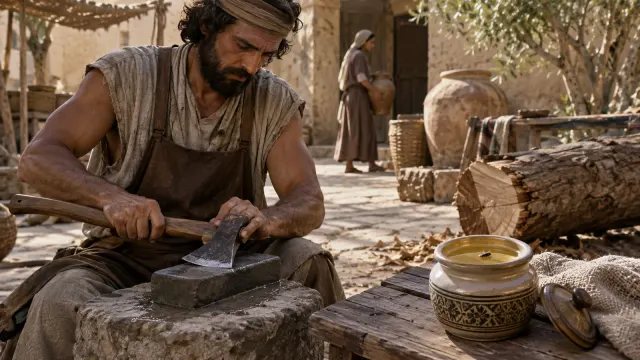
These verses describe everyday work: digging a pit, breaking through a wall where a snake may lurk, quarrying stone, splitting wood. Each task carries its own risk. Explain hedge as a stone wall, where snakes often hid. Then 10:10, the heart of the section: the blunt iron needs more strength, but wisdom directs. Verse 11 adds the snake charmer who is bitten before he can charm; skill unused at the right time is no use. Teach these as practical wisdom about work, and use drawings rather than any demonstration with tools.
Ecclesiastes 10:12-15
The fool's words gather speed
Now speech. The wise speak graciously; the fool's lips swallow him up. Trace the progression in 10:13 from foolishness at the beginning to mischievous madness at the end, then 10:14, where the fool keeps talking about the future as if he knew it, though no one can tell what will be. Link this to 5:3 and 6:12. Verse 15 closes with a dry joke: the fool is worn out by his labour because he does not even know the way to the city. Teach this to show that folly in speech and in work are of a piece: busy, confident and lost.
Ecclesiastes 10:16-20
Leaders, roofs, money and a bird
End with the land and its leaders. Contrast 10:16 and 10:17 carefully: princes who feast in the morning and those who eat at the proper time for strength. Then 10:18, the roof that leaks through laziness, a picture of neglected responsibility, whether in a house or a kingdom. Explain 10:19 as the voice of those who think feasting and money solve everything; read it beside 5:10-15. Finally 10:20, a warning not to curse the king or the rich even in private, because words travel. Teach it last because it brings the chapter back to speech and its consequences.
Where learners get stuck
The misreadings this passage tends to produce, and how to answer each from the text.
"Verse 2 is about political left and right."
Ecclesiastes 10:2 uses an ancient Hebrew idiom in which the right hand is the side of strength, skill and favour, and the left the weaker side. The verse contrasts the wise heart with the foolish heart. It has nothing to do with modern political parties, which did not exist, or with being left handed. Teaching it that way imports the present into the text and turns a proverb about wisdom into a party slogan.
"Verse 19 says money answers all things, so the Bible teaches that money solves every problem."
The verse reports a saying: "A feast is made for laughter, and wine maketh merry: but money answereth all things" (10:19). It sits among descriptions of foolish princes feasting in the morning (10:16) and lazy hands letting the roof leak (10:18), and it is the kind of thing they would say. The same book says "He that loveth silver shall not be satisfied with silver" (5:10). Money meets many needs; it does not answer everything.
"Verse 20 means birds really report what we say."
Ecclesiastes 10:20 uses a vivid saying, much like the English one about walls having ears. The words "a bird of the air shall carry the voice" warn that words spoken in private, even thoughts nursed in a bedroom, have a way of getting out. The point is that contempt is dangerous to cherish, because it will surface. Do not use the verse to make anyone fearful of surveillance; use it to make them careful with their words.
"Verse 4 means I must always stay put and take whatever anger a ruler throws at me."
The proverb counsels composure, "for yielding pacifieth great offences" (10:4), against walking out in a temper. It is practical wisdom for a royal court, where hasty departure looked like rebellion (8:3). It is not a command to remain in abuse or danger. Scripture elsewhere shows God's people fleeing violent rulers, as David fled Saul. If anyone in the room is in an abusive situation, speak with them privately and help them find proper protection.
Learning objectives
- Explain the dead flies' effect on valuable ointment.
- Distinguish composure before a ruler from impulsive withdrawal.
- Identify wisdom's practical advantage with a blunt tool.
- Trace the escalation of foolish speech.
- Contrast leadership for strength with leadership for indulgence.
- Explain the warning about apparently private words.
Teacher preparation
- Read 9:18 before 10:1; connect one sinner destroying much good with small folly spoiling a valued reputation.
- Clarify 'apothecary' as an ointment-maker and 'whet' as sharpen; use a drawing, never an actual sharp-tool demonstration.
- Prepare clusters for reputation, authority, risky work, speech, and leadership; do not force every proverb into a single incident.
- Keep right and left in 10:2 within its wisdom contrast; exclude modern party labels and claims about handedness.
- Prepare to read 10:19 beside 5:10–15; money's usefulness is not unlimited power or final security.
Evidence and interpretation checks
Explicit
Point to Ecclesiastes 10:1,10: a little folly damages reputation, while a blunt edge demands more force and wisdom offers better direction.
Scripture-supported
Read Ecclesiastes 10:12–14 with 5:2–3: abundant words do not establish wisdom and can disclose folly instead.
Strong inference
Infer from Ecclesiastes 10:16–18 that undisciplined leadership and neglect damage more than the leaders themselves; the land and the house bear consequences.
Possible or traditional reading
Present the 'child' king in Ecclesiastes 10:16 as possibly emphasizing immaturity as well as age; contrast conduct in 10:17 before fixing an interpretation.
Limit
State that Ecclesiastes 10:19 does not mean money can purchase every good; 10:20 does not teach that literal birds routinely report private conversations.
Discussion with answer guidance
1. Why begin with a dead fly rather than a dramatic catastrophe?
What a good answer contains
Because the smallness is the warning. "Dead flies cause the ointment of the apothecary to send forth a stinking savour: so doth a little folly him that is in reputation for wisdom and honour" (10:1). A costly perfume ruined by something tiny pictures a good reputation spoiled by one foolish act. It follows "one sinner destroyeth much good" in 9:18. A good answer sees the disproportion: small cause, large damage. A weak answer misses that the warning is aimed at the wise and honoured, who think a little folly will not matter.
Show teacher guidance
Use 10:1's disproportion: something small spoils something valuable; the image makes minor-looking folly impossible to dismiss.
2. What response is advised when a ruler's anger rises?
What a good answer contains
Stay calm and do not abandon your post. "If the spirit of the ruler rise up against thee, leave not thy place; for yielding pacifieth great offences" (10:4). Yielding here means calmness or composure, a gentle spirit that defuses anger. A good answer links this to 8:3, "Be not hasty to go out of his sight", and sees the wisdom of not reacting in kind. A weak answer turns it into a rule that one must always stay in a dangerous situation, which the proverb does not claim.
Show teacher guidance
Locate staying one's place and yielding in 10:4; discuss composure without making it a universal command to remain in danger.
3. What does the blunt iron expose about simply trying harder?
What a good answer contains
That effort is no substitute for skill. "If the iron be blunt, and he do not whet the edge, then must he put to more strength: but wisdom is profitable to direct" (10:10). A dull axe needs more force; a sharpened one needs less. Whet means sharpen. A good answer draws the lesson that wisdom improves the method instead of only adding effort. A weak answer hears only a call to work harder, which is exactly what the woodcutter with the blunt edge is already doing.
Show teacher guidance
Use 10:10: more strength is required when the edge is not sharpened; wisdom can improve the method, not merely increase effort.
4. How does the fool's talk develop from beginning to end?
What a good answer contains
It starts foolish and ends in madness, with more and more words on the way. "The words of a wise man's mouth are gracious; but the lips of a fool will swallow up himself" (10:12). Then "The beginning of the words of his mouth is foolishness: and the end of his talk is mischievous madness" (10:13), and "A fool also is full of words" though "a man cannot tell what shall be" (10:14). A good answer traces the escalation and the false confidence about the future. A weak answer treats the verses as a rule against talking much.
Show teacher guidance
Trace 10:12–14 from self-consuming lips to mischievous madness and multiplying words; contrast confidence with inability to know the future.
5. Why distinguish princes eating for strength from princes eating for drunkenness?
What a good answer contains
Because the contrast is about purpose and discipline in leadership. In 10:16 the land is in trouble when its king is a child and "thy princes eat in the morning", feasting when they should be working. In 10:17 the land is blessed when "thy princes eat in due season, for strength, and not for drunkenness". A good answer sees that the issue is leaders who serve their appetites rather than the people. Child may mean immature as well as young. A weak answer turns it into a ban on breakfast.
Show teacher guidance
Read 10:16–17 as a contrast in disciplined purpose and timing, not a universal prohibition of breakfast.
6. How do a leaking house and a reporting bird finish the warnings?
What a good answer contains
They show that neglect and careless words both have consequences that arrive later. "By much slothfulness the building decayeth; and through idleness of the hands the house droppeth through" (10:18), the roof leaking because no one repaired it. And "Curse not the king, no not in thy thought" because "a bird of the air shall carry the voice" (10:20). A good answer reads the bird as a vivid saying, like the walls have ears. A weak answer takes the bird literally or misses that 10:19 sits between them, on money's limited answer.
Show teacher guidance
Connect 10:18 with accumulated neglect and 10:20 with speech escaping apparent privacy; keep the images vivid without reading them mechanically.
Responsible application
Heart and habits
Give a fictional worker a failing method and a demand to work harder; ask for a wiser response using the blunt-iron comparison.
Relationships and community
Have a group distinguish effective leadership from an invented committee that consumes resources while ignoring the community's maintenance needs.
Speech beyond the room
Ask learners to revise a fictional private message whose contempt would damage others if repeated; focus on words, not surveillance tactics.
Session plans
Two timings of the same lesson. The shorter keeps the reading, the central discussion and one response; the longer gives the confusions and the application their own time.
45 minutes
A very small saboteur
Read 10:1-3. Take question one and confusion one on right and left.
Composure and upside down honour
Read 10:4-7. Take question two and confusion four.
Sharpen before straining
Read 10:8-11. Take question three, using a drawing of a blunt and a sharp axe.
Words gathering speed
Read 10:12-15. Take question four.
When the roof starts leaking
Read 10:16-20. Take questions five and six, and confusions two and three.
Handout
Give out the handout and read 10:12 together.
90 minutes
Little things
Ask the group for examples, from life in general, of something small that spoiled something valuable. Keep answers general.
The dead fly
Read 9:18 and 10:1-3. Take question one and confusion one.
Before the ruler
Read 10:4-7 with 8:2-5. Take question two and confusion four, with care for anyone in a hard situation.
The sharpened edge
Read 10:8-11. Take question three and work the first application on a failing method.
The fool's words
Read 10:12-15 with James 3:5-6. Take question four.
The land and its leaders
Read 10:16-19. Take question five and confusion two, reading 5:10 beside 10:19.
Words beyond the room
Read 10:20. Take question six and confusion three, then the third application on a private message.
Handout and prayer
Read 10:12 together and pray for gracious words and wise hands.
Adapting the lesson
Children
Draw a big jar of perfume and a tiny fly, and talk about how one small wrong choice can spoil a good name. Then draw a blunt axe and a sharp one and ask which would be easier to use; explain that wisdom is like sharpening the axe. Use a paper house with a hole in the roof to talk about doing small jobs before they become big ones. Use no real tools.
Youth
Use a fictional group chat where a private insult spreads, and read 10:20 and 10:12-14. Do not ask anyone to share real messages. Then talk about the blunt axe: working harder versus working wiser at school or in a job. Treat 10:16-17 as wisdom about leadership in general, and keep modern politics and real leaders out of the discussion.
Adults
Adults can apply 10:1 to reputations in work and church, and 10:10 to methods that need sharpening rather than more hours. Spend time on 10:16-18 as a picture of leadership and maintenance, in a household, a business or a congregation, without naming any. Read 10:19 carefully beside 5:10. Keep the right hand and left hand of 10:2 well away from political labels.
One to one
Ask the person whether there is a small thing in their life that is spoiling something they value, like the fly in 10:1. Listen without lecturing. If they are worn out from working harder, read 10:10 and ask together what sharpening the edge might look like. If they are in a situation with an angry authority, listen carefully and help them seek proper advice.
Song and video learning lab
A song or video may interpret, compress, or dramatize the text. Its value becomes clearer when its choices are compared with Scripture.
- Before the media: the exact passage and its central movement.
- During the media: the words, people, events, and emotions the artist emphasizes.
- After the media: what it clarifies, what it leaves out, and what belongs back in the biblical text.
Handout
One page for learners to take home. The print button prints this section alone.
Ecclesiastes 10
The passage in brief
Ecclesiastes 10 is a collection of wise sayings. A dead fly can spoil a jar of perfume, and a little foolishness can spoil a good name. Stay calm when someone in power is angry. A blunt axe needs more strength, but wisdom shows a better way. Wise words are gracious, but a fool talks on and on and ends in madness. A land suffers when its leaders feast instead of working, and a house leaks when no one repairs the roof. Be careful even with private words, because they have a way of getting out.
A verse to keep
The words of a wise man’s mouth are gracious; but the lips of a fool will swallow up himself.
Ecclesiastes 10:12 · King James Version
Questions to take home
What small foolish thing could spoil a good name, according to 10:1?
What does the blunt axe of 10:10 teach about working wisely?
How can you make your words "gracious" this week, as 10:12 describes?
This week
Choose one small repair you have been putting off this week, at home or in a relationship, and do it.
Music and video connected to the passage
Related media appears when its Scripture reference overlaps this study. Music and video can illuminate a theme while the biblical text remains the foundation.