About this song
About this song
This song belongs to the Acts collection. One recording is available to play here, with the complete lyrics below.
- Collection
- Acts
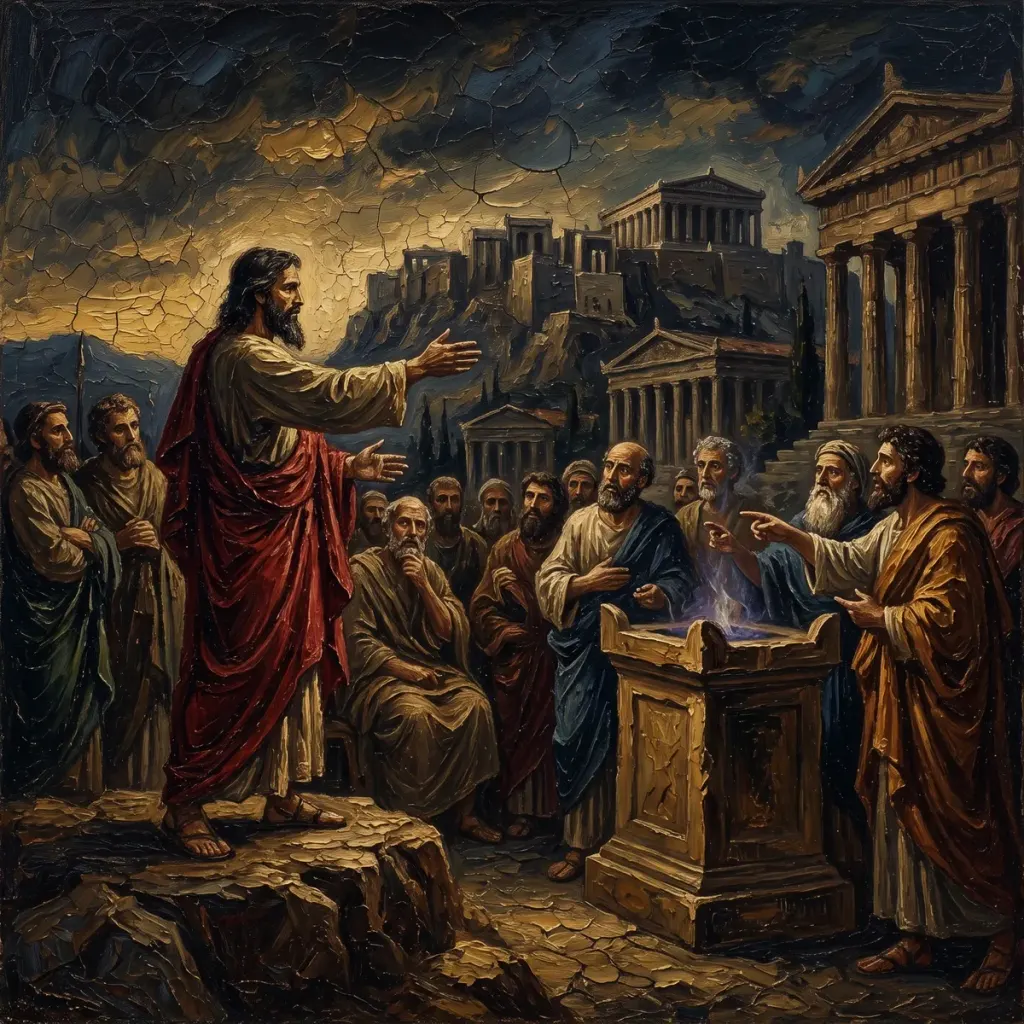
[City of Altars]
Athens was crowded with marble and name,
A thousand devotions, a carefully tended flame.
Paul walked the market with sorrow and thought,
Reasoning daily where wisdom was bought.
[Address]
Men of Athens, I see how you fear,
An altar confessed what your knowledge held unclear.
Whom therefore ye worship without knowing His face,
Him I declare in this public place.
[Chorus]
The unknown God is not unknown,
He made the world and needs no throne.
Not served by hands as though lacking breath,
He gives life to all and appoints every step.
The unknown God is not unknown,
In Him we live, and move, and are known.
[Verse II]
From one blood He formed every nation and time,
Marked where they dwell and invited them nigh.
Gold cannot fashion the Godhead divine,
Nor stone hold the One who created the mind.
[Bridge]
The times of this ignorance God once allowed,
But now He commands all repentance aloud.
A day has been fixed and a Judge has been shown,
Confirmed to the world by His rising from death.
[Responses]
Some mocked resurrection, some asked to hear more,
Dionysius believed with a woman named Damaris.
The sermon did not make the whole city agree,
But witness stood clear where the idols could see.
[Final Chorus]
The unknown God is not unknown,
The risen Judge has made Him known.
Seek Him, though He is not far from each one,
The Maker of all is not housed under stone.
[Outro]
The altar kept its inscription,
But ignorance had been answered.
Named in this songAthensPaul
About the passage
Acts 17: The Scriptures are searched, and the unknown God is named
The Book of Acts, chapter 17, moves through three cities without giving the same audience the same opening. In Thessalonica, Paul reasons from Scripture about a suffering and risen Christ, and opposition translates the claim into a political accusation involving another king. Berea answers readiness with daily examination of the Scriptures, while hostility follows from Thessalonica. In Athens, Paul's waiting period becomes a public argument with synagogue hearers, marketplace listeners, and philosophers. His Areopagus address begins with the city's acknowledged ignorance, presses the dependence of humanity upon the Creator, and ends with repentance, judgment, and resurrection. The responses are mixed: mockery, postponement, and belief. The Book of Acts neither inflates the result nor dismisses it.
Study Acts 17 in depth →