
Places of the Bible

Athens

He was waiting for his colleagues to catch up, and the sightseeing made him angry.

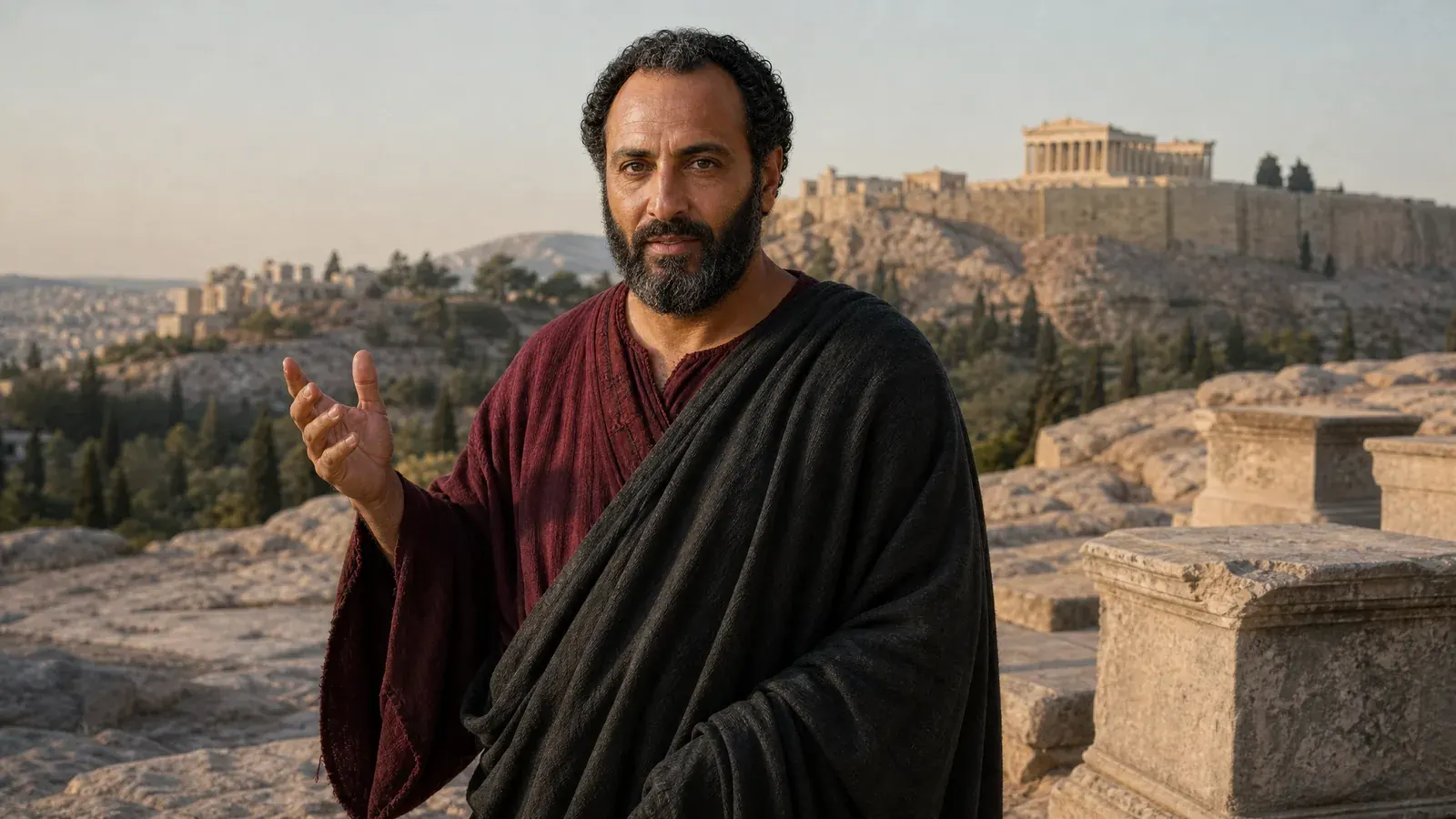
Paul is in Athens by accident. He has been moved out of Thessalonica and Berea ahead of trouble and is waiting for Silas and Timotheus to arrive. The city is four hundred years past its best and still the intellectual address of the Mediterranean. Luke describes the local habit with a dryness that is hard to miss: all the Athenians and strangers which were there spent their time in nothing else, but either to tell, or to hear some new thing.

Where it appearsActs 17

Scroll down to the account

The movements, in the order the text gives them.

The Account of Athens

  1. 01

    Acts 17:16

    His spirit was stirred in him

    The reaction is not admiration. The word Luke uses is the one a physician might use for a fever, and the cause is the number of idols.

    Athens enters Paul's itinerary as a place to wait, not as the announced target of a carefully arranged speaking tour. Silas and Timothy are still behind him, and the people who escorted him have gone. The pause does not remain a pause. What he sees presses on him before any philosopher asks for an explanation.

    His spirit was stirred is considerably stronger than an appreciative response to impressive surroundings. The object of that disturbance is specified: the city's idolatry. The verse does not give a count of statues, a list of temples, or a complaint about the quality of Athenian art. Its concern is the worship those objects receive.

    The next word in verse 17 is therefore. Paul's answer to what troubles him is sustained argument in the synagogue and daily conversation in the marketplace. The intensity does not remove the reasoning. That connection governs the whole encounter: a man deeply provoked by the city's worship takes its inhabitants seriously enough to speak, listen, and answer. The waiting time becomes working time.

    Verse by verse

    1. 17:16

      Them refers to Silas and Timothy, whom Paul asked to join him in verse 15. The delay is part of the travel account, not a planned retreat.

    2. 17:16

      The Greek adjective kateidolos describes the city as full of idols. It supplies an emphatic description, not an archaeological inventory.
    Acts 17:16

    King James Version · 1 verse

    17:16Now while Paul waited for them at Athens, his spirit was stirred in him, when he saw the city wholly given to idolatry.

    Acts 17:16: His spirit was stirred in him
  2. 02

    Acts 17:21

    To tell, or to hear some new thing

    The Book of Acts adds an aside about the local appetite for novelty, and it explains both the invitation and the outcome.

    The Book of Acts interrupts the introductions to explain the audience. A request to hear Paul sounds promising until the parenthesis reveals that hearing something new is practically the local occupation. The newcomers have taken it up too. Athens does not require citizenship for membership in the conversation.

    The wit is precise rather than hostile to learning. Immediately before this, the Bereans were commended for searching the Scriptures daily. The contrast is not between thinking and believing; it is between examining a claim and enjoying its novelty. Paul has been brought forward because his teaching sounds strange, which is a reason to listen but not yet a reason to accept it.

    That distinction gives the scene its tension without requiring a caricature of every Athenian as shallow. Epicurean and Stoic philosophers have already entered the discussion, and the ending will distinguish several responses. For the moment, however, the city has made room for another subject. Paul is announcing something he regards as true. His audience has first noticed that it is new.

    Verse by verse

    1. 17:21

      The parentheses in the KJV mark an explanatory aside about the setting. They are not part of what the Athenian speakers say to Paul.

    2. 17:21

      Strangers means visiting foreigners here, not mysterious persons. The description includes people temporarily in Athens as well as its residents.

    Acts 17:21

    King James Version · 1 verse

    17:21(For all the Athenians and strangers which were there spent their time in nothing else, but either to tell, or to hear some new thing.)

    Acts 17:21: To tell, or to hear some new thing
  3. 03

    Acts 17:22-23

    To the unknown god

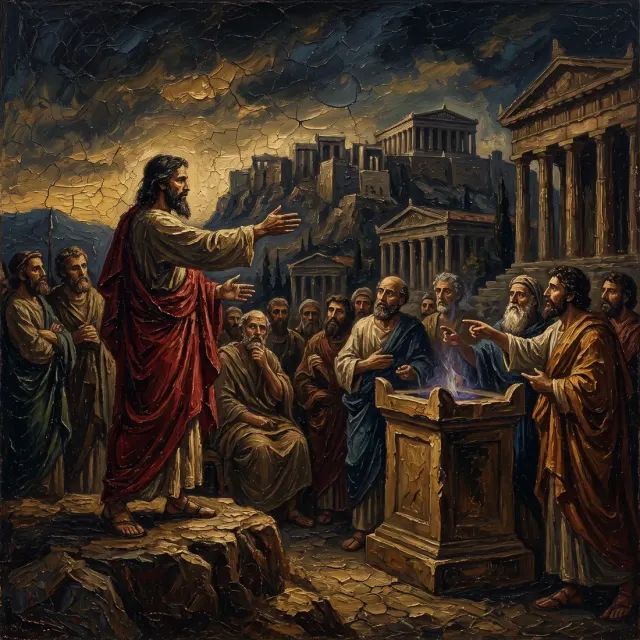
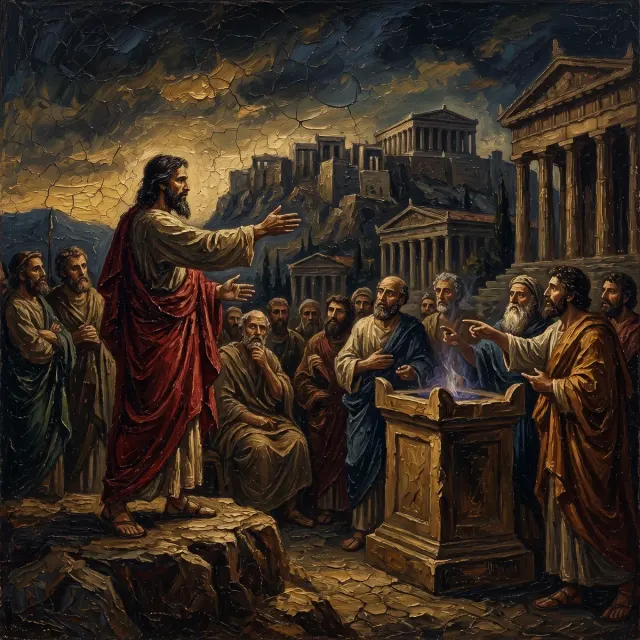
    He opens with something they built themselves, and declares it rather than argues it. Whom therefore ye ignorantly worship, him declare I unto you.

    The most useful inscription in a city full of religious objects turns out to be an admission of ignorance. Paul does not need to invent a gap in Athens' religious knowledge. An altar has already put one in writing.

    His opening is more carefully balanced than the modern sound of too superstitious might suggest. The Greek expression can describe strong religious scruple or superstition, depending on context. He begins with something his hearers can recognize about themselves, then takes the unknown in the inscription as his point of entry. Recognition is not endorsement. The declaration that follows identifies God as maker and giver, not as another deity needing a place in the existing collection.

    Verses 24-25 press directly against the surroundings: God is not housed in handmade temples or sustained by human service as though he lacked something. The movement is from the altar's acknowledged ignorance to the Creator's independence. Athens has objects devoted to powers that people serve. Paul announces the source of the breath with which the service is performed.

    Verse by verse

    1. 17:22

      Mars' hill renders Areopagus, the hill of Ares and the name associated with its council. Whether this was a formal judicial hearing is debated.

    2. 17:23

      Devotions here means objects of worship, not private devotional exercises. Paul reports an altar inscription; the passage does not identify a surviving archaeological object.

    Acts 17:22-23

    King James Version · 2 verses

    17:22Then Paul stood in the midst of Mars’ hill, and said, Ye men of Athens, I perceive that in all things ye are too superstitious.

    17:23For as I passed by, and beheld your devotions, I found an altar with this inscription, TO THE UNKNOWN GOD. Whom therefore ye ignorantly worship, him declare I unto you.

  4. 04

    Acts 17:28

    As certain also of your own poets have said

    The only quotations in the sermon are Greek. He is speaking to people who would not have recognised a citation of Isaiah.

    The quotation is not a decorative pause in the argument. Paul takes language from the audience's own poets and turns it against the city's manufactured gods. Human beings derive life from God; God cannot therefore be adequately represented as a thing human beings manufacture. Verse 29 states the inference immediately after the line about offspring. The poetry has work to do.

    This is not permission for every assertion in a pagan poem to pass unnoticed into Paul's teaching. The God of the speech has already been identified as the maker of the world, the giver of life, and the ruler of humanity's appointed times. The borrowed words now operate inside that account of God, not inside the poet's original account of Zeus.

    The effect is sharper than dismissing everything the audience knows. A statement familiar within Greek poetry becomes evidence against an assumption visible throughout Athens. Gold, silver, stone, and artistic skill cannot explain the being from whom living humanity comes. The city's poetry has supplied an argument against its statues.

    Verse by verse

    1. 17:28

      Offspring refers here to humanity's derivation from God as creator. It does not make a separate argument about adoption through faith, as in Galatians 3:26.

    2. 17:28

      The verse names no poet. Aratus is identifiable through his surviving wording; the exact source of the earlier phrase about living and moving remains uncertain.

    Acts 17:28

    King James Version · 1 verse

    17:28For in him we live, and move, and have our being; as certain also of your own poets have said, For we are also his offspring.

  5. 05

    Acts 17:32-34

    We will hear thee again of this matter

    The polite deferral is the majority response. Dionysius and Damaris are named, which is how Luke records a result that looked like a failure.

    The dividing point is resurrection, not a failure to appreciate a clever quotation. Paul has moved from the Creator to a coming judgment and the man whom God raised from the dead. At that point the audience separates into responses the Book of Acts keeps distinct: ridicule, a proposal to listen again, and belief.

    The offer of another hearing need not be made kinder or harsher than the text makes it. It might express interest or serve as a courteous dismissal; no private motive is supplied. Nor does Paul's departure turn the whole visit into a failure. The final sentence names Dionysius and Damaris, then adds others with them. An account that ends by identifying believers is not reporting that nobody believed.

    Dionysius receives an institutional identification, the Areopagite. Damaris receives her name. Neither is given a speech or a biography. They are not rhetorical prizes awarded to Paul for an excellent address, but people who joined him and believed. Athens has produced more than an afternoon's conversation.

    Verse by verse

    1. 17:32

      The proposed further hearing is recorded, but no second address to this group is narrated in Acts. Its occurrence should not be assumed.

    2. 17:34

      Areopagite identifies Dionysius with the Areopagus. Nothing in this verse establishes Damaris's occupation, marital status, or social rank.

    Acts 17:32-34

    King James Version · 3 verses

    17:32And when they heard of the resurrection of the dead, some mocked: and others said, We will hear thee again of this matter.

    17:33So Paul departed from among them.

    17:34Howbeit certain men clave unto him, and believed: among the which was Dionysius the Areopagite, and a woman named Damaris, and others with them.

Why it matters

The speech at the Areopagus is the one sermon in Acts aimed at people with no scripture at all, and it is built accordingly. He starts from an altar he found in their own city, quotes two of their own poets, and never cites a prophet. But the argument arrives in the same place as every other sermon in the book, and it is the arrival that empties the room: a day appointed, a man ordained, and assurance given to all men in that he hath raised him from the dead. Some mocked. Others said we will hear thee again. A few believed, and Luke names two of them.

1 song

The music

Every song in the catalogue whose passage falls inside these chapters.

  1. Acts 17:16-34

    The Unknown God

Nearby

All the places

Report an error on this page