[Vision One]
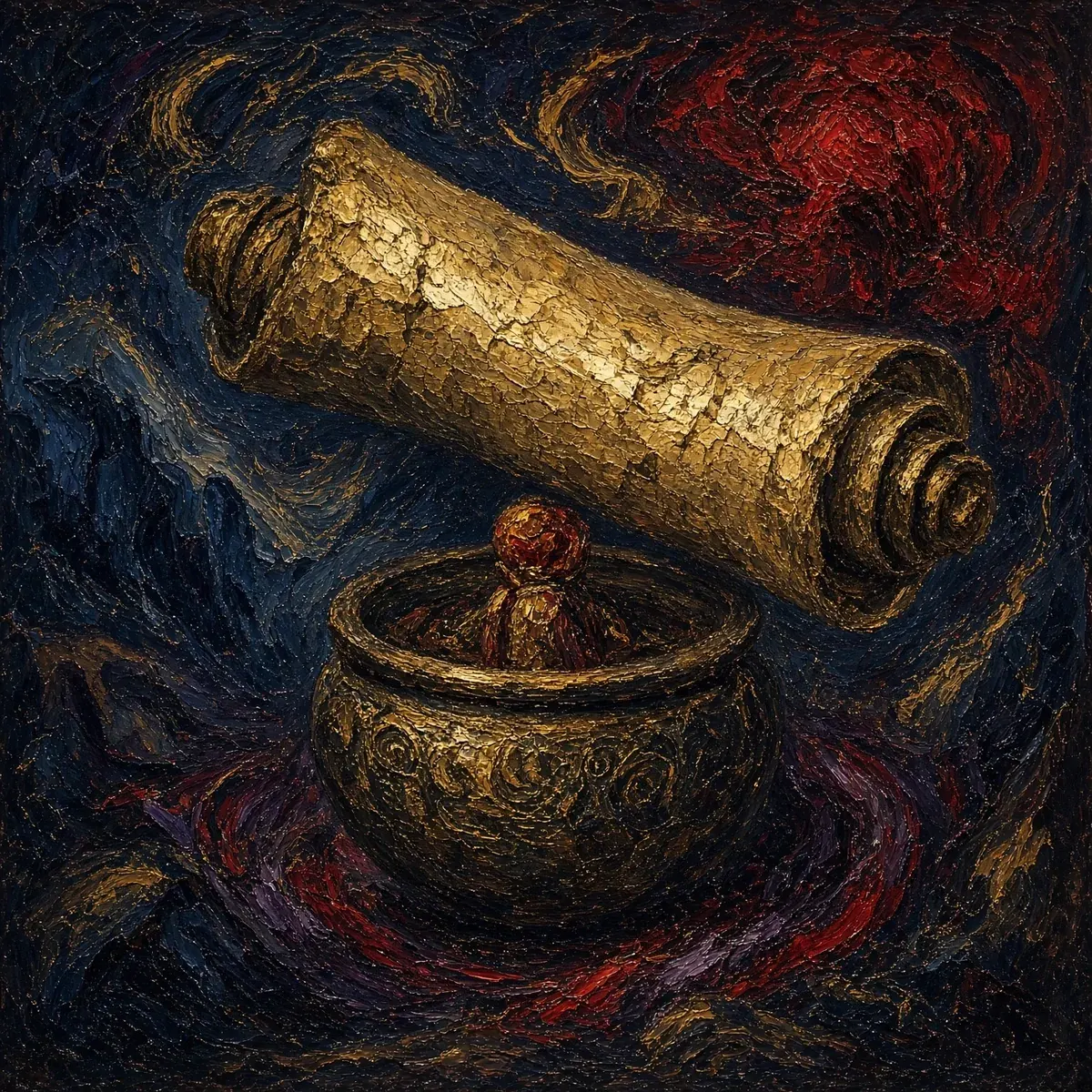
A roll crossed over the rooftops,
Long as a chamber, broad as a gate.
Words without ink in the visible sky,
Carrying covenant weight.
[Refrain]
It enters the house of the thief,
It enters the falsely sworn name.
Stone and timber cannot shelter
A life that sanctifies its shame.
[Vision Two]
Then an ephah rose from the ground,
Commerce measured in a basket frame.
Within sat wickedness personified;
The angel named the hidden claim.
[Seal]
A lead weight fell across the opening,
The restless figure pressed below.
Two winged bearers caught the vessel,
Wind beneath them began to blow.
[Chorus]
The flying roll and the ephah,
Judgment searches, evil is weighed.
What the market hid in measure,
What the oath concealed, is displayed.
The flying roll and the ephah,
No false balance keeps its throne.
Wickedness is sealed and carried
To a distant house of its own.
[Bridge]
Across the breadth of Shinar's plain,
A base is built, a place prepared.
The burden leaves the covenant land;
The secret sickness is declared.
[Final Chorus]
The flying roll and the ephah,
Truth has crossed the shuttered door.
Theft and perjury lose their shelter;
Hidden commerce hides no more.
The flying roll and the ephah,
Wind bears what the land must lose.
Holiness begins by naming
What the heart would rather excuse.
[Coda]
The scroll kept flying;
The basket did not open.
About the passage
Zechariah 5: What cannot remain in the restored land
Restoration turns inward in Zechariah 5. A massive flying scroll carries judgment against theft and false swearing, entering the offender’s own house and consuming timber and stone. The vision refuses to let rebuilt public life hide private corruption. Then an ephah becomes a container for a woman explicitly identified as Wickedness. She is pressed beneath a heavy lead cover, not destroyed, and the next scene answers the question of destination. Two winged women carry the sealed vessel to Shinar, where a house will be built and the ephah established on its own base. The unsettling symmetry is hard to miss. While the LORD’s house is being restored in Jerusalem, another house is prepared elsewhere for what must be removed from the restored community. The chapter presents cleansing not as cosmetic improvement but as separation from practices that would reproduce the old ruin inside new walls.