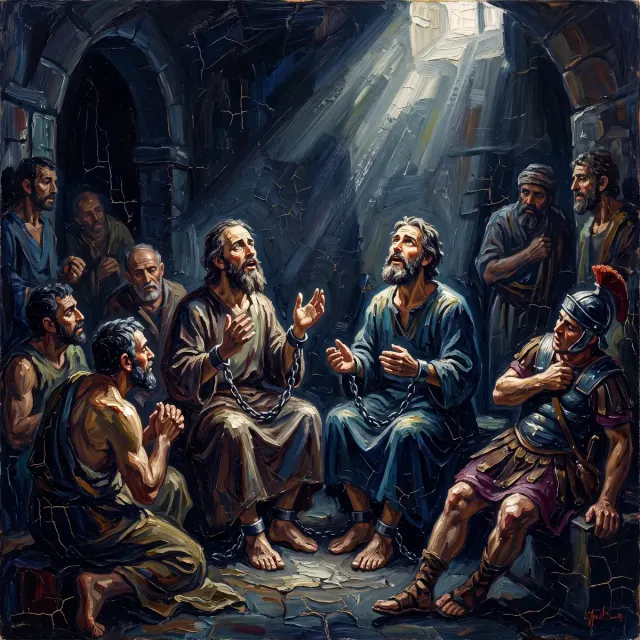

New · FreePlay The Witnesses The in-depth puzzle battle quest through Bible history

People of the Bible

Lydia

The first convert in Europe was a foreign businesswoman at a riverside prayer meeting with no synagogue in town.

Philippi is a Roman colony and there is no synagogue there, which in that period meant fewer than ten Jewish men in the city. So on the sabbath Paul goes out by a river side where prayer was wont to be made, and speaks to the women who gathered there. Lydia is from Thyatira, which is back across the sea in Asia, and she sells purple, the expensive dye. She is a worshipper of God already, an outsider twice over, trading in a city that is not hers.

Where she appearsActs 16 · Acts 16

Scroll down to the account
Lydia

The movements, in the order the text gives them.

The Account of Lydia

  1. 01

    Acts 16:11-13

    By a river side, where prayer was wont to be made

    No synagogue, no building, and the first congregation in Europe is a group of women outdoors on a sabbath morning.

    A man of Macedonia appeared in the vision. Women beside a river are the first audience described after the crossing. The Book of Acts does not treat that as a disappointing substitute. The mission answers the call by sitting down and speaking to the people who are actually there.

    Philippi receives its Roman description first: a colony. The meeting then happens outside the city, away from the civic setting that the chapter has just named. The contrast is quiet but substantial. An arrival in a Roman colony leads not to an official reception but to an established place of prayer, on the sabbath, with women gathered. The sitting matters too. This is conversation and instruction, not a procession claiming the town.

    The passage does not expressly say there was no synagogue in Philippi, although the riverside gathering often prompts that inference. Nor does it make Lydia a representative of an entire continent. Before the later labels accumulate, there is this precise beginning: travelers who crossed the sea, a customary prayer gathering, and enough attention to sit down.

    Verse by verse

    1. 16:11

      Loosing means putting out to sea. Neapolis is the arrival point before the travelers proceed to Philippi.

    2. 16:12

      Colony identifies Philippi's Roman civic status; it does not mean a newly founded settlement.

    3. 16:13

      The prayer gathering is explicit. The absence of any synagogue anywhere in Philippi is an inference, not a statement in this verse.

    Acts 16:11-13

    King James Version · 3 verses

    16:11Therefore loosing from Troas, we came with a straight course to Samothracia, and the next day to Neapolis;

    16:12And from thence to Philippi, which is the chief city of that part of Macedonia, and a colony: and we were in that city abiding certain days.

    16:13And on the sabbath we went out of the city by a river side, where prayer was wont to be made; and we sat down, and spake unto the women which resorted thither.

    Acts 16:11-13: By a river side, where prayer was wont to be made
  2. 02

    Acts 16:14

    Whose heart the Lord opened

    She is already a worshipper and already listening. What changes is stated as something done to her attention rather than to her morals.

    The trade is named, but it does not explain the opening of her heart. Lydia sells purple; Paul speaks; the Lord opens. Those actions belong to different subjects, and the sentence keeps them distinct. The teacher is genuinely speaking and Lydia is genuinely listening, but the decisive credit does not settle on the teacher's technique.

    She already worships God. This is not an introduction to religion for someone portrayed as having none. The turn concerns her attention to what Paul says, and the Book of Acts gives no transcript of that conversation. A single verse holds both continuity and change: a worshipper hears, and something more than ordinary hearing takes place.

    Purple has encouraged some very expensive biographies. The text identifies her business, not her balance sheet. It gives no husband, no widowhood, no list of employees, and no explanation of the dye she sells. What it does give is firmer: her name, her city, her occupation, and the Lord's action. The most consequential fact about Lydia is not a commercial estimate.

    Verse by verse

    1. 16:14

      Seller of purple identifies a trade. It does not establish the exact source of the dye, the scale of the business, or her total wealth.

    2. 16:14

      Thyatira is her city of origin; the encounter takes place near Philippi. The verse distinguishes the two locations.

    3. 16:14

      The Lord is explicitly the subject of opened. The text also preserves Lydia's hearing and attention rather than erasing her response.

    Acts 16:14

    King James Version · 1 verse

    16:14And a certain woman named Lydia, a seller of purple, of the city of Thyatira, which worshipped God, heard us: whose heart the Lord opened, that she attended unto the things which were spoken of Paul.

    Acts 16:14: Whose heart the Lord opened
  3. 03

    Acts 16:15

    She constrained us

    The invitation is framed as a test of their own judgement of her. It is the first recorded hospitality of the European church and it is insisted on.

    Lydia makes their own judgment the reason to accept her hospitality. If they have counted her faithful to the Lord, then staying in her house is the fitting acknowledgment. It is an invitation with an argument attached. The Book of Acts ends the sentence by admitting that she prevailed.

    The shift from hearer to host is immediate. Baptism does not leave her standing at the edge of someone else's work; she puts her household at the travelers' disposal. My house is the concrete offer. There is no need to turn it into a palace for its significance to be substantial. Lodging gives a traveling company a place from which to stay and work.

    Her household is baptized with her, but its membership and ages are not supplied. Later baptismal arguments cannot fill that blank by assertion. The verse's own emphasis lies elsewhere: the woman whose heart has been opened now presses an open door upon her guests. Paul has done the speaking. Lydia can make a point too.

    Verse by verse

    1. 16:15

      Household can refer to the people belonging to a domestic establishment. This verse does not list their relationships or ages.

    2. 16:15

      Faithful to the Lord connects her request with the missionaries' recognition of her faith, not with a business reference.

    3. 16:15

      Constrained means prevailed through earnest urging in this context. The close states that her invitation succeeded.

    Acts 16:15

    King James Version · 1 verse

    16:15And when she was baptized, and her household, she besought us, saying, If ye have judged me to be faithful to the Lord, come into my house, and abide there. And she constrained us.

    Acts 16:15: She constrained us
  4. 04

    Acts 16:40

    They entered into the house of Lydia

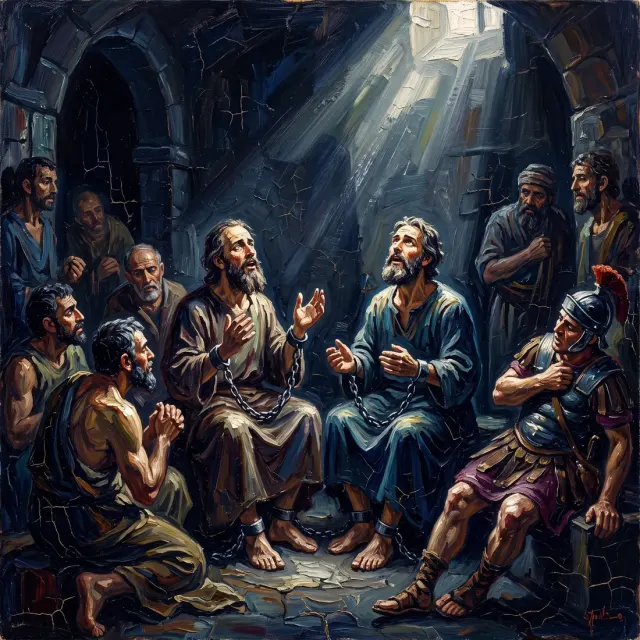
    Released from prison, they return to her house to see the brethren and comfort them, and only then leave. The church there has an address.

    The magistrates want Paul and Silas out of the city. Their first recorded stop after prison is Lydia's house. That visit interrupts any impression that release simply ends the Philippian mission. There are people to see before departure, and a recognizable place to find them.

    The bruised men do the comforting. The chapter has described their beating and imprisonment; now it makes them the ones encouraging the brethren. Lydia's house holds that exchange. The building need not be grand, and the verse assigns her no formal title, but her earlier invitation has become more than a travel convenience. The household is a meeting point for believers after public hostility has made their connection with these missionaries costly.

    Lydia is not named in the Epistle to the Philippians, and the text never identifies her with Euodias or Syntyche. Her importance does not depend on supplying a later identity. In her final named appearance, the travelers leave and the brethren remain. The house is still there. So are the people gathered inside it.

    Verse by verse

    1. 16:40

      They comforted them makes Paul and Silas the encouragers and the gathered brethren the recipients. The direction of the action is worth retaining.

    2. 16:40

      The verse identifies a gathering of believers in Lydia's house without defining her formal office.

    3. 16:40

      Lydia's later movements, death, and possible identification with other named Philippian women are not supplied in Scripture.

    Acts 16:40

    King James Version · 1 verse

    16:40And they went out of the prison, and entered into the house of Lydia: and when they had seen the brethren, they comforted them, and departed.

    Acts 16:40: They entered into the house of Lydia

Why it matters

The sentence Luke uses is careful: whose heart the Lord opened, that she attended unto the things which were spoken. Then she and her household are baptized and she makes an argument out of it. If you have judged me to be faithful to the Lord, come into my house and abide there. Luke adds that she constrained us, which is the only note of pressure in the passage. That house becomes the church at Philippi, and after the earthquake and the prison Paul and Silas go back to it before leaving town.

2 songs

The music

Every song in the catalogue whose passage falls inside these chapters.

  1. Acts 16:16-40

    At Midnight Paul and Silas Sang

  2. Acts 16

    Come Over and Help Us

Nearby

All the people

Report an error on this page