
New · FreePlay The Witnesses The in-depth puzzle battle quest through Bible history

People of the Bible

Priscilla and Aquila

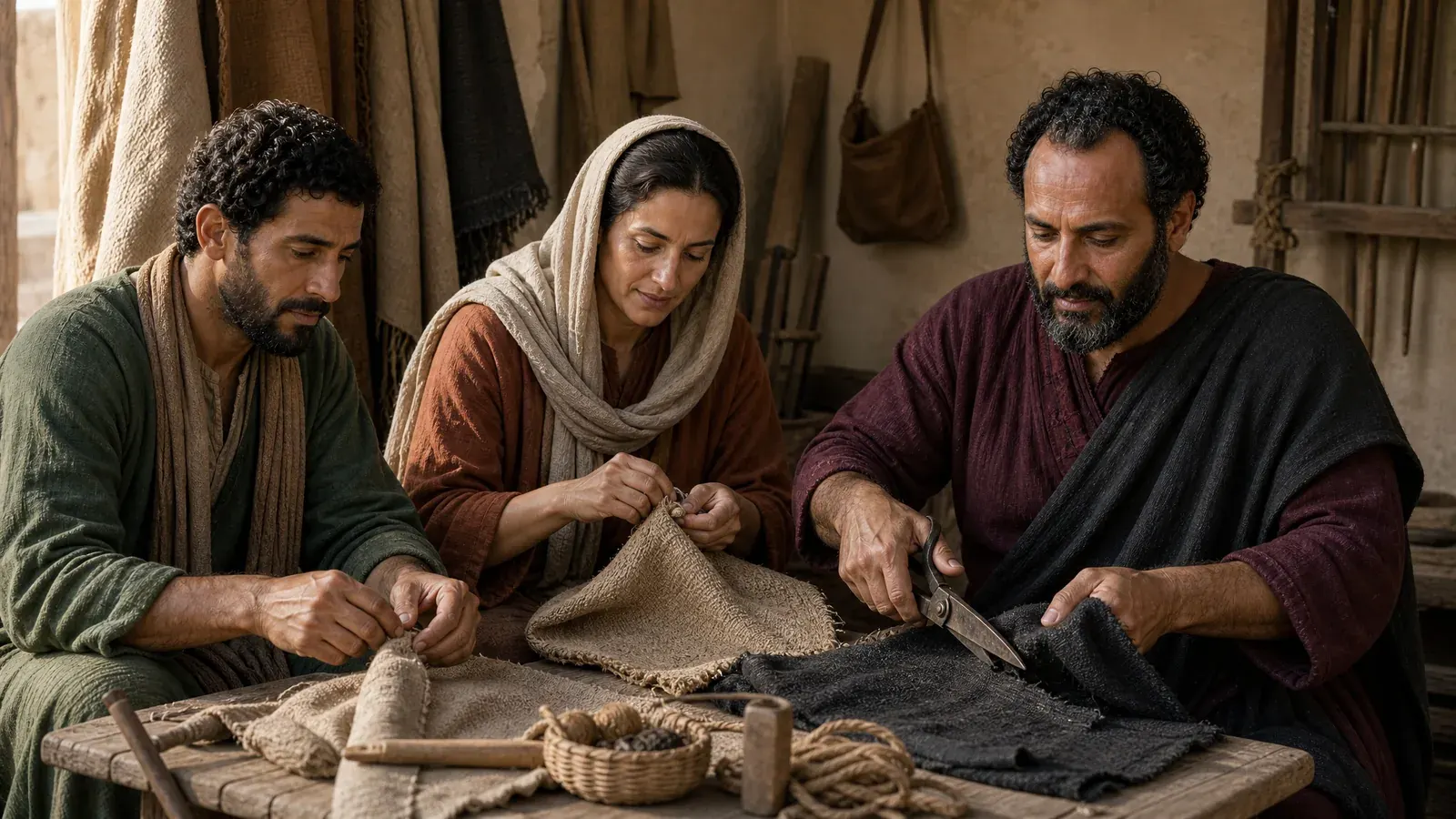
Ran a tentmaking business, moved cities three times, and kept a church in whatever house they were renting.

They arrive in Corinth because Claudius has expelled the Jews from Rome, so the marriage enters the New Testament as a refugee household. Paul finds them, joins the business because he is of the same craft, and stays. They are never mentioned apart. Four of the six times they are named, Priscilla is named first, which in that era is unusual enough that readers have argued about it for centuries and which the text simply does without comment.

Where they appearActs 18 · Romans 16 · 1 Corinthians 16

Scroll down to the account

The movements, in the order the text gives them.

The Account of Priscilla and Aquila

  1. 01

    Acts 18:1-3

    Because he was of the same craft

    Paul finds a couple expelled from Rome and moves in to work. The mission is funded by tents for the length of his stay in Corinth.

    The first connection is a trade, not a platform. Before Priscilla and Aquila are named as Paul's fellow workers in Christ, he is literally working beside them. Same craft, same lodging, actual work. The Book of Acts gives the partnership a workbench before it gives it a teaching role.

    Their address also carries an imperial decision inside it. Aquila was born in Pontus, had lived in Italy, and is now in Corinth because Claudius ordered the Jews out of Rome. The parenthesis is short. The displacement was not an optional change of scenery. Yet the passage does not make the couple merely recipients of help: Paul comes to them and stays with them. People uprooted from one city provide a foothold in another.

    There is no account here of their conversion, and no statement that Paul first brought them to faith. That silence matters. Their recorded relationship begins with shared labor, not with an apostle collecting two anonymous assistants. Priscilla and Aquila already have names, a household, and a craft.

    Verse by verse

    1. 18:2

      Pontus is Aquila's birthplace, not Priscilla's stated birthplace. The verse does not identify her ancestry.

    2. 18:2

      The expulsion explains the move from Rome. The passage does not specify when or through whom the couple became Christians.

    3. 18:3

      Wrought means worked. The shared occupation is expressly part of the reason for Paul's lodging with them.
    Acts 18:1-3

    King James Version · 3 verses

    18:1After these things Paul departed from Athens, and came to Corinth;

    18:2And found a certain Jew named Aquila, born in Pontus, lately come from Italy, with his wife Priscilla; (because that Claudius had commanded all Jews to depart from Rome:) and came unto them.

    18:3And because he was of the same craft, he abode with them, and wrought: for by their occupation they were tentmakers.

    Acts 18:1-3: Because he was of the same craft
  2. 02

    Acts 18:18-19

    They came to Ephesus and he left them there

    They sail with Paul and are left to hold a city he only passes through. The work in Ephesus starts with them, not with him.

    Left them there is not a dismissal. Paul moves on; Priscilla and Aquila remain in Ephesus, and the work there does not require his permanent presence to be real. The sentence is so economical that their change of city can look like a travel detail. It is also a transfer of responsibility.

    The couple who received Paul in Corinth now travel with him. Their relationship has grown beyond a shared occupation without making that occupation disappear. The Book of Acts gives no farewell speech, no appointment ceremony, and no account of their arrangements for a new home. It records the people who stay when the better-known traveler leaves. Ephesus is not an empty stage waiting for Paul to return.

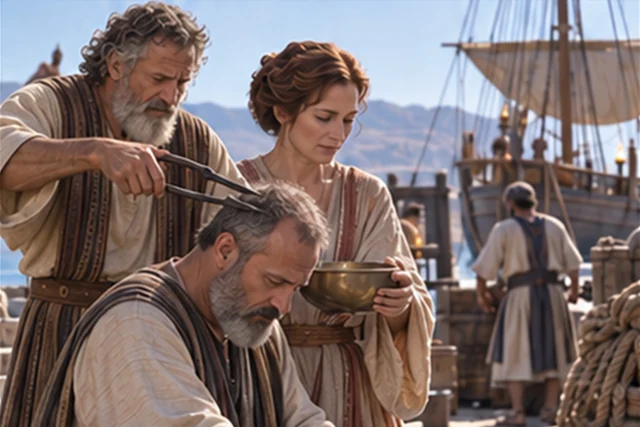
    The haircut attracts more argument than the couple's relocation. The vow is mentioned but not explained, and readers differ over whether Paul or Aquila is the immediate subject. Priscilla and Aquila's presence is much less doubtful. An uncertain haircut should not obscure two named people carrying the work forward.

    Verse by verse

    1. 18:18

      Cenchrea is named as the place of the haircut. The nature and full terms of the vow are not supplied.

    2. 18:18

      The grammatical attachment of having shorn his head has been disputed between Paul and Aquila; the passage gives no separate explanation.

    3. 18:19

      Paul's brief synagogue visit and the couple's remaining in Ephesus are distinct actions. Acts 18:20-21 describes his departure.

    Acts 18:18-19

    King James Version · 2 verses

    18:18And Paul after this tarried there yet a good while, and then took his leave of the brethren, and sailed thence into Syria, and with him Priscilla and Aquila; having shorn his head in Cenchrea: for he had a vow.

    18:19And he came to Ephesus, and left them there: but he himself entered into the synagogue, and reasoned with the Jews.

    Acts 18:18-19: They came to Ephesus and he left them there
  3. 03

    Acts 18:24-26

    They took him unto them

    Apollos is publicly impressive and privately incomplete. The correction happens in a house, by two people, and costs him no standing at all.

    The man mighty in the scriptures still has something to learn from the tentmakers. The Book of Acts does not retract his gifts to make room for theirs. Eloquent, instructed, fervent, accurate within what he knows: the praise remains standing. So does the gap. Knowing only the baptism of John is a limit, not a complete inventory of everything Apollos believes.

    Aquila and Priscilla hear him before they explain anything. Then they take him unto them. The correction is not presented as a public contest in the synagogue, and neither spouse is erased from the teaching. They expounded is plural. Nothing in the verse assigns Priscilla the refreshments while Aquila supplies the theology.

    The result is greater precision, not a new personality. His boldness is not identified as the fault, and the couple are not credited with creating his knowledge of Scripture from nothing. Their contribution is particular and substantial: they supply what this already capable teacher lacks. The passage has room for an impressive speaker and for people who can improve his teaching.

    Verse by verse

    1. 18:24

      Alexandria is Apollos's birthplace. The verse does not name his teachers or attribute a particular philosophical school to him.

    2. 18:25

      Knowing only John's baptism marks a stated limitation; the complete contents of Apollos's instruction are not listed.

    3. 18:26

      Both Aquila and Priscilla are subjects of the plural teaching verb. The passage does not divide the explanation between them.

    Acts 18:24-26

    King James Version · 3 verses

    18:24And a certain Jew named Apollos, born at Alexandria, an eloquent man, and mighty in the scriptures, came to Ephesus.

    18:25This man was instructed in the way of the Lord; and being fervent in the spirit, he spake and taught diligently the things of the Lord, knowing only the baptism of John.

    18:26And he began to speak boldly in the synagogue: whom when Aquila and Priscilla had heard, they took him unto them, and expounded unto him the way of God more perfectly.

  4. 04

    Romans 16:3-5

    Who have for my life laid down their own necks

    Paul greets them back in Rome, says all the churches of the Gentiles thank them, and greets the church that is in their house.

    Their own necks is a severe phrase to find in a list of greetings. Paul does not thank Priscilla and Aquila merely for pleasant lodging or useful introductions. He says they put their lives at risk for his. The circumstances are missing, but the cost is not. Assigning this to a particular riot would supply an episode the letter does not identify.

    Then the gratitude widens. Not only Paul, but all the churches of the Gentiles give thanks. The point is larger than one rescued friendship: the survival of this worker mattered to congregations beyond the couple's own household. A personal risk has a public reach.

    And there is still a church in their house. Their home is not a footnote to their ministry; it is one of its settings. The letter addresses them in Rome after Acts placed them in Corinth and Ephesus. Addresses change. This combination of work, hospitality, instruction, and costly loyalty remains recognizable. Paul calls them helpers in Christ Jesus, a description much larger than two people who happened to know his trade.

    Verse by verse

    1. 16:3

      Both spouses are called fellow workers in Christ Jesus. Neither is reduced to the other's unnamed support.

    2. 16:4

      Laid down their own necks expresses mortal risk. The letter does not describe the event or say they were actually executed.

    3. 16:5

      The church is the congregation meeting in their house. Ownership, rental terms, and the building's layout are not specified.

    Romans 16:3-5

    King James Version · 3 verses

    16:3Greet Priscilla and Aquila my helpers in Christ Jesus:

    16:4Who have for my life laid down their own necks: unto whom not only I give thanks, but also all the churches of the Gentiles.

    16:5Likewise greet the church that is in their house. Salute my wellbeloved Epaenetus, who is the firstfruits of Achaia unto Christ.

    Romans 16:3-5: Who have for my life laid down their own necks

Why it matters

They leave Corinth with Paul, settle at Ephesus, and there they hear Apollos, an eloquent man mighty in the Scriptures who knows only the baptism of John. They do not correct him publicly. They take him unto them and expound unto him the way of God more perfectly, and the man goes on to water what Paul had planted. The church in their house is greeted in two different cities in two different letters, which means they did it again wherever they moved.

The music

The music

Every song in the catalogue whose passage falls inside these chapters.

No song in the catalogue reaches these chapters yet.

Nearby

All the people

Report an error on this page