New · FreePlay The Witnesses The in-depth puzzle battle quest through Bible history

People of the Bible

Tamar

The twice-widowed daughter-in-law who was denied her rights, took them by a veil and a pledge, and was called more righteous than Judah.

Also called Thamar; mother of Perez and Zerah; named in the genealogy of Christ

Tamar is the wife Judah chooses for his firstborn Er. Er is wicked in the sight of the LORD and dies. By the custom later written into the law, Judah gives her to his second son Onan to raise up seed for the dead brother, and Onan, knowing the child will not count as his, spills his seed on the ground and dies too. Judah tells Tamar to remain a widow in her father's house until Shelah, the third son, is grown, and the text says why: he feared Shelah would die like his brothers. Shelah grows up, and Tamar is not sent for.

When Judah's wife dies and he goes up to the sheepshearing at Timnath, Tamar takes off her widow's garments, covers herself with a veil, and sits in an open place on the road. Judah takes her for a harlot, and she asks for a pledge until he sends the kid he promises: his signet, his bracelets and his staff. She conceives, goes home, and puts her widow's clothes back on. Three months later Judah is told his daughter-in-law is with child by whoredom, and he says, bring her forth, and let her be burnt. She sends the pledge to him with the words the brothers once used to Jacob about Joseph's coat: discern, I pray thee, whose are these. Judah says, she hath been more righteous than I. She bears twins. Zerah puts out a hand and receives a scarlet thread, then draws it back, and Perez breaks out first.

Where she appearsGenesis 38

Scroll down to the account
Tamar

The movements, in the order the text gives them.

The Account of Tamar

  1. 01

    Genesis 38:6-7

    Wife of Er

    Judah takes a wife for Er his firstborn, whose name is Tamar. Er is wicked in the sight of the LORD, and the LORD slays him.

    She enters the account as a name attached to someone else's decision: Judah took a wife for Er his firstborn, and her name was Tamar. Nothing is said about where she came from or what she wanted. Then one of the shortest and heaviest verses in Genesis: and Er, Judah's firstborn, was wicked in the sight of the LORD; and the LORD slew him. The text does not say what he did. It gives the verdict without the charge, which is unusual, and leaves Tamar a widow in the opening lines of her own chapter with no child and no standing. Everything she does afterwards is an attempt to get back what this verse took from her before she had a chance to speak.

    Verse by verse

    1. 38:6

      Judah took a wife for Er: the marriage is arranged for her, as was normal. She is named and he is barely described.

    2. 38:7

      Wicked in the sight of the LORD: the offence is never stated. Genesis records the judgement and withholds the reason.

    Genesis 38:6-7

    King James Version · 2 verses

    38:6And Judah took a wife for Er his firstborn, whose name was Tamar.

    38:7And Er, Judah’s firstborn, was wicked in the sight of the LORD; and the LORD slew him.

    Genesis 38:6-7: Wife of Er
  2. 02

    Genesis 38:8-10

    Onan

    Judah tells Onan to go in to his brother's wife and raise up seed to his brother. Onan knows the seed will not be his, and spills it on the ground. The thing he does displeases the LORD, and he dies also.

    Judah tells Onan to do the duty of a husband's brother: raise up seed to thy brother. The custom, later written into the law of Deuteronomy 25, existed to keep a dead man's name alive and to keep his widow inside a household rather than outside one. Onan knew that the seed should not be his, and the text describes what he did with blunt clarity and then the reason for it, which is what the passage is actually about. He takes the marriage and refuses the obligation that came with it. He gets the use of a wife and withholds from her the one thing that would give her a future and give his brother a name. The thing which he did displeased the LORD: wherefore he slew him also.

    Verse by verse

    1. 38:8

      Marry her, and raise up seed to thy brother: the levirate duty, later codified in Deuteronomy 25:5-10, where a refusal is shamed rather than punished.

    2. 38:9

      Knew that the seed should not be his: the motive is inheritance. With Er childless, Onan stands to gain a larger share.

    3. 38:10

      Displeased the LORD: the offence named here is the using of her while defrauding her, not the act in isolation.

    Genesis 38:8-10

    King James Version · 3 verses

    38:8And Judah said unto Onan, Go in unto thy brother’s wife, and marry her, and raise up seed to thy brother.

    38:9And Onan knew that the seed should not be his; and it came to pass, when he went in unto his brother’s wife, that he spilled it on the ground, lest that he should give seed to his brother.

    38:10And the thing which he did displeased the LORD: wherefore he slew him also.

    Genesis 38:8-10: Onan
  3. 03

    Genesis 38:11

    Sent home to wait

    Judah tells Tamar to remain a widow at her father's house until Shelah is grown, for he says in himself, lest he die also, as his brethren did. Tamar goes and dwells in her father's house.

    Judah sends her home with a promise and a reason, and the reason is not the one he gives her. Remain a widow at thy father's house, till Shelah my son be grown. Then the Book of Genesis opens his head for us: for he said, lest peradventure he die also, as his brethren did. He thinks she is the danger. Two sons have died and he has decided she is the cause, so he puts her in a holding pattern that costs her nothing to maintain and everything to endure. She cannot remarry, because she is promised to Shelah. She cannot bear a child, because Shelah is withheld. She goes back to her father's house and waits, in the widow's garments the chapter will mention again when she takes them off.

    Verse by verse

    1. 38:11

      Till Shelah my son be grown: a promise with no date. It keeps her bound to Judah's house without giving her a place in it.

    2. 38:11

      Lest peradventure he die also: Judah's real reason, given to the reader and not to her. He is protecting a son at her expense.

    Genesis 38:11

    King James Version · 1 verse

    38:11Then said Judah to Tamar his daughter in law, Remain a widow at thy father’s house, till Shelah my son be grown: for he said, Lest peradventure he die also, as his brethren did. And Tamar went and dwelt in her father’s house.

    Genesis 38:11: Sent home to wait
  4. 04

    Genesis 38:12-14

    The veil

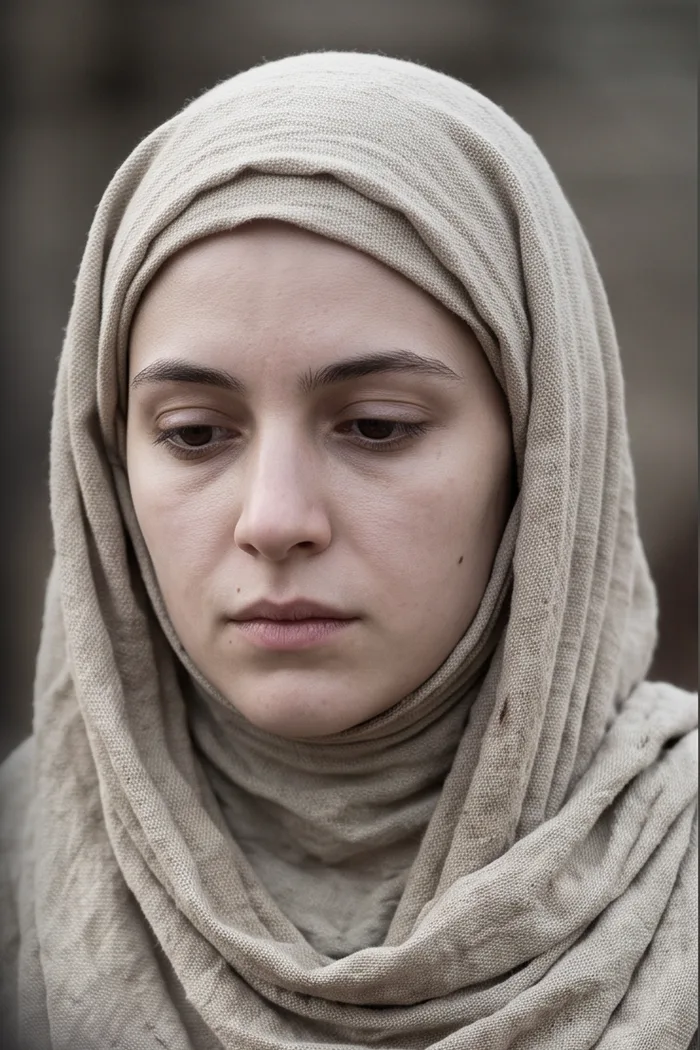
    Judah's wife dies. After he is comforted he goes up to his sheepshearers at Timnath. Tamar hears of it, and seeing that Shelah is grown and she has not been given to him, she puts off her widow's garments, covers herself with a veil, and sits in an open place by the road.

    Time passes, Judah's own wife dies, and when his mourning is over he goes up to the sheepshearers at Timnath, which was a festival as much as a job. Tamar is told, and the verse that follows is the hinge of the chapter and is entirely about what she has worked out: she saw that Shelah was grown, and she was not given unto him to wife. The promise has quietly expired and nobody intends to tell her. So she puts off her widow's garments, covers herself with a vail, and sits in an open place by the way. She is not acting out of appetite. She is taking the only route left to the thing she is owed, and the text is careful to say she knew exactly why.

    Verse by verse

    1. 38:12

      Went up unto his sheepshearers: shearing was a feast with wine. The chapter notes Judah's circumstances have improved while hers have not.

    2. 38:14

      She saw that Shelah was grown, and she was not given unto him: the Book of Genesis states her reasoning plainly, which shapes how everything after is read.

    3. 38:14

      An open place by the way to Timnath: a crossroads, in the open. She puts herself where he will pass.

    Genesis 38:12-14

    King James Version · 3 verses

    38:12And in process of time the daughter of Shuah Judah’s wife died; and Judah was comforted, and went up unto his sheepshearers to Timnath, he and his friend Hirah the Adullamite.

    38:13And it was told Tamar, saying, Behold thy father in law goeth up to Timnath to shear his sheep.

    38:14And she put her widow’s garments off from her, and covered her with a vail, and wrapped herself, and sat in an open place, which is by the way to Timnath; for she saw that Shelah was grown, and she was not given unto him to wife.

    Genesis 38:12-14: The veil
  5. 05

    Genesis 38:15-19

    Signet, bracelets and staff

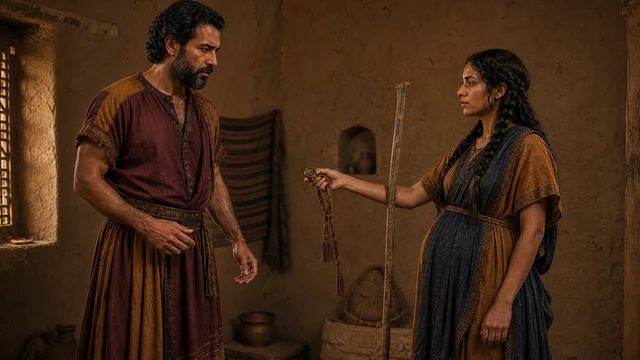
    Judah, seeing her veiled, takes her for a harlot. He offers a kid from the flock; she asks for a pledge until it comes. Thy signet, thy bracelets, and thy staff that is in thine hand. He gives them, she conceives, and she goes back to her widow's clothes.

    When Judah saw her, he thought her to be an harlot; because she had covered her face. The irony is exact: the veil that conceals is also what he reads her by, and the woman he will not give to his son he propositions by the roadside without recognising. She asks what he will give, and negotiates: a kid from the flock, and a pledge until it comes. Then she names the pledge herself, and she chooses the three things that identify a man absolutely. Thy signet, and thy bracelets, and thy staff that is in thine hand. He hands over his seal, his cord and his stick, which is close to handing over his name, and he does it without a thought. She takes them, and she goes, and she puts her widow's garments back on.

    Verse by verse

    1. 38:15

      Because she had covered her face: the veil is what makes him misread her. In 24:65 the same gesture marks a bride.

    2. 38:18

      Thy signet, and thy bracelets, and thy staff: his seal, its cord, and his staff. Together they are proof of identity, like a name and a signature.

    3. 38:19

      Put on the garments of her widowhood: she returns to exactly where she was. Nothing has changed except what she is carrying.

    Genesis 38:15-19

    King James Version · 5 verses

    38:15When Judah saw her, he thought her to be an harlot; because she had covered her face.

    38:16And he turned unto her by the way, and said, Go to, I pray thee, let me come in unto thee; (for he knew not that she was his daughter in law.) And she said, What wilt thou give me, that thou mayest come in unto me?

    38:17And he said, I will send thee a kid from the flock. And she said, Wilt thou give me a pledge, till thou send it?

    38:18And he said, What pledge shall I give thee? And she said, Thy signet, and thy bracelets, and thy staff that is in thine hand. And he gave it her, and came in unto her, and she conceived by him.

    38:19And she arose, and went away, and laid by her vail from her, and put on the garments of her widowhood.

    Genesis 38:15-19: Signet, bracelets and staff
  6. 06

    Genesis 38:20-23

    The kid that found no one

    Judah sends the kid by his friend Hirah to redeem the pledge. Hirah asks the men of the place for the harlot at Enaim and is told there was none. Judah lets it drop: let her take it to her, lest we be shamed.

    Judah sends the kid by a friend to redeem his pledge, and the woman cannot be found. His friend asks the men of the place where the harlot is, and they answer that there was no harlot in this place, which is the chapter quietly noting that she never was one. The pledge is now loose in the world with Judah's identity on it. His response is the most revealing line he speaks: let her take it to her, lest we be shamed. He would rather lose his seal than be seen looking for her. Shame is the currency of the whole chapter, and Judah is already spending it to protect himself two verses before he demands Tamar be burned.

    Verse by verse

    1. 38:21

      There was no harlot in this place: the men of Timnath had seen no such woman, because there was none.

    2. 38:23

      Lest we be shamed: Judah weighs his reputation against his seal and chooses the seal as the cheaper loss.

    Genesis 38:20-23

    King James Version · 4 verses

    38:20And Judah sent the kid by the hand of his friend the Adullamite, to receive his pledge from the woman’s hand: but he found her not.

    38:21Then he asked the men of that place, saying, Where is the harlot, that was openly by the way side? And they said, There was no harlot in this place.

    38:22And he returned to Judah, and said, I cannot find her; and also the men of the place said, that there was no harlot in this place.

    38:23And Judah said, Let her take it to her, lest we be shamed: behold, I sent this kid, and thou hast not found her.

  7. 07

    Genesis 38:24-26

    Discern whose these are

    Three months on, Judah is told Tamar has played the harlot and is with child. Bring her forth, and let her be burnt. As she is brought out she sends the pledge to her father-in-law: by the man whose these are, am I with child. Judah acknowledges them: she hath been more righteous than I, because I gave her not to Shelah my son. He knows her again no more.

    Three months later: Tamar thy daughter in law hath played the harlot; and also, behold, she is with child by whoredom. Judah's answer takes one sentence and no enquiry. Bring her forth, and let her be burnt. The penalty exceeds anything the later law prescribes, and he pronounces it against a woman whose situation he created. Then she sends the pledge out to him, without an accusation and without naming him aloud: discern, I pray thee, whose are these. The whole chapter turns on that one verb. He had asked his father to discern a bloody coat in chapter 37, and now he is asked to discern his own seal. And Judah acknowledged them, and said, She hath been more righteous than I; because that I gave her not to Shelah my son. It is the first time he tells the truth about himself, and he does it in public.

    Verse by verse

    1. 38:24

      Let her be burnt: harsher than any law in the Torah for this offence. Judah sentences without hearing her.

    2. 38:25

      Discern, I pray thee: the same verb Judah used to his father over Joseph's coat in 37:32. The deceiver is asked to identify his own token.

    3. 38:26

      She hath been more righteous than I: not a claim that she did no wrong, but that her cause was just and his refusal was not.

    4. 38:26

      He knew her again no more: the relationship ends there. What she wanted was the child, not the man.

    Genesis 38:24-26

    King James Version · 3 verses

    38:24And it came to pass about three months after, that it was told Judah, saying, Tamar thy daughter in law hath played the harlot; and also, behold, she is with child by whoredom. And Judah said, Bring her forth, and let her be burnt.

    38:25When she was brought forth, she sent to her father in law, saying, By the man, whose these are, am I with child: and she said, Discern, I pray thee, whose are these, the signet, and bracelets, and staff.

    38:26And Judah acknowledged them, and said, She hath been more righteous than I; because that I gave her not to Shelah my son. And he knew her again no more.

  8. 08

    Genesis 38:27-30

    Perez and Zerah

    Twins are in her womb. One puts out a hand and the midwife ties a scarlet thread on it, saying this came out first. He draws it back, and his brother comes out: how hast thou broken forth, and he is called Pharez. Then the one with the scarlet thread, Zarah.


    Twins, and a struggle at the birth that repeats the one in chapter 25. A hand comes out, the midwife ties a scarlet thread on it, and then the hand withdraws and the other child is born first. How hast thou broken forth? this breach be upon thee: and his name was called Pharez, a breach. The one with the thread is Zarah. Tamar disappears from the narrative here, having got the thing she was refused, and the last word belongs to the genealogies. Pharez stands in the line that runs to Boaz, to David, and into the first chapter of Matthew, where four women are named among the fathers and she is the first of them. The book gives her no epitaph. It gives her descendants instead.

    Verse by verse

    1. 38:28

      A scarlet thread: the midwife marks the firstborn in advance, and the marking is immediately overturned.

    2. 38:29

      Pharez: a breach, or a bursting out. The younger comes first again, as with Jacob and Esau and later with Ephraim.

    3. 38:29

      Ruth 4:12 blesses Boaz's house as the house of Pharez, whom Tamar bare unto Judah, naming her in a wedding blessing generations later.

    4. 38:30

      Matthew 1:3 lists Thamar in the genealogy of Christ, the first of four women named there.

    Genesis 38:27-30

    King James Version · 4 verses

    38:27And it came to pass in the time of her travail, that, behold, twins were in her womb.

    38:28And it came to pass, when she travailed, that the one put out his hand: and the midwife took and bound upon his hand a scarlet thread, saying, This came out first.

    38:29And it came to pass, as he drew back his hand, that, behold, his brother came out: and she said, How hast thou broken forth? this breach be upon thee: therefore his name was called Pharez.

    38:30And afterward came out his brother, that had the scarlet thread upon his hand: and his name was called Zarah.

The people, the places and the rest of Scripture.

Reading Tamar closely

The people she dealt with

Judah is her father-in-law, her withholder, and the father of her children. He chooses her for Er, gives her to Onan, promises Shelah, and breaks the promise out of fear. He passes sentence on her without a hearing and reverses it in a sentence when the pledge arrives. The text never records her speaking to him again, or him to her. Her husbands, Er and Onan, are two verses each: one wicked, one refusing his duty, both slain by the LORD. Shelah is the son she waited for and never received; he appears later only in the genealogies. Hirah the Adullamite, Judah's friend, is the man sent to find her and told she was never there. The midwife who ties the scarlet thread is the last person in her account, and the only one who speaks kindly.

The law she claimed

The duty Onan refused and Judah withheld is written down later in Deuteronomy 25: if brethren dwell together and one dies without a child, his brother shall take the widow and the first son shall succeed in the name of the dead brother. The custom is older than Moses, and Tamar's account is the Bible's first instance of it. Ruth's is the second, and Ruth 4 quotes Tamar by name. Tamar's method was deceit; her claim was just, and Judah says so. Readers who have called her the harlot have missed that Genesis reserves that word for what Judah thought she was, not for what she was.

What came before and what followed

Her chapter sits between the sale of Joseph and Joseph's arrival in Potiphar's house, and it takes twenty years or more of Judah's life to tell. It shows the family of Israel drifting into Canaan, marrying Canaanites, and losing sons, at the very moment Joseph is preserving a future for them in Egypt. Her twins are born before the family goes down to Egypt, and Perez's sons Hezron and Hamul are in the list of the seventy souls.

After her, Perez's line runs through Hezron, Ram, Amminadab, Nahshon, Salmon, Boaz, Obed and Jesse to David. Zerah's line produces Achan, who troubled Israel at Jericho with a Babylonish garment and a wedge of gold, and the scarlet thread on Zerah's wrist has been paired by readers with the scarlet cord in Rahab's window, another outsider woman who ends up in the same genealogy.

Where the rest of Scripture reaches back

1 Chronicles 2:4 records that Tamar his daughter in law bare him Pharez and Zerah, with no comment. Ruth 4:12 makes her the blessing spoken over Ruth. Matthew 1:3 places her at the head of the four women in the genealogy of Jesus, with Rahab, Ruth and the wife of Uriah, all four outsiders or women with an account that respectable genealogies would have left out. Matthew leaves them in. Her name means palm tree, and it is given again to David's daughter, whose account of wrong in 2 Samuel 13 is a dark echo of hers, and to Absalom's daughter.

Why it matters

Tamar is the reason the line of Judah continues. Er and Onan are dead, Shelah is withheld, and without her act there is no Perez, no Boaz, no David and, by Matthew's genealogy, no Christ. Matthew names her first among the four women in the ancestry of Jesus, and does not soften how she got there: Judas begat Phares and Zara of Thamar. The elders of Bethlehem bless Boaz's marriage by her son's name, let thy house be like the house of Pharez, whom Tamar bare unto Judah, and Ruth's account is in some ways hers told again with the roles reversed, a foreign widow claiming the kinsman's duty.

She is also the hinge of Judah's own account. The man who lied to his father with a goat and a coat is caught by a goat and a pledge, and his confession is the first sign of the brother who will later offer himself for Benjamin. Genesis calls her righteous through Judah's own mouth, and the law of Moses later requires exactly what she claimed: that a dead man's brother raise up his name. She is one of the few women in Scripture whose deceit is judged, in the text itself, to have been the right thing.

1 song

The music

Every song in the catalogue whose passage falls inside these chapters.

  1. Genesis 37:1-38:30

    The Dreamer in the Pit

Nearby

All the people

Report an error on this page