
Ang malaking larawan
Nagbubukas ang 1 Samuel 17 sa “Now the Philistines gathered together their armies to battle, and were gathered together…”, nagbabago malapit sa talata 29 sa “And David said, What have I now done? Is there not a cause?”, at nagtatapos sa “And Saul said to him, Whose son art thou, thou young man? And David answered, I am the…”. Sinusundan ng mga puntong ito ang sariling galaw ng kabanata mula simula hanggang wakas.
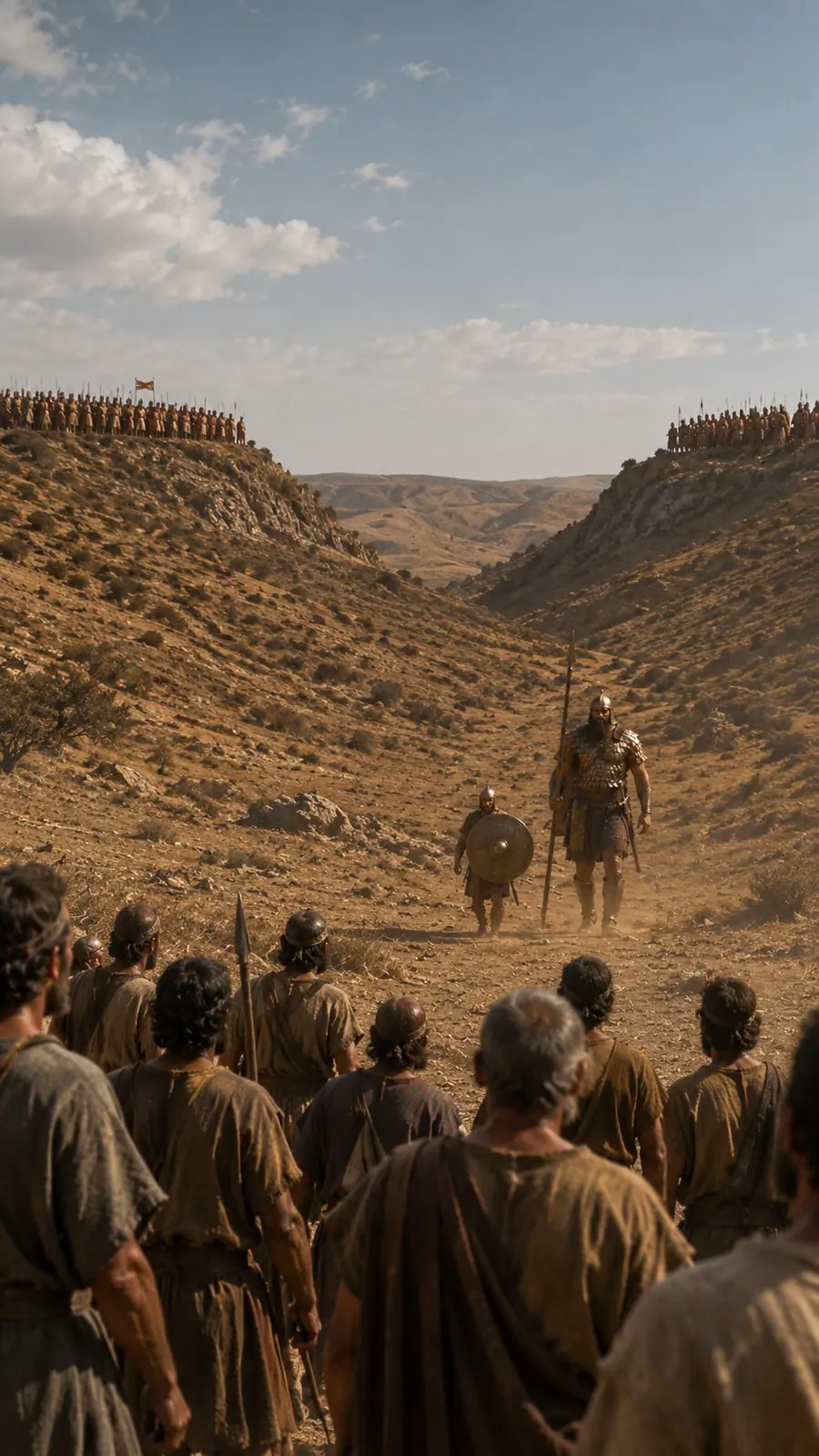
Kasulatan sa tabi ng buod
1 Samuel · Bersiyong King James · 581 Samuel 17:1-8
Mga talata 1–8: The Philistines gathered together their armies to battle, and were…
Nagbubukas ang 1 Samuel 17:1–8 sa “Now the Philistines gathered together their armies to battle, and were gathered together at…” at umaabot sa “And he stood and cried unto the armies of Israel, and said unto them, Why are ye come out to set…” sa huling talata. Binubuo ng galaw na iyon ang Pag-aralan ang sandaling binabago ng pananampalataya, paghihimagsik, tapang, o pagkalinga ng Diyos ang direksiyon ng 1 Samuel.
Mas malalim na pag-aaral
Isang buong yunit ang 1 Samuel 17:1–8. Nagbubukas ito sa “Now the Philistines gathered together their armies to battle, and were gathered together at…”, nagbabago malapit sa talata 4 sa “And there went out a champion out of the camp of the Philistines, named Goliath, of Gath…”, at umaabot sa “And he stood and cried unto the armies of Israel, and said unto them, Why are ye come out to…”. Lumilikha ng kahulugan ang tagapagsalaysay sa pamamagitan ng unang kumikilos, tumutugon, nagbabago, at ng mga bungang nananatili. Ang isinalaysay na kilos ay hindi awtomatikong sinasang-ayunan. Bilang pagsusuri sa teksto, ang KJV na sanggunian ay may 1 palatandaan ng pananalita, 1 tanong, 0 paghahambing, at 0 talatang bumabanggit sa LORD o sa Diyos. Maaari ding ihambing ang mga ito sa mapagkakatiwalaang salin ng Bibliya sa Filipino.
Nauugnay ang bawat obserbasyon sa pokus ng aralin, Pag-aralan ang sandaling binabago ng pananampalataya, paghihimagsik, tapang, o pagkalinga ng Diyos ang direksiyon ng 1 Samuel. May mga pahayag na tuwiran, may nabubuo mula sa ilang talata, at may dapat manatiling malinaw na interpretasyon.
Kabilang sa mga pangalang o salitang humahawak sa tagpo ang Philistines, Israel, Saul, Shochoh, Azekah, Elah. Kasama sa wikang bilang ang one, six, five, thousand, hundred. Ang pinakamalapit na pagbabago sa gitna ay nasa talata 1: “Now the Philistines gathered together their armies to battle, and were gathered together at Shochoh, which belongeth to Judah, and…” Tinutulungan tayo ng detalyeng ito na makita ang kaibahan ng simula at ng sumunod na pangyayari.
Pag-aaral sa bawat talata
- 1 Samuel 17:1
“Now the Philistines gathered together their armies to battle, and were gathered together at Shochoh, which belongeth…” Ang pagbanggit sa Shochoh at Azekah ay nag-uugat sa salaysay sa tiyak na tao o lugar. Sundan kung saan bumabalik ang pangalan at ano ang nagbabago sa paligid nito.
- 1 Samuel 17:2
“And Saul and the men of Israel were gathered together, and pitched by the valley of Elah, and set the battle in array…” Ang pagbanggit sa Elah at Israel ay nag-uugat sa salaysay sa tiyak na tao o lugar. Sundan kung saan bumabalik ang pangalan at ano ang nagbabago sa paligid nito.
- 1 Samuel 17:3
“And the Philistines stood on a mountain on the one side, and Israel stood on a mountain on the other side: and there…” Ginagawang kongkreto ng bilang na one ang ulat. Bago tukuyin ang bigat nito, pansinin kung sinusukat nito ang oras, tao, layo, pag-uulit, o kabuuan.
- 1 Samuel 17:4
“And there went out a champion out of the camp of the Philistines, named Goliath, of Gath, whose height was six cubits…” Ginagawang kongkreto ng bilang na six ang ulat. Bago tukuyin ang bigat nito, pansinin kung sinusukat nito ang oras, tao, layo, pag-uulit, o kabuuan.
- 1 Samuel 17:5
“And he had an helmet of brass upon his head, and he was armed with a coat of mail; and the weight of the coat was five…” Ginagawang kongkreto ng bilang na five ang ulat. Bago tukuyin ang bigat nito, pansinin kung sinusukat nito ang oras, tao, layo, pag-uulit, o kabuuan.
- 1 Samuel 17:6
“And he had greaves of brass upon his legs, and a target of brass between his shoulders.” Kabilang sa mga natatanging salita sa linyang ito ang brass, greaves, legs. Masusuri ang gawain nito sa sipi sa ugnayan nito sa mga talata 5 at 7.
- 1 Samuel 17:7
“And the staff of his spear was like a weaver’s beam; and his spear’s head weighed six hundred shekels of iron: and one…” Ginagawang kongkreto ng bilang na six ang ulat. Bago tukuyin ang bigat nito, pansinin kung sinusukat nito ang oras, tao, layo, pag-uulit, o kabuuan.
- 1 Samuel 17:8
“And he stood and cried unto the armies of Israel, and said unto them, Why are ye come out to set your battle in array…” Pinababagal ng tanong ang sipi. Pansinin kung sino ang kailangang sumagot, ano ang ipinapalagay nito, at kung may tugon sa mga susunod na linya.
1 Samuel 17:1-8
Bersiyong King James1Now the Philistines gathered together their armies to battle, and were gathered together at Shochoh, which belongeth to Judah, and pitched between Shochoh and Azekah, in Ephes-dammim.
2And Saul and the men of Israel were gathered together, and pitched by the valley of Elah, and set the battle in array against the Philistines.
3And the Philistines stood on a mountain on the one side, and Israel stood on a mountain on the other side: and there was a valley between them.
4And there went out a champion out of the camp of the Philistines, named Goliath, of Gath, whose height was six cubits and a span.
5And he had an helmet of brass upon his head, and he was armed with a coat of mail; and the weight of the coat was five thousand shekels of brass.
6And he had greaves of brass upon his legs, and a target of brass between his shoulders.
7And the staff of his spear was like a weaver’s beam; and his spear’s head weighed six hundred shekels of iron: and one bearing a shield went before him.
8And he stood and cried unto the armies of Israel, and said unto them, Why are ye come out to set your battle in array? am not I a Philistine, and ye servants to Saul? choose you a man for you, and let him come down to me.
1 Samuel 17:9-16
Mga talata 9–16: If he be able to fight with me, and to kill me, then will we be your…
Nagbubukas ang 1 Samuel 17:9–16 sa “If he be able to fight with me, and to kill me, then will we be your servants: but if I prevail…” at umaabot sa “And the Philistine drew near morning and evening, and presented himself forty days.” sa huling talata. Binubuo ng galaw na iyon ang Pag-aralan ang sandaling binabago ng pananampalataya, paghihimagsik, tapang, o pagkalinga ng Diyos ang direksiyon ng 1 Samuel.
Mas malalim na pag-aaral
Isang buong yunit ang 1 Samuel 17:9–16. Nagbubukas ito sa “If he be able to fight with me, and to kill me, then will we be your servants: but if I…”, nagbabago malapit sa talata 12 sa “Now David was the son of that Ephrathite of Beth-lehem-judah, whose name was Jesse; and he…”, at umaabot sa “And the Philistine drew near morning and evening, and presented himself forty days.”. Lumilikha ng kahulugan ang tagapagsalaysay sa pamamagitan ng unang kumikilos, tumutugon, nagbabago, at ng mga bungang nananatili. Ang isinalaysay na kilos ay hindi awtomatikong sinasang-ayunan. Bilang pagsusuri sa teksto, ang KJV na sanggunian ay may 1 palatandaan ng pananalita, 0 tanong, 2 paghahambing, at 0 talatang bumabanggit sa LORD o sa Diyos. Maaari ding ihambing ang mga ito sa mapagkakatiwalaang salin ng Bibliya sa Filipino.
Nauugnay ang bawat obserbasyon sa pokus ng aralin, Pag-aralan ang sandaling binabago ng pananampalataya, paghihimagsik, tapang, o pagkalinga ng Diyos ang direksiyon ng 1 Samuel. May mga pahayag na tuwiran, may nabubuo mula sa ilang talata, at may dapat manatiling malinaw na interpretasyon.
Kabilang sa mga pangalang o salitang humahawak sa tagpo ang Saul, David, Philistine, Beth, Israel, Jesse. Kasama sa wikang bilang ang eight, three, forty. Ang pinakamalapit na pagbabago sa gitna ay nasa talata 12: “Now David was the son of that Ephrathite of Beth-lehem-judah, whose name was Jesse; and he had eight sons: and the man went among…” Tinutulungan tayo ng detalyeng ito na makita ang kaibahan ng simula at ng sumunod na pangyayari.
Pag-aaral sa bawat talata
- 1 Samuel 17:9
“If he be able to fight with me, and to kill me, then will we be your servants: but if I prevail against him, and kill…” Hindi mauunawaan ang utos sa pandiwa lamang. Ang tumatanggap, layunin, at lugar nito sa mas malaking tipan o pangangatwiran ang nagtatakda ng pananagutan.
- 1 Samuel 17:10
“And the Philistine said, I defy the armies of Israel this day; give me a man, that we may fight together.” Ang pagbanggit sa Israel at Philistine ay nag-uugat sa salaysay sa tiyak na tao o lugar. Sundan kung saan bumabalik ang pangalan at ano ang nagbabago sa paligid nito.
- 1 Samuel 17:11
“When Saul and all Israel heard those words of the Philistine, they were dismayed, and greatly afraid.” Ang pagbanggit sa Israel at Philistine ay nag-uugat sa salaysay sa tiyak na tao o lugar. Sundan kung saan bumabalik ang pangalan at ano ang nagbabago sa paligid nito.
- 1 Samuel 17:12
“Now David was the son of that Ephrathite of Beth-lehem-judah, whose name was Jesse; and he had eight sons: and the man…” Ginagawang kongkreto ng bilang na eight ang ulat. Bago tukuyin ang bigat nito, pansinin kung sinusukat nito ang oras, tao, layo, pag-uulit, o kabuuan.
- 1 Samuel 17:13
“And the three eldest sons of Jesse went and followed Saul to the battle: and the names of his three sons that went to…” Ginagawang kongkreto ng bilang na three ang ulat. Bago tukuyin ang bigat nito, pansinin kung sinusukat nito ang oras, tao, layo, pag-uulit, o kabuuan.
- 1 Samuel 17:14
“And David was the youngest: and the three eldest followed Saul.” Ginagawang kongkreto ng bilang na three ang ulat. Bago tukuyin ang bigat nito, pansinin kung sinusukat nito ang oras, tao, layo, pag-uulit, o kabuuan.
- 1 Samuel 17:15
“But David went and returned from Saul to feed his father’s sheep at Beth-lehem.” Ang pagbanggit sa Beth at David ay nag-uugat sa salaysay sa tiyak na tao o lugar. Sundan kung saan bumabalik ang pangalan at ano ang nagbabago sa paligid nito.
- 1 Samuel 17:16
“And the Philistine drew near morning and evening, and presented himself forty days.” Ginagawang kongkreto ng bilang na forty ang ulat. Bago tukuyin ang bigat nito, pansinin kung sinusukat nito ang oras, tao, layo, pag-uulit, o kabuuan.
1 Samuel 17:9-16
Bersiyong King James9If he be able to fight with me, and to kill me, then will we be your servants: but if I prevail against him, and kill him, then shall ye be our servants, and serve us.
10And the Philistine said, I defy the armies of Israel this day; give me a man, that we may fight together.
11When Saul and all Israel heard those words of the Philistine, they were dismayed, and greatly afraid.
12Now David was the son of that Ephrathite of Beth-lehem-judah, whose name was Jesse; and he had eight sons: and the man went among men for an old man in the days of Saul.
13And the three eldest sons of Jesse went and followed Saul to the battle: and the names of his three sons that went to the battle were Eliab the firstborn, and next unto him Abinadab, and the third Shammah.
14And David was the youngest: and the three eldest followed Saul.
15But David went and returned from Saul to feed his father’s sheep at Beth-lehem.
16And the Philistine drew near morning and evening, and presented himself forty days.
1 Samuel 17:17-24
Mga talata 17–24: Jesse said unto David his son, Take now for thy brethren an ephah of…
Nagbubukas ang 1 Samuel 17:17–24 sa “And Jesse said unto David his son, Take now for thy brethren an ephah of this parched corn, and…” at umaabot sa “And all the men of Israel, when they saw the man, fled from him, and were sore afraid.” sa huling talata. Binubuo ng galaw na iyon ang Pag-aralan ang sandaling binabago ng pananampalataya, paghihimagsik, tapang, o pagkalinga ng Diyos ang direksiyon ng 1 Samuel.
Mas malalim na pag-aaral
Isang buong yunit ang 1 Samuel 17:17–24. Nagbubukas ito sa “And Jesse said unto David his son, Take now for thy brethren an ephah of this parched corn…”, nagbabago malapit sa talata 20 sa “And David rose up early in the morning, and left the sheep with a keeper, and took, and…”, at umaabot sa “And all the men of Israel, when they saw the man, fled from him, and were sore afraid.”. Lumilikha ng kahulugan ang tagapagsalaysay sa pamamagitan ng unang kumikilos, tumutugon, nagbabago, at ng mga bungang nananatili. Ang isinalaysay na kilos ay hindi awtomatikong sinasang-ayunan. Bilang pagsusuri sa teksto, ang KJV na sanggunian ay may 2 palatandaan ng pananalita, 0 tanong, 0 paghahambing, at 0 talatang bumabanggit sa LORD o sa Diyos. Maaari ding ihambing ang mga ito sa mapagkakatiwalaang salin ng Bibliya sa Filipino.
Nauugnay ang bawat obserbasyon sa pokus ng aralin, Pag-aralan ang sandaling binabago ng pananampalataya, paghihimagsik, tapang, o pagkalinga ng Diyos ang direksiyon ng 1 Samuel. May mga pahayag na tuwiran, may nabubuo mula sa ilang talata, at may dapat manatiling malinaw na interpretasyon.
Kabilang sa mga pangalang o salitang humahawak sa tagpo ang David, Israel, Philistines, Jesse, Elah, Gath. Kasama sa wikang bilang ang ten, thousand. Ang pinakamalapit na pagbabago sa gitna ay nasa talata 19: “Now Saul, and they, and all the men of Israel, were in the valley of Elah, fighting with the Philistines.” Tinutulungan tayo ng detalyeng ito na makita ang kaibahan ng simula at ng sumunod na pangyayari.
Pag-aaral sa bawat talata
- 1 Samuel 17:17
“And Jesse said unto David his son, Take now for thy brethren an ephah of this parched corn, and these ten loaves, and…” Ginagawang kongkreto ng bilang na ten ang ulat. Bago tukuyin ang bigat nito, pansinin kung sinusukat nito ang oras, tao, layo, pag-uulit, o kabuuan.
- 1 Samuel 17:18
“And carry these ten cheeses unto the captain of their thousand, and look how thy brethren fare, and take their pledge.” Ginagawang kongkreto ng bilang na ten ang ulat. Bago tukuyin ang bigat nito, pansinin kung sinusukat nito ang oras, tao, layo, pag-uulit, o kabuuan.
- 1 Samuel 17:19
“Now Saul, and they, and all the men of Israel, were in the valley of Elah, fighting with the Philistines.” Ang pagbanggit sa Elah at Israel ay nag-uugat sa salaysay sa tiyak na tao o lugar. Sundan kung saan bumabalik ang pangalan at ano ang nagbabago sa paligid nito.
- 1 Samuel 17:20
“And David rose up early in the morning, and left the sheep with a keeper, and took, and went, as Jesse had commanded…” Hindi mauunawaan ang utos sa pandiwa lamang. Ang tumatanggap, layunin, at lugar nito sa mas malaking tipan o pangangatwiran ang nagtatakda ng pananagutan.
- 1 Samuel 17:21
“For Israel and the Philistines had put the battle in array, army against army.” Nagbibigay ang linyang ito ng dahilan, bunga, o konklusyon. Dapat itong manatiling kaugnay ng pahayag o kilos na nagbibigay rito ng kahulugan.
- 1 Samuel 17:22
“And David left his carriage in the hand of the keeper of the carriage, and ran into the army, and came and saluted his…” Ang pagbanggit sa David ay nag-uugat sa salaysay sa tiyak na tao o lugar. Sundan kung saan bumabalik ang pangalan at ano ang nagbabago sa paligid nito.
- 1 Samuel 17:23
“And as he talked with them, behold, there came up the champion, the Philistine of Gath, Goliath by name, out of the…” Ang pagbanggit sa David at Gath ay nag-uugat sa salaysay sa tiyak na tao o lugar. Sundan kung saan bumabalik ang pangalan at ano ang nagbabago sa paligid nito.
- 1 Samuel 17:24
“And all the men of Israel, when they saw the man, fled from him, and were sore afraid.” Ang pagbanggit sa Israel ay nag-uugat sa salaysay sa tiyak na tao o lugar. Sundan kung saan bumabalik ang pangalan at ano ang nagbabago sa paligid nito.
1 Samuel 17:17-24
Bersiyong King James17And Jesse said unto David his son, Take now for thy brethren an ephah of this parched corn, and these ten loaves, and run to the camp to thy brethren;
18And carry these ten cheeses unto the captain of their thousand, and look how thy brethren fare, and take their pledge.
19Now Saul, and they, and all the men of Israel, were in the valley of Elah, fighting with the Philistines.
20And David rose up early in the morning, and left the sheep with a keeper, and took, and went, as Jesse had commanded him; and he came to the trench, as the host was going forth to the fight, and shouted for the battle.
21For Israel and the Philistines had put the battle in array, army against army.
22And David left his carriage in the hand of the keeper of the carriage, and ran into the army, and came and saluted his brethren.
23And as he talked with them, behold, there came up the champion, the Philistine of Gath, Goliath by name, out of the armies of the Philistines, and spake according to the same words: and David heard them.
24And all the men of Israel, when they saw the man, fled from him, and were sore afraid.
1 Samuel 17:25-32
Mga talata 25–32: The men of Israel said, Have ye seen this man that is come up? surely to…
Nagbubukas ang 1 Samuel 17:25–32 sa “And the men of Israel said, Have ye seen this man that is come up? surely to defy Israel is he…” at umaabot sa “And David said to Saul, Let no man’s heart fail because of him; thy servant will go and fight…” sa huling talata. Binubuo ng galaw na iyon ang Pag-aralan ang sandaling binabago ng pananampalataya, paghihimagsik, tapang, o pagkalinga ng Diyos ang direksiyon ng 1 Samuel.
Mas malalim na pag-aaral
Isang buong yunit ang 1 Samuel 17:25–32. Nagbubukas ito sa “And the men of Israel said, Have ye seen this man that is come up? surely to defy Israel is…”, nagbabago malapit sa talata 28 sa “And Eliab his eldest brother heard when he spake unto the men; and Eliab’s anger was kindled…”, at umaabot sa “And David said to Saul, Let no man’s heart fail because of him; thy servant will go and…”. Lumilikha ng kahulugan ang tagapagsalaysay sa pamamagitan ng unang kumikilos, tumutugon, nagbabago, at ng mga bungang nananatili. Ang isinalaysay na kilos ay hindi awtomatikong sinasang-ayunan. Bilang pagsusuri sa teksto, ang KJV na sanggunian ay may 8 palatandaan ng pananalita, 4 tanong, 0 paghahambing, at 1 talatang bumabanggit sa LORD o sa Diyos. Maaari ding ihambing ang mga ito sa mapagkakatiwalaang salin ng Bibliya sa Filipino.
Nauugnay ang bawat obserbasyon sa pokus ng aralin, Pag-aralan ang sandaling binabago ng pananampalataya, paghihimagsik, tapang, o pagkalinga ng Diyos ang direksiyon ng 1 Samuel. May mga pahayag na tuwiran, may nabubuo mula sa ilang talata, at may dapat manatiling malinaw na interpretasyon.
Kabilang sa mga pangalang o salitang humahawak sa tagpo ang David, Israel, Philistine, Eliab, Saul, God. Ang pinakamalapit na pagbabago sa gitna ay nasa talata 28: “And Eliab his eldest brother heard when he spake unto the men; and Eliab’s anger was kindled against David, and he said, Why…” Tinutulungan tayo ng detalyeng ito na makita ang kaibahan ng simula at ng sumunod na pangyayari.
Pag-aaral sa bawat talata
- 1 Samuel 17:25
“And the men of Israel said, Have ye seen this man that is come up? surely to defy Israel is he come up: and it shall…” Pinababagal ng tanong ang sipi. Pansinin kung sino ang kailangang sumagot, ano ang ipinapalagay nito, at kung may tugon sa mga susunod na linya.
- 1 Samuel 17:26
“And David spake to the men that stood by him, saying, What shall be done to the man that killeth this Philistine, and…” Pinababagal ng tanong ang sipi. Pansinin kung sino ang kailangang sumagot, ano ang ipinapalagay nito, at kung may tugon sa mga susunod na linya.
- 1 Samuel 17:27
“And the people answered him after this manner, saying, So shall it be done to the man that killeth him.” Hindi mauunawaan ang utos sa pandiwa lamang. Ang tumatanggap, layunin, at lugar nito sa mas malaking tipan o pangangatwiran ang nagtatakda ng pananagutan.
- 1 Samuel 17:28
“And Eliab his eldest brother heard when he spake unto the men; and Eliab’s anger was kindled against David, and he…” Pinababagal ng tanong ang sipi. Pansinin kung sino ang kailangang sumagot, ano ang ipinapalagay nito, at kung may tugon sa mga susunod na linya.
- 1 Samuel 17:29
“And David said, What have I now done? Is there not a cause?” Pinababagal ng tanong ang sipi. Pansinin kung sino ang kailangang sumagot, ano ang ipinapalagay nito, at kung may tugon sa mga susunod na linya.
- 1 Samuel 17:30
“And he turned from him toward another, and spake after the same manner: and the people answered him again after the…” Kabilang sa mga natatanging salita sa linyang ito ang manner, former, people. Masusuri ang gawain nito sa sipi sa ugnayan nito sa mga talata 29 at 31.
- 1 Samuel 17:31
“And when the words were heard which David spake, they rehearsed them before Saul: and he sent for him.” Ang pagbanggit sa David at Saul ay nag-uugat sa salaysay sa tiyak na tao o lugar. Sundan kung saan bumabalik ang pangalan at ano ang nagbabago sa paligid nito.
- 1 Samuel 17:32
“And David said to Saul, Let no man’s heart fail because of him; thy servant will go and fight with this Philistine.” Ang pagbanggit sa David at Philistine ay nag-uugat sa salaysay sa tiyak na tao o lugar. Sundan kung saan bumabalik ang pangalan at ano ang nagbabago sa paligid nito.
1 Samuel 17:25-32
Bersiyong King James25And the men of Israel said, Have ye seen this man that is come up? surely to defy Israel is he come up: and it shall be, that the man who killeth him, the king will enrich him with great riches, and will give him his daughter, and make his father’s house free in Israel.
26And David spake to the men that stood by him, saying, What shall be done to the man that killeth this Philistine, and taketh away the reproach from Israel? for who is this uncircumcised Philistine, that he should defy the armies of the living God?
27And the people answered him after this manner, saying, So shall it be done to the man that killeth him.
28And Eliab his eldest brother heard when he spake unto the men; and Eliab’s anger was kindled against David, and he said, Why camest thou down hither? and with whom hast thou left those few sheep in the wilderness? I know thy pride, and the naughtiness of thine heart; for thou art come down that thou mightest see the battle.
29And David said, What have I now done? Is there not a cause?
30And he turned from him toward another, and spake after the same manner: and the people answered him again after the former manner.
31And when the words were heard which David spake, they rehearsed them before Saul: and he sent for him.
32And David said to Saul, Let no man’s heart fail because of him; thy servant will go and fight with this Philistine.
1 Samuel 17:33-40
Mga talata 33–40: Saul said to David, Thou art not able to go against this Philistine to…
Nagbubukas ang 1 Samuel 17:33–40 sa “And Saul said to David, Thou art not able to go against this Philistine to fight with him: for…” at umaabot sa “And he took his staff in his hand, and chose him five smooth stones out of the brook, and put…” sa huling talata. Binubuo ng galaw na iyon ang Pag-aralan ang sandaling binabago ng pananampalataya, paghihimagsik, tapang, o pagkalinga ng Diyos ang direksiyon ng 1 Samuel.
Mas malalim na pag-aaral
Isang buong yunit ang 1 Samuel 17:33–40. Nagbubukas ito sa “And Saul said to David, Thou art not able to go against this Philistine to fight with him…”, nagbabago malapit sa talata 36 sa “Thy servant slew both the lion and the bear: and this uncircumcised Philistine shall be as…”, at umaabot sa “And he took his staff in his hand, and chose him five smooth stones out of the brook, and…”. Lumilikha ng kahulugan ang tagapagsalaysay sa pamamagitan ng unang kumikilos, tumutugon, nagbabago, at ng mga bungang nananatili. Ang isinalaysay na kilos ay hindi awtomatikong sinasang-ayunan. Bilang pagsusuri sa teksto, ang KJV na sanggunian ay may 4 palatandaan ng pananalita, 0 tanong, 1 paghahambing, at 2 talatang bumabanggit sa LORD o sa Diyos. Maaari ding ihambing ang mga ito sa mapagkakatiwalaang salin ng Bibliya sa Filipino.
Nauugnay ang bawat obserbasyon sa pokus ng aralin, Pag-aralan ang sandaling binabago ng pananampalataya, paghihimagsik, tapang, o pagkalinga ng Diyos ang direksiyon ng 1 Samuel. May mga pahayag na tuwiran, may nabubuo mula sa ilang talata, at may dapat manatiling malinaw na interpretasyon.
Kabilang sa mga pangalang o salitang humahawak sa tagpo ang David, Saul, Philistine, Thy, God, Thou. Kasama sa wikang bilang ang one, five. Ang pinakamalapit na pagbabago sa gitna ay nasa talata 36: “Thy servant slew both the lion and the bear: and this uncircumcised Philistine shall be as one of them, seeing he hath defied the…” Tinutulungan tayo ng detalyeng ito na makita ang kaibahan ng simula at ng sumunod na pangyayari.
Pag-aaral sa bawat talata
- 1 Samuel 17:33
“And Saul said to David, Thou art not able to go against this Philistine to fight with him: for thou art but a youth…” Ang pagbanggit sa David at Philistine ay nag-uugat sa salaysay sa tiyak na tao o lugar. Sundan kung saan bumabalik ang pangalan at ano ang nagbabago sa paligid nito.
- 1 Samuel 17:34
“And David said unto Saul, Thy servant kept his father’s sheep, and there came a lion, and a bear, and took a lamb out…” Ang pagbanggit sa David at Saul ay nag-uugat sa salaysay sa tiyak na tao o lugar. Sundan kung saan bumabalik ang pangalan at ano ang nagbabago sa paligid nito.
- 1 Samuel 17:35
“And I went out after him, and smote him, and delivered it out of his mouth: and when he arose against me, I caught him…” Kabilang sa mga natatanging salita sa linyang ito ang smote, arose, beard. Masusuri ang gawain nito sa sipi sa ugnayan nito sa mga talata 34 at 36.
- 1 Samuel 17:36
“Thy servant slew both the lion and the bear: and this uncircumcised Philistine shall be as one of them, seeing he hath…” Hindi mauunawaan ang utos sa pandiwa lamang. Ang tumatanggap, layunin, at lugar nito sa mas malaking tipan o pangangatwiran ang nagtatakda ng pananagutan.
- 1 Samuel 17:37
“David said moreover, The LORD that delivered me out of the paw of the lion, and out of the paw of the bear, he will…” Ang pagbanggit sa David at Philistine ay nag-uugat sa salaysay sa tiyak na tao o lugar. Sundan kung saan bumabalik ang pangalan at ano ang nagbabago sa paligid nito.
- 1 Samuel 17:38
“And Saul armed David with his armour, and he put an helmet of brass upon his head; also he armed him with a coat of…” Ang pagbanggit sa David at Saul ay nag-uugat sa salaysay sa tiyak na tao o lugar. Sundan kung saan bumabalik ang pangalan at ano ang nagbabago sa paligid nito.
- 1 Samuel 17:39
“And David girded his sword upon his armour, and he assayed to go; for he had not proved it. And David said unto Saul…” Ang pagbanggit sa David at Saul ay nag-uugat sa salaysay sa tiyak na tao o lugar. Sundan kung saan bumabalik ang pangalan at ano ang nagbabago sa paligid nito.
- 1 Samuel 17:40
“And he took his staff in his hand, and chose him five smooth stones out of the brook, and put them in a shepherd’s bag…” Ginagawang kongkreto ng bilang na five ang ulat. Bago tukuyin ang bigat nito, pansinin kung sinusukat nito ang oras, tao, layo, pag-uulit, o kabuuan.
1 Samuel 17:33-40
Bersiyong King James33And Saul said to David, Thou art not able to go against this Philistine to fight with him: for thou art but a youth, and he a man of war from his youth.
34And David said unto Saul, Thy servant kept his father’s sheep, and there came a lion, and a bear, and took a lamb out of the flock:
35And I went out after him, and smote him, and delivered it out of his mouth: and when he arose against me, I caught him by his beard, and smote him, and slew him.
36Thy servant slew both the lion and the bear: and this uncircumcised Philistine shall be as one of them, seeing he hath defied the armies of the living God.
37David said moreover, The LORD that delivered me out of the paw of the lion, and out of the paw of the bear, he will deliver me out of the hand of this Philistine. And Saul said unto David, Go, and the LORD be with thee.
38And Saul armed David with his armour, and he put an helmet of brass upon his head; also he armed him with a coat of mail.
39And David girded his sword upon his armour, and he assayed to go; for he had not proved it. And David said unto Saul, I cannot go with these; for I have not proved them. And David put them off him.
40And he took his staff in his hand, and chose him five smooth stones out of the brook, and put them in a shepherd’s bag which he had, even in a scrip; and his sling was in his hand: and he drew near to the Philistine.
1 Samuel 17:41-48
Mga talata 41–48: The Philistine came on and drew near unto David; and the man that bare…
Nagbubukas ang 1 Samuel 17:41–48 sa “And the Philistine came on and drew near unto David; and the man that bare the shield went…” at umaabot sa “And it came to pass, when the Philistine arose, and came and drew nigh to meet David, that David…” sa huling talata. Binubuo ng galaw na iyon ang Pag-aralan ang sandaling binabago ng pananampalataya, paghihimagsik, tapang, o pagkalinga ng Diyos ang direksiyon ng 1 Samuel.
Mas malalim na pag-aaral
Isang buong yunit ang 1 Samuel 17:41–48. Nagbubukas ito sa “And the Philistine came on and drew near unto David; and the man that bare the shield went…”, nagbabago malapit sa talata 44 sa “And the Philistine said to David, Come to me, and I will give thy flesh unto the fowls of…”, at umaabot sa “And it came to pass, when the Philistine arose, and came and drew nigh to meet David, that…”. Lumilikha ng kahulugan ang tagapagsalaysay sa pamamagitan ng unang kumikilos, tumutugon, nagbabago, at ng mga bungang nananatili. Ang isinalaysay na kilos ay hindi awtomatikong sinasang-ayunan. Bilang pagsusuri sa teksto, ang KJV na sanggunian ay may 3 palatandaan ng pananalita, 1 tanong, 2 paghahambing, at 3 talatang bumabanggit sa LORD o sa Diyos. Maaari ding ihambing ang mga ito sa mapagkakatiwalaang salin ng Bibliya sa Filipino.
Nauugnay ang bawat obserbasyon sa pokus ng aralin, Pag-aralan ang sandaling binabago ng pananampalataya, paghihimagsik, tapang, o pagkalinga ng Diyos ang direksiyon ng 1 Samuel. May mga pahayag na tuwiran, may nabubuo mula sa ilang talata, at may dapat manatiling malinaw na interpretasyon.
Kabilang sa mga pangalang o salitang humahawak sa tagpo ang David, Philistine, God, Israel, Come, Philistines. Ang pinakamalapit na pagbabago sa gitna ay nasa talata 43: “And the Philistine said unto David, Am I a dog, that thou comest to me with staves? And the Philistine cursed David by his gods.” Tinutulungan tayo ng detalyeng ito na makita ang kaibahan ng simula at ng sumunod na pangyayari.
Pag-aaral sa bawat talata
- 1 Samuel 17:41
“And the Philistine came on and drew near unto David; and the man that bare the shield went before him.” Ang pagbanggit sa David at Philistine ay nag-uugat sa salaysay sa tiyak na tao o lugar. Sundan kung saan bumabalik ang pangalan at ano ang nagbabago sa paligid nito.
- 1 Samuel 17:42
“And when the Philistine looked about, and saw David, he disdained him: for he was but a youth, and ruddy, and of a…” Ang pagbanggit sa David at Philistine ay nag-uugat sa salaysay sa tiyak na tao o lugar. Sundan kung saan bumabalik ang pangalan at ano ang nagbabago sa paligid nito.
- 1 Samuel 17:43
“And the Philistine said unto David, Am I a dog, that thou comest to me with staves? And the Philistine cursed David by…” Pinababagal ng tanong ang sipi. Pansinin kung sino ang kailangang sumagot, ano ang ipinapalagay nito, at kung may tugon sa mga susunod na linya.
- 1 Samuel 17:44
“And the Philistine said to David, Come to me, and I will give thy flesh unto the fowls of the air, and to the beasts…” Ang pagbanggit sa Come at David ay nag-uugat sa salaysay sa tiyak na tao o lugar. Sundan kung saan bumabalik ang pangalan at ano ang nagbabago sa paligid nito.
- 1 Samuel 17:45
“Then said David to the Philistine, Thou comest to me with a sword, and with a spear, and with a shield: but I come to…” Ang pagbanggit sa David ay nag-uugat sa salaysay sa tiyak na tao o lugar. Sundan kung saan bumabalik ang pangalan at ano ang nagbabago sa paligid nito.
- 1 Samuel 17:46
“This day will the LORD deliver thee into mine hand; and I will smite thee, and take thine head from thee; and I will…” Ang pagbanggit sa Israel ay nag-uugat sa salaysay sa tiyak na tao o lugar. Sundan kung saan bumabalik ang pangalan at ano ang nagbabago sa paligid nito.
- 1 Samuel 17:47
“And all this assembly shall know that the LORD saveth not with sword and spear: for the battle is the LORD’s , and he…” Hindi mauunawaan ang utos sa pandiwa lamang. Ang tumatanggap, layunin, at lugar nito sa mas malaking tipan o pangangatwiran ang nagtatakda ng pananagutan.
- 1 Samuel 17:48
“And it came to pass, when the Philistine arose, and came and drew nigh to meet David, that David hasted, and ran…” Itinutulak ng pamilyar na hudyat na ito ang oras ng salaysay. Ang sumusunod ay bagong tagpo, bunga, o sagot sa naunang tensiyon.
1 Samuel 17:41-48
Bersiyong King James41And the Philistine came on and drew near unto David; and the man that bare the shield went before him.
42And when the Philistine looked about, and saw David, he disdained him: for he was but a youth, and ruddy, and of a fair countenance.
43And the Philistine said unto David, Am I a dog, that thou comest to me with staves? And the Philistine cursed David by his gods.
44And the Philistine said to David, Come to me, and I will give thy flesh unto the fowls of the air, and to the beasts of the field.
45Then said David to the Philistine, Thou comest to me with a sword, and with a spear, and with a shield: but I come to thee in the name of the LORD of hosts, the God of the armies of Israel, whom thou hast defied.
46This day will the LORD deliver thee into mine hand; and I will smite thee, and take thine head from thee; and I will give the carcases of the host of the Philistines this day unto the fowls of the air, and to the wild beasts of the earth; that all the earth may know that there is a God in Israel.
47And all this assembly shall know that the LORD saveth not with sword and spear: for the battle is the LORD’s , and he will give you into our hands.
48And it came to pass, when the Philistine arose, and came and drew nigh to meet David, that David hasted, and ran toward the army to meet the Philistine.
1 Samuel 17:49-56
Mga talata 49–56: David put his hand in his bag, and took thence a stone, and slang it…
Nagbubukas ang 1 Samuel 17:49–56 sa “And David put his hand in his bag, and took thence a stone, and slang it, and smote the…” at umaabot sa “And the king said, Enquire thou whose son the stripling is.” sa huling talata. Binubuo ng galaw na iyon ang Pag-aralan ang sandaling binabago ng pananampalataya, paghihimagsik, tapang, o pagkalinga ng Diyos ang direksiyon ng 1 Samuel.
Mas malalim na pag-aaral
Isang buong yunit ang 1 Samuel 17:49–56. Nagbubukas ito sa “And David put his hand in his bag, and took thence a stone, and slang it, and smote the…”, nagbabago malapit sa talata 52 sa “And the men of Israel and of Judah arose, and shouted, and pursued the Philistines, until…”, at umaabot sa “And the king said, Enquire thou whose son the stripling is.”. Lumilikha ng kahulugan ang tagapagsalaysay sa pamamagitan ng unang kumikilos, tumutugon, nagbabago, at ng mga bungang nananatili. Ang isinalaysay na kilos ay hindi awtomatikong sinasang-ayunan. Bilang pagsusuri sa teksto, ang KJV na sanggunian ay may 2 palatandaan ng pananalita, 1 tanong, 2 paghahambing, at 0 talatang bumabanggit sa LORD o sa Diyos. Maaari ding ihambing ang mga ito sa mapagkakatiwalaang salin ng Bibliya sa Filipino.
Nauugnay ang bawat obserbasyon sa pokus ng aralin, Pag-aralan ang sandaling binabago ng pananampalataya, paghihimagsik, tapang, o pagkalinga ng Diyos ang direksiyon ng 1 Samuel. May mga pahayag na tuwiran, may nabubuo mula sa ilang talata, at may dapat manatiling malinaw na interpretasyon.
Kabilang sa mga pangalang o salitang humahawak sa tagpo ang David, Philistine, Philistines, Abner, Ekron, Israel. Ang pinakamalapit na pagbabago sa gitna ay nasa talata 52: “And the men of Israel and of Judah arose, and shouted, and pursued the Philistines, until thou come to the valley, and to the…” Tinutulungan tayo ng detalyeng ito na makita ang kaibahan ng simula at ng sumunod na pangyayari.
Pag-aaral sa bawat talata
- 1 Samuel 17:49
“And David put his hand in his bag, and took thence a stone, and slang it, and smote the Philistine in his forehead…” Ang pagbanggit sa David at Philistine ay nag-uugat sa salaysay sa tiyak na tao o lugar. Sundan kung saan bumabalik ang pangalan at ano ang nagbabago sa paligid nito.
- 1 Samuel 17:50
“So David prevailed over the Philistine with a sling and with a stone, and smote the Philistine, and slew him; but…” Nagbibigay ang linyang ito ng dahilan, bunga, o konklusyon. Dapat itong manatiling kaugnay ng pahayag o kilos na nagbibigay rito ng kahulugan.
- 1 Samuel 17:51
“Therefore David ran, and stood upon the Philistine, and took his sword, and drew it out of the sheath thereof, and…” Nagbibigay ang linyang ito ng dahilan, bunga, o konklusyon. Dapat itong manatiling kaugnay ng pahayag o kilos na nagbibigay rito ng kahulugan.
- 1 Samuel 17:52
“And the men of Israel and of Judah arose, and shouted, and pursued the Philistines, until thou come to the valley, and…” Ang pagbanggit sa Ekron at Philistines ay nag-uugat sa salaysay sa tiyak na tao o lugar. Sundan kung saan bumabalik ang pangalan at ano ang nagbabago sa paligid nito.
- 1 Samuel 17:53
“And the children of Israel returned from chasing after the Philistines, and they spoiled their tents.” Ang pagbanggit sa Israel at Philistines ay nag-uugat sa salaysay sa tiyak na tao o lugar. Sundan kung saan bumabalik ang pangalan at ano ang nagbabago sa paligid nito.
- 1 Samuel 17:54
“And David took the head of the Philistine, and brought it to Jerusalem; but he put his armour in his tent.” Ang pagbanggit sa David at Jerusalem ay nag-uugat sa salaysay sa tiyak na tao o lugar. Sundan kung saan bumabalik ang pangalan at ano ang nagbabago sa paligid nito.
- 1 Samuel 17:55
“And when Saul saw David go forth against the Philistine, he said unto Abner, the captain of the host, Abner, whose son…” Pinababagal ng tanong ang sipi. Pansinin kung sino ang kailangang sumagot, ano ang ipinapalagay nito, at kung may tugon sa mga susunod na linya.
- 1 Samuel 17:56
“And the king said, Enquire thou whose son the stripling is.” Ang pagbanggit sa Enquire ay nag-uugat sa salaysay sa tiyak na tao o lugar. Sundan kung saan bumabalik ang pangalan at ano ang nagbabago sa paligid nito.
1 Samuel 17:49-56
Bersiyong King James49And David put his hand in his bag, and took thence a stone, and slang it, and smote the Philistine in his forehead, that the stone sunk into his forehead; and he fell upon his face to the earth.
50So David prevailed over the Philistine with a sling and with a stone, and smote the Philistine, and slew him; but there was no sword in the hand of David.
51Therefore David ran, and stood upon the Philistine, and took his sword, and drew it out of the sheath thereof, and slew him, and cut off his head therewith. And when the Philistines saw their champion was dead, they fled.
52And the men of Israel and of Judah arose, and shouted, and pursued the Philistines, until thou come to the valley, and to the gates of Ekron. And the wounded of the Philistines fell down by the way to Shaaraim, even unto Gath, and unto Ekron.
53And the children of Israel returned from chasing after the Philistines, and they spoiled their tents.
54And David took the head of the Philistine, and brought it to Jerusalem; but he put his armour in his tent.
55And when Saul saw David go forth against the Philistine, he said unto Abner, the captain of the host, Abner, whose son is this youth? And Abner said, As thy soul liveth, O king, I cannot tell.
56And the king said, Enquire thou whose son the stripling is.
1 Samuel 17:57-58
Mga talata 57–58: As David returned from the slaughter of the Philistine, Abner took him…
Nagbubukas ang 1 Samuel 17:57–58 sa “And as David returned from the slaughter of the Philistine, Abner took him, and brought him…” at umaabot sa “And Saul said to him, Whose son art thou, thou young man? And David answered, I am the son of…” sa huling talata. Binubuo ng galaw na iyon ang Pag-aralan ang sandaling binabago ng pananampalataya, paghihimagsik, tapang, o pagkalinga ng Diyos ang direksiyon ng 1 Samuel.
Mas malalim na pag-aaral
Isang buong yunit ang 1 Samuel 17:57–58. Nagbubukas ito sa “And as David returned from the slaughter of the Philistine, Abner took him, and brought him…”, nagbabago malapit sa talata 57 sa “And as David returned from the slaughter of the Philistine, Abner took him, and brought him…”, at umaabot sa “And Saul said to him, Whose son art thou, thou young man? And David answered, I am the son…”. Lumilikha ng kahulugan ang tagapagsalaysay sa pamamagitan ng unang kumikilos, tumutugon, nagbabago, at ng mga bungang nananatili. Ang isinalaysay na kilos ay hindi awtomatikong sinasang-ayunan. Bilang pagsusuri sa teksto, ang KJV na sanggunian ay may 1 palatandaan ng pananalita, 1 tanong, 0 paghahambing, at 0 talatang bumabanggit sa LORD o sa Diyos. Maaari ding ihambing ang mga ito sa mapagkakatiwalaang salin ng Bibliya sa Filipino.
Nauugnay ang bawat obserbasyon sa pokus ng aralin, Pag-aralan ang sandaling binabago ng pananampalataya, paghihimagsik, tapang, o pagkalinga ng Diyos ang direksiyon ng 1 Samuel. May mga pahayag na tuwiran, may nabubuo mula sa ilang talata, at may dapat manatiling malinaw na interpretasyon.
Kabilang sa mga pangalang o salitang humahawak sa tagpo ang David, Philistine, Saul, Abner, Beth, Jesse. Ang pinakamalapit na pagbabago sa gitna ay nasa talata 58: “And Saul said to him, Whose son art thou, thou young man? And David answered, I am the son of thy servant Jesse the Beth-lehemite.” Tinutulungan tayo ng detalyeng ito na makita ang kaibahan ng simula at ng sumunod na pangyayari.
Pag-aaral sa bawat talata
- 1 Samuel 17:57
“And as David returned from the slaughter of the Philistine, Abner took him, and brought him before Saul with the head…” Ang pagbanggit sa Philistine at Abner ay nag-uugat sa salaysay sa tiyak na tao o lugar. Sundan kung saan bumabalik ang pangalan at ano ang nagbabago sa paligid nito.
- 1 Samuel 17:58
“And Saul said to him, Whose son art thou, thou young man? And David answered, I am the son of thy servant Jesse the…” Pinababagal ng tanong ang sipi. Pansinin kung sino ang kailangang sumagot, ano ang ipinapalagay nito, at kung may tugon sa mga susunod na linya.
1 Samuel 17:57-58
Bersiyong King James57And as David returned from the slaughter of the Philistine, Abner took him, and brought him before Saul with the head of the Philistine in his hand.
58And Saul said to him, Whose son art thou, thou young man? And David answered, I am the son of thy servant Jesse the Beth-lehemite.
Mga tanong na dapat isaisip habang nagbabasa
- Sundan kung sino ang kumikilos, nagsasalita, naaapektuhan, at kung ano ang nagbabago.
- Pansinin ang inuulit na pangako, kabiguan, pagliligtas, at bunga.
- Huwag ipalagay na sinasang-ayunan ng tagapagsalaysay ang bawat kilos na iniulat.
Unahin ang teksto
Kung saan nagkakaiba ang mga mambabasa
Nagsisimula ang buod sa sinasabi ng sipi at sa ugnayan ng mga bahagi nito. Hindi nito ipinapalagay na nalutas na ng isang denominasyon ang lahat ng tanong. Malinaw na tinutukoy kung ang konklusyon ay nakasalalay sa tradisyon, teoryang pampanitikan, o rekonstruksiyong pangkasaysayan.
Unang inihaharap ang tekstong KJV. Nilalagyan ng malinaw na pangalan ang mga interpretasyon, at ipinapakita lamang ang mga pagkakaiba kapag nakatutulong ang mga ito upang maunawaan kung bakit hindi palaging iisa ang sagot ng mga seryosong komunidad.
Inihahanda pa ang paghahambing ng mga interpretasyon para sa kabanatang ito. Habang wala pa ang mga nasuring tala, malinaw na pinaghihiwalay ng pahinang ito ang teksto ng KJV, buod, at aplikasyon nang hindi sinasabing nagkakasundo ang lahat ng responsableng mambabasa sa bawat tanong.
Mga tanong sa ilalim ng kuwento
- Anong bahagi ng 1 Samuel 17 ang nagpapatigil, gumagambala, o ikinagugulat mo, at bakit?
- Anong detalye sa sipi ang madaling malampasan? Paano nito binabago ang iyong pagkaunawa?
- Saan mo nakikita ang tensiyon sa pagitan ng nangyayari at ng pokus na ito: 1 Samuel 17?
- Anong mahalagang tanong ang iniiwang bukas ng sipi sa halip na sagutin agad?
Mga tanong para sa seryosong personal na pagninilay
Sadyang bukas ang mga tanong na ito. Manatili sa tensiyon ng sipi, sumagot nang tapat, at bumalik sa Kasulatan bago bumuo ng konklusyon.
Magmasid nang hindi nagmamadali
Anong bahagi ng 1 Samuel 17 ang nagpapatigil, gumagambala, o ikinagugulat mo, at bakit?
Anong detalye sa sipi ang madaling malampasan? Paano nito binabago ang iyong pagkaunawa?
Saan mo nakikita ang tensiyon sa pagitan ng nangyayari at ng pokus na ito: Pag-aralan ang sandaling binabago ng pananampalataya, paghihimagsik, tapang, o pagkalinga ng Diyos ang direksiyon ng 1 Samuel.?
Anong mahalagang tanong ang iniiwang bukas ng sipi sa halip na sagutin agad?
Suriin ang sarili nang tapat
Saang tao, tugon, takot, o pagnanais sa sipi mo pinakanakikita ang sarili mo ngayon?
Anong palagay mo tungkol sa Diyos, ibang tao, o sarili ang hinahamon ng tekstong ito?
Anong bahagi ang gusto mong palambutin, iwasan, o ipaliwanag agad? Ano kaya ang ipinapakita ng reaksiyong iyon?
Kung direktang magtatanong sa iyo ang Kasulatang ito, ano kaya ang tanong nito?
Tumugon nang may karunungan at tapang
Ano ang kailangan mong alalahanin, ipagtapat, ipagdalamhati, ipagpasalamat, o pagkatiwalaan matapos basahin ang sipi?
Paano maaaring basahin ng isa pang tapat na tao ang sitwasyon nang naiiba nang hindi binabalewala ang teksto?
Anong masunuring tugon ang mahirap, hindi komportable, o mabagal, ngunit tapat pa rin sa Kasulatan?
Anong tanong ang dadalhin mo sa panalangin ngayong linggo at anong mga talata ang pananatilihin mong nasa harap mo?