
O panorama
Gênesis 19 abre com “And there came two angels to Sodom at even; and Lot sat in the gate of Sodom: and Lot…”, muda perto do versículo 19 com “Behold now, thy servant hath found grace in thy sight, and thou hast magnified thy…” e termina com “And the younger, she also bare a son, and called his name Ben-ammi: the same is the…”. Esses pontos traçam o movimento próprio do capítulo, da abertura à conclusão.
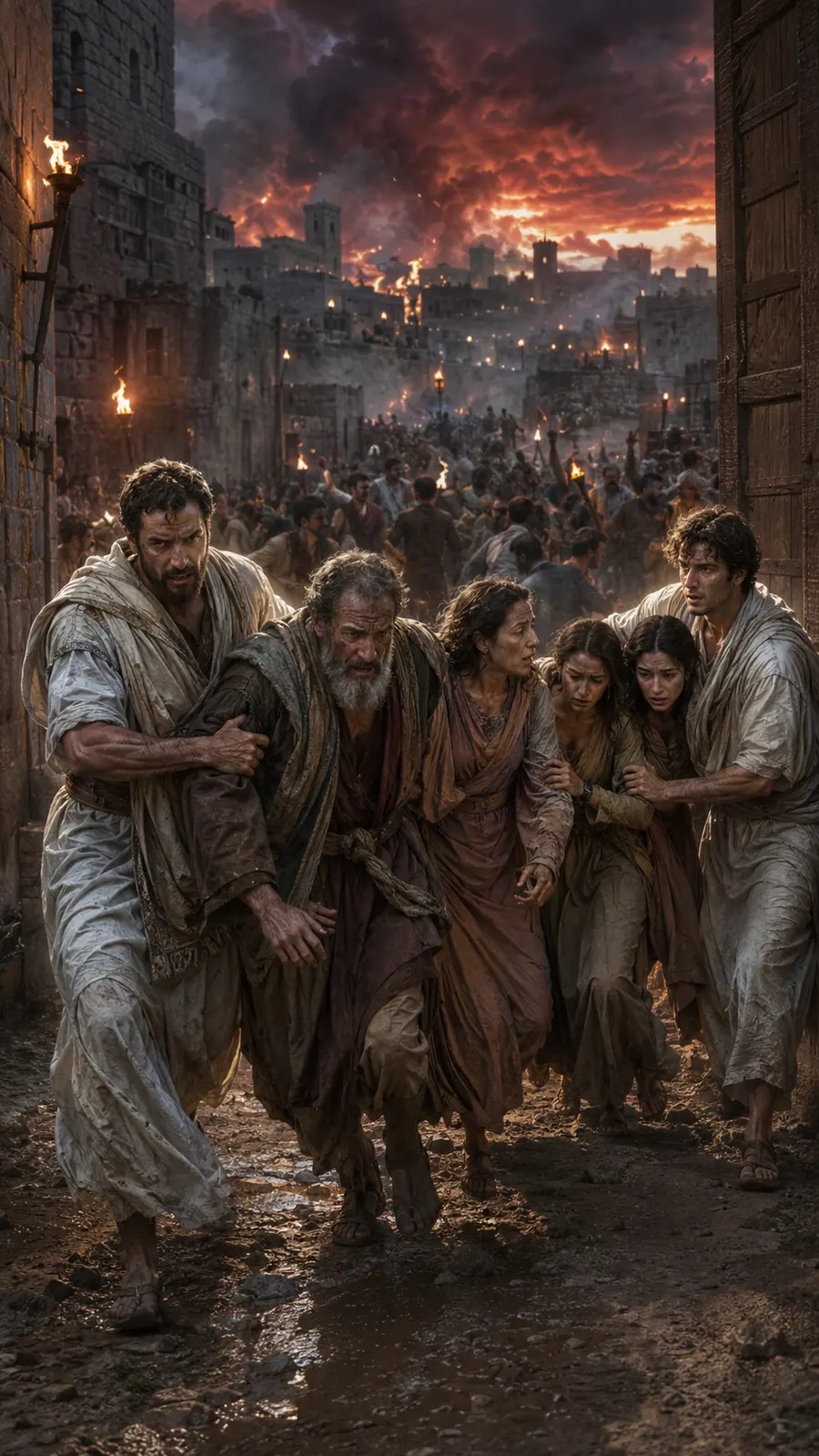
A Escritura ao lado do resumo
Gênesis · Versão King James · 38Gênesis 19:1-8
Versículos 1–8: There came two angels to Sodom at even; and Lot sat in the gate of…
Gênesis 19:1–8 abre com “And there came two angels to Sodom at even; and Lot sat in the gate of Sodom: and Lot seeing…” e chega a “Behold now, I have two daughters which have not known man; let me, I pray you, bring them out…” no último versículo. Esse percurso desenvolve Deus chama Abraão para deixar o conhecido e viver uma história de fé, aliança, fracasso, resgate e um filho prometido por meio de quem as nações seriam abençoadas.
Contexto que dá vida à passagem
Este bloco contém 1 perguntas. Elas não são simples pontuação: mostram onde uma voz procura, desafia, teme ou tenta compreender.
“And there came two angels to Sodom at even; and Lot sat in the gate of Sodom: and Lot seeing them rose up to meet…” O número two torna o relato concreto. Antes de decidir seu peso, observe se mede tempo, pessoas, distância, repetição ou totalidade.
“And he pressed upon them greatly; and they turned in unto him, and entered into his house; and he made them a feast…” Os termos próprios desta linha incluem bake, bread, entered. A relação com os versículos 2 e 4 permite verificar sua função na passagem.
“And they called unto Lot, and said unto him, Where are the men which came in to thee this night? bring them out unto…” A pergunta desacelera a passagem. Observe quem precisa responder, o que ela pressupõe e se as linhas seguintes apresentam uma resposta.
Gênesis 19:1-8
Versão King James1And there came two angels to Sodom at even; and Lot sat in the gate of Sodom: and Lot seeing them rose up to meet them; and he bowed himself with his face toward the ground;
2And he said, Behold now, my lords, turn in, I pray you, into your servant’s house, and tarry all night, and wash your feet, and ye shall rise up early, and go on your ways. And they said, Nay; but we will abide in the street all night.
3And he pressed upon them greatly; and they turned in unto him, and entered into his house; and he made them a feast, and did bake unleavened bread, and they did eat.
4But before they lay down, the men of the city, even the men of Sodom, compassed the house round, both old and young, all the people from every quarter:
5And they called unto Lot, and said unto him, Where are the men which came in to thee this night? bring them out unto us, that we may know them.
6And Lot went out at the door unto them, and shut the door after him,
7And said, I pray you, brethren, do not so wickedly.
8Behold now, I have two daughters which have not known man; let me, I pray you, bring them out unto you, and do ye to them as is good in your eyes: only unto these men do nothing; for therefore came they under the shadow of my roof.
Gênesis 19:9-16
Versículos 9–16: They said, Stand back. And they said again, This one fellow came in to…
Gênesis 19:9–16 abre com “And they said, Stand back. And they said again, This one fellow came in to sojourn, and he will…” e chega a “And while he lingered, the men laid hold upon his hand, and upon the hand of his wife, and upon…” no último versículo. Esse percurso desenvolve Deus chama Abraão para deixar o conhecido e viver uma história de fé, aliança, fracasso, resgate e um filho prometido por meio de quem as nações seriam abençoadas.
Contexto que dá vida à passagem
Este bloco contém 1 perguntas. Elas não são simples pontuação: mostram onde uma voz procura, desafia, teme ou tenta compreender.
“And they said, Stand back. And they said again, This one fellow came in to sojourn, and he will needs be a judge: now…” O número one torna o relato concreto. Antes de decidir seu peso, observe se mede tempo, pessoas, distância, repetição ou totalidade.
“And they smote the men that were at the door of the house with blindness, both small and great: so that they wearied…” Os termos próprios desta linha incluem door, blindness, both. A relação com os versículos 10 e 12 permite verificar sua função na passagem.
“For we will destroy this place, because the cry of them is waxen great before the face of the LORD; and the LORD hath…” Esta linha fornece uma razão, resultado ou conclusão. Ela deve permanecer ligada à afirmação ou ação que lhe dá sentido.
Gênesis 19:9-16
Versão King James9And they said, Stand back. And they said again, This one fellow came in to sojourn, and he will needs be a judge: now will we deal worse with thee, than with them. And they pressed sore upon the man, even Lot, and came near to break the door.
10But the men put forth their hand, and pulled Lot into the house to them, and shut to the door.
11And they smote the men that were at the door of the house with blindness, both small and great: so that they wearied themselves to find the door.
12And the men said unto Lot, Hast thou here any besides? son in law, and thy sons, and thy daughters, and whatsoever thou hast in the city, bring them out of this place:
13For we will destroy this place, because the cry of them is waxen great before the face of the LORD; and the LORD hath sent us to destroy it.
14And Lot went out, and spake unto his sons in law, which married his daughters, and said, Up, get you out of this place; for the LORD will destroy this city. But he seemed as one that mocked unto his sons in law.
15And when the morning arose, then the angels hastened Lot, saying, Arise, take thy wife, and thy two daughters, which are here; lest thou be consumed in the iniquity of the city.
16And while he lingered, the men laid hold upon his hand, and upon the hand of his wife, and upon the hand of his two daughters; the LORD being merciful unto him: and they brought him forth, and set him without the city.
Gênesis 19:17-24
Versículos 17–24: It came to pass, when they had brought them forth abroad, that he said…
Gênesis 19:17–24 abre com “And it came to pass, when they had brought them forth abroad, that he said, Escape for thy life…” e chega a “Then the LORD rained upon Sodom and upon Gomorrah brimstone and fire from the LORD out of…” no último versículo. Esse percurso desenvolve Deus chama Abraão para deixar o conhecido e viver uma história de fé, aliança, fracasso, resgate e um filho prometido por meio de quem as nações seriam abençoadas.
Contexto que dá vida à passagem
Este bloco contém 1 perguntas. Elas não são simples pontuação: mostram onde uma voz procura, desafia, teme ou tenta compreender.
“And it came to pass, when they had brought them forth abroad, that he said, Escape for thy life; look not behind thee…” Esse conhecido sinal narrativo faz o tempo avançar. O que segue é uma nova cena, consequência ou resposta a uma tensão anterior.
“Behold now, thy servant hath found grace in thy sight, and thou hast magnified thy mercy, which thou hast shewed unto…” Os termos próprios desta linha incluem escape, evil, grace. A relação com os versículos 18 e 20 permite verificar sua função na passagem.
Gênesis 19:17-24
Versão King James17And it came to pass, when they had brought them forth abroad, that he said, Escape for thy life; look not behind thee, neither stay thou in all the plain; escape to the mountain, lest thou be consumed.
18And Lot said unto them, Oh, not so, my Lord:
19Behold now, thy servant hath found grace in thy sight, and thou hast magnified thy mercy, which thou hast shewed unto me in saving my life; and I cannot escape to the mountain, lest some evil take me, and I die:
20Behold now, this city is near to flee unto, and it is a little one: Oh, let me escape thither, (is it not a little one?) and my soul shall live.
21And he said unto him, See, I have accepted thee concerning this thing also, that I will not overthrow this city, for the which thou hast spoken.
22Haste thee, escape thither; for I cannot do any thing till thou be come thither. Therefore the name of the city was called Zoar.
23The sun was risen upon the earth when Lot entered into Zoar.
24Then the LORD rained upon Sodom and upon Gomorrah brimstone and fire from the LORD out of heaven;
Gênesis 19:25-32
Versículos 25–32: He overthrew those cities, and all the plain, and all the inhabitants of…
Gênesis 19:25–32 abre com “And he overthrew those cities, and all the plain, and all the inhabitants of the cities, and…” e chega a “Come, let us make our father drink wine, and we will lie with him, that we may preserve seed of…” no último versículo. Esse percurso desenvolve Deus chama Abraão para deixar o conhecido e viver uma história de fé, aliança, fracasso, resgate e um filho prometido por meio de quem as nações seriam abençoadas.
Contexto que dá vida à passagem
“And he overthrew those cities, and all the plain, and all the inhabitants of the cities, and that which grew upon the…” Os termos próprios desta linha incluem cities, grew, ground. A relação com os versículos 26 permite verificar sua função na passagem.
“And Abraham gat up early in the morning to the place where he stood before the LORD:” Nomear Abraham mantém o relato ligado a pessoas ou lugares concretos. Acompanhe onde o nome retorna e o que muda ao redor dele.
“And it came to pass, when God destroyed the cities of the plain, that God remembered Abraham, and sent Lot out of the…” Esse conhecido sinal narrativo faz o tempo avançar. O que segue é uma nova cena, consequência ou resposta a uma tensão anterior.
Gênesis 19:25-32
Versão King James25And he overthrew those cities, and all the plain, and all the inhabitants of the cities, and that which grew upon the ground.
26But his wife looked back from behind him, and she became a pillar of salt.
27And Abraham gat up early in the morning to the place where he stood before the LORD:
28And he looked toward Sodom and Gomorrah, and toward all the land of the plain, and beheld, and, lo, the smoke of the country went up as the smoke of a furnace.
29And it came to pass, when God destroyed the cities of the plain, that God remembered Abraham, and sent Lot out of the midst of the overthrow, when he overthrew the cities in the which Lot dwelt.
30And Lot went up out of Zoar, and dwelt in the mountain, and his two daughters with him; for he feared to dwell in Zoar: and he dwelt in a cave, he and his two daughters.
31And the firstborn said unto the younger, Our father is old, and there is not a man in the earth to come in unto us after the manner of all the earth:
32Come, let us make our father drink wine, and we will lie with him, that we may preserve seed of our father.
Gênesis 19:33-38
Versículos 33–38: They made their father drink wine that night: and the firstborn went in…
Gênesis 19:33–38 abre com “And they made their father drink wine that night: and the firstborn went in, and lay with her…” e chega a “And the younger, she also bare a son, and called his name Ben-ammi: the same is the father of…” no último versículo. Esse percurso desenvolve Deus chama Abraão para deixar o conhecido e viver uma história de fé, aliança, fracasso, resgate e um filho prometido por meio de quem as nações seriam abençoadas.
Contexto que dá vida à passagem
“And they made their father drink wine that night: and the firstborn went in, and lay with her father; and he perceived…” Os termos próprios desta linha incluem father, arose, drink. A relação com os versículos 34 permite verificar sua função na passagem.
“And it came to pass on the morrow, that the firstborn said unto the younger, Behold, I lay yesternight with my father…” Esse conhecido sinal narrativo faz o tempo avançar. O que segue é uma nova cena, consequência ou resposta a uma tensão anterior.
Gênesis 19:33-38
Versão King James33And they made their father drink wine that night: and the firstborn went in, and lay with her father; and he perceived not when she lay down, nor when she arose.
34And it came to pass on the morrow, that the firstborn said unto the younger, Behold, I lay yesternight with my father: let us make him drink wine this night also; and go thou in, and lie with him, that we may preserve seed of our father.
35And they made their father drink wine that night also: and the younger arose, and lay with him; and he perceived not when she lay down, nor when she arose.
36Thus were both the daughters of Lot with child by their father.
37And the firstborn bare a son, and called his name Moab: the same is the father of the Moabites unto this day.
38And the younger, she also bare a son, and called his name Ben-ammi: the same is the father of the children of Ammon unto this day.
Detalhes que merecem atenção
A imagem de abertura
Genesis 19:1 começa com “And there came two angels to Sodom at even; and Lot sat in the gate of Sodom: and Lot seeing them rose up to meet them; and he bowed himself with his face…”
Onde o capítulo muda
Genesis 19:20 forma uma mudança natural: “Behold now, this city is near to flee unto, and it is a little one: Oh, let me escape thither, (is it not a little one?) and my soul shall live.”
A nota final
Genesis 19:38 deixa o leitor com “And the younger, she also bare a son, and called his name Ben-ammi: the same is the father of the children of Ammon unto this day.”
Um caminho de palavras pelo capítulo
As palavras father, city, daughters, LORD, door, night ajudam a revelar as preocupações repetidas do capítulo.
Primeiro o texto
Onde os leitores divergem
O resumo começa com o que a passagem diz e como suas partes se relacionam. Ele não presume que uma denominação já resolveu todas as questões. A dependência de uma tradição, teoria literária ou reconstrução histórica é claramente identificada.
O texto KJV aparece primeiro. As conclusões interpretativas são identificadas, e as diferenças surgem quando ajudam a explicar por que comunidades sérias nem sempre chegam à mesma resposta.
Por que Sodoma é condenada?
Gênesis 19 apresenta uma multidão que ameaça hóspedes com violência sexual. A narrativa mais ampla fala de grande maldade e clamor; Ezequiel acrescenta orgulho, fartura sem cuidado dos pobres e abominações, e Judas destaca pecado sexual. Esses testemunhos devem ser lidos juntos, sem serem reduzidos a um slogan político.
Genesis 18:20-21 · Genesis 19:1-11 · Ezekiel 16:49-50 · Jude 7