
1 Samuel 17
David and Goliath

Ages 8 to 11
The account
The Philistines and Israelites faced each other across the valley of Elah. A huge Philistine champion named Goliath came out and challenged Israel. He was heavily armed, and the Israelite soldiers were afraid. Goliath repeated his challenge for forty days.
David was caring for his father's sheep while three of his older brothers were with Saul's army. Jesse sent David to the camp with food for his brothers. While David was there, he heard Goliath speak against Israel. David asked why no one answered him.
David's oldest brother, Eliab, became angry with him. Later, David's words were reported to King Saul. David told Saul that he would fight Goliath. He explained that, while keeping sheep, he had fought a lion and a bear, and the LORD had delivered him.
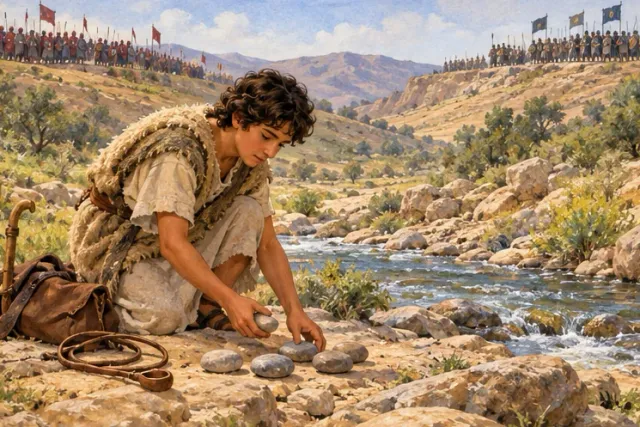
Saul offered David his armour, but David was not used to it, so he took it off. David chose five smooth stones from a brook, put them in his shepherd's bag, and went out with his sling.
Goliath mocked David, but David said he came in the name of the LORD. David ran toward him, put a stone in his sling, and struck Goliath in the forehead. Goliath fell. David defeated and killed him, and the Philistines fled. Israel then pursued them.
Memory verse
And all this assembly shall know that the LORD saveth not with sword and spear: for the battle is the LORD’s, and he will give you into our hands.
1 Samuel 17:47
Talk about it
- Why did Jesse send David to the army camp?
- What did David take with him when he went to face Goliath?
- What happened after Goliath fell?
Try this
Find five small stones outside, or draw five stones on paper if you are indoors. On each one, write or imagine one detail from the account in order: the challenge, David's arrival, Saul's armour, the sling and the victory.
What can we learn?
A lesson from this account is that courage is not the same as pretending danger is small. David saw the danger, but he trusted that the battle belonged to the LORD.
Ages 12 to 15
The account
The Philistines gathered for battle against Israel near the valley of Elah. The two armies stood on opposite sides of the valley. From the Philistine camp came a champion named Goliath of Gath. The passage describes him as six cubits and a span tall and lists his heavy armour, spear and shield. Goliath challenged Israel to send one man to fight him. If that Israelite won, the Philistines would serve Israel. If Goliath won, Israel would serve the Philistines. Saul and the Israelites were afraid.
Goliath came forward morning and evening for forty days. During this time David was moving between Saul and his father's sheep at Bethlehem. Jesse sent David to the camp with food for his three oldest brothers and provisions for their commander. David arrived as the army was going out to battle and heard Goliath repeat his challenge.
The men of Israel fled from Goliath. David asked what would be done for the man who defeated him and removed this disgrace from Israel. David's oldest brother, Eliab, became angry and accused David of bad motives. David continued asking about the challenge, and his words eventually reached Saul.
David told Saul that he would fight the Philistine. Saul objected that David was only a youth while Goliath had been a warrior from his youth. David answered by describing how he had defended his father's sheep from a lion and a bear. He said the LORD who had delivered him from those animals would deliver him from Goliath.
Saul dressed David in armour and gave him a sword, but David removed them because he had not tested them. Instead, David took his staff, chose five smooth stones from the brook, placed them in his shepherd's bag, and carried his sling.
Goliath despised David when he saw him and cursed him by his gods. David answered that Goliath came with sword, spear and shield, but David came in the name of the LORD of hosts, the God of Israel's armies. David said the battle belonged to the LORD.
When Goliath moved closer, David ran toward him. He took one stone, slung it, and struck Goliath in the forehead. Goliath fell face down. David had no sword, so after Goliath fell David used the Philistine's own sword to finish the fight. When the Philistines saw that their champion was dead, they fled, and Israel pursued them.
Memory verse
And all this assembly shall know that the LORD saveth not with sword and spear: for the battle is the LORD’s, and he will give you into our hands.
1 Samuel 17:47
Think about it
- Why do you think Goliath's repeated challenge had such a strong effect on Saul and the Israelite army?
- What does David's answer to Saul show about where David believed his confidence came from?
- Why did David remove Saul's armour instead of treating the king's equipment as an automatic advantage?
- What does David's speech before the fight show about what he believed the victory would demonstrate?
Going deeper
This account repeats a pattern seen elsewhere in the Bible: God is able to save without depending on the strongest human weapons or the largest visible advantage. Judges 7 shows a similar pattern with Gideon's reduced force. In David's own history, the victory also becomes an early public step in the life of the man Samuel had already anointed.
What can we learn?
A lesson from this account is that courage can be rooted in remembered faithfulness rather than in size, equipment or reputation. David's confidence was tied to what he believed the LORD had already done and would do, not to the idea that Goliath was harmless.